
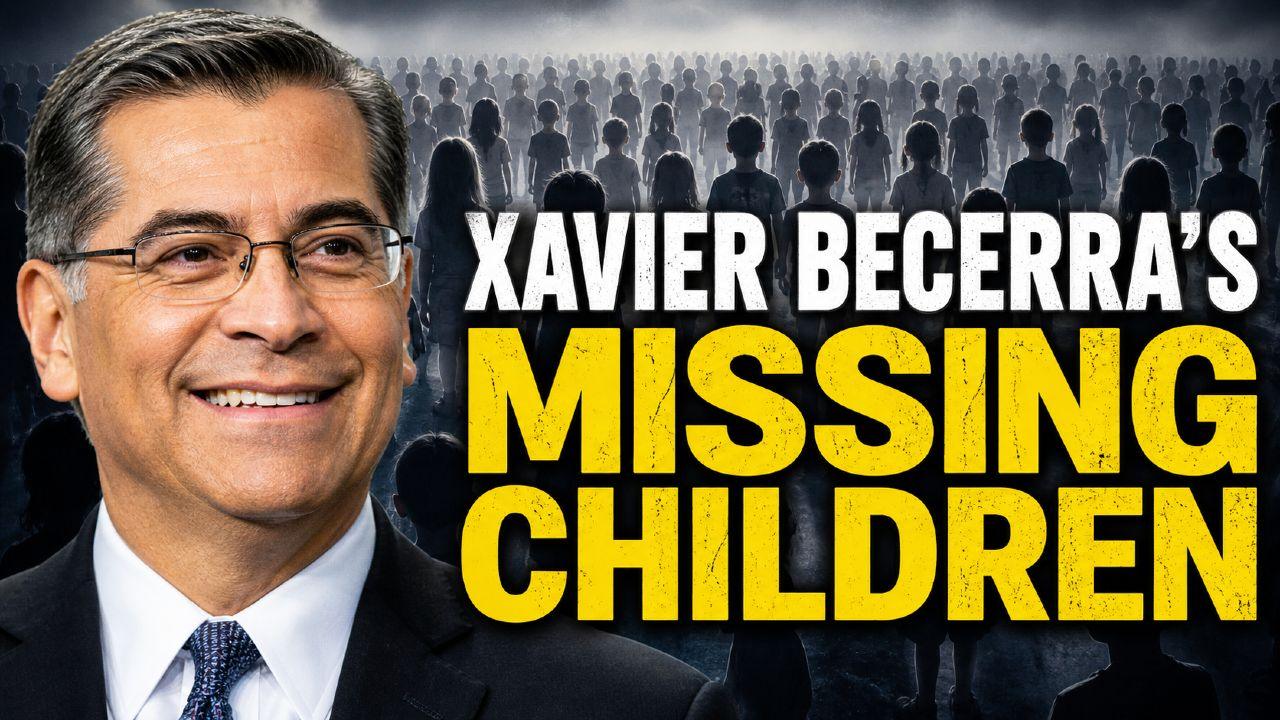
Three hundred thousand. That is the figure the federal government now uses to describe the unaccompanied migrant children that the Biden administration’s Department of Health and Human Services lost track of or handed to unvetted sponsors between January 2021 and December 2024. Three hundred thousand children is not a statistic. It is the population of Anaheim. It is larger than Pittsburgh, larger than Cincinnati, larger than St. Louis. It is a city of children, and the United States government cannot tell you where most of them are tonight.
The cabinet secretary who presided over that disappearance is now asking Californians to make him their next governor.
Xavier Becerra served as Secretary of Health and Human Services from March 2021 through January 2025. His agency, through the Office of Refugee Resettlement, held legal custody of every unaccompanied alien child encountered at the southern border. His agency was charged by Congress with placing those children in safe, vetted homes and following up on their welfare. His campaign website now sells him as the candidate of “experience” and the only Democrat with the managerial chops to govern the nation’s largest state. The experience is real. The results are the indictment.
He Was Warned. In Writing. By His Own People.
The most generous reading of Becerra’s tenure would be that he inherited a chaotic system and did his best in difficult circumstances. The documentary record makes that reading impossible to sustain.
In July 2021, eleven managers inside the Office of Refugee Resettlement signed an internal memo warning that labor trafficking of children was increasing. They told their superiors, in plain language, that the system had become “one that rewards individuals for making quick releases, and not one that rewards individuals for preventing unsafe releases.” That memo went up the chain. It did not produce reform. It produced acceleration.
By 2022, the HHS Office of Inspector General had reached the same conclusion from the outside, finding that guidance issued under Becerra to speed releases had stripped safeguards and likely increased the risk of harm to children. A second OIG report in February 2024 documented missing safety-check documentation in 16 percent of sampled case files and untimely or undocumented follow-up calls in many more.
None of this was secret. None of this was unknown to the secretary. The pattern was warned of by career staff, confirmed by the inspector general, exposed by congressional investigators, and reported on the front page of The New York Times.
The Assembly Line
The most damning evidence in the entire scandal is in Becerra’s own voice. At a 2022 staff meeting, captured on a recording later obtained by The Times, the secretary scolded HHS employees for not moving children out of federal custody fast enough. His chosen analogy was Henry Ford’s auto plants.
“If Henry Ford had seen this in his plants, he would have never become famous and rich. This is not the way you do an assembly line.”
That is a sitting cabinet secretary, talking about migrant children — many of them under twelve, some of them infants — and complaining that the rate of disposal was insufficiently industrial. A former HHS contractor, Kelsey Keswani, told The Times that staff understood the directive clearly. They had to release roughly twenty percent of the children every week or face discipline. The vetting that survived this pressure was minimal. Sometimes the only document used to confirm a “familial relationship” was a birth certificate from a country where forged birth certificates are sold openly. DNA testing, which would have caught most of the frauds, was used only voluntarily. So the assembly line ran.
“I Have Never Heard That Number”
In March 2023, Senator James Lankford asked Becerra, under oath at a Senate Finance Committee hearing, about the 85,000 children HHS could not contact. Becerra’s answer:
“I have never heard that number of 85,000, I don’t know where it comes from and so I would say it doesn’t sound at all to be realistic.”
The number came from his own department’s data, obtained by The New York Times and published weeks earlier in the same investigation that captured the Henry Ford recording. The number turned out to be conservative. By the time the Trump administration took over in January 2025 and conducted a full audit, the actual figure of children lost or placed with unvetted sponsors had reached approximately 300,000 — out of roughly 470,000 unaccompanied minors processed during the four Biden years. Two-thirds of all the children in his agency’s care were, in the most precise sense, gone.
What Was on the Other End
Numbers anesthetize. The cases do not.

The Department of Homeland Security Inspector General has documented children placed at addresses that did not exist. Roughly 31,000 of the unaccompanied minors processed under Becerra were registered to invalid addresses. In Orlando, twenty-two children were at one point connected to a single strip club. A whistleblower told senators that more than three hundred children had been routed to a single Texas apartment that turned out to be a human trafficking site. The DHS Inspector General also found that biographic and biometric vetting requirements for sponsors and household members were quietly dropped in 2021 — meaning sponsors could not be reliably checked for criminal histories or cartel ties.
When the Trump administration began processing the backlog in 2025, HHS uncovered something the Biden administration had managed to keep buried for years: a stack of 65,605 unaddressed reports filed by HHS staff, contractors, and the children themselves. The breakdown was released in May 2025 by Senate Judiciary Chairman Chuck Grassley. It included 56,591 notifications of concern, 7,346 reports of suspected human trafficking, and 1,688 fraud leads where adults were impersonating relatives. None of this had been investigated. The reports had been filed and shelved.
Of the roughly 22,000 children the Trump task force has located so far, twenty-seven were found to have died — by murder, suicide, or drug overdose. DHS has documented at least two cases of girls aged fourteen and fifteen who were impregnated by their sponsor or by a member of the sponsor’s household. ORR has identified 1,700 cases in which children were placed with unrelated sponsors with no record that any home study was ever performed. In at least one case, surfaced through Grassley’s oversight, HHS placed a child with a household tied to MS-13 — and then punished the whistleblower who reported it.
Jeremiah 22:3 commands those in authority: Execute ye judgment and righteousness, and deliver the spoiled out of the hand of the oppressor; and do no wrong, do no violence to the stranger, the fatherless, nor the widow, neither shed innocent blood. Whatever the secretary believed he was doing, his department did the opposite. It delivered the spoiled into the hand of the oppressor. It did violence to the stranger and the fatherless. The blood is not metaphorical.
The Obstruction
The instinct of a competent administrator confronted with this catastrophe would be transparency. Becerra chose obstruction. When Grassley opened an investigation into HHS’s vetting failures, the Iowa senator’s office documented that Becerra’s HHS instructed contractors and grantees not to answer his questions, and rerouted his inquiries to the Assistant Secretary for Legislation, who promptly produced nothing. Two-thirds of the law-enforcement subpoenas issued as a result of Grassley’s whistleblower referrals went unanswered by the Biden administration. House Republicans likewise complained that document productions were incomplete. Becerra was hauled back to Capitol Hill. The full accounting was never delivered on his watch. It took a change of administration to produce the records.
That is not the behavior of a man who lost children by accident. That is the behavior of a man who knew exactly what an honest accounting would show.
The Ask
Becerra now stands on California debate stages and tells voters he is the experienced steward who will manage the state’s housing crisis, its homelessness crisis, its budget crisis, and its public health crisis. He brags that he sued the first Trump administration 122 times. He does not mention the cabinet department he ran. He does not mention the recording. He does not mention the eleven managers who tried to warn him. He does not mention the 65,000 reports that piled up unread. He does not mention the strip club in Orlando, or the apartment in Texas, or the girls who came into HHS custody as children and emerged pregnant.
The kindest thing one can say about Xavier Becerra’s stewardship of HHS is that he was overwhelmed by a crisis he did not create and failed to manage it. The honest thing one must say is that he was warned, on tape and in writing, by his own staff and his own inspector general, that children were being trafficked on his watch — and his recorded response was to demand the assembly line move faster.
California has roughly nine million children. The man asking to govern them is the man who, when entrusted with a smaller number, lost a city’s worth. Voters do not need to be conservatives or Christians or Republicans to understand what that record means. They need only ask whether a man who could not find 300,000 children when it was his literal job ought to be promoted to a larger one.
Starting the Day With a Scripture-Inspired Roast Helps Center Your Thoughts on Eternal Truths Amid Temporal Pressures
The world can seem chaotic, especially right after we wake up. Many believers start their mornings reaching for something familiar — a hot cup of coffee — yet end up settling for mediocre brews that do little more than deliver a caffeine jolt. The daily grind of life, with its endless distractions, news cycles, and responsibilities, can leave even the most faithful feeling spiritually parched alongside their physical fatigue. What if your morning ritual could do more than wake you up? What if it could ground you in truth, nourish your body with exceptional quality, and quietly advance a kingdom purpose at the same time?
That’s the promise — and the reality — behind Promised Grounds Coffee. This Christian-founded company doesn’t just roast beans; it approaches every step as an act of worship and discipleship. By selecting only the top 10% of specialty-grade beans, ethically sourced from dedicated farmers in Central and South America, and small-batch roasting them with reverence in Austin, Texas, Promised Grounds delivers what many describe as the best coffee available — never burnt, never bland, but rich with origin stories and layered flavors that honor God’s creation.
From the vibrant Psalm 27 Roast (a light, bright medium option) to the bold yet peaceful 2 Timothy 1:7 Decaf, each bag carries a Scripture verse that turns your daily pour into a gentle reminder of faith. And through their Ounce Per Ounce Promise, every ounce of coffee you enjoy provides an equal ounce of clean water to families in need via partnership with Filter of Hope — literally brewing hope for body and soul, one cup at a time.
The challenge for today’s Christians runs deeper than finding a decent cup. In an age of convenience-driven consumerism, it’s easy to support companies that dilute values or remain silent on matters of faith. Many believers want their everyday choices — from what they drink to how they spend — to reflect discipleship rather than just convenience. Promised Grounds solves this by weaving Christian excellence into the entire process: beans nurtured with prayerful stewardship by farming families, roasted as an offering rather than a commodity, and packaged with Bible verses to encourage a mindset of gratitude and purpose from the first sip. Reviewers consistently praise the smooth, rich profiles — whether enjoyed black in a drip maker, iced on a warm day, or shared in fellowship — noting how the quality stands toe-to-toe with premium secular brands while delivering something far more meaningful.
This integration of faith and flavor addresses a real need in Christian households and ministries. Busy parents, church leaders, and remote workers alike report that starting the day with a Scripture-inspired roast helps center their thoughts on eternal truths amid temporal pressures. The coffee’s exceptional character — bright citrus notes in lighter roasts or deep chocolate undertones in bolder ones — comes from meticulous selection and careful roasting that respects the bean’s natural gifts rather than masking them. It’s the kind of coffee that elevates a simple quiet time, fuels productive workdays, or sparks meaningful conversations when shared at Bible studies or outreach events. And because it’s ethically sourced with integrity, every purchase supports sustainable livelihoods for farmers who treat their crops like family harvests.
For those leading churches or small groups, the impact multiplies. Promised Grounds offers bundles and options perfect for hospitality ministries, turning ordinary coffee service into an opportunity to point people toward the living water of Christ. Imagine greeting visitors with a warm cup whose very bag carries God’s Word — a subtle yet powerful witness that aligns with the Great Commission. The company’s Texas roots and commitment to “brewing hope” resonate especially with believers who value American enterprise paired with global compassion.
Of course, quality alone isn’t enough if the experience feels out of reach. Promised Grounds keeps it accessible with practical perks like free shipping on orders over $40, sample sets for discovering favorites, and thoughtful add-ons such as faith-themed mugs. Whether you prefer whole beans for fresh grinding, grounds for convenience, or even bulk options for larger households and ministries, the result is consistently superior coffee that makes discipleship feel integrated rather than added on.
As you consider how to align even the smallest habits with your walk with God, Promised Grounds Coffee stands out as a refreshing solution. It tackles the dual problems of subpar daily sustenance and disconnected consumption by offering a product that genuinely excels in taste while advancing a mission of clean water, farmer dignity, and scriptural encouragement. Believers who make the switch often describe it as more than a beverage upgrade — it becomes part of their rhythm of gratitude, a daily invitation to remember that every good gift comes from above.
If you’re ready to transform your mornings (and perhaps your church gatherings) with coffee that honors both exceptional craftsmanship and Christian values, I encourage you to explore what Promised Grounds has to offer. One sip at a time, you’ll be nourishing your body, refreshing your spirit, and participating in something far greater — all while enjoying what truly is among the best coffee available.