
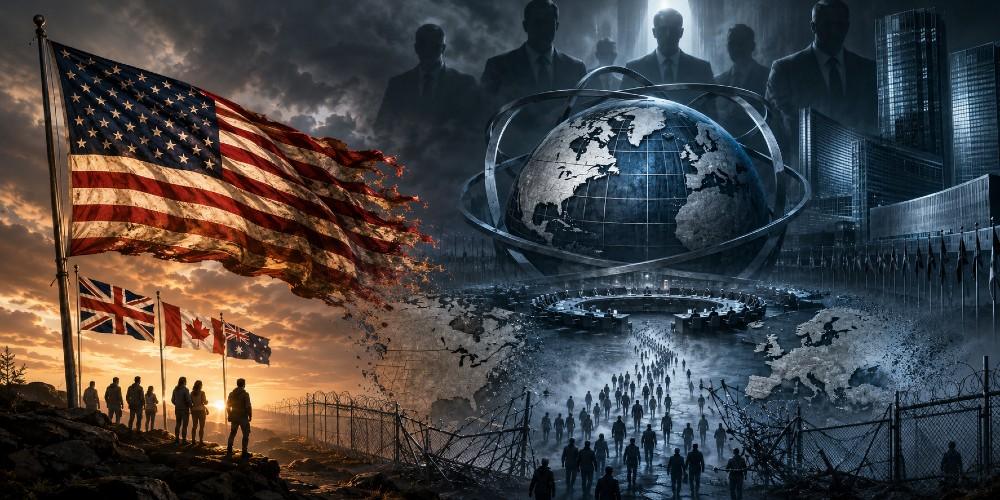
Some politically charged words become part of our common vocabulary almost overnight. “Globalism” is a timely example. Ten or fifteen years ago, calling someone a “globalist” didn’t have much effect. Today, it is well understood as a pejorative that highlights someone’s allegiance to international institutions over those created within a nation state.
Although the term has been used in various academic circles for more than a century, it didn’t become part of our common political parlance until anti-Establishment conservatives in the United States and Europe found it a useful taxonomic description of their ideological opponents. In hindsight, it is surprising how long the word “globalism” remained dormant and hidden away in the context of political speech and debate.
During the Cold War, however, the world was divided between the Soviet Union and the United States, between communism and freedom, between closed economies and open markets. To the extent that nationalism and globalism were distinguished from each other, academics and political leaders did so under the umbrella of the Cold War contest between East and West to gobble up as many nation states as possible. Both sides embraced a “domino theory” of geopolitics in which partisans fought for global domination, one nation at a time.
There was, however, an intentional, albeit rarely described, linguistic shift from the 1950s forward. In newspapers and scholarly essays of the nineteenth and early-twentieth centuries, “nationalism” and “patriotism” were largely used interchangeably. Following WWII, “nationalism” increasingly acquired a negative connotation until eventually becoming a proxy word for “fascism” or “Nazism.” In our current age, prominent political and academic leaders speak of “nationalism” as if it were a virulent form of racism, imperialism, and authoritarianism rolled into one malevolent philosophy.
In contrast, until rather recently, “patriotism” retained a positive meaning, even though its Greek roots describe a person’s connection to “fellow countrymen” and the “fatherland.” If only one of these two words — “nationalism” or “patriotism” — were to survive WWII unchanged, a reasonable person might have wagered that “nationalism” seemed more innocuous and less “problematic” for contemporary sensibilities and therefore more likely to endure with its politically neutral meaning intact. “Patriotism,” on the other hand, with its emotional appeal to the “fatherland,” might have appeared more objectionable.
Instead, “nationalism” was eventually demonized for its semantic connection to the “national socialism” of the Nazi Party, while “patriotism” was embraced as an essential quality for Western citizens fighting the Soviet Union’s communist expansion during the Cold War. This was not a historical accident.
After WWII, there was a concerted effort among political and intellectual leaders in the West to use the destruction from two catastrophic global wars as a profound moral argument for charting a new course for humanity. Framing the carnage of those wars as the natural result of unbridled “nationalism,” architects of the post-war world put their faith in international institutions.
The United Nations, the North Atlantic Treaty Organization, and the European Union all emerged immediately after WWII but so did a thousand new international bodies constructed to do everything from standardizing industrial production in factories around the world to regulating the movement of people and goods across borders. “Internationalism” was sold as an antidote to war and therefore became almost synonymous with “peace.”
The dichotomy between “nationalism” and “internationalism” was much easier to advance publicly than a contrast between patriotic love of country and an unpatriotic hatred for one’s countrymen. The United Nations decided that patriots could be internationalists. Nobody asked out loud whether internationalists could be patriots.
This paradigm has remained attractive for its simplicity but never made much sense.
For starters, German Nazism, Italian fascism, and Japanese imperialism (in which an absolute monarch was worshipped as a deity) were not inherently dangerous because their proponents organized power through national governments. They were dangerous because they were totalitarian in nature and compelled citizens to sacrifice themselves completely in the interest of the State. Had the Germans, Italians, and Japanese strongly believed in limiting government power and maximizing personal freedom, respect for individual rights would have kept expansive authoritarianism in check.
It is illogical to assume that international forms of government are somehow more humanitarian or philanthropic than national forms, just as it is illogical to assume that national forms of government are more just and capable of representing citizens than local municipal governments. One might ask what the difference is between the Green Party in Germany demanding total civilian obedience to “global warming” mandates and a group of international ambassadors demanding the same thing through the Paris Climate Accords.

Are the United Nations Framework Convention on Climate Change and the Intergovernmental Panel on Climate Change somehow less totalitarian because international bureaucrats are regulating the behavior of both Germans and non-Germans alike?
Would we not describe the great empires of the past as “globalist” or “international” in nature? Did Alexander the Great, Julius Caesar, Napoleon Bonaparte, or Cecil Rhodes not swallow up entire nations when they expanded the territorial dominions of their respective empires? How does one distinguish those global empires from modern equivalents such as the European Union or the United Nations?
Surely the average European, Asian, or African finds it just as difficult to object to an edict coming from the E.U. or U.N. as it would have been for Europeans, Asians, or Africans of the past to resist imperial edicts from faraway capitals. Had Alexander, Caesar, Napoleon, or Queen Victoria described their empires as “united nations,” would their conquests have been considered more just and peaceful?
In other words, have we not simply rebranded imperialism as “internationalism” and pretended that the rhetorical distinction represents “progress”?
This brings us to the current day, when we are finally having a meaningful debate regarding the merits of “nationalism” versus “globalism.” As has become all too evident in recent years, globalists really do wish to dispense with the nation state. But they are not content with merely replacing national governments with international institutions.
Decades of open borders policies in North America and Europe reveal globalism’s true goal: to eradicate the vestiges of culture and history that bind a nation’s people together. In the United States, it is quite common to see immigrants flying their “home” flags in sports stadiums, while mainstream news pundits describe the American flag as a form of “white supremacy.”
Across the United Kingdom, government officials are cracking down on citizens who wave British flags. On both sides of the Atlantic, globalists berate citizens for not embracing “multiculturalism.” We have finally reached a point when “patriotism” is demonized just as much as “nationalism.”
Without nations or patriots, where does that leave us? It leaves us with continental landmasses filled with strangers. Instead of people bound by common history, culture, religion, values, language, and family, North America and Europe are being transformed into spaces defined by absolutely nothing.
America’s new immigrants want to do away with the political ideals of the Declaration of Independence and the U.S. Constitution. Europe’s new immigrants insist on replacing all the Christian churches with mosques.
Both continents are heading for a future when tribes of distinct peoples will fight for political power within turbulent territories that remain nations in name only. Does anyone really believe that they will put aside their disagreements and obey the international proclamations of the United Nations or the European Union?
Eighty years of “internationalism” have destroyed the most natural political order that has ever existed: the nation state. Now entire continents are filled with immigrants whose incompatible cultures ensure future conflict. And instead of recognizing how destructive their policies have been across the West, globalists have the audacity to ridicule nationalists as threats to peace.
The most important lesson from WWII was not that nations are bad but that totalitarian government is evil. Globalists sacrificed the former and embraced the latter. Westerners will now have to defeat globalism, too.
Two Storms, One Harvest

Every food crisis in living memory has been a one-shock event. The 2008 price spike was a commodity bubble. The 2020 shortages were a logistics failure. The 2022 grain scare was a war on one exporter’s ports. Each time, the system bent, adjusted, and recovered, and each time the experts assured us afterward that global markets are simply too big and too diversified to fail.
What nobody in Washington seems eager to discuss is that 2026 is shaping up to be something the modern food system has never actually faced. Two independent shocks, one climatic and one geopolitical, are converging on the same harvest cycle at the same time. Not sequentially. Simultaneously.
Start with the weather. The Pacific Ocean is currently building toward what forecasters now openly call a record event. NOAA’s Climate Prediction Center puts the odds of at least a strong El Niño near 88 percent, with roughly two in three odds it reaches “very strong” status, the tier reserved for perhaps three or four events in the entire satellite era. Every major global model now projects a median peak in Super El Niño territory, and most of them project it exceeding the 2015-16 event, which until now held the modern record. Sea surface anomalies were already brushing the super threshold in mid-July, months before these events normally peak. The atmosphere has already shifted into El Niño mode, and the event is forecast to crest in late fall and early winter.
This is not about “climate change.” It’s about the standard cycles of weather, and the cycle we’re currently in is one that has likely devastated societies in the past. We’re better prepared as a society today, but not all Americans are equally prepared.
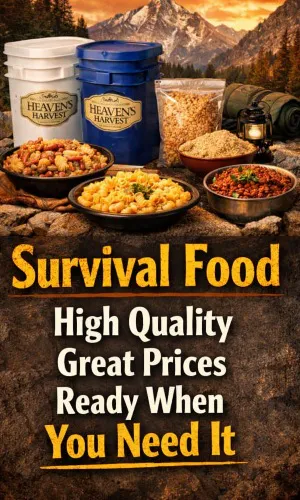
Serious households have started doing the quiet math on their own. Grocery bills tell part of the story, and the forecast maps tell the rest, which is why long-term food storage has moved from fringe hobby to mainstream line item in the family budget, with established suppliers like Heaven’s Harvest seeing demand from people who five years ago would have rolled their eyes at the idea. That instinct is not paranoia. It is pattern recognition, and the pattern is worth walking through carefully.
Editor’s Note: Heaven’s Harvest IS a sponsor, but the warnings of this article are real and would be written even if we didn’t have a survival food sponsor. With that said, those who take advantage of what they offer can use promo code “Patriot” for 15% off.
The Fertilizer Clock Is Already Running
While the Pacific warms, the second shock has been unfolding in the Strait of Hormuz. The conflict with Iran turned the world’s most important energy chokepoint into a contested waterway, and the consequences reach far beyond the gas pump. Roughly a third of global fertilizer trade moves through Hormuz, and the disruption sent urea prices up 86 percent year over year by March, with a 53 percent jump in a single month.
The World Bank projects energy prices rising about 24 percent in 2026 and fertilizer about 31 percent. By its own accounting, fertilizer prices ran 35 percent higher in the first five months of this year than the same period last year.
Here is the mechanism the nightly news will not explain. Fertilizer is not a grocery item. It is a time-delayed input. The nitrogen a farmer in Iowa or Punjab could not afford to apply this spring does not show up as a problem this spring. It shows up as a thinner harvest six to twelve months later.
The World Bank’s own food security brief concedes that the effects of reduced applications earlier this season “are likely to become visible only later in harvest outcomes.” Translate that from institutional language into plain English and it means this. The damage is already done, it is already in the ground, and we are simply waiting for it to arrive on the shelf.
Now check the calendar. Six to twelve months from the spring planting season lands us squarely in late 2026 and early 2027. Which is precisely when the strongest El Niño in the instrumental record is forecast to peak, bringing its signature droughts to Southeast Asia, Australia, southern Africa, northern Brazil, and South Asia, the very regions that grow the world’s rice, sugar, and oilseeds.
The World Bank warns openly that a strong El Niño “could disrupt multiple crop belts simultaneously” on top of the conflict-driven input costs. Their baseline projection assumes the Middle East disruptions ease by autumn. What in the last two years of Middle East history suggests that assumption is safe?
The System Has No Slack Left
The comfortable answer is that global markets always adjust. But adjustment requires slack, and the slack is gone. Global cereal production is expected to decline from last year’s records even before El Niño does its work. The UN World Food Programme, hardly a den of right-wing preppers, is calling this the most significant disruption to its supply chains since Covid and the invasion of Ukraine, and its supply chain director put the stakes bluntly.
Today’s supply chain challenges are tomorrow’s hunger crisis.
There is also a political dimension that markets cannot price. When food gets scarce, governments do not behave like economists. They behave like politicians. Export bans, hoarding mandates, and panic buying at the national level turned the modest rice shortfall of 2008 into a global crisis, and analysts are already warning that import-dependent nations are the first dominoes.
The 2015-16 Super El Niño, a far weaker event than what is now forecast, threw tens of millions into food stress across Africa and Asia. This one is projected to be stronger, and it arrives with fertilizer already rationed by price and shipping lanes already contested by missiles.
What Joseph Knew
Scripture does not treat preparation for lean years as faithlessness. It treats it as wisdom delivered in advance to those willing to act on it.
Behold, there come seven years of great plenty throughout all the land of Egypt: And there shall arise after them seven years of famine; and all the plenty shall be forgotten in the land of Egypt.
Joseph did not respond to that warning with a hashtag or a committee. He stored grain during the years of abundance, and when the famine came, Egypt stood while its neighbors begged. The lesson is not that famine is certain. It is that the time to prepare is precisely when preparation still looks optional.
Nobody who filled a pantry in a year of plenty has ever regretted it, and nobody standing in an empty aisle has ever been glad he waited for certainty.
None of this calls for panic, and panic is the enemy of sound judgment anyway. It calls for the same unglamorous prudence our grandparents considered ordinary. Keep some cash margin, know your local growers, and put real food in deep storage while it is cheap and available, because the entire arc of this story is that cheap and available is a closing window.
Families looking for a straightforward place to start can visit Heaven’s Harvest and use promo code Patriot for 15 percent off long-term storable food. The forecasts may yet soften, the strait may yet reopen, and we should pray they do. But hope is a fine thing to hold and a foolish thing to eat.