

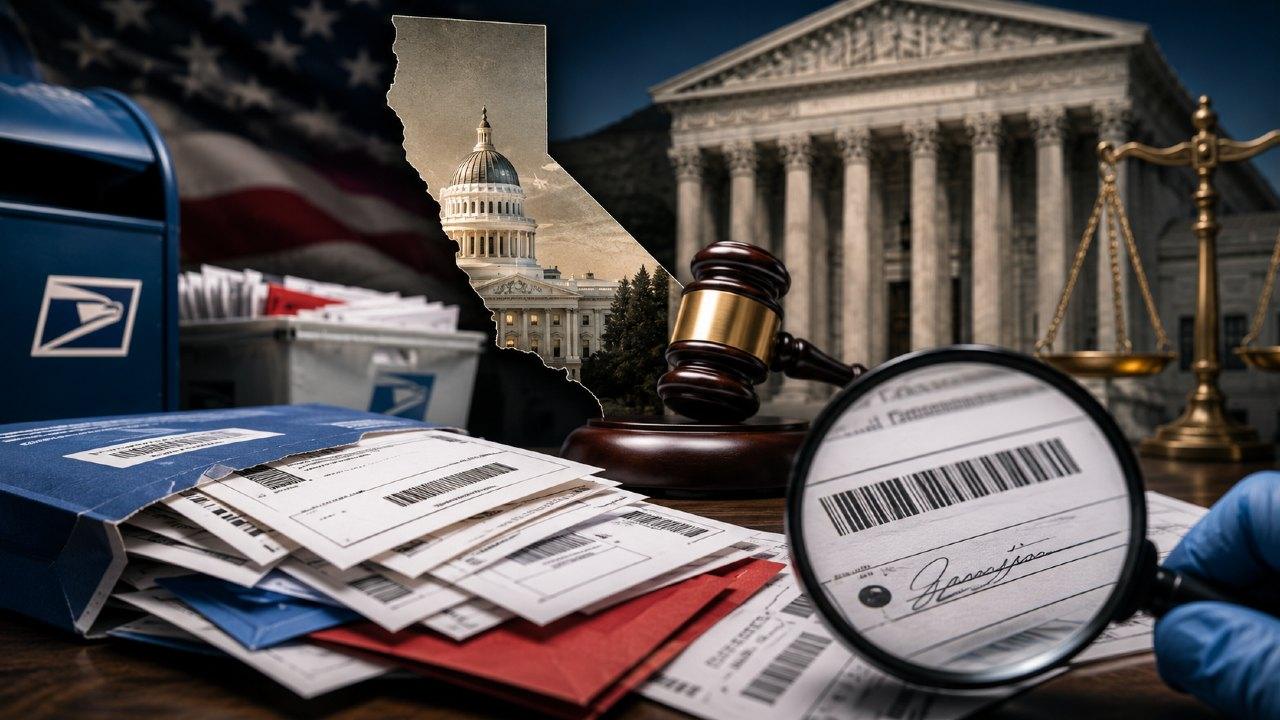
A federal appeals court has handed the U.S. Postal Service a significant victory in its push to impose stricter controls on mail-in ballots for federal elections, clearing the way for enhanced verification measures that could reshape voting practices in states like California.
The D.C. Circuit Court of Appeals temporarily lifted a lower court block on Friday, allowing USPS to advance its proposed rule requiring states to submit voter registration lists and use serialized barcodes on ballots before federal mail ballots are distributed.
This stems directly from an executive order aimed at bolstering election integrity through citizenship checks and accurate voter rolls. For California, which mails ballots to nearly every active registered voter, the implications are profound.
Critics of the status quo have long pointed to the vulnerabilities inherent in expansive mail-in systems. Delays in counting, questions over signature verification, and incomplete voter data create fertile ground for doubt. California’s own officials acknowledge the logistical challenges of processing millions of ballots in counties larger than many states, yet they have bristled at federal efforts to verify eligibility. The state’s refusal to fully cooperate with voter roll audits only fuels skepticism about whether every ballot cast truly belongs to a lawful voter.
This ruling represents more than procedural maneuvering. It underscores a fundamental tension: the push for convenient voting must not come at the expense of verifiable legitimacy. When ballots flood the system without robust upfront checks, public confidence erodes. Supporters rightly hail the move as a practical step toward restoring trust, especially after years of contested results and allegations that have left millions questioning outcomes.
First Assistant U.S. Attorney Bill Essayli captured it well: “This ruling is a win for election integrity and would have significant implications for states like California that refuse to submit their voter rolls to verify compliance with federal election laws.”
California has leaned heavily into universal mail-in voting, a practice expanded during the pandemic and made permanent in some forms. While proponents tout accessibility, the system invites criticism for potential chain-of-custody issues, late-arriving ballots, and the sheer volume that strains both postal and local election resources. Requiring serialized tracking and voter list sharing before mailing isn’t an attack on voting—it’s a defense of its integrity. States that resist such measures invite the very scrutiny they decry.
The left’s reflexive opposition to these reforms reveals a telling contradiction. For years, Democrats championed expanded mail voting as essential for democracy, dismissing integrity concerns as baseless. Yet when federal authorities—under lawful executive direction—seek modest safeguards like accurate rolls and trackable ballots, the same voices cry foul, framing verification as suppression. This selective defense of lax procedures over secure ones exposes priorities skewed toward turnout metrics rather than lawful participation.

The appeals court’s order is temporary, pending full litigation, but it signals momentum. The underlying case, involving the NAACP and others, highlights how voting rights rhetoric often clashes with basic administrative accountability. Election officials in high-volume states like California defend their processes, yet repeated delays and disputes suggest room for improvement—not resistance.
As this plays out, the broader principle remains clear: elections are the bedrock of self-government, and their security demands diligence. Lax mail-in regimes, unmoored from rigorous verification, risk turning ballots into mere suggestions rather than solemn expressions of the people’s will.
“And I saw the dead, small and great, stand before God; and the books were opened: and another book was opened, which is the book of life: and the dead were judged out of those things which were written in the books, according to their works.” (Revelation 20:12)
Accountability matters in every sphere, including the sacred duty of stewarding a republic. Accurate records and transparent processes align with the moral order of truth and justice. California and similarly situated states would do well to embrace these changes rather than litigate against them. The American people deserve elections beyond reproach—not just convenient ones.
This development offers hope that federalism and integrity can coexist, even as entrenched interests dig in. The fight for trustworthy elections continues, but a key barrier has been cleared.

Starting the Day With a Scripture-Inspired Roast Helps Center Your Thoughts on Eternal Truths Amid Temporal Pressures
The world can seem chaotic, especially right after we wake up. Many believers start their mornings reaching for something familiar — a hot cup of coffee — yet end up settling for mediocre brews that do little more than deliver a caffeine jolt. The daily grind of life, with its endless distractions, news cycles, and responsibilities, can leave even the most faithful feeling spiritually parched alongside their physical fatigue. What if your morning ritual could do more than wake you up? What if it could ground you in truth, nourish your body with exceptional quality, and quietly advance a kingdom purpose at the same time?
That’s the promise — and the reality — behind Promised Grounds Coffee. This Christian-founded company doesn’t just roast beans; it approaches every step as an act of worship and discipleship. By selecting only the top 10% of specialty-grade beans, ethically sourced from dedicated farmers in Central and South America, and small-batch roasting them with reverence in Austin, Texas, Promised Grounds delivers what many describe as the best coffee available — never burnt, never bland, but rich with origin stories and layered flavors that honor God’s creation.
From the vibrant Psalm 27 Roast (a light, bright medium option) to the bold yet peaceful 2 Timothy 1:7 Decaf, each bag carries a Scripture verse that turns your daily pour into a gentle reminder of faith. And through their Ounce Per Ounce Promise, every ounce of coffee you enjoy provides an equal ounce of clean water to families in need via partnership with Filter of Hope — literally brewing hope for body and soul, one cup at a time.
The challenge for today’s Christians runs deeper than finding a decent cup. In an age of convenience-driven consumerism, it’s easy to support companies that dilute values or remain silent on matters of faith. Many believers want their everyday choices — from what they drink to how they spend — to reflect discipleship rather than just convenience. Promised Grounds solves this by weaving Christian excellence into the entire process: beans nurtured with prayerful stewardship by farming families, roasted as an offering rather than a commodity, and packaged with Bible verses to encourage a mindset of gratitude and purpose from the first sip. Reviewers consistently praise the smooth, rich profiles — whether enjoyed black in a drip maker, iced on a warm day, or shared in fellowship — noting how the quality stands toe-to-toe with premium secular brands while delivering something far more meaningful.
This integration of faith and flavor addresses a real need in Christian households and ministries. Busy parents, church leaders, and remote workers alike report that starting the day with a Scripture-inspired roast helps center their thoughts on eternal truths amid temporal pressures. The coffee’s exceptional character — bright citrus notes in lighter roasts or deep chocolate undertones in bolder ones — comes from meticulous selection and careful roasting that respects the bean’s natural gifts rather than masking them. It’s the kind of coffee that elevates a simple quiet time, fuels productive workdays, or sparks meaningful conversations when shared at Bible studies or outreach events. And because it’s ethically sourced with integrity, every purchase supports sustainable livelihoods for farmers who treat their crops like family harvests.
For those leading churches or small groups, the impact multiplies. Promised Grounds offers bundles and options perfect for hospitality ministries, turning ordinary coffee service into an opportunity to point people toward the living water of Christ. Imagine greeting visitors with a warm cup whose very bag carries God’s Word — a subtle yet powerful witness that aligns with the Great Commission. The company’s Texas roots and commitment to “brewing hope” resonate especially with believers who value American enterprise paired with global compassion.
Of course, quality alone isn’t enough if the experience feels out of reach. Promised Grounds keeps it accessible with practical perks like free shipping on orders over $40, sample sets for discovering favorites, and thoughtful add-ons such as faith-themed mugs. Whether you prefer whole beans for fresh grinding, grounds for convenience, or even bulk options for larger households and ministries, the result is consistently superior coffee that makes discipleship feel integrated rather than added on.
As you consider how to align even the smallest habits with your walk with God, Promised Grounds Coffee stands out as a refreshing solution. It tackles the dual problems of subpar daily sustenance and disconnected consumption by offering a product that genuinely excels in taste while advancing a mission of clean water, farmer dignity, and scriptural encouragement. Believers who make the switch often describe it as more than a beverage upgrade — it becomes part of their rhythm of gratitude, a daily invitation to remember that every good gift comes from above.
If you’re ready to transform your mornings (and perhaps your church gatherings) with coffee that honors both exceptional craftsmanship and Christian values, I encourage you to explore what Promised Grounds has to offer. One sip at a time, you’ll be nourishing your body, refreshing your spirit, and participating in something far greater — all while enjoying what truly is among the best coffee available.