
This is a thought experiment written from the perspective of a journalist in 2030 detailing the state of the nation.
WASHINGTON, D.C. — April 2030. The flags still fly over the federal buildings on Pennsylvania Avenue. The Marine Band still plays on ceremonial occasions, at least the ones that are still honored. The White House press secretary still holds briefings, and the networks still send cameras. But somewhere between the pageantry and the reality, the United States of America as a constitutional republic quietly ceased to function — and almost no one in power will say so out loud.
What you are reading is not a post-mortem. The patient is not yet dead. But the vital signs are catastrophic, the attending physicians have fled, and the men who wrote the do-not-resuscitate order are now running the hospital.
This is how it happened.
First, Kill the Referee
When the 120th Congress convened in January 2027, Democrats wasted no time establishing what kind of majority they intended to be. Within the first week, Senate Majority Leader Mark Kelly moved to abolish what remained of the filibuster — the procedural mechanism that had for decades forced the Senate toward at least the appearance of bipartisan deliberation. The motion passed 51-49. The last institutional speed bump between a bare Senate majority and unlimited legislative power was gone before most Americans had finished their New Year’s resolutions.
Speaker Hakeem Jeffries, operating with a comfortable House majority, immediately moved Articles of Impeachment against President Trump. The charges were familiar in their construction — a bouquet of process allegations, obstruction claims, and the now-standard assertion that Trump’s continued existence in the Oval Office constituted a threat to democratic norms. The House voted to impeach in February 2027. The networks ran the vote live. The chyrons were breathless. And then the case moved to the Senate, where it died.
Most Republican senators, whatever their private reservations about Trump, were not going to hand the Democratic Party the political prize of a conviction on charges that their own constituents regarded as manufactured. Most. Five Republicans voted with the Democrats to convict.
The acquittal came in April 2027. Trump emerged defiant. Democrats emerged furious. And the next eighteen months became something the history books will struggle to classify — not quite a constitutional crisis, not quite a cold civil war, but something with the texture and temperature of both.

Government by Hostage
With impeachment exhausted and Trump still in the White House wielding his veto pen, Democrats turned to the one instrument of congressional power that does not require a presidential signature to cause damage — the power of the purse. What followed was the longest and most deliberately engineered government shutdown in American history, a rolling funding crisis that stretched, with brief interruptions, across most of 2027 and into 2028.
The shutdown was not accidental. It was a negotiating strategy, and the Democrats’ demands made their priorities unmistakable. To reopen the government, they insisted, Trump would have to accept a spending framework that resurrected USAID in expanded form, restoring billions in foreign aid that had been redirected or eliminated in his first two years. He would have to accept the reinstatement of catch-and-release protocols at the southern border, effectively dismantling the enforcement architecture that had reduced illegal crossings to their lowest levels in decades. He would have to accept the reimposition of DEI mandates across the entire federal workforce — the training programs, the hiring frameworks, the bureaucratic infrastructure of ideological compliance that his executive orders had swept away.
And he would have to accept the restoration of the regulatory state he had spent two years cutting back — EPA emissions standards that had been relaxed, Department of Education rules that had been rolled back, the sprawling network of federal oversight that conservative reformers had treated as low-hanging fruit and progressive administrators regarded as the load-bearing walls of their entire policy architecture.
Trump refused. He refused repeatedly, loudly, and with characteristic rhetorical force. The vetoes piled up. The continuing resolutions collapsed. Federal agencies ran on skeleton budgets or not at all. Agents across the FBI, DEA, ATF, and U.S. Marshals Service went stretches without paychecks, watched colleagues retire early, and learned to operate in an environment where institutional support had become a memory rather than a guarantee. The damage to federal law enforcement was not accomplished by legislation. It was accomplished by attrition — the slow bleeding of institutions that depend on morale, continuity, and the reasonable expectation that the government backing you up will still be there tomorrow.

The DOJ, meanwhile, was being quietly reshaped not by statute but by personnel and priority. Democratic appropriators funded certain divisions lavishly while starving others. Investigative resources flowed toward cases with political utility and away from those without. Career officials who had survived previous administrations began to understand that survival in this one required a different kind of flexibility.
None of this, of course, is how the press covered it. The shutdown narrative that reached most American households was simpler and considerably less accurate — a president too stubborn and too extreme to keep the government open, holding federal workers hostage to his political vanity. Every furloughed park ranger was a Trump story. Every delayed veterans’ benefit check was a Trump story. The polling moved accordingly, and it never really moved back.
The Speaker Who Didn’t Believe in Brakes
Hakeem Jeffries was many things, but he was not a revolutionary. He understood power as a practitioner, not a prophet, and he operated with at least a residual respect for the institutional rhythms that had shaped the House he now led. That made him, by late 2027, increasingly out of step with the caucus he nominally controlled.
Alexandria Ocasio-Cortez had spent years building what Jeffries had inherited — a grassroots donor network, a media profile that dwarfed most sitting senators, and a generation of House members who regarded her not as a colleague but as a cause. When she moved against Jeffries for the speakership in November 2027, it was less a coup than a coronation. She assumed the gavel in January 2028 with a mandate she wore openly and an agenda she did not bother to soften for audiences who might find it alarming.
Under Ocasio-Cortez, the House became an instrument of ideological urgency rather than legislative deliberation. Hearings were theater. Markups were formalities. The objective was not to legislate carefully but to position aggressively — to build the record, stock the pipeline, and have the bills ready to move the moment a friendly White House arrived to sign them. She was, in that sense, building for 2029. Everything else was prologue.
The Primary That Finished the Job
If the government shutdown had wounded the Republican Party from outside, the 2028 presidential primary finished the job from within. What began as a wide-open field narrowed through a series of debates, controversies, and strategic miscalculations into a three-way war of attrition between JD Vance, Marco Rubio, and Ron DeSantis that none of them emerged from unscathed.
Vance and Rubio, each calculating that the other was the primary obstacle, trained their heaviest fire on one another through the fall of 2027 and into the early primary states. The opposition research was comprehensive. The super PAC spending was merciless. By the time both had sufficiently damaged the other, DeSantis — who had spent months absorbing punishment from both flanks while keeping his own powder relatively dry — consolidated enough of the remaining coalition to take the nomination. He arrived at the convention as the last man standing in a field that had burned itself to the ground to produce him.
He selected Representative Nancy Mace of South Carolina as his running mate, a choice that satisfied certain tactical requirements and generated the requisite amount of convention enthusiasm. It was not enough. Nothing was going to be enough.
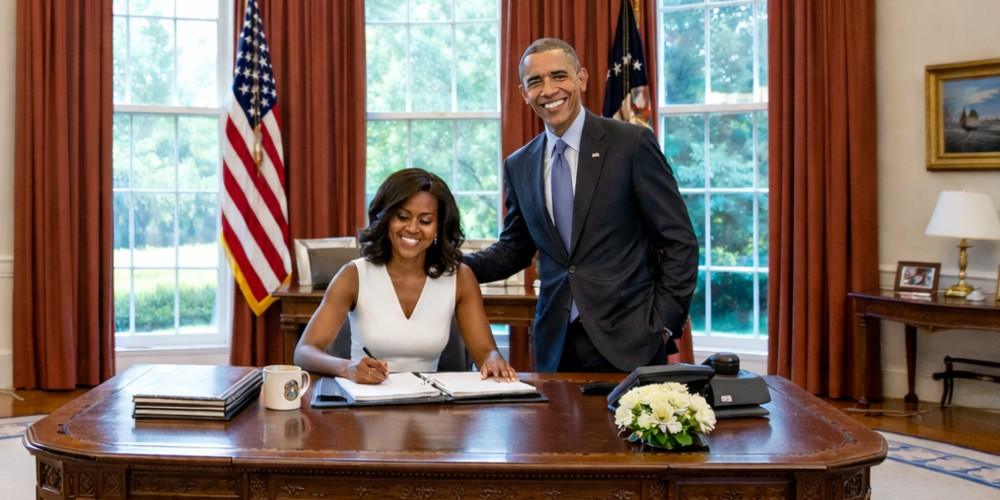
On the other side of the aisle, the Democrats had unified with a speed and emotional intensity that political professionals had not seen in a generation. Michelle Obama at the top of the ticket represented something that transcended conventional campaign strategy — she was, to her coalition, not merely a candidate but a cultural moment, a historical correction, a restoration of something they felt had been taken from them. And she had placed at her side the most gifted retail politician the Democratic Party had produced in fifty years, a man who understood the operational machinery of the American presidency from the inside and who was, by the plain reading of the Constitution, eligible to serve as vice president despite having already served two terms as president.
After years of speculation that Barack and Michelle Obama were splitting up, they came together to form a power ticket nobody saw coming.
The Twenty-Second Amendment bars a person from being elected president more than twice. It does not bar a former two-term president from the vice presidency. The lawyers had checked. The ticket was constitutional. Whether it was wise is a question the country is still answering.
DeSantis and Mace lost thirty-four states. The popular vote margin was the largest in forty years. The Republican Party, fractured by a brutal primary and operating in a media environment that had spent two years constructing a narrative of conservative governance as national sabotage, had nothing left to fight with. The returns came in early. The concession came before midnight.
The Trifecta Arrives
Michelle Obama was inaugurated on January 20, 2029, with Democratic majorities in both chambers and her husband one heartbeat from the Oval Office he had occupied for eight years. For the first time since the 2027 Congress convened, the left had everything it needed — the White House, the Senate, the House, and a legislative pipeline packed with bills that had been waiting two years for a signature. They moved immediately.
The Judicial Modernization and Equity Act passed the Senate in February 2029 and was signed within the week. The Supreme Court expanded from nine justices to fifteen. Six new seats were filled within thirty days with jurists whose confirmation hearings were exercises in managed brevity — the questions were gentle, the answers were careful, and the outcomes were never in doubt. The Court’s new 10-5 progressive majority convened its first session in March.
What followed was a restructuring of constitutional law conducted at a pace the American legal tradition had never experienced and was not built to absorb. In United States v. Harrington, the new majority held that the individual right to keep and bear arms recognized in District of Columbia v. Heller had been, in the majority’s own words, “historically misread and constitutionally unsustainable.” The Second Amendment, the Court ruled, protects militia service — not individual ownership. Eleven states moved to enact near-total civilian disarmament statutes within ninety days of the ruling, each one immediately insulated from challenge by the new precedent.
The Online Civil Rights and Equity Act — upheld 10-5 in a decision that the dissent called “the most consequential assault on the First Amendment since its ratification” — authorized a newly created federal Digital Equity Commission to identify, flag, and ultimately silence political speech deemed to constitute coordinated disinformation. The definition of disinformation, left deliberately elastic in the statute, has since been stretched to encompass virtually any sustained conservative political messaging at scale. Accounts have vanished. Websites have gone dark. The Commission does not explain its decisions. It is not required to.
Then came the churches. Americans United v. Calvary Bible Fellowship did not strip religious organizations of their tax exemptions outright — it was more surgical than that, and therefore more insidious. The Court held that a congregation engaged in what the majority termed “civic advocacy” could be found to have forfeited its nonprofit protections under the Internal Revenue Code. The IRS, operating with a budget that Congress had tripled specifically for enforcement purposes, has since opened inquiries into more than three hundred religious organizations. Most have gone quiet. A few have fought back. None have won yet. The warning of Second Timothy has rarely felt more contemporary — “For the time will come when they will not endure sound doctrine” — and a nation that has turned the machinery of government against its own houses of worship is learning what that turning costs.
The Laws That Broke the Seal
In the spring of 2029, the country was troubled but not yet broken. The Court’s rulings had generated protests, legal challenges, and a level of political fury that the administration’s communications team managed with practiced efficiency. The new president’s approval ratings remained strong. The White House projected confidence. And then, in the third week of June, President Obama signed three pieces of legislation in seven days that together constitute what future analysts — if the institutions that produce future analysts survive intact — will identify as the point of no return.
The Community Safety and Policing Equity Act nationalized local law enforcement standards while simultaneously eliminating the federal grant mechanisms that had subsidized local police departments for a generation. Departments across the country faced an impossible choice — comply with sweeping new federal mandates or lose funding they could not replace from any other source. Hundreds of departments, particularly in smaller municipalities and rural counties, chose neither and simply dissolved. The areas they had served did not become safer.
The Firearm Accountability and Community Protection Act operationalized the Harrington decision with enforcement teeth — mandatory registration timelines, confiscation schedules, and penalties administered by an IRS whose investigative capacity had been specifically expanded for the purpose. In rural America, where the firearm is not a political symbol but a practical instrument of livelihood and self-defense, the law was not received as a policy disagreement. It was received as a declaration.
The Federal Election Integrity and Access Modernization Act was the quietest of the three and the most consequential. It eliminated state authority over federal election administration entirely, vesting it in the Digital Equity Commission — the same body that already controlled which political voices were permitted in the online public square. The Commission that curated speech now administered ballots. The architecture of permanent majority was complete.
The Figurehead and the Ruins
By August 2029, the consequences were visible in ways no press briefing could paper over. Supply chains in three agricultural states had broken down following standoffs between federal regulators and local sheriffs who had publicly refused to enforce the Firearm Act. A federal courthouse in one Midwestern city closed indefinitely after the U.S. Marshals Service could not staff a security detail. Two state legislatures passed resolutions asserting sovereign authority over federal election administration within their borders — resolutions that, in a functioning constitutional order, a federal court would have enjoined within hours. The courts are no longer functioning in that way.
Michelle Obama gives good speeches. The family has always had a gift for them. In July she delivered one from the Oval Office that was widely praised for its reach, its cadence, its call to national unity. The networks ran it live. Commentators said it was exactly what the country needed to hear. The morning after it aired, a county sheriff announced that his department would not enforce federal firearms registration requirements and invited any federal agent who disagreed to come discuss the matter in person. Within seventy-two hours, fourteen other sheriffs had issued similar statements.
The president’s words moved no one who was not already moved. That is what a figurehead discovers — the symbols remain intact long after the authority has departed.
The Book of Revelation describes a vision of earthly power structures failing not gradually but suddenly — a moment when kings and mighty men discover that the thrones they occupied were never as permanent as they appeared, and that authority evacuated of justice does not diminish slowly but collapses. Whether one reads that as prophecy or as the most precise political psychology ever committed to writing, it captures something true about what is unfolding here. The institutions did not simply weaken. They inverted — becoming instruments of the very consolidation they were designed to prevent.
Washington today is a city of press releases and podiums. The meetings still happen. The briefings still occur. The flags still fly. But the animating principle of a constitutional republic — that power is bounded, that rights are enforceable, that the law applies equally regardless of who holds office — has been so thoroughly evacuated from the foundation that what remains is facade. Impressive from a distance. Hollow at the center.
All of it — the killed filibuster, the impeachment theater, the shutdown sabotage, the resurrected USAID, the restored open border, the reimposed DEI regime, the rebuilt regulatory state, the repurposed DOJ, the savage primary that broke the opposition before the general election even began, the packed courts, the gutted amendments, the nationalized elections — every brick of this ruin was laid in a sequence that began with a single midterm election in November 2026.
And that election, and everything that followed from it, would in all likelihood have turned out differently if the United States Senate had simply passed the SAVE America Act that spring — the bill that required nothing more radical than proof of citizenship to register to vote in a federal election. It never received a floor vote. Four years later, here we are.
Starting the Day With a Scripture-Inspired Roast Helps Center Your Thoughts on Eternal Truths Amid Temporal Pressures
The world can seem chaotic, especially right after we wake up. Many believers start their mornings reaching for something familiar — a hot cup of coffee — yet end up settling for mediocre brews that do little more than deliver a caffeine jolt. The daily grind of life, with its endless distractions, news cycles, and responsibilities, can leave even the most faithful feeling spiritually parched alongside their physical fatigue. What if your morning ritual could do more than wake you up? What if it could ground you in truth, nourish your body with exceptional quality, and quietly advance a kingdom purpose at the same time?
That’s the promise — and the reality — behind Promised Grounds Coffee. This Christian-founded company doesn’t just roast beans; it approaches every step as an act of worship and discipleship. By selecting only the top 10% of specialty-grade beans, ethically sourced from dedicated farmers in Central and South America, and small-batch roasting them with reverence in Austin, Texas, Promised Grounds delivers what many describe as the best coffee available — never burnt, never bland, but rich with origin stories and layered flavors that honor God’s creation.
From the vibrant Psalm 27 Roast (a light, bright medium option) to the bold yet peaceful 2 Timothy 1:7 Decaf, each bag carries a Scripture verse that turns your daily pour into a gentle reminder of faith. And through their Ounce Per Ounce Promise, every ounce of coffee you enjoy provides an equal ounce of clean water to families in need via partnership with Filter of Hope — literally brewing hope for body and soul, one cup at a time.
The challenge for today’s Christians runs deeper than finding a decent cup. In an age of convenience-driven consumerism, it’s easy to support companies that dilute values or remain silent on matters of faith. Many believers want their everyday choices — from what they drink to how they spend — to reflect discipleship rather than just convenience. Promised Grounds solves this by weaving Christian excellence into the entire process: beans nurtured with prayerful stewardship by farming families, roasted as an offering rather than a commodity, and packaged with Bible verses to encourage a mindset of gratitude and purpose from the first sip. Reviewers consistently praise the smooth, rich profiles — whether enjoyed black in a drip maker, iced on a warm day, or shared in fellowship — noting how the quality stands toe-to-toe with premium secular brands while delivering something far more meaningful.
This integration of faith and flavor addresses a real need in Christian households and ministries. Busy parents, church leaders, and remote workers alike report that starting the day with a Scripture-inspired roast helps center their thoughts on eternal truths amid temporal pressures. The coffee’s exceptional character — bright citrus notes in lighter roasts or deep chocolate undertones in bolder ones — comes from meticulous selection and careful roasting that respects the bean’s natural gifts rather than masking them. It’s the kind of coffee that elevates a simple quiet time, fuels productive workdays, or sparks meaningful conversations when shared at Bible studies or outreach events. And because it’s ethically sourced with integrity, every purchase supports sustainable livelihoods for farmers who treat their crops like family harvests.
For those leading churches or small groups, the impact multiplies. Promised Grounds offers bundles and options perfect for hospitality ministries, turning ordinary coffee service into an opportunity to point people toward the living water of Christ. Imagine greeting visitors with a warm cup whose very bag carries God’s Word — a subtle yet powerful witness that aligns with the Great Commission. The company’s Texas roots and commitment to “brewing hope” resonate especially with believers who value American enterprise paired with global compassion.
Of course, quality alone isn’t enough if the experience feels out of reach. Promised Grounds keeps it accessible with practical perks like free shipping on orders over $40, sample sets for discovering favorites, and thoughtful add-ons such as faith-themed mugs. Whether you prefer whole beans for fresh grinding, grounds for convenience, or even bulk options for larger households and ministries, the result is consistently superior coffee that makes discipleship feel integrated rather than added on.
As you consider how to align even the smallest habits with your walk with God, Promised Grounds Coffee stands out as a refreshing solution. It tackles the dual problems of subpar daily sustenance and disconnected consumption by offering a product that genuinely excels in taste while advancing a mission of clean water, farmer dignity, and scriptural encouragement. Believers who make the switch often describe it as more than a beverage upgrade — it becomes part of their rhythm of gratitude, a daily invitation to remember that every good gift comes from above.
If you’re ready to transform your mornings (and perhaps your church gatherings) with coffee that honors both exceptional craftsmanship and Christian values, I encourage you to explore what Promised Grounds has to offer. One sip at a time, you’ll be nourishing your body, refreshing your spirit, and participating in something far greater — all while enjoying what truly is among the best coffee available.