

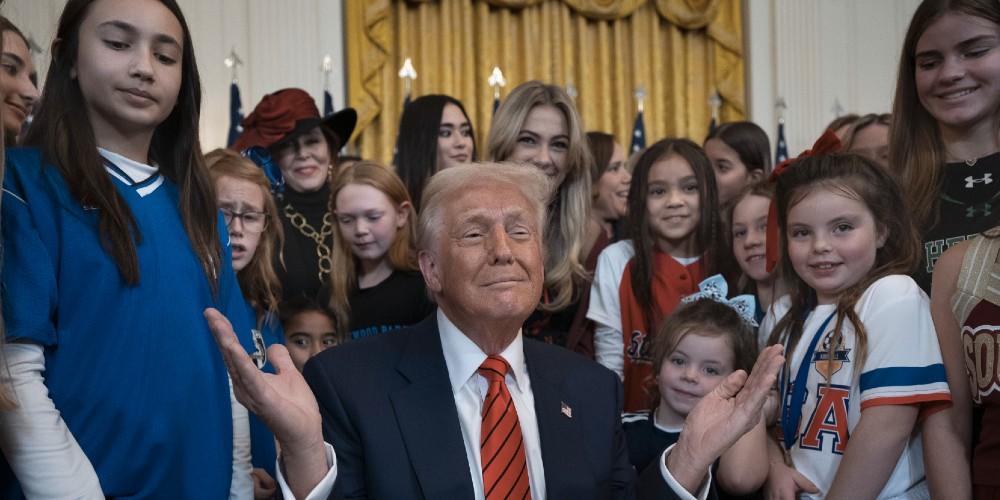
The Department of Education’s Office for Civil Rights has opened investigations into 18 schools, districts, and other entities across 10 states, accusing them of violating Title IX by letting males compete in girls’ and women’s sports. These probes target policies that prioritize gender identity over biological sex, putting female athletes at a disadvantage in terms of safety, fairness, and opportunities. The move comes just days after the Supreme Court heard arguments in a case that could reshape Title IX enforcement nationwide.
President Trump’s administration made its stance clear last year with Executive Order 14201, signed on February 5, 2025, which bars biological males from women’s sports at federally funded institutions. The order, titled “Keeping Men Out of Women’s Sports,” aimed to reverse what many see as harmful policies from the previous administration that allowed such participation. Now, with these investigations, the Education Department is enforcing that directive aggressively, responding to complaints from parents, athletes, and advocacy groups.
Among the entities under scrutiny are several in California, including Jurupa School District, Placentia-Yorba Linda School District, Santa Monica College, and Santa Rosa Junior College. Other targets span Connecticut’s Waterbury Public Schools, the Hawaii State Department of Education, Maine’s Regional School Units 19 and 57, Massachusetts’ Foxborough Public Schools, Nevada’s University of Nevada-Reno, New York’s Bellmore-Merrick Central High School District and New York City Department of Education, Pennsylvania’s Great Valley School District, Vermont’s Champlain Valley School District, and Washington’s Cheney Public Schools, Sultan School District No. 311, Tacoma Public Schools, and Vancouver Public Schools.
Assistant Secretary for Civil Rights Kimberly Richey addressed the action directly: “Time and again, the Trump Administration has made its position clear: violations of women’s rights, dignity, and fairness are unacceptable. We will leave no stone unturned in these investigations to uphold women’s right to equal access in education programs—a fight that started over half a century ago and is far from finished.”
Some of the targeted institutions have pushed back, claiming their policies align with state laws that protect transgender participation. Tacoma Public Schools, for instance, stated it would not comply with the executive order, arguing it conflicts with Washington state regulations against discrimination based on gender identity. Washington’s state superintendent’s office echoed this, noting that districts follow local guidelines allowing trans students to compete according to their identity. Hawaii’s Department of Education faces similar scrutiny, with federal officials alleging outright sex discrimination.
This resistance from blue states raises questions about deeper agendas at play. For years, progressive lawmakers and activists have embedded these policies into education systems, often ignoring the physical realities that give biological males advantages in strength and speed. Critics argue this isn’t just about inclusion but part of a broader effort to erode distinctions between men and women, potentially orchestrated by entrenched interests in academia and government that outlasted the Biden years. Recent expansions of the probes, including into California’s Community College Athletic Association as reported by EdSource and the Los Angeles Times, suggest the administration is uncovering a network of similar violations.
The timing aligns with the Supreme Court’s review of Title IX’s scope, where justices are weighing whether federal law mandates sex-segregated sports based on biology. Oral arguments last week exposed divisions, with conservative justices questioning the legality of gender-identity-based participation. If the court rules in favor of biological definitions, it could bolster these investigations and force non-compliant schools to change or face funding cuts.
Beyond legal battles, the issue touches on fundamental truths about human design. Scripture reminds us in Genesis that God created male and female distinctly, a principle that supports protecting spaces where biological differences matter most, like athletics. Allowing males into girls’ sports not only risks injury—as seen in cases where female volleyball players faced physical threats—but also diminishes the hard-won achievements of women who train rigorously within their category.
As these investigations proceed, they signal a return to policies that prioritize reality over ideology. Female athletes deserve environments free from unfair competition, and the Trump administration’s actions may finally deliver that protection after years of neglect. With more probes possibly on the horizon, the fight to safeguard women’s sports continues.
Comments About This Story Through X:
We are switching to using X as our comment “system.” Our hope is that by using that public forum, more of our readers will be willing to share their thoughts.
Starting the Day With a Scripture-Inspired Roast Helps Center Your Thoughts on Eternal Truths Amid Temporal Pressures
The world can seem chaotic, especially right after we wake up. Many believers start their mornings reaching for something familiar — a hot cup of coffee — yet end up settling for mediocre brews that do little more than deliver a caffeine jolt. The daily grind of life, with its endless distractions, news cycles, and responsibilities, can leave even the most faithful feeling spiritually parched alongside their physical fatigue. What if your morning ritual could do more than wake you up? What if it could ground you in truth, nourish your body with exceptional quality, and quietly advance a kingdom purpose at the same time?
That’s the promise — and the reality — behind Promised Grounds Coffee. This Christian-founded company doesn’t just roast beans; it approaches every step as an act of worship and discipleship. By selecting only the top 10% of specialty-grade beans, ethically sourced from dedicated farmers in Central and South America, and small-batch roasting them with reverence in Austin, Texas, Promised Grounds delivers what many describe as the best coffee available — never burnt, never bland, but rich with origin stories and layered flavors that honor God’s creation.
From the vibrant Psalm 27 Roast (a light, bright medium option) to the bold yet peaceful 2 Timothy 1:7 Decaf, each bag carries a Scripture verse that turns your daily pour into a gentle reminder of faith. And through their Ounce Per Ounce Promise, every ounce of coffee you enjoy provides an equal ounce of clean water to families in need via partnership with Filter of Hope — literally brewing hope for body and soul, one cup at a time.
The challenge for today’s Christians runs deeper than finding a decent cup. In an age of convenience-driven consumerism, it’s easy to support companies that dilute values or remain silent on matters of faith. Many believers want their everyday choices — from what they drink to how they spend — to reflect discipleship rather than just convenience. Promised Grounds solves this by weaving Christian excellence into the entire process: beans nurtured with prayerful stewardship by farming families, roasted as an offering rather than a commodity, and packaged with Bible verses to encourage a mindset of gratitude and purpose from the first sip. Reviewers consistently praise the smooth, rich profiles — whether enjoyed black in a drip maker, iced on a warm day, or shared in fellowship — noting how the quality stands toe-to-toe with premium secular brands while delivering something far more meaningful.
This integration of faith and flavor addresses a real need in Christian households and ministries. Busy parents, church leaders, and remote workers alike report that starting the day with a Scripture-inspired roast helps center their thoughts on eternal truths amid temporal pressures. The coffee’s exceptional character — bright citrus notes in lighter roasts or deep chocolate undertones in bolder ones — comes from meticulous selection and careful roasting that respects the bean’s natural gifts rather than masking them. It’s the kind of coffee that elevates a simple quiet time, fuels productive workdays, or sparks meaningful conversations when shared at Bible studies or outreach events. And because it’s ethically sourced with integrity, every purchase supports sustainable livelihoods for farmers who treat their crops like family harvests.
For those leading churches or small groups, the impact multiplies. Promised Grounds offers bundles and options perfect for hospitality ministries, turning ordinary coffee service into an opportunity to point people toward the living water of Christ. Imagine greeting visitors with a warm cup whose very bag carries God’s Word — a subtle yet powerful witness that aligns with the Great Commission. The company’s Texas roots and commitment to “brewing hope” resonate especially with believers who value American enterprise paired with global compassion.
Of course, quality alone isn’t enough if the experience feels out of reach. Promised Grounds keeps it accessible with practical perks like free shipping on orders over $40, sample sets for discovering favorites, and thoughtful add-ons such as faith-themed mugs. Whether you prefer whole beans for fresh grinding, grounds for convenience, or even bulk options for larger households and ministries, the result is consistently superior coffee that makes discipleship feel integrated rather than added on.
As you consider how to align even the smallest habits with your walk with God, Promised Grounds Coffee stands out as a refreshing solution. It tackles the dual problems of subpar daily sustenance and disconnected consumption by offering a product that genuinely excels in taste while advancing a mission of clean water, farmer dignity, and scriptural encouragement. Believers who make the switch often describe it as more than a beverage upgrade — it becomes part of their rhythm of gratitude, a daily invitation to remember that every good gift comes from above.
If you’re ready to transform your mornings (and perhaps your church gatherings) with coffee that honors both exceptional craftsmanship and Christian values, I encourage you to explore what Promised Grounds has to offer. One sip at a time, you’ll be nourishing your body, refreshing your spirit, and participating in something far greater — all while enjoying what truly is among the best coffee available.