

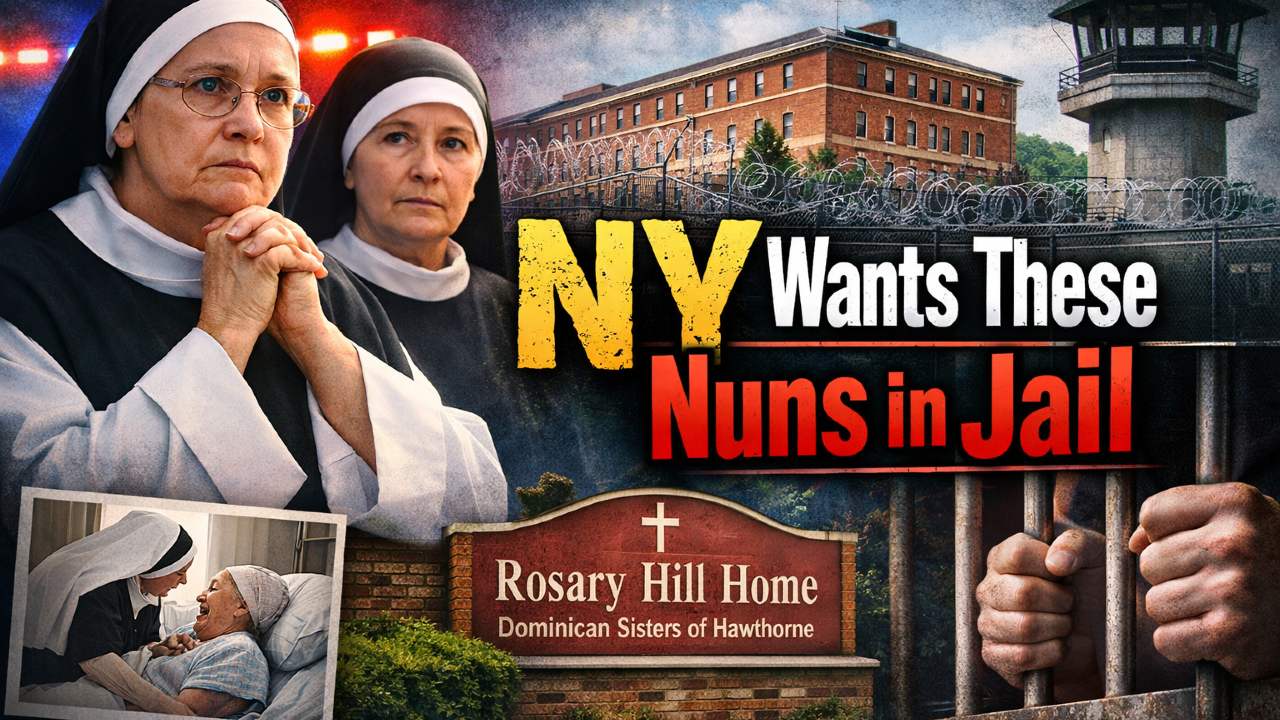
New York State has decided that the women who have spent 125 years washing, feeding, and sitting with the dying poor need to be taught a lesson in gender ideology — or face jail time. That is not a rhetorical flourish. It is the actual situation facing the Dominican Sisters of Hawthorne, an order of Catholic nuns who run Rosary Hill Home in Hawthorne, New York, a 42-bed facility where terminal cancer patients who cannot afford care go to spend their last days in dignity, free of charge.
The state of New York would now like to require these sisters to assign patient rooms by gender identity rather than biological sex, grant access to opposite-sex bathrooms, use preferred pronouns, undergo state-mandated training in gender ideology, and post notices of compliance with the progressive vision of human nature — or risk fines, loss of their license, and up to one year in prison.
- The Dominican Sisters of Hawthorne, a 125-year-old Catholic religious order, filed a federal lawsuit on April 7, 2026, challenging New York’s LGBTQ Long-Term Care Facility Residents’ Bill of Rights, signed by Gov. Kathy Hochul in November 2023.
- The sisters operate Rosary Hill Home, a 42-bed facility in Hawthorne, New York, providing free terminal cancer care to those who cannot afford it — accepting no insurance or government funds.
- New York’s law requires nursing homes to assign rooms and grant bathroom access based on gender identity, use preferred pronouns, conduct biennial gender ideology staff training, and post anti-discrimination notices — all under threat of criminal penalties.
- Non-compliance can result in fines starting at $2,000 per violation, escalating to $5,000 for repeat violations, with “willful violations” carrying fines up to $10,000 and up to one year in prison.
- Over a four-year period, the New York State Department of Health received zero complaints against Rosary Hill Home, compared to more than 55,000 complaints against other nursing facilities statewide.
- The state’s law includes a religious exemption for facilities operated by the Church of Christ, Scientist, but provides no such protection for Catholic or other religious organizations.
- The Catholic Benefits Association sought a religious exemption from the state on March 5, 2026; no response was received, prompting the lawsuit.
- The sisters’ lawsuit, filed in U.S. District Court for the Southern District of New York, argues the law violates the First and Fourteenth Amendments.
- The order was founded in 1900 by Mother Mary Alphonsa Lathrop, daughter of author Nathaniel Hawthorne; Pope Francis declared her venerable in March 2024.
The order was founded in 1900 by Mother Mary Alphonsa Lathrop — the daughter of Nathaniel Hawthorne — who resolved to give her life to what she called the “cancerous poor.” She wrote that she had set her “whole being to endeavor to bring consolation to the cancerous poor,” and the congregation she built has honored that charge for more than a century, asking nothing from those they serve. No insurance. No government reimbursement. No payment of any kind from patients or families. Just consecrated women caring for the dying as if, in the words of their mission, they were caring for Christ himself.
This is who New York has decided to make an example of.
A Law in Search of a Problem
The most damning detail in this entire controversy is not the breadth of the mandates or the severity of the penalties — though both are remarkable. It is this: during the four-year reporting period from February 2022 through January 2026, the New York State Department of Health received zero complaints from Rosary Hill Home residents, compared to more than 55,000 complaints against other nursing homes statewide, with an average of 23 citations per facility during the same period.
Zero. Not “very few.” Not “a handful.” Zero complaints. In four years. At a facility caring for some of the most vulnerable people in the state. Yet Albany’s Department of Health did not send its compliance letters to the 55,000-complaint facilities first. It sent them to the nuns.
The sisters’ attorney, L. Martin Nussbaum, put it plainly: “This law imposed on the Dominican Hawthorne Sisters is a form of gender ideology virtue signaling, to require these sisters to be trained in an ideology entirely contrary to Catholic belief. Why are we doing this? We don’t even have such patients. It’s the state requiring these holy nuns to bend the knee to an ideology contrary to their faith.”
That framing deserves to be taken seriously. The state is not responding to a documented harm. It is not protecting patients who have been mistreated at Rosary Hill. It is compelling ideological conformity from a religious institution that has, by every measurable standard, served the public with extraordinary care and compassion. When government power is used not to correct a wrong but to enforce a worldview, the word for that is coercion.
The Exemption That Exposes Everything
Perhaps the most legally significant wrinkle in this case is one that barely registers in mainstream coverage: New York’s law exempts facilities operated by the Church of Christ, Scientist, but does not provide the same exemption for Catholic organizations. The sisters are not asking for the entire law to be invalidated. They are asking to be treated the same as another religious group that Albany has already decided deserves protection. That the state has not responded to that request — or explained why one faith community merits accommodation and another does not — is not a bureaucratic oversight. It is a theological judgment rendered by the government, which is precisely the kind of judgment the First Amendment forbids.
The Catholic Benefits Association sent a request to the state on March 5, seeking a religious exemption for the organization, and received no response. Faced with silence and the prospect of criminal penalties, the sisters had no recourse but federal court.
What the State Is Actually Demanding
It is worth spelling out in plain terms what New York is demanding of these women. The law requires them to assign rooms by gender identity rather than biological sex, allow access to opposite-sex bathrooms, permit expression, relationships, and identity practices, use preferred pronouns, require staff training in gender ideology, and post a public notice stating compliance with the law. One state letter warned the sisters that the nursing home cannot restrict a resident’s right to intimate or sexual relations unless the restriction is uniformly applied across all residents — a directive so incongruous with the spiritual nature of a Catholic end-of-life ministry that it reads like satire, were the consequences not so serious.
Mother Marie Edward, the order’s general superior, described the sisters’ mission with characteristic simplicity:

“We are consecrated religious Sisters and have one mission. It is to provide comfort and skilled care to persons dying of cancer who cannot afford nursing care. We do not take insurance or government funds or money from our patients or families. The care is totally free. We do this without discriminating on the basis of race, religion, or sex. We do it because Jesus taught us that, when the least among us are sick, we should care for them, as if they were Christ himself.”
Against that statement of purpose, the state’s demands take on a clarifying quality. The sisters are not a corporation seeking to maximize profit while avoiding regulatory inconvenience. They are a small congregation of 44 women — about 14 of whom tend to sick patients in the Hawthorne facility, assisted by lay certified nursing assistants — who have organized their entire lives around the care of the dying. New York is telling them that unless they reorganize that ministry around the state’s anthropology, they will be fined, stripped of their license, and potentially imprisoned.
A Pattern the Courts Will Recognize
This is not the first time the state has tried to conscript Catholic religious sisters into serving its ideological agenda. The Little Sisters of the Poor previously fought the government between 2012 and 2020, pushing back against the requirement to provide cost-free contraceptives and abortifacients in their health insurance plans, ultimately prevailing after years of litigation. The Hawthorne Dominicans’ case follows a similar pattern — a government mandate that cannot be complied with in good conscience, a religious community that asks only to be left alone to do its work, and a state apparatus that responds with threats rather than dialogue.
The sisters are represented by the First & Fourteenth law firm and are suing under the First and Fourteenth Amendments. Their case rests on the straightforward argument that the government cannot compel a religious organization to adopt beliefs it considers heretical — especially when the government has already demonstrated its willingness to exempt other religious bodies from the same requirements. Courts, including the Supreme Court, have grown increasingly skeptical of government mandates that single out religious institutions for disfavored treatment.
The words of Isaiah speak to the vocation these sisters have answered, and the injustice now arrayed against them: “When thou passest through the waters, I will be with thee; and through the rivers, they shall not overflow thee.” — Isaiah 43:2. Albany may have the machinery of regulation, but it has not yet reckoned with what happens when a state picks a fight with women who have already surrendered everything to God.
The Real Stakes
If New York prevails, the message to every faith-based charity, hospital, hospice, and nursing home in the state is unambiguous: adopt the government’s definition of human personhood or cease to exist. That is not a marginal outcome — it is the elimination of an entire sector of civil society that has historically done what government cannot, caring for the most vulnerable with a personal devotion that no bureaucracy can replicate or replace.
Sister Stella Mary, administrator of Rosary Hill Home, invoked the order’s foundress in describing what is at stake:
“Our foundress, Mother Alphonsa Hawthorne, charged us to serve those who are ‘to pass from one life to another’ and to ‘make them as comfortable and happy as if their own people had kept them and put them into the very best bedroom.’ We intend to continue honoring this sacred obligation but need relief from the Court to do so.”
The sisters are not asking New York to change its laws for everyone. They are asking to be allowed to serve the dying poor according to the faith that makes that service possible in the first place. That Albany cannot find the grace to say yes — and that it would threaten jail time before even answering a letter — tells you everything you need to know about who is being unreasonable here.
Starting the Day With a Scripture-Inspired Roast Helps Center Your Thoughts on Eternal Truths Amid Temporal Pressures
The world can seem chaotic, especially right after we wake up. Many believers start their mornings reaching for something familiar — a hot cup of coffee — yet end up settling for mediocre brews that do little more than deliver a caffeine jolt. The daily grind of life, with its endless distractions, news cycles, and responsibilities, can leave even the most faithful feeling spiritually parched alongside their physical fatigue. What if your morning ritual could do more than wake you up? What if it could ground you in truth, nourish your body with exceptional quality, and quietly advance a kingdom purpose at the same time?
That’s the promise — and the reality — behind Promised Grounds Coffee. This Christian-founded company doesn’t just roast beans; it approaches every step as an act of worship and discipleship. By selecting only the top 10% of specialty-grade beans, ethically sourced from dedicated farmers in Central and South America, and small-batch roasting them with reverence in Austin, Texas, Promised Grounds delivers what many describe as the best coffee available — never burnt, never bland, but rich with origin stories and layered flavors that honor God’s creation.
From the vibrant Psalm 27 Roast (a light, bright medium option) to the bold yet peaceful 2 Timothy 1:7 Decaf, each bag carries a Scripture verse that turns your daily pour into a gentle reminder of faith. And through their Ounce Per Ounce Promise, every ounce of coffee you enjoy provides an equal ounce of clean water to families in need via partnership with Filter of Hope — literally brewing hope for body and soul, one cup at a time.
The challenge for today’s Christians runs deeper than finding a decent cup. In an age of convenience-driven consumerism, it’s easy to support companies that dilute values or remain silent on matters of faith. Many believers want their everyday choices — from what they drink to how they spend — to reflect discipleship rather than just convenience. Promised Grounds solves this by weaving Christian excellence into the entire process: beans nurtured with prayerful stewardship by farming families, roasted as an offering rather than a commodity, and packaged with Bible verses to encourage a mindset of gratitude and purpose from the first sip. Reviewers consistently praise the smooth, rich profiles — whether enjoyed black in a drip maker, iced on a warm day, or shared in fellowship — noting how the quality stands toe-to-toe with premium secular brands while delivering something far more meaningful.
This integration of faith and flavor addresses a real need in Christian households and ministries. Busy parents, church leaders, and remote workers alike report that starting the day with a Scripture-inspired roast helps center their thoughts on eternal truths amid temporal pressures. The coffee’s exceptional character — bright citrus notes in lighter roasts or deep chocolate undertones in bolder ones — comes from meticulous selection and careful roasting that respects the bean’s natural gifts rather than masking them. It’s the kind of coffee that elevates a simple quiet time, fuels productive workdays, or sparks meaningful conversations when shared at Bible studies or outreach events. And because it’s ethically sourced with integrity, every purchase supports sustainable livelihoods for farmers who treat their crops like family harvests.
For those leading churches or small groups, the impact multiplies. Promised Grounds offers bundles and options perfect for hospitality ministries, turning ordinary coffee service into an opportunity to point people toward the living water of Christ. Imagine greeting visitors with a warm cup whose very bag carries God’s Word — a subtle yet powerful witness that aligns with the Great Commission. The company’s Texas roots and commitment to “brewing hope” resonate especially with believers who value American enterprise paired with global compassion.
Of course, quality alone isn’t enough if the experience feels out of reach. Promised Grounds keeps it accessible with practical perks like free shipping on orders over $40, sample sets for discovering favorites, and thoughtful add-ons such as faith-themed mugs. Whether you prefer whole beans for fresh grinding, grounds for convenience, or even bulk options for larger households and ministries, the result is consistently superior coffee that makes discipleship feel integrated rather than added on.
As you consider how to align even the smallest habits with your walk with God, Promised Grounds Coffee stands out as a refreshing solution. It tackles the dual problems of subpar daily sustenance and disconnected consumption by offering a product that genuinely excels in taste while advancing a mission of clean water, farmer dignity, and scriptural encouragement. Believers who make the switch often describe it as more than a beverage upgrade — it becomes part of their rhythm of gratitude, a daily invitation to remember that every good gift comes from above.
If you’re ready to transform your mornings (and perhaps your church gatherings) with coffee that honors both exceptional craftsmanship and Christian values, I encourage you to explore what Promised Grounds has to offer. One sip at a time, you’ll be nourishing your body, refreshing your spirit, and participating in something far greater — all while enjoying what truly is among the best coffee available.