
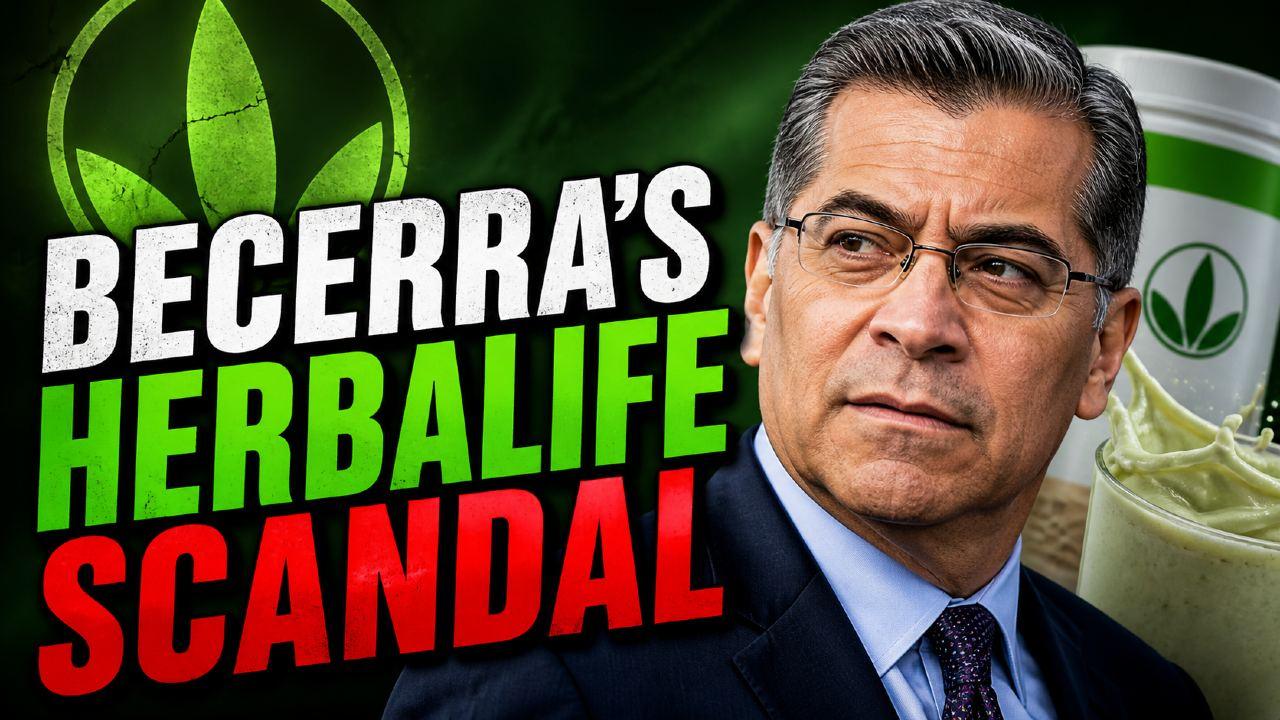
Xavier Becerra wants to be the first Latino governor of California in more than 150 years. He is running on biography, on representation, on the idea that a son of Mexican immigrants who climbed from a one-room apartment to the Biden Cabinet is uniquely positioned to fight for working Latino families against corporate exploitation and Republican villainy.
It is a powerful pitch. It also raises an uncomfortable question for the voters he is courting most aggressively: when Latino families in his own backyard were being systematically separated from their savings by a multi-level marketing operation headquartered in his congressional district, whose side did Xavier Becerra take?
The answer is on the public record, and it is not the side his campaign website would have you believe.
- Herbalife, a multi-level marketing nutrition company long accused of operating a pyramid scheme, derives roughly 65 percent of its U.S. sales from Latino consumers and was found by the FTC in 2016 to have misled hundreds of thousands of distributors with deceptive earnings claims.
- Herbalife relocated its headquarters to Becerra’s Los Angeles congressional district in 2008 and quickly became one of his largest political donors, with the company’s PAC and employees giving more than $20,000 in the 2011-2012 cycle alone, making Herbalife his third-largest contributor.
- No federal candidate received more from Herbalife in the 2012 cycle than Becerra; only the Republican National Committee received a larger share of the company’s political giving that year.
- When fellow Democrats in the Congressional Hispanic Caucus moved to sign a letter urging the FTC to investigate Herbalife, Becerra blocked it, telling colleagues to wait until “all the facts” were in.
- The FTC ultimately fined Herbalife $200 million, ordered roughly 350,000 distributors compensated for their losses, and forced the company to restructure its compensation system top to bottom.
- Becerra’s pattern of standing with the donor over the constituent has continued, including a recent Politico report that close aides allegedly siphoned $225,000 from his campaign accounts over two years without his knowledge.
- Becerra is now asking Latino voters to entrust him with the governorship of the largest Latino-majority state in the country.
The Company at the Center of the Story
Herbalife sells protein shakes, nutrition supplements, and weight-loss products. It does not sell them in stores. It sells them through a network of “distributors” who buy product, recruit other distributors, and earn commissions on the chain of sellers below them. Hedge fund manager Bill Ackman famously called it a pyramid scheme in 2012 and bet a billion dollars that it would collapse. He spent more than $50 million publicizing the case against the company.
The accusation that drew the most blood was demographic. Herbalife had aggressively targeted Latino communities, sponsoring telenovelas, signing on Latino political figures, and recruiting in working-class neighborhoods where the promise of “be your own boss” landed hardest. By the early 2010s, roughly 65 percent of Herbalife’s U.S. sales were to Latino consumers. Latino civic groups began collecting horror stories of distributors who lost their savings, drained their retirement accounts, and ended up with garages full of unsold shakes.
The FTC eventually agreed something was deeply wrong. In a 2016 settlement, the agency ordered Herbalife to pay $200 million to defrauded distributors, restructure its compensation model from top to bottom, and stop rewarding distributors for recruitment over actual retail sales. Roughly 350,000 people received refund checks.
The FTC’s complaint documented that half of Herbalife’s “sales leaders” earned less than five dollars a month on average. The agency’s chairwoman pointedly declined to call Herbalife “not a pyramid scheme,” telling reporters her focus was not on labels but on the deceptive practices themselves.
The Money
Herbalife moved its corporate headquarters into Becerra’s Los Angeles congressional district in 2008. The political relationship that followed was not subtle.
According to OpenSecrets data, Herbalife’s PAC and employees combined to give Becerra more than $20,000 during the 2011-2012 election cycle, making the company his third-largest contributor. No other federal candidate received more from Herbalife that cycle. Only the Republican National Committee took a larger share of the company’s political giving than Becerra did. Herbalife’s PAC also contributed to Becerra in 2010 and 2014, and made its first-ever donation to the Congressional Hispanic Caucus’s BOLD PAC in 2013, the same year lobbyists hired by Ackman were trying to get CHC members to demand an FTC investigation.
This is the pattern political journalists describe as a member becoming a company’s “friend” in Washington. Becerra was, by any reasonable definition, Herbalife’s friend.
The Cover
The most consequential thing Becerra did for Herbalife was not vote on a bill or sponsor legislation. It was the quiet act of running interference inside his own caucus.
By late 2013 and early 2014, Rep. Linda Sanchez of California was circulating a letter asking the FTC to investigate Herbalife. Lobbyists working for Pershing Square were courting signatures from members of the Congressional Hispanic Caucus, the very members whose constituents made up the bulk of Herbalife’s customer base. According to reporting at the time by OpenSecrets and Politico, Becerra urged his CHC colleagues not to sign on, asking them not to rush to conclusions until all the facts were known.

The facts, of course, were already known to anyone who cared to look. Latino civic organizations had been documenting them for years. Local journalists in Boyle Heights had been documenting them. The League of United Latin American Citizens had been documenting them. Massachusetts Sen. Ed Markey had received complaints from constituents who lost their entire 401(k)s. The Congressional Hispanic Caucus did not need to wait for more facts. It needed a chairman who was not on Herbalife’s donor list.
The Verdict, and the Vindication of His Critics
Two years after Becerra cooled the CHC’s appetite for an investigation, the FTC delivered its $200 million verdict. The agency confirmed almost everything the Latino civic groups had been saying. The compensation structure that Becerra had asked his colleagues not to second-guess was the exact compensation structure the federal government ordered Herbalife to dismantle.
Three hundred fifty thousand refund checks went out. Many of the recipients were the very Latino constituents Becerra now asks to make him governor.
It is worth pausing on the moral arithmetic. The choice in front of Becerra in 2013 was not between two close calls. It was between a billionaire’s lobbying campaign on one side and a documented pattern of harm to working Latino families on the other. Becerra chose the side that was writing him checks.
The Pattern Keeps Repeating
The Herbalife episode might be defensible as a one-time misjudgment if it stood alone. It does not. Politico reported in November 2025 that Becerra’s longtime chief of staff and other close aides allegedly siphoned $225,000 from his campaign accounts over a two-year period. Becerra was not personally accused of wrongdoing, but federal investigators reportedly approached him before he noticed the money was gone. Earlier in 2024, reporting surfaced that he was paying $10,000 a month for “campaign reporting” out of a dormant state account, an arrangement campaign finance experts described as extraordinarily expensive for what it purportedly produced.
His record at Health and Human Services compounds the picture. White House officials, on background, described him as absent during the COVID response. His agency’s handling of the 2022 mpox outbreak drew sharp criticism. Tens of thousands of unaccompanied migrant children were placed in homes that HHS subsequently lost track of, with some later identified as trafficking victims. Becerra’s defenders argue he was given an unclear portfolio. His critics argue that a man who could not keep track of children he was responsible for, or money flowing out of his own campaign, is not the man California needs running a $300 billion state government.
What This Reveals About How He Will Govern
Politicians often ask voters to judge them on their best speeches. Voters are usually wiser to judge them on their hardest tests. The Herbalife episode was a hard test, and Becerra failed it in the direction the donor wanted him to fail it.
He had every reason to know what was happening. The company was in his district. The victims were in his district. The civic organizations sounding the alarm were organizations he had every other reason to listen to. He chose the donor anyway, and he used his position of trust within the Congressional Hispanic Caucus to make sure other members did not break ranks.
Isaiah warned of leaders of exactly this kind. Thy princes are rebellious, and companions of thieves: every one loveth gifts, and followeth after rewards: they judge not the fatherless, neither doth the cause of the widow come unto them. The verse is uncomfortably specific. Princes who love gifts. Princes who follow rewards. Princes who do not take up the cause of those who actually need defending.
California Latino voters are being told that Xavier Becerra is the candidate who will fight for them in the governor’s mansion. The most relevant data point in evaluating that claim is what he did the last time fighting for them required pushing back against someone writing him a check. He did not push back. He ran interference for the check writer. The voters he is asking to trust him already received the Becerra treatment once. They should think hard before signing up for it again.
Starting the Day With a Scripture-Inspired Roast Helps Center Your Thoughts on Eternal Truths Amid Temporal Pressures
The world can seem chaotic, especially right after we wake up. Many believers start their mornings reaching for something familiar — a hot cup of coffee — yet end up settling for mediocre brews that do little more than deliver a caffeine jolt. The daily grind of life, with its endless distractions, news cycles, and responsibilities, can leave even the most faithful feeling spiritually parched alongside their physical fatigue. What if your morning ritual could do more than wake you up? What if it could ground you in truth, nourish your body with exceptional quality, and quietly advance a kingdom purpose at the same time?
That’s the promise — and the reality — behind Promised Grounds Coffee. This Christian-founded company doesn’t just roast beans; it approaches every step as an act of worship and discipleship. By selecting only the top 10% of specialty-grade beans, ethically sourced from dedicated farmers in Central and South America, and small-batch roasting them with reverence in Austin, Texas, Promised Grounds delivers what many describe as the best coffee available — never burnt, never bland, but rich with origin stories and layered flavors that honor God’s creation.
From the vibrant Psalm 27 Roast (a light, bright medium option) to the bold yet peaceful 2 Timothy 1:7 Decaf, each bag carries a Scripture verse that turns your daily pour into a gentle reminder of faith. And through their Ounce Per Ounce Promise, every ounce of coffee you enjoy provides an equal ounce of clean water to families in need via partnership with Filter of Hope — literally brewing hope for body and soul, one cup at a time.
The challenge for today’s Christians runs deeper than finding a decent cup. In an age of convenience-driven consumerism, it’s easy to support companies that dilute values or remain silent on matters of faith. Many believers want their everyday choices — from what they drink to how they spend — to reflect discipleship rather than just convenience. Promised Grounds solves this by weaving Christian excellence into the entire process: beans nurtured with prayerful stewardship by farming families, roasted as an offering rather than a commodity, and packaged with Bible verses to encourage a mindset of gratitude and purpose from the first sip. Reviewers consistently praise the smooth, rich profiles — whether enjoyed black in a drip maker, iced on a warm day, or shared in fellowship — noting how the quality stands toe-to-toe with premium secular brands while delivering something far more meaningful.
This integration of faith and flavor addresses a real need in Christian households and ministries. Busy parents, church leaders, and remote workers alike report that starting the day with a Scripture-inspired roast helps center their thoughts on eternal truths amid temporal pressures. The coffee’s exceptional character — bright citrus notes in lighter roasts or deep chocolate undertones in bolder ones — comes from meticulous selection and careful roasting that respects the bean’s natural gifts rather than masking them. It’s the kind of coffee that elevates a simple quiet time, fuels productive workdays, or sparks meaningful conversations when shared at Bible studies or outreach events. And because it’s ethically sourced with integrity, every purchase supports sustainable livelihoods for farmers who treat their crops like family harvests.
For those leading churches or small groups, the impact multiplies. Promised Grounds offers bundles and options perfect for hospitality ministries, turning ordinary coffee service into an opportunity to point people toward the living water of Christ. Imagine greeting visitors with a warm cup whose very bag carries God’s Word — a subtle yet powerful witness that aligns with the Great Commission. The company’s Texas roots and commitment to “brewing hope” resonate especially with believers who value American enterprise paired with global compassion.
Of course, quality alone isn’t enough if the experience feels out of reach. Promised Grounds keeps it accessible with practical perks like free shipping on orders over $40, sample sets for discovering favorites, and thoughtful add-ons such as faith-themed mugs. Whether you prefer whole beans for fresh grinding, grounds for convenience, or even bulk options for larger households and ministries, the result is consistently superior coffee that makes discipleship feel integrated rather than added on.
As you consider how to align even the smallest habits with your walk with God, Promised Grounds Coffee stands out as a refreshing solution. It tackles the dual problems of subpar daily sustenance and disconnected consumption by offering a product that genuinely excels in taste while advancing a mission of clean water, farmer dignity, and scriptural encouragement. Believers who make the switch often describe it as more than a beverage upgrade — it becomes part of their rhythm of gratitude, a daily invitation to remember that every good gift comes from above.
If you’re ready to transform your mornings (and perhaps your church gatherings) with coffee that honors both exceptional craftsmanship and Christian values, I encourage you to explore what Promised Grounds has to offer. One sip at a time, you’ll be nourishing your body, refreshing your spirit, and participating in something far greater — all while enjoying what truly is among the best coffee available.