
- President Donald Trump has declared that election integrity, specifically through voter ID and proof of citizenship, constitutes a core element of homeland security and must be addressed immediately.
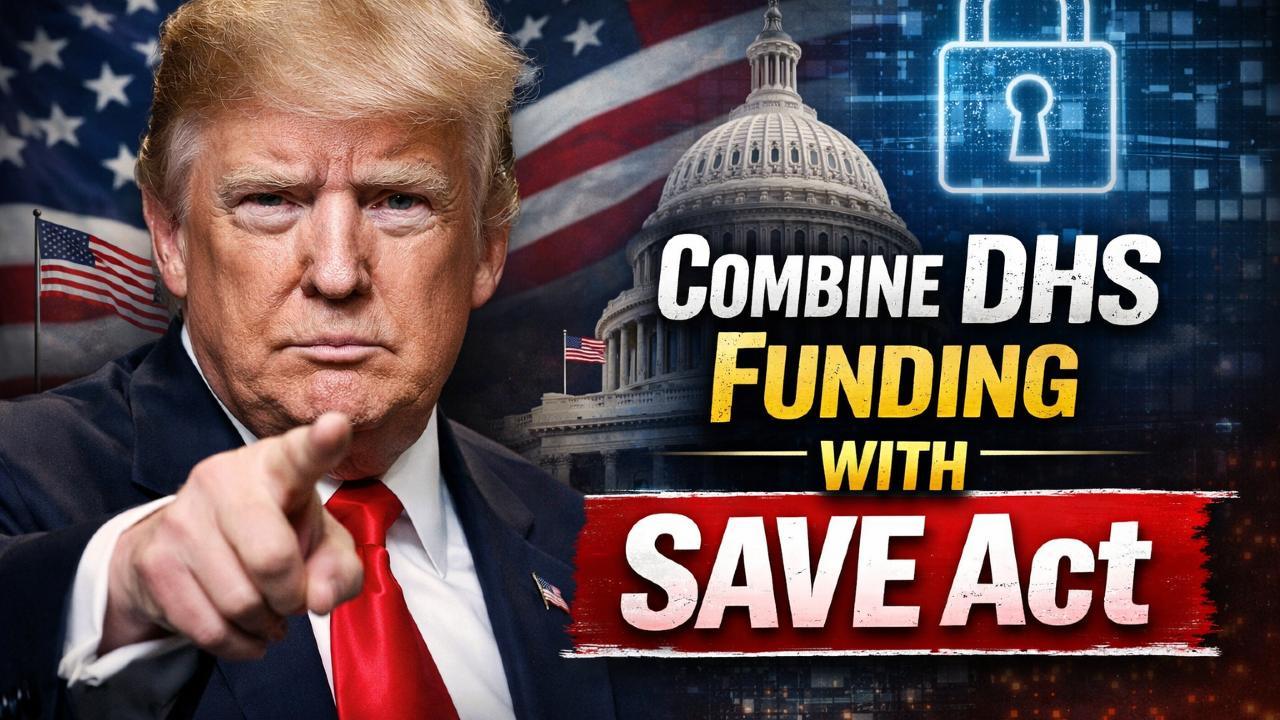
- Trump urged Senate Republicans to attach the Safeguard American Voter Eligibility (SAVE) America Act to the Department of Homeland Security funding bill to resolve the ongoing partial government shutdown.
- The SAVE America Act requires documentary proof of U.S. citizenship for voter registration in federal elections and photo identification at the time of voting, with limited exceptions for mail-in ballots.
- Trump framed the two issues as inseparable, stating that “voter ID is part of Homeland Security” and “proof of citizenship is part of homeland security.”
- A month-long stalemate over DHS funding has led to TSA staffing shortages at airports, prompting Trump to deploy ICE agents for assistance.
- Democrats have vowed to block the SAVE America Act, while Trump has insisted he will not sign other legislation until it passes in strong form.
- Public support for basic voter identification measures remains high across party lines, yet the bill faces filibuster hurdles in the Senate.
- The push comes amid broader concerns that unsecured borders and lax registration practices could allow non-citizens to influence American elections.
- Trump’s position echoes long-standing arguments that the integrity of the ballot box directly affects national sovereignty and security.
- Failure to secure elections risks eroding public trust in the democratic process itself.
President Donald Trump is correct when he asserts that election integrity represents a national security concern. On Monday, speaking during a roundtable in Memphis, Tennessee, the president called on the Senate to weld the Safeguard American Voter Eligibility (SAVE) America Act directly into the legislation funding the Department of Homeland Security through September. His message was unambiguous: the two priorities are not separate but intertwined.
Trump made the case plainly. “We want voter ID, we want proof of citizenship as part of our funding,” he said. He continued, “I’m suggesting very strongly that the Republicans, in going for the SAVE America Act, that you weld it into exactly this because voter ID is part of Homeland Security. Think of it. We’re talking about two separate items, but they’re really the same. Voter ID is part of Homeland Security. Proof of citizenship is part of homeland security. So I think it should be welded in. I think it should be together.”
The timing carries weight. A partial shutdown of DHS operations has stretched into its second month, creating visible strain at the nation’s airports where TSA staffing shortages have caused delays and frustration for travelers. Trump has already directed Immigration and Customs Enforcement agents to support crowd management at affected facilities. Against that backdrop, he refuses to accept a funding patch that ignores the more fundamental vulnerability at the ballot box.
The SAVE America Act, which passed the House earlier this year, seeks to close loopholes that have persisted for decades. It mandates that individuals registering to vote in federal elections provide documentary proof of U.S. citizenship—options include a valid U.S. passport, certified birth certificate, naturalization certificate, or other government-issued records confirming citizenship. At the polls, voters would present photo identification. Mail-in ballots would be restricted to cases of illness, disability, military service, or overseas travel. The legislation also directs states to use federal databases to audit voter rolls and remove non-citizens.
These measures address observable patterns rather than abstract fears. In the years following record levels of illegal border crossings, multiple states have documented instances of non-citizens appearing on voter registration lists. While outright proven cases of non-citizen ballots cast in large numbers remain difficult to quantify due to limited auditing in many jurisdictions, the mere possibility undermines confidence. When millions enter the country without vetting and registration processes rely largely on self-attestation, the risk to electoral sovereignty becomes real.
Trump has reinforced the point on Truth Social, writing: “THE SAVE AMERICA ACT MUST BE PASSED BY THE SENATE. THERE IS NOTHING THAT IS MORE IMPORTANT FOR THE U.S.A. Voter I.D., Proof of Citizenship, etc. Get it done and watch all of the good things that will happen!!!” He has gone further, stating he will not sign other bills until the legislation reaches his desk in uncompromised form.
Critics argue that such requirements impose undue burdens, yet everyday Americans already navigate far stricter identification demands to board an airplane, purchase a firearm, open a bank account, or enter federal buildings. The notion that verifying citizenship before deciding who governs the nation is somehow discriminatory defies common sense. Polling has consistently shown that roughly 80 percent or more of voters, including significant majorities of independents and even many Democrats, support photo voter ID.
The deeper issue is trust. Elections are the mechanism by which the people exercise their sovereignty. When that process appears porous—whether through unverified registrations, unsecured mail-in expansion, or resistance to basic audits—faith in the republic erodes. History offers sobering examples of republics that fell not from external invasion alone but from internal decay of their institutions. A nation that cannot or will not secure its own elections invites manipulation from foreign actors, domestic opportunists, and ideological forces alike.
Linking the SAVE America Act to DHS funding is not gamesmanship; it is leverage born of necessity. The Department of Homeland Security exists to protect the American people from threats both external and internal. An unsecured border that funnels millions of unknown individuals into the country, combined with voting systems that cannot reliably distinguish citizens from non-citizens, constitutes precisely such a threat. President Trump recognizes this connection and refuses to treat symptoms while ignoring the disease.
Senate Democrats have signaled unified opposition, threatening filibusters and decrying the bill as a “federal takeover” of elections traditionally managed at the state level. Yet the Constitution grants Congress authority to regulate the time, place, and manner of federal elections, and safeguarding citizenship requirements falls squarely within that power. States retain flexibility under the legislation to implement processes for those lacking standard documents and to handle name changes.
The current standoff places Senate Republicans in a position of decision. They can pursue a short-term funding resolution that kicks the can down the road, or they can heed the president’s call and insist that genuine election security accompany any deal. Trump has urged them not to worry about Easter recess but to remain in Washington and get the work done.
Americans have watched institutions falter before. From intelligence community failures to public health missteps to border policies that strained communities nationwide, patterns of elite indifference to basic safeguards have bred widespread skepticism. Restoring trust demands action, not rhetoric. Requiring proof that only American citizens decide American elections is among the most straightforward and defensible steps possible.

President Trump’s insistence carries moral clarity. The ballot box is not a suggestion; it is the foundation of self-government. Protecting it is not optional. It is a national security imperative. If Congress fails to act, the consequences will extend far beyond one funding bill or one election cycle. They will touch the legitimacy of governance itself for years to come.
The coming days in the Senate will test whether lawmakers prioritize political theater or the plain duty to secure the republic. The president has drawn the line. The question now is whether sufficient resolve exists to hold it.
Starting the Day With a Scripture-Inspired Roast Helps Center Your Thoughts on Eternal Truths Amid Temporal Pressures
The world can seem chaotic, especially right after we wake up. Many believers start their mornings reaching for something familiar — a hot cup of coffee — yet end up settling for mediocre brews that do little more than deliver a caffeine jolt. The daily grind of life, with its endless distractions, news cycles, and responsibilities, can leave even the most faithful feeling spiritually parched alongside their physical fatigue. What if your morning ritual could do more than wake you up? What if it could ground you in truth, nourish your body with exceptional quality, and quietly advance a kingdom purpose at the same time?
That’s the promise — and the reality — behind Promised Grounds Coffee. This Christian-founded company doesn’t just roast beans; it approaches every step as an act of worship and discipleship. By selecting only the top 10% of specialty-grade beans, ethically sourced from dedicated farmers in Central and South America, and small-batch roasting them with reverence in Austin, Texas, Promised Grounds delivers what many describe as the best coffee available — never burnt, never bland, but rich with origin stories and layered flavors that honor God’s creation.
From the vibrant Psalm 27 Roast (a light, bright medium option) to the bold yet peaceful 2 Timothy 1:7 Decaf, each bag carries a Scripture verse that turns your daily pour into a gentle reminder of faith. And through their Ounce Per Ounce Promise, every ounce of coffee you enjoy provides an equal ounce of clean water to families in need via partnership with Filter of Hope — literally brewing hope for body and soul, one cup at a time.
The challenge for today’s Christians runs deeper than finding a decent cup. In an age of convenience-driven consumerism, it’s easy to support companies that dilute values or remain silent on matters of faith. Many believers want their everyday choices — from what they drink to how they spend — to reflect discipleship rather than just convenience. Promised Grounds solves this by weaving Christian excellence into the entire process: beans nurtured with prayerful stewardship by farming families, roasted as an offering rather than a commodity, and packaged with Bible verses to encourage a mindset of gratitude and purpose from the first sip. Reviewers consistently praise the smooth, rich profiles — whether enjoyed black in a drip maker, iced on a warm day, or shared in fellowship — noting how the quality stands toe-to-toe with premium secular brands while delivering something far more meaningful.
This integration of faith and flavor addresses a real need in Christian households and ministries. Busy parents, church leaders, and remote workers alike report that starting the day with a Scripture-inspired roast helps center their thoughts on eternal truths amid temporal pressures. The coffee’s exceptional character — bright citrus notes in lighter roasts or deep chocolate undertones in bolder ones — comes from meticulous selection and careful roasting that respects the bean’s natural gifts rather than masking them. It’s the kind of coffee that elevates a simple quiet time, fuels productive workdays, or sparks meaningful conversations when shared at Bible studies or outreach events. And because it’s ethically sourced with integrity, every purchase supports sustainable livelihoods for farmers who treat their crops like family harvests.
For those leading churches or small groups, the impact multiplies. Promised Grounds offers bundles and options perfect for hospitality ministries, turning ordinary coffee service into an opportunity to point people toward the living water of Christ. Imagine greeting visitors with a warm cup whose very bag carries God’s Word — a subtle yet powerful witness that aligns with the Great Commission. The company’s Texas roots and commitment to “brewing hope” resonate especially with believers who value American enterprise paired with global compassion.
Of course, quality alone isn’t enough if the experience feels out of reach. Promised Grounds keeps it accessible with practical perks like free shipping on orders over $40, sample sets for discovering favorites, and thoughtful add-ons such as faith-themed mugs. Whether you prefer whole beans for fresh grinding, grounds for convenience, or even bulk options for larger households and ministries, the result is consistently superior coffee that makes discipleship feel integrated rather than added on.
As you consider how to align even the smallest habits with your walk with God, Promised Grounds Coffee stands out as a refreshing solution. It tackles the dual problems of subpar daily sustenance and disconnected consumption by offering a product that genuinely excels in taste while advancing a mission of clean water, farmer dignity, and scriptural encouragement. Believers who make the switch often describe it as more than a beverage upgrade — it becomes part of their rhythm of gratitude, a daily invitation to remember that every good gift comes from above.
If you’re ready to transform your mornings (and perhaps your church gatherings) with coffee that honors both exceptional craftsmanship and Christian values, I encourage you to explore what Promised Grounds has to offer. One sip at a time, you’ll be nourishing your body, refreshing your spirit, and participating in something far greater — all while enjoying what truly is among the best coffee available.