
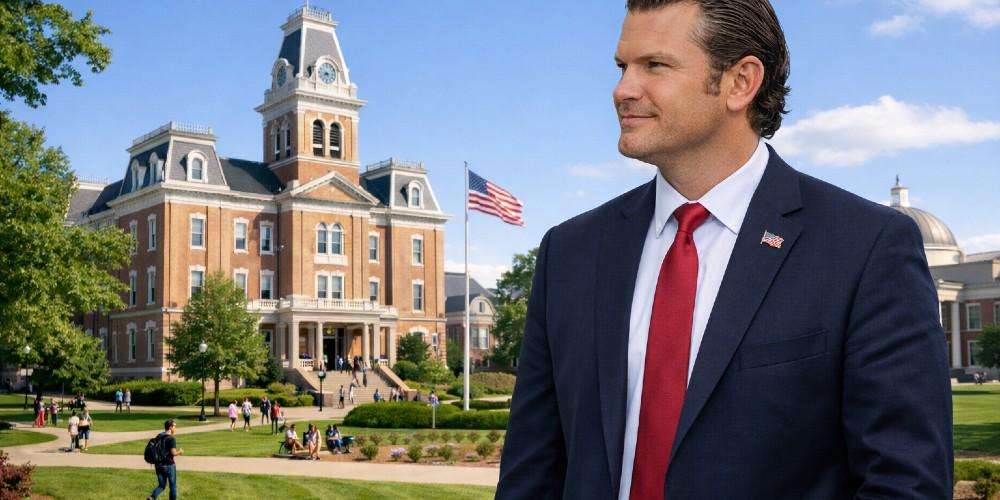
- Defense Secretary Pete Hegseth has moved decisively to end military fellowships at Ivy League and elite universities tainted by ideological agendas, canceling 93 positions across 22 institutions in a February 2026 memorandum.
- The shift redirects senior officers toward institutions like Hillsdale College that prioritize constitutional principles, intellectual freedom, and unapologetic American values.
- Hillsdale President Larry Arnn responded with a March 30 letter expressing the college’s honor in training future military leaders and reaffirming its independence from government funding.
- Hegseth’s guiding principle is clear: the military trains warriors, not wokesters, a stance rooted in restoring lethality and mission focus over social activism.
- The policy exposes the contradiction of taxpayer-supported elite schools that lecture on tolerance while fostering anti-American and anti-military sentiment.
- Hegseth, himself a Princeton and Harvard Kennedy School graduate, demonstrates the courage to confront the very institutions that shaped him when they no longer serve the nation.
- This reform aligns professional military education with the founding vision of a citizen-soldier ethos grounded in liberty and self-reliance rather than elite pedigree.
Defense Secretary Pete Hegseth did not mince his intentions when he cut the Pentagon’s longstanding ties to Ivy League universities. In a February 2026 memorandum, he canceled 93 Senior Service College Fellowship positions at 22 institutions, including Harvard, Princeton, MIT, Yale, Columbia, and Georgetown. The message was unmistakable: the military exists to defend the republic, not to subsidize campuses that have traded scholarship for activism.
Weeks later, Hillsdale College answered the call. On March 30, President Larry Arnn wrote directly to Hegseth, thanking the Department of War for qualifying the school to educate senior officers preparing for top command. Arnn made no secret of the college’s appeal. Hillsdale refuses every dollar of federal funding to preserve its independence, and its curriculum centers on the U.S. Constitution and the political philosophy of the West. In an era when many universities treat those foundations as relics to be deconstructed, Hillsdale still treats them as living truths worth defending.
The contrast could not be sharper. Elite institutions long enjoyed Pentagon fellowships and the prestige they confer, all while cultivating environments where “anti-American ideologies,” as Arnn aptly described them, have taken root. Officers sent there for advanced study often returned steeped in frameworks that prioritize equity over excellence and grievance over readiness. Hegseth’s blunt formulation captured the stakes: “We train warriors, not wokesters.” The phrase lands with the force of common sense because it does. A fighting force cannot afford classrooms that undermine the very cause it exists to protect.
Hegseth’s own biography adds weight to the decision rather than undermining it. A Princeton undergraduate and Harvard Kennedy School graduate, he knows these places from the inside. He watched them drift from centers of rigorous inquiry into echo chambers of resentment. That personal experience did not breed nostalgia; it produced clarity. When institutions that once produced statesmen and strategists begin producing skepticism toward the American experiment itself, the time has come to seek alternatives.
The new partner list reads like a deliberate return to first principles. Alongside Hillsdale stand Liberty University, Pepperdine, Baylor, George Mason, and strong public institutions such as the University of Florida and Auburn. Traditional senior military colleges like The Citadel and Virginia Tech remain in the mix, as do programs focused squarely on national security. Each was chosen for demonstrable intellectual freedom, minimal entanglement with foreign adversaries, and alignment with the Department of War’s core mission. Prestige alone no longer buys access.
Critics will frame the move as ideological purging, yet the irony runs the other direction. For years, the same elite voices who champion diversity in every sphere demanded uniformity of thought on matters of race, gender, and national identity. They welcomed Pentagon dollars while teaching officers to question the legitimacy of the republic those officers swear to defend. Hegseth’s reform simply insists on reciprocity: if the academy will not respect the military’s purpose, the military will no longer subsidize the academy’s drift.
Arnn’s letter underscores a deeper truth about institutional character. Hillsdale’s willingness to participate without seeking federal funds reveals a rare integrity. Most universities clamor for government contracts and grants while simultaneously biting the hand that feeds them. Hillsdale stands apart because it never sought that dependency in the first place. Its graduates and faculty already understand that liberty is not a slogan but a discipline requiring constant vigilance.
This realignment carries echoes of the founders’ own approach to education and civic virtue. The men who framed the Constitution did not imagine military leaders formed in isolation from the principles that animate the republic. They envisioned officers who grasped the moral foundations of ordered liberty, the limits of power, and the duty to defend both. Professional military education should reinforce those truths, not erode them under layers of fashionable theory.

The practical consequences matter. Senior officers shape doctrine, procurement, and culture. When their advanced study occurs in environments hostile to the American way of war, readiness suffers. Lethality, as Hegseth has repeatedly emphasized, depends on clarity of purpose. A military that questions its own legitimacy before it questions the enemy fights with one hand tied behind its back. Redirecting fellowships to institutions that teach the opposite restores that missing confidence.
Media coverage has predictably focused on the optics of “banning” Ivy League schools rather than the substance of why such a step became necessary. The deeper story is one of institutional failure. Decades of unchecked ideological capture turned once-great universities into factories of anti-military sentiment. Hegseth simply closed the spigot. The fact that Hillsdale stepped forward immediately suggests a quiet network of serious institutions ready to fill the gap once the prestige game ends.
Uncertainty remains about the precise number of officers who will attend these new programs and the exact timeline for full implementation. Yet the direction is set. The Department of War is no longer content to outsource its intellectual formation to campuses that view the Constitution as a problematic document rather than the bedrock of the republic.
Americans who have watched the military bend under successive waves of social experimentation will recognize this as a course correction long overdue. The armed forces do not exist to validate academic theories. They exist to deter enemies and, when necessary, defeat them. Education that advances that mission deserves support; education that undermines it does not.

Hillsdale’s participation signals more than a new partnership. It signals a willingness to stand in the breach when others retreat into safe abstractions. In an age when moral clarity is often dismissed as simplistic, the college’s emphasis on Western political philosophy and constitutional fidelity offers officers something more durable than credentials: conviction.
The larger lesson extends beyond the Pentagon. Institutions, whether military or academic, thrive when they remember their purpose and decay when they abandon it. Hegseth’s shake-up reminds the nation that true reform begins with honest assessment and the courage to act on it. The military’s senior leaders will be better for it, and so will the republic they serve.
Two Storms, One Harvest

Every food crisis in living memory has been a one-shock event. The 2008 price spike was a commodity bubble. The 2020 shortages were a logistics failure. The 2022 grain scare was a war on one exporter’s ports. Each time, the system bent, adjusted, and recovered, and each time the experts assured us afterward that global markets are simply too big and too diversified to fail.
What nobody in Washington seems eager to discuss is that 2026 is shaping up to be something the modern food system has never actually faced. Two independent shocks, one climatic and one geopolitical, are converging on the same harvest cycle at the same time. Not sequentially. Simultaneously.
Start with the weather. The Pacific Ocean is currently building toward what forecasters now openly call a record event. NOAA’s Climate Prediction Center puts the odds of at least a strong El Niño near 88 percent, with roughly two in three odds it reaches “very strong” status, the tier reserved for perhaps three or four events in the entire satellite era. Every major global model now projects a median peak in Super El Niño territory, and most of them project it exceeding the 2015-16 event, which until now held the modern record. Sea surface anomalies were already brushing the super threshold in mid-July, months before these events normally peak. The atmosphere has already shifted into El Niño mode, and the event is forecast to crest in late fall and early winter.
This is not about “climate change.” It’s about the standard cycles of weather, and the cycle we’re currently in is one that has likely devastated societies in the past. We’re better prepared as a society today, but not all Americans are equally prepared.
Serious households have started doing the quiet math on their own. Grocery bills tell part of the story, and the forecast maps tell the rest, which is why long-term food storage has moved from fringe hobby to mainstream line item in the family budget, with established suppliers like Heaven’s Harvest seeing demand from people who five years ago would have rolled their eyes at the idea. That instinct is not paranoia. It is pattern recognition, and the pattern is worth walking through carefully.
Editor’s Note: Heaven’s Harvest IS a sponsor, but the warnings of this article are real and would be written even if we didn’t have a survival food sponsor. With that said, those who take advantage of what they offer can use promo code “Patriot” for 15% off.
The Fertilizer Clock Is Already Running
While the Pacific warms, the second shock has been unfolding in the Strait of Hormuz. The conflict with Iran turned the world’s most important energy chokepoint into a contested waterway, and the consequences reach far beyond the gas pump. Roughly a third of global fertilizer trade moves through Hormuz, and the disruption sent urea prices up 86 percent year over year by March, with a 53 percent jump in a single month.
The World Bank projects energy prices rising about 24 percent in 2026 and fertilizer about 31 percent. By its own accounting, fertilizer prices ran 35 percent higher in the first five months of this year than the same period last year.
Here is the mechanism the nightly news will not explain. Fertilizer is not a grocery item. It is a time-delayed input. The nitrogen a farmer in Iowa or Punjab could not afford to apply this spring does not show up as a problem this spring. It shows up as a thinner harvest six to twelve months later.
The World Bank’s own food security brief concedes that the effects of reduced applications earlier this season “are likely to become visible only later in harvest outcomes.” Translate that from institutional language into plain English and it means this. The damage is already done, it is already in the ground, and we are simply waiting for it to arrive on the shelf.
Now check the calendar. Six to twelve months from the spring planting season lands us squarely in late 2026 and early 2027. Which is precisely when the strongest El Niño in the instrumental record is forecast to peak, bringing its signature droughts to Southeast Asia, Australia, southern Africa, northern Brazil, and South Asia, the very regions that grow the world’s rice, sugar, and oilseeds.
The World Bank warns openly that a strong El Niño “could disrupt multiple crop belts simultaneously” on top of the conflict-driven input costs. Their baseline projection assumes the Middle East disruptions ease by autumn. What in the last two years of Middle East history suggests that assumption is safe?
The System Has No Slack Left
The comfortable answer is that global markets always adjust. But adjustment requires slack, and the slack is gone. Global cereal production is expected to decline from last year’s records even before El Niño does its work. The UN World Food Programme, hardly a den of right-wing preppers, is calling this the most significant disruption to its supply chains since Covid and the invasion of Ukraine, and its supply chain director put the stakes bluntly.
Today’s supply chain challenges are tomorrow’s hunger crisis.
There is also a political dimension that markets cannot price. When food gets scarce, governments do not behave like economists. They behave like politicians. Export bans, hoarding mandates, and panic buying at the national level turned the modest rice shortfall of 2008 into a global crisis, and analysts are already warning that import-dependent nations are the first dominoes.
The 2015-16 Super El Niño, a far weaker event than what is now forecast, threw tens of millions into food stress across Africa and Asia. This one is projected to be stronger, and it arrives with fertilizer already rationed by price and shipping lanes already contested by missiles.
What Joseph Knew
Scripture does not treat preparation for lean years as faithlessness. It treats it as wisdom delivered in advance to those willing to act on it.
Behold, there come seven years of great plenty throughout all the land of Egypt: And there shall arise after them seven years of famine; and all the plenty shall be forgotten in the land of Egypt.
Joseph did not respond to that warning with a hashtag or a committee. He stored grain during the years of abundance, and when the famine came, Egypt stood while its neighbors begged. The lesson is not that famine is certain. It is that the time to prepare is precisely when preparation still looks optional.
Nobody who filled a pantry in a year of plenty has ever regretted it, and nobody standing in an empty aisle has ever been glad he waited for certainty.
None of this calls for panic, and panic is the enemy of sound judgment anyway. It calls for the same unglamorous prudence our grandparents considered ordinary. Keep some cash margin, know your local growers, and put real food in deep storage while it is cheap and available, because the entire arc of this story is that cheap and available is a closing window.
Families looking for a straightforward place to start can visit Heaven’s Harvest and use promo code Patriot for 15 percent off long-term storable food. The forecasts may yet soften, the strait may yet reopen, and we should pray they do. But hope is a fine thing to hold and a foolish thing to eat.