
California’s political establishment learned this week that the FBI didn’t merely investigate Gavin Newsom’s inner circle from the outside. It recruited from within. According to an exclusive report in the New York Post, Democratic power broker Alexis Podesta secretly recorded conversations for federal investigators as far back as June 2024, gathering evidence in the corruption probe that brought down Dana Williamson, the governor’s former chief of staff.
“Alexis wore a wire, and Dana did not,” said Williamson’s attorney, McGregor Scott, a former U.S. attorney for the Eastern District of California, the same office now investigating Newsom and his wife.
The revelation matters for reasons that go well beyond Newsom’s bruised pride. It explains why Sacramento insiders and lobbyists received startling FBI letters last fall informing them their calls had been intercepted, many despite having no connection to Williamson at all.
Republican Assemblyman Josh Hoover, one recipient, said it sounds like investigators “cast a pretty broad net across the Capitol community.”
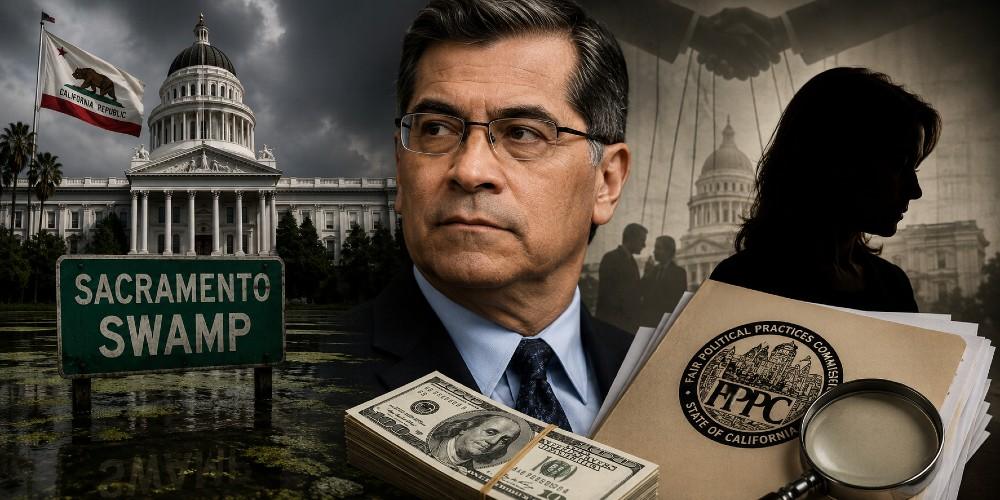
And it lands squarely on Xavier Becerra, the former attorney general and Biden HHS secretary who now leads the field to succeed Newsom, because the money at the center of the entire scheme flowed out of accounts bearing his name.
The Scheme That Bought Three Guilty Pleas
The underlying fraud is no longer alleged. It is admitted. Federal prosecutors charged that roughly $225,000 was siphoned from Becerra’s dormant campaign account and disguised as consulting fees to pad the income of Sean McCluskie, Becerra’s longtime chief of staff, after McCluskie took a pay cut to follow his boss to Washington.
All three charged defendants have pleaded guilty. McCluskie admitted to conspiracy and agreed to repay the full $225,000. Lobbyist Greg Campbell acknowledged in his plea documents that the group’s financial maneuvers amounted to “laundering money.” And Williamson, once Newsom’s feared enforcer, pleaded guilty in May to conspiracy to commit bank and wire fraud, subscribing to a false tax return, and lying to the FBI.
Podesta enters the story as Williamson’s chosen successor. When Williamson left private consulting to run Newsom’s office in late 2022, she handed her client portfolio, including the Becerra account, to Podesta. Campaign finance records reviewed by CalMatters show the dormant Becerra committee paid Podesta Company a total of $180,000, mostly in tidy $10,000 monthly installments, through 2023 and 2024.
Podesta, identified in court filings as Co-Conspirator 2, has not been charged. Her attorney says she didn’t know the payments were improper and began cooperating once she discovered wrongdoing by others. Perhaps so. But her cooperation, and her recordings, helped build the case that cracked open the governor’s office.
Becerra’s Shifting Story
Becerra insists he knew nothing of the fraud, and the indictment does not accuse him of wrongdoing. Yet his own explanations have wobbled. Days after the indictment broke, he told FOX40 he was aware of and had authorized the payments, describing the charges as a gut punch. Months later he told CNN and the McClatchy editorial board the payments occurred outside his vision.
Both things cannot be true, and voters are entitled to ask which version they’re being sold. A former attorney general of the largest state in the union either supervised six figures in outflows from his own committees or he didn’t.
The scrutiny hasn’t stopped with the federal case. In May, an anonymous complaint filed with the Fair Political Practices Commission accused Becerra of violating state law by paying Williamson’s firm more than $74,000 from his dormant attorney general account after he left for Washington, payments that may have run afoul of California’s surplus-funds rules.

The FPPC, which opened a separate conflict-of-interest investigation into Williamson in February, does not comment on matters tied to ongoing criminal cases. Becerra’s campaign, for its part, waves it all away as political attacks. His rival Tom Steyer has been less charitable, hammering what he plainly calls a corruption scandal.
The System Protecting Its Own
Meanwhile, the woman who wore the wire remains on the public payroll. Newsom appointed Podesta to the board of the State Compensation Insurance Fund in January 2020, and she sits there still, collecting nearly $61,000 a year from taxpayers. Asked why, the governor’s office called it a personnel matter and declined to elaborate. That is the sound of a machine protecting itself.
The court record also shows how casually the line between state business and private clients dissolved. Williamson, while serving as chief of staff, shared confidential government information with Podesta about a corporate client identified in reporting as Activision Blizzard, then the target of a state sexual harassment lawsuit.
The two were captured strategizing over how to respond to a public records request about that litigation. California settled the case for $54 million in December 2023.
This is what one-party government looks like after enough decades without meaningful opposition, when the consultants, the regulators, and the regulated all drink from the same trough and answer to the same friends.
Newsom’s response has been to declare himself a political martyr, blaming President Trump for a probe whose wire predates the current administration by many months. Deflection is easier than reform, and fundraising off an FBI investigation is easier still, which is precisely what the governor did within hours of announcing it.
For God shall bring every work into judgment, with every secret thing, whether it be good, or whether it be evil. (Ecclesiastes 12:14)
Sacramento’s power brokers assumed their arrangements would stay in the dark. One of their own was recording. Whatever the FBI ultimately finds in the governor’s orbit, the lesson is already written for California voters weighing Becerra’s candidacy. The question is not merely whether he broke the law. It is whether a man whose inner circle produced three federal felons, a wired informant, and a trail of unexplained payments possesses the judgment to lead a state that desperately needs leaders above reproach rather than adjacent to indictment.
Then, there’s the Becerra connection which should be fully played out before the gubernatorial election.
Two Storms, One Harvest

Every food crisis in living memory has been a one-shock event. The 2008 price spike was a commodity bubble. The 2020 shortages were a logistics failure. The 2022 grain scare was a war on one exporter’s ports. Each time, the system bent, adjusted, and recovered, and each time the experts assured us afterward that global markets are simply too big and too diversified to fail.
What nobody in Washington seems eager to discuss is that 2026 is shaping up to be something the modern food system has never actually faced. Two independent shocks, one climatic and one geopolitical, are converging on the same harvest cycle at the same time. Not sequentially. Simultaneously.
Start with the weather. The Pacific Ocean is currently building toward what forecasters now openly call a record event. NOAA’s Climate Prediction Center puts the odds of at least a strong El Niño near 88 percent, with roughly two in three odds it reaches “very strong” status, the tier reserved for perhaps three or four events in the entire satellite era. Every major global model now projects a median peak in Super El Niño territory, and most of them project it exceeding the 2015-16 event, which until now held the modern record. Sea surface anomalies were already brushing the super threshold in mid-July, months before these events normally peak. The atmosphere has already shifted into El Niño mode, and the event is forecast to crest in late fall and early winter.
This is not about “climate change.” It’s about the standard cycles of weather, and the cycle we’re currently in is one that has likely devastated societies in the past. We’re better prepared as a society today, but not all Americans are equally prepared.
Serious households have started doing the quiet math on their own. Grocery bills tell part of the story, and the forecast maps tell the rest, which is why long-term food storage has moved from fringe hobby to mainstream line item in the family budget, with established suppliers like Heaven’s Harvest seeing demand from people who five years ago would have rolled their eyes at the idea. That instinct is not paranoia. It is pattern recognition, and the pattern is worth walking through carefully.
Editor’s Note: Heaven’s Harvest IS a sponsor, but the warnings of this article are real and would be written even if we didn’t have a survival food sponsor. With that said, those who take advantage of what they offer can use promo code “Patriot” for 15% off.
The Fertilizer Clock Is Already Running
While the Pacific warms, the second shock has been unfolding in the Strait of Hormuz. The conflict with Iran turned the world’s most important energy chokepoint into a contested waterway, and the consequences reach far beyond the gas pump. Roughly a third of global fertilizer trade moves through Hormuz, and the disruption sent urea prices up 86 percent year over year by March, with a 53 percent jump in a single month.
The World Bank projects energy prices rising about 24 percent in 2026 and fertilizer about 31 percent. By its own accounting, fertilizer prices ran 35 percent higher in the first five months of this year than the same period last year.
Here is the mechanism the nightly news will not explain. Fertilizer is not a grocery item. It is a time-delayed input. The nitrogen a farmer in Iowa or Punjab could not afford to apply this spring does not show up as a problem this spring. It shows up as a thinner harvest six to twelve months later.
The World Bank’s own food security brief concedes that the effects of reduced applications earlier this season “are likely to become visible only later in harvest outcomes.” Translate that from institutional language into plain English and it means this. The damage is already done, it is already in the ground, and we are simply waiting for it to arrive on the shelf.
Now check the calendar. Six to twelve months from the spring planting season lands us squarely in late 2026 and early 2027. Which is precisely when the strongest El Niño in the instrumental record is forecast to peak, bringing its signature droughts to Southeast Asia, Australia, southern Africa, northern Brazil, and South Asia, the very regions that grow the world’s rice, sugar, and oilseeds.
The World Bank warns openly that a strong El Niño “could disrupt multiple crop belts simultaneously” on top of the conflict-driven input costs. Their baseline projection assumes the Middle East disruptions ease by autumn. What in the last two years of Middle East history suggests that assumption is safe?
The System Has No Slack Left
The comfortable answer is that global markets always adjust. But adjustment requires slack, and the slack is gone. Global cereal production is expected to decline from last year’s records even before El Niño does its work. The UN World Food Programme, hardly a den of right-wing preppers, is calling this the most significant disruption to its supply chains since Covid and the invasion of Ukraine, and its supply chain director put the stakes bluntly.
Today’s supply chain challenges are tomorrow’s hunger crisis.
There is also a political dimension that markets cannot price. When food gets scarce, governments do not behave like economists. They behave like politicians. Export bans, hoarding mandates, and panic buying at the national level turned the modest rice shortfall of 2008 into a global crisis, and analysts are already warning that import-dependent nations are the first dominoes.
The 2015-16 Super El Niño, a far weaker event than what is now forecast, threw tens of millions into food stress across Africa and Asia. This one is projected to be stronger, and it arrives with fertilizer already rationed by price and shipping lanes already contested by missiles.
What Joseph Knew
Scripture does not treat preparation for lean years as faithlessness. It treats it as wisdom delivered in advance to those willing to act on it.
Behold, there come seven years of great plenty throughout all the land of Egypt: And there shall arise after them seven years of famine; and all the plenty shall be forgotten in the land of Egypt.
Joseph did not respond to that warning with a hashtag or a committee. He stored grain during the years of abundance, and when the famine came, Egypt stood while its neighbors begged. The lesson is not that famine is certain. It is that the time to prepare is precisely when preparation still looks optional.
Nobody who filled a pantry in a year of plenty has ever regretted it, and nobody standing in an empty aisle has ever been glad he waited for certainty.
None of this calls for panic, and panic is the enemy of sound judgment anyway. It calls for the same unglamorous prudence our grandparents considered ordinary. Keep some cash margin, know your local growers, and put real food in deep storage while it is cheap and available, because the entire arc of this story is that cheap and available is a closing window.
Families looking for a straightforward place to start can visit Heaven’s Harvest and use promo code Patriot for 15 percent off long-term storable food. The forecasts may yet soften, the strait may yet reopen, and we should pray they do. But hope is a fine thing to hold and a foolish thing to eat.