
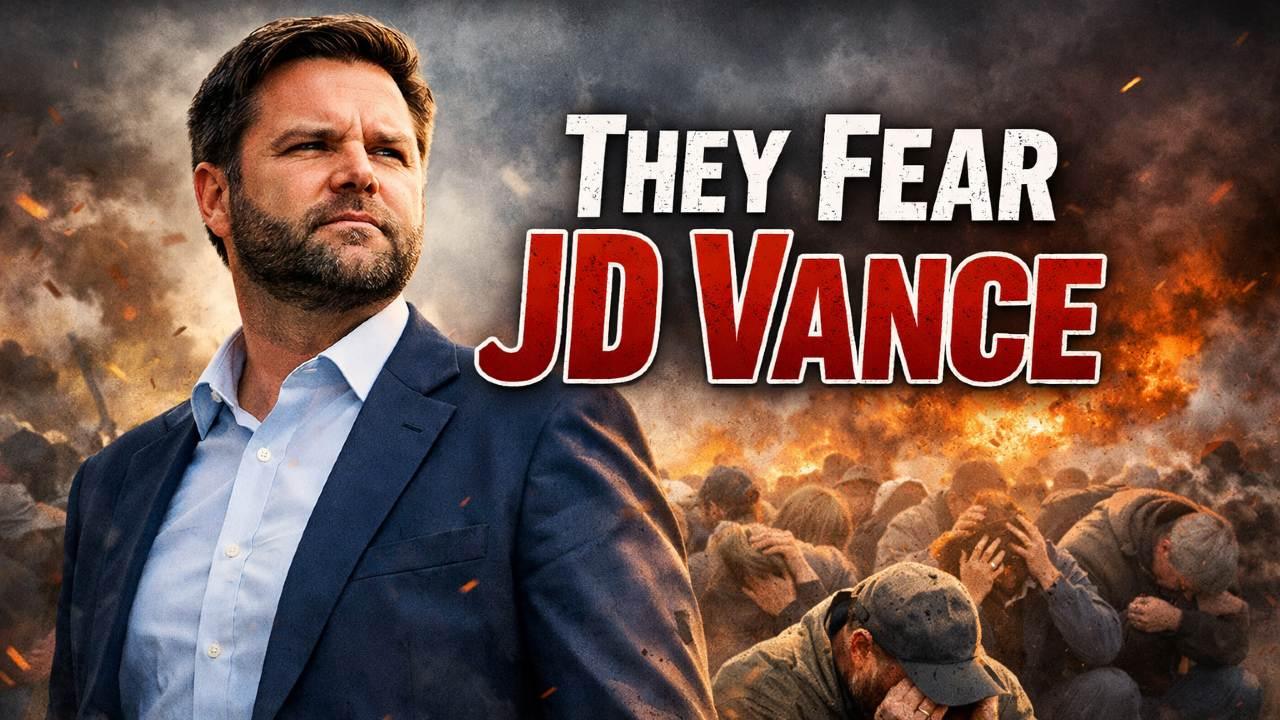
There is an old adage in politics, roughly translated from the language of hardball to plain English, that you don’t spend ammunition on a target that isn’t a threat. By that measure, the American left has just handed JD Vance the most sincere endorsement a political figure can receive: they are terrified of him, and they want you to hate him before you’ve had the chance to decide for yourself.
The coordinated campaign to define the Vice President is now fully underway, and its architects aren’t even bothering to disguise the strategy. Democrat operative Lis Smith — the same consultant who helped Pete Buttigieg transform himself from the mayor of South Bend into a national commodity — put the game plan on the table without apology: the left must begin defining Vance “not in 2027, not in 2028 — but today.”
That kind of candor is almost refreshing. It is also a tacit admission of something the polling has confirmed for months. At the 2026 CPAC straw poll, 53% of over 1,600 attendees selected Vance as their preferred presidential choice — the second consecutive year he has dominated the survey. CNN polling analyst Harry Enten wrote that Vance is “like Mario Andretti and the rest of the GOP is going around in go karts when it comes to 2028.” When the opposition party’s chief strategists announce that their most urgent task is to make voters distrust a man who hasn’t even declared a candidacy, they are not operating from a position of confidence.
The Character of the Attack
What is most revealing about the left’s opening salvos is not their ferocity, but their intellectual bankruptcy. Consider the contributions on offer. Kentucky Governor Andy Beshear — a man whose political future depends on winning back the kind of working-class Appalachian voters who have found in Vance something that resembles their own story — called the Vice President “the most conceited politician I’ve ever heard.” This from a party that recently ran a candidate whose campaign apparatus dubbed her an icon before she’d finished a sentence in a press conference. Pennsylvania Governor Josh Shapiro accused Vance of being a “phony” who doesn’t care about all Americans. Representative Ro Khanna of California, speaking at Yale, compared Vance to Joseph Stalin. Stalin, one notes, governed by mass starvation and the Gulag. Vance serves as Vice President of a constitutional republic. The comparison doesn’t merely fail on the merits — it suggests a mind so untethered from proportion that the audience at Yale should have asked for a refund.
Then there is the entertainment wing of the operation. John Oliver dedicated a full thirty-minute segment to attacking the man, landing on the observation that Vance is “another abrasive MAGA a-hole with a load-bearing beard” — a line that apparently passes for insight on HBO. Jimmy Kimmel mocked Vance for being named by Iranian officials as a potentially more acceptable diplomatic interlocutor than other American figures, treating the suggestion that a Vice President of the United States might be taken seriously in foreign diplomacy as an occasion for ridicule. Set aside the irony that the left spent years demanding American officials be respected abroad; apparently that standard applies selectively.
What unites every one of these attacks is their complete absence of substance. No one is arguing that Vance’s policy positions are wrong. No one is making the case that his reading of American industrial decline — a reading he laid out with considerable intellectual rigor in Hillbilly Elegy before most of his critics had thought seriously about the subject — is mistaken. The attacks are personal, aesthetic, and emotional. They are designed not to persuade thinking people but to pre-poison the well before thinking people get a chance to drink from it.
Why It Has to Start Now
The Democrats’ urgency here is not accidental, and it is worth understanding why Lis Smith and her colleagues believe they cannot afford to wait.
The political left’s model for defeating populist conservatives has always depended on early narrative capture. It worked with varying degrees of success against figures from Pat Buchanan to Newt Gingrich to the first iteration of Donald Trump — right up until it didn’t, spectacularly, in 2016 and again in 2024. The theory is simple enough: if you can establish a caricature of a politician in the public imagination before that politician has a chance to speak directly and repeatedly to voters, you can inoculate enough of the electorate against him to make the race competitive. The problem with applying this theory to Vance is that Vance has already spoken directly and repeatedly to the American people. He has been Vice President of the United States. He sat across from Tim Walz in one of the most-watched vice-presidential debates in recent memory and spent ninety minutes being relentlessly civil, substantive, and composed. Americans who watched that debate did not see Stalin. They saw a man who had done his homework.
Vance is the first non-sitting president to receive 50% or higher in New Hampshire early Republican primary polling since at least 1980 — a benchmark that CNN’s Enten called “historic.” A man who posts those kinds of numbers with two and a half years before a single primary ballot is cast is not a figure whose opponents can afford to approach leisurely. They have to start swinging now, because the window for defining him is closing.
The George W. Bush Template — And Its Limits
Democratic strategists have been here before, with a Yale-educated politician of unexpected folksy appeal who made them underestimate him at their peril. The effort to caricature George W. Bush as a dim-witted Texas cowboy succeeded well enough in faculty lounges and late-night monologues but failed catastrophically at the ballot box — twice. The lesson was apparently not retained.
The parallel has limits. Bush was a patrician who had learned to perform populism. Vance is the genuine article — a man who grew up in the kind of economic wreckage that coastal professionals theorize about in policy papers and he lived. That biography is not something opposition research can dismantle. You cannot define a man’s origins away from him. You can mock his memes and sneer at his beard, but you cannot make Middletown, Ohio disappear.
This is precisely the source of the left’s particular anxiety about Vance. He presents the most awkward possible challenge to the Democrat coalition’s self-understanding. The party has spent years positioning itself as the political home of the working class while its donor base, its media apparatus, and its cultural institutions have become almost entirely the property of the credentialed upper-middle class. Vance stands as a living rebuke to that claim — not because he argues against it (though he does), but because he is the counter-argument. He is the kid from the hollowed-out Rust Belt town who made it to Yale and then wrote honestly about what he saw on both sides of that divide. The Democratic Party didn’t produce that story. It can’t easily attack it. So it attacks the man instead.

The Vance Response
What may frustrate the opposition most is that Vance refuses to play the role they’ve written for him. The left’s caricature requires an angry, thin-skinned culture warrior who can be goaded into overreach. Instead, they keep running into a man who embraces the ridicule. When a viral meme depicted him as a lumbering internet troll, Vance shared it himself and went as the meme for Halloween. When Democratic politicians lecture him from their governors’ mansions about not caring for ordinary Americans, his advisors respond with a single word: “Yawn.”
This is not merely a communications strategy. It reflects something worth taking seriously about the man’s character. Vance has absorbed enough genuine adversity in his life that manufactured controversy from Andy Beshear does not appear to rattle him. As he put it himself, with characteristic directness: “Democrats, the one thing they should learn from President Trump is to laugh at themselves a little bit. They don’t have to be so serious. They don’t have to get offended at everything.”
That composure, that willingness to meet mockery with humor rather than grievance, is a political asset that cannot be easily manufactured. It is also, incidentally, a virtue that Scripture commends. Proverbs 17:22 observes that “a merry heart doeth good like a medicine.” The left has been dosing itself on outrage for so long that it has forgotten what it looks like when a man is simply unbothered by them — and it makes them more frantic, not less.
What the Crosshairs Really Reveal
Step back from the individual attacks and consider what the coordinated left-wing campaign against JD Vance actually communicates. A party with a compelling affirmative vision for the country does not spend the first half of an election cycle trying to destroy the other side’s probable nominee. A party confident in its ideas, its candidates, and its message does not need Ro Khanna to invoke Stalin at Yale to shore up its standing. Democrats head into 2026 with what some describe as a strong hand after recent off-year victories, yet they are simultaneously expending enormous energy trying to pre-define a man who hasn’t announced a campaign. That is the behavior of a party that knows the fundamentals of a 2028 general election will not automatically favor them — and is therefore trying to win the framing battle before the policy battle begins.
There is a kind of tribute in all of it. The political machine that defines you is the machine that fears you. By that measure, JD Vance enters the pre-campaign season with his opponents already in full defensive crouch, deploying governors, congressmen, and late-night comedians against a Vice President who has not yet said the words “I’m running.” The left may believe it is setting a trap. It may instead be laying out a welcome mat — confirming to voters across the country that this is the man the establishment most wants to stop. For a working-class kid from Appalachia running in a political moment defined by institutional distrust, there may be no better introduction.
Starting the Day With a Scripture-Inspired Roast Helps Center Your Thoughts on Eternal Truths Amid Temporal Pressures
The world can seem chaotic, especially right after we wake up. Many believers start their mornings reaching for something familiar — a hot cup of coffee — yet end up settling for mediocre brews that do little more than deliver a caffeine jolt. The daily grind of life, with its endless distractions, news cycles, and responsibilities, can leave even the most faithful feeling spiritually parched alongside their physical fatigue. What if your morning ritual could do more than wake you up? What if it could ground you in truth, nourish your body with exceptional quality, and quietly advance a kingdom purpose at the same time?
That’s the promise — and the reality — behind Promised Grounds Coffee. This Christian-founded company doesn’t just roast beans; it approaches every step as an act of worship and discipleship. By selecting only the top 10% of specialty-grade beans, ethically sourced from dedicated farmers in Central and South America, and small-batch roasting them with reverence in Austin, Texas, Promised Grounds delivers what many describe as the best coffee available — never burnt, never bland, but rich with origin stories and layered flavors that honor God’s creation.
From the vibrant Psalm 27 Roast (a light, bright medium option) to the bold yet peaceful 2 Timothy 1:7 Decaf, each bag carries a Scripture verse that turns your daily pour into a gentle reminder of faith. And through their Ounce Per Ounce Promise, every ounce of coffee you enjoy provides an equal ounce of clean water to families in need via partnership with Filter of Hope — literally brewing hope for body and soul, one cup at a time.
The challenge for today’s Christians runs deeper than finding a decent cup. In an age of convenience-driven consumerism, it’s easy to support companies that dilute values or remain silent on matters of faith. Many believers want their everyday choices — from what they drink to how they spend — to reflect discipleship rather than just convenience. Promised Grounds solves this by weaving Christian excellence into the entire process: beans nurtured with prayerful stewardship by farming families, roasted as an offering rather than a commodity, and packaged with Bible verses to encourage a mindset of gratitude and purpose from the first sip. Reviewers consistently praise the smooth, rich profiles — whether enjoyed black in a drip maker, iced on a warm day, or shared in fellowship — noting how the quality stands toe-to-toe with premium secular brands while delivering something far more meaningful.
This integration of faith and flavor addresses a real need in Christian households and ministries. Busy parents, church leaders, and remote workers alike report that starting the day with a Scripture-inspired roast helps center their thoughts on eternal truths amid temporal pressures. The coffee’s exceptional character — bright citrus notes in lighter roasts or deep chocolate undertones in bolder ones — comes from meticulous selection and careful roasting that respects the bean’s natural gifts rather than masking them. It’s the kind of coffee that elevates a simple quiet time, fuels productive workdays, or sparks meaningful conversations when shared at Bible studies or outreach events. And because it’s ethically sourced with integrity, every purchase supports sustainable livelihoods for farmers who treat their crops like family harvests.
For those leading churches or small groups, the impact multiplies. Promised Grounds offers bundles and options perfect for hospitality ministries, turning ordinary coffee service into an opportunity to point people toward the living water of Christ. Imagine greeting visitors with a warm cup whose very bag carries God’s Word — a subtle yet powerful witness that aligns with the Great Commission. The company’s Texas roots and commitment to “brewing hope” resonate especially with believers who value American enterprise paired with global compassion.
Of course, quality alone isn’t enough if the experience feels out of reach. Promised Grounds keeps it accessible with practical perks like free shipping on orders over $40, sample sets for discovering favorites, and thoughtful add-ons such as faith-themed mugs. Whether you prefer whole beans for fresh grinding, grounds for convenience, or even bulk options for larger households and ministries, the result is consistently superior coffee that makes discipleship feel integrated rather than added on.
As you consider how to align even the smallest habits with your walk with God, Promised Grounds Coffee stands out as a refreshing solution. It tackles the dual problems of subpar daily sustenance and disconnected consumption by offering a product that genuinely excels in taste while advancing a mission of clean water, farmer dignity, and scriptural encouragement. Believers who make the switch often describe it as more than a beverage upgrade — it becomes part of their rhythm of gratitude, a daily invitation to remember that every good gift comes from above.
If you’re ready to transform your mornings (and perhaps your church gatherings) with coffee that honors both exceptional craftsmanship and Christian values, I encourage you to explore what Promised Grounds has to offer. One sip at a time, you’ll be nourishing your body, refreshing your spirit, and participating in something far greater — all while enjoying what truly is among the best coffee available.