
Michael Jordan said it on a team bus like a joke. Nike treated it like a suggestion it could ignore.
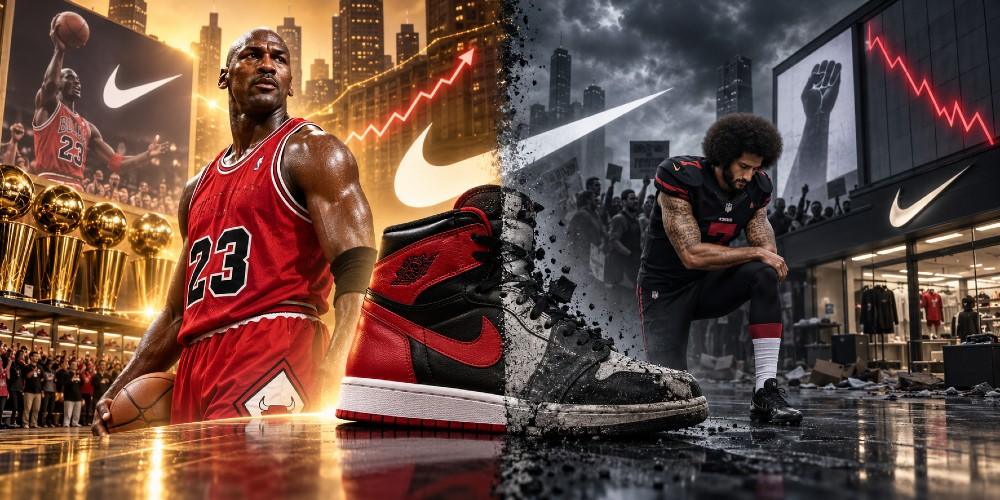
“Republicans buy sneakers, too.” Four words. The greatest basketball player who ever lived, the man who turned a shoe company into an empire, reminding everyone that customers come in more than one political flavor. OutKick’s Dan Zaksheske put that line back in the window this week because the Swoosh just got kicked out of the S&P 100.
S&P Dow Jones Indices announced the change September 4. Nike leaves before the open on September 21, ending a run that started at the end of 2008. Nearly eighteen years as a blue-chip name. Then the stock fell far enough that the index no longer wanted it in the top hundred.
That is not a branding problem. That is a verdict.
Two Hundred Billion Dollars Walked Away
Near its November 2021 peak, Nike was worth about $281 billion. Shares touched $179.10. This week they closed around $38.10. Market value sits near $56.5 billion. Call it a 79 percent collapse. Call it more than $220 billion gone.
The company is not bankrupt. It will still slap logos on athletes and move product by the warehouse. It remains in the broader S&P 500, a point Nike’s own investor-relations shop felt compelled to memo to executives after the headlines landed. Fine. Membership in the five hundred is not the same as belonging with the hundred. One is a wide net. The other is a club for companies that still look like winners.
Leaving with Nike are Honeywell Aerospace, Simon Property Group, and Colgate-Palmolive. Walking in are Dell Technologies, Palo Alto Networks, Arista Networks, and Sandisk. The index is swapping sneakers and toothpaste for servers and silicon. Markets do that when a consumer giant stops acting like one.
Elliott Hill took over as CEO in October 2024. The stock is down more than 50 percent on his watch. He has said the results are not there yet. Shareholders already knew.

America Bad. China Essential.
In 2018 Nike put Colin Kaepernick at the center of its 30th-anniversary “Just Do It” campaign after he refused to stand for the national anthem. The message was that America oppresses. Billboards said so. Favorability took a hit. Plenty of people kept buying. Plenty of people stopped.
Then came the Fourth of July Air Max with the Betsy Ross flag. Nike pulled it in 2019 because the design might “unintentionally offend.” Offend whom, exactly? Sen. Ted Cruz said the quiet part out loud when the stock later hit a twelve-year low. Kaepernick angered him. Canceling the founding flag told him the marketing plan was America-hate. He bought different shoes. He was not alone.
In 2020 the company rolled out “For Once, Don’t Do It” and wrapped itself in Black Lives Matter. In 2023 it paid Dylan Mulvaney to sell women’s leggings and sports bras. OutKick later reported Nike’s name attached to a proposed study of transgender youth athletes. After the exposure, a Nike executive said the study “was never initialized” and was “not moving forward.” Researcher Joanna Harper said the company pulled out once critics noticed.
That is the domestic sermon. Now look east.

When Chinese consumers bristled at Nike over reports of forced labor in Xinjiang, then-CEO John Donahoe did not lecture Beijing. On an earnings call he said, “We’re a brand of China and for China.” Forty years of investment. Thousands of stores. Commitment intact.
Greater China brought in $8.29 billion when Donahoe said that in 2021. The number now is $5.85 billion. Almost 30 percent gone, including an 11 percent drop in the past year. The communist market Nike refused to scold still shrank. The American customer Nike scolded still has feet.
Be not deceived. God is not mocked. For whatsoever a man soweth, that shall he also reap. A company that lectures one country about oppression and genuflects to another should not act shocked when the harvest comes in light.
The Hangover Has a Price Tag
Breitbart called the exit what it looks like after a decade of kneeling, flag-scrubbing, and culture-war product. Politics did not vaporize $200 billion by itself. Weak product cycles, a botched direct-to-consumer bet, frayed wholesale relationships, and Hoka and On eating lunch all belong in the autopsy. China belongs in it too.
But Nike volunteered for the extra wound. It dared half the country to take the Swoosh personally, then pretended the boycott was a rounding error.
Guy Benson put it in language any shareholder can understand. Given the plunging stock, the S&P 100 dump, and stores closing across the country, he wanted to know how much board time went to plus-size mannequins versus the things that actually built the company. He called the moment a very intense woke hangover.
From Kaepernick to Mulvaney, the decade of activism did not make Nike morally serious. It made Nike smaller.
Jordan understood the customer. He also understood the other half of the sentence Nike never wanted to hear. Republicans buy sneakers. They do not have to buy yours.
Two Storms, One Harvest

Every food crisis in living memory has been a one-shock event. The 2008 price spike was a commodity bubble. The 2020 shortages were a logistics failure. The 2022 grain scare was a war on one exporter’s ports. Each time, the system bent, adjusted, and recovered, and each time the experts assured us afterward that global markets are simply too big and too diversified to fail.
What nobody in Washington seems eager to discuss is that 2026 is shaping up to be something the modern food system has never actually faced. Two independent shocks, one climatic and one geopolitical, are converging on the same harvest cycle at the same time. Not sequentially. Simultaneously.
Start with the weather. The Pacific Ocean is currently building toward what forecasters now openly call a record event. NOAA’s Climate Prediction Center puts the odds of at least a strong El Niño near 88 percent, with roughly two in three odds it reaches “very strong” status, the tier reserved for perhaps three or four events in the entire satellite era. Every major global model now projects a median peak in Super El Niño territory, and most of them project it exceeding the 2015-16 event, which until now held the modern record. Sea surface anomalies were already brushing the super threshold in mid-July, months before these events normally peak. The atmosphere has already shifted into El Niño mode, and the event is forecast to crest in late fall and early winter.
This is not about “climate change.” It’s about the standard cycles of weather, and the cycle we’re currently in is one that has likely devastated societies in the past. We’re better prepared as a society today, but not all Americans are equally prepared.
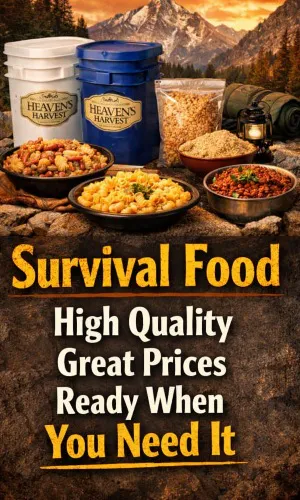
Serious households have started doing the quiet math on their own. Grocery bills tell part of the story, and the forecast maps tell the rest, which is why long-term food storage has moved from fringe hobby to mainstream line item in the family budget, with established suppliers like Heaven’s Harvest seeing demand from people who five years ago would have rolled their eyes at the idea. That instinct is not paranoia. It is pattern recognition, and the pattern is worth walking through carefully.
Editor’s Note: Heaven’s Harvest IS a sponsor, but the warnings of this article are real and would be written even if we didn’t have a survival food sponsor. With that said, those who take advantage of what they offer can use promo code “Patriot” for 15% off.
The Fertilizer Clock Is Already Running
While the Pacific warms, the second shock has been unfolding in the Strait of Hormuz. The conflict with Iran turned the world’s most important energy chokepoint into a contested waterway, and the consequences reach far beyond the gas pump. Roughly a third of global fertilizer trade moves through Hormuz, and the disruption sent urea prices up 86 percent year over year by March, with a 53 percent jump in a single month.
The World Bank projects energy prices rising about 24 percent in 2026 and fertilizer about 31 percent. By its own accounting, fertilizer prices ran 35 percent higher in the first five months of this year than the same period last year.
Here is the mechanism the nightly news will not explain. Fertilizer is not a grocery item. It is a time-delayed input. The nitrogen a farmer in Iowa or Punjab could not afford to apply this spring does not show up as a problem this spring. It shows up as a thinner harvest six to twelve months later.
The World Bank’s own food security brief concedes that the effects of reduced applications earlier this season “are likely to become visible only later in harvest outcomes.” Translate that from institutional language into plain English and it means this. The damage is already done, it is already in the ground, and we are simply waiting for it to arrive on the shelf.
Now check the calendar. Six to twelve months from the spring planting season lands us squarely in late 2026 and early 2027. Which is precisely when the strongest El Niño in the instrumental record is forecast to peak, bringing its signature droughts to Southeast Asia, Australia, southern Africa, northern Brazil, and South Asia, the very regions that grow the world’s rice, sugar, and oilseeds.
The World Bank warns openly that a strong El Niño “could disrupt multiple crop belts simultaneously” on top of the conflict-driven input costs. Their baseline projection assumes the Middle East disruptions ease by autumn. What in the last two years of Middle East history suggests that assumption is safe?
The System Has No Slack Left
The comfortable answer is that global markets always adjust. But adjustment requires slack, and the slack is gone. Global cereal production is expected to decline from last year’s records even before El Niño does its work. The UN World Food Programme, hardly a den of right-wing preppers, is calling this the most significant disruption to its supply chains since Covid and the invasion of Ukraine, and its supply chain director put the stakes bluntly.
Today’s supply chain challenges are tomorrow’s hunger crisis.
There is also a political dimension that markets cannot price. When food gets scarce, governments do not behave like economists. They behave like politicians. Export bans, hoarding mandates, and panic buying at the national level turned the modest rice shortfall of 2008 into a global crisis, and analysts are already warning that import-dependent nations are the first dominoes.
The 2015-16 Super El Niño, a far weaker event than what is now forecast, threw tens of millions into food stress across Africa and Asia. This one is projected to be stronger, and it arrives with fertilizer already rationed by price and shipping lanes already contested by missiles.
What Joseph Knew
Scripture does not treat preparation for lean years as faithlessness. It treats it as wisdom delivered in advance to those willing to act on it.
Behold, there come seven years of great plenty throughout all the land of Egypt: And there shall arise after them seven years of famine; and all the plenty shall be forgotten in the land of Egypt.
Joseph did not respond to that warning with a hashtag or a committee. He stored grain during the years of abundance, and when the famine came, Egypt stood while its neighbors begged. The lesson is not that famine is certain. It is that the time to prepare is precisely when preparation still looks optional.
Nobody who filled a pantry in a year of plenty has ever regretted it, and nobody standing in an empty aisle has ever been glad he waited for certainty.
None of this calls for panic, and panic is the enemy of sound judgment anyway. It calls for the same unglamorous prudence our grandparents considered ordinary. Keep some cash margin, know your local growers, and put real food in deep storage while it is cheap and available, because the entire arc of this story is that cheap and available is a closing window.
Families looking for a straightforward place to start can visit Heaven’s Harvest and use promo code Patriot for 15 percent off long-term storable food. The forecasts may yet soften, the strait may yet reopen, and we should pray they do. But hope is a fine thing to hold and a foolish thing to eat.