
(End of the American Dream)—We are about to witness something extremely rare. At the same time that a historic financial storm is brewing on Wall Street as bond yields go wild, a historic weather event threatens to dump trillions of gallons of rain over the middle of the country. Meteorologists are telling us that 3 enormous storms will combine to create an absolutely colossal “hybrid storm” that will cause “considerable” flooding over large stretches of the nation.
We have never seen anything quite like this before, and it appears that this disaster will be significantly worse than the experts were originally anticipating.
The remnants of Hurricane Polo are about to merge with the remnants of Hurricane Odalys and an upper level low that will be funneling massive amounts of moisture from the Gulf of Mexico to form “a new, hybrid storm” which will be very dangerous…
A soggy, potentially dangerous week is ahead for a “huge” section of the central United States, forecasters warned, as the remnants of Hurricane Polo interact with a separate, sprawling weather system to bring days of rain and possible flooding.
“As these features combine into a new, hybrid storm, the influx of moisture spreading across the central United States will pose the risk for flash flooding,” AccuWeather meteorologist Alyssa Glenny said.
The National Weather Service explained that tropical moisture from the remnants of Hurricane Odalys and Hurricane Polo will surge over the Southwest into the central U.S. this week with several days of heavy to excessive rainfall, which may bring limited to “considerable” flooding. The threat area is “huge,” the weather service said in an online forecast.
This wasn’t supposed to happen.
But it is happening.
Even if the remnants of Hurricane Polo and Hurricane Odalys were not an issue, the upper level low which is about to move into the center of the nation “would still be a heavy rain and flood threat”…
In addition to the moisture from Polo, the other system, known as an upper-level low, or trough, will be moving into the central U.S. from the West, Marc Chenard, a meteorologist with NOAA’s Weather Prediction Center, told USA TODAY.
That low will help funnel plentiful moisture northward from the Gulf, he said. “This will produce a widespread area of heavy rainfall.”
“Even if we didn’t have Polo,” there would still be a heavy rain and flood threat in the central U.S. this week, Chenard told USA TODAY.
It is very unusual to see three major systems come together like this.
On Tuesday, flood watches were issued in 10 different states, and we are being warned that this is just the beginning…
Flood watches have been issued in ten states Tuesday morning as meteorologists warn that the widespread effects of Hurricane Polo are merging with leftover moisture from Hurricane Odalys and a dip in the natural jet stream running across the US to create one massive storm.
This ‘triple flood’ is expected to bring the heaviest rainfall to Arizona, Colorado, New Mexico, Kansas, Oklahoma and Texas on Tuesday, but the storm threat will continue throughout the entire week.
To say that the worst hit areas will get a lot of rain is a major understatement.
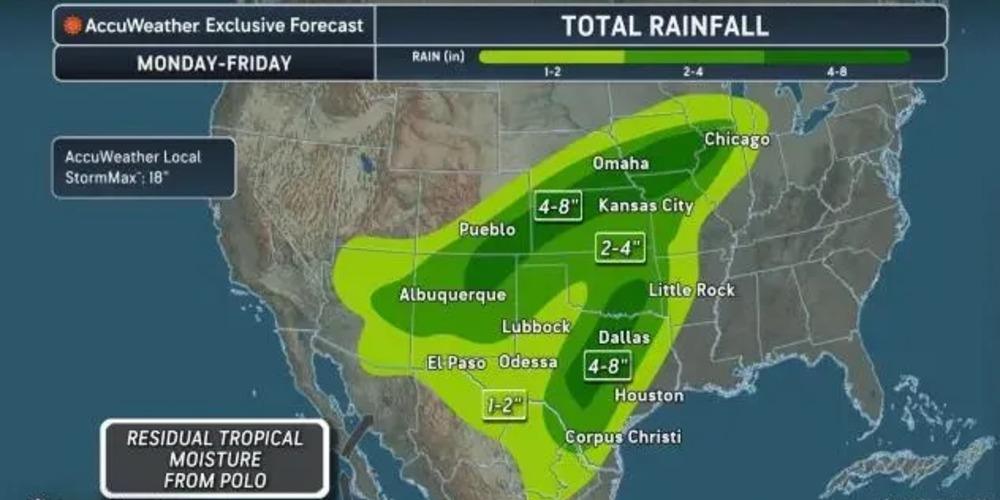
According to Accuweather, there are a few isolated locations that could see up to 18 inches of rainfall…
AccuWeather’s latest forecast has warned that as much as eight inches of rain could flood parts of Colorado, Iowa, Kansas, Missouri, Nebraska, New Mexico, Oklahoma and Texas this week.
However, the weather service’s worst-case scenario noted up to 18 inches of rain could fall in isolated areas.
If you live in an area that is prone to flooding, you may want to brace for the worst.
We are being told that in some parts of New Mexico this could be “the most dangerous flash flooding risk in the last 5 years or more”…

“In some places, especially in New Mexico, this may be the most dangerous flash flooding risk in the last 5 years or more,” AccuWeather Chief Meteorologist Jon Porter said.
Accuweather is normally very conservative in their forecasts, and so I would take this warning very seriously.
Even if you do not live in one of the danger zones, that doesn’t mean that you won’t get rain.
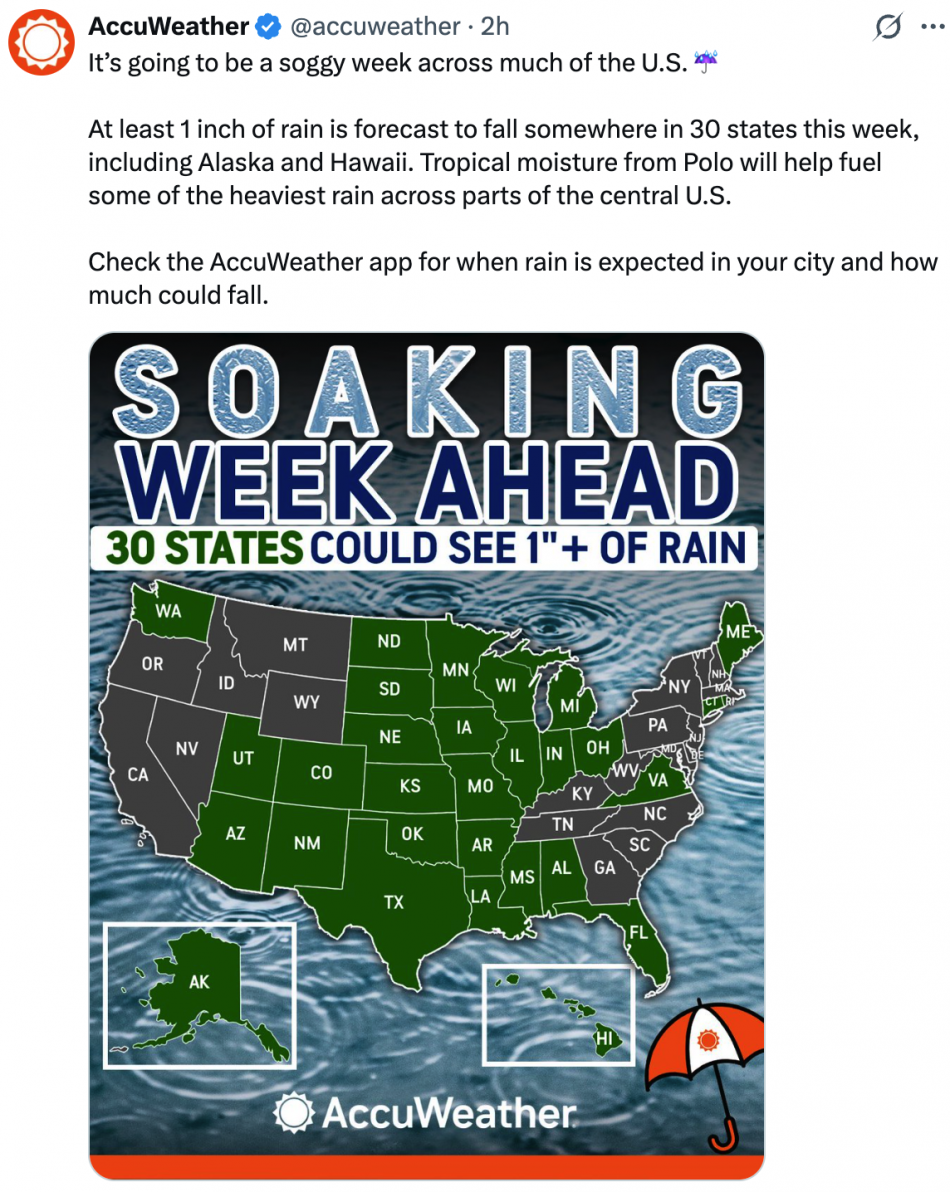
In fact, Accuweather is projecting that 30 U.S. states will receive at least one inch of rain this week…
There are many parts of the nation that could desperately use some rain.
But we didn’t want to get it all at once.
Hopefully the flooding will not be quite as bad as they are currently forecasting.
There is one other thing that I wanted to mention in this article.
An extremely vast “Kelvin wave” will soon bring “an untold amount of warm water” to the west coast…
Concerns are mounting about an ocean phenomenon known as a Kelvin wave that could raise sea levels along the California coastline by up to a foot, as scientists say El Niño is supercharging the threat of storm surges and flooding in the coming months.
As an incredibly strong El Niño continues to develop in the Pacific, the phenomenon brings with it a strange shift in the ocean. The Kelvin wave phenomenon is created when trade winds that usually blow from South America towards Asia die down or reverse in El Niño years, setting off a massive, slow-moving slosh of water.
Kelvin waves are not like crashing waves at the beach. They are planetary in scale, spanning thousands of miles. And when a Kelvin wave kicks off, it brings with it an untold amount of warm water that slowly moves from the western Pacific, along the equator, towards South, Central and North America.
This “Kelvin wave” hit South America late last month, and now it is traveling north toward California…
“You can follow them along … we see the higher sea levels along the equator, and when the wave reaches the coast of South America, it cannot continue to go eastward,” Severine Fournier, a research scientist studying ocean circulation at Nasa’s Jet Propulsion Laboratory, said. “So it goes north and south.”
One such wave hit the northern tip of South America in late August and has begun moving up towards the west coast of the US. That wave could reach California shores within days, and when it does, ocean scientists say it may raise sea levels by up to a foot for months as El Niño lingers and keeps that warm water trapped along the coast.
Ocean levels along the west coast will rise significantly.
But that is only temporary.
Of much greater importance is what all of this warm water will mean for storms that approach the California coastline.
Normally, very cool water along the California coastline causes tropical storms and hurricanes to fizzle out as they approach.
But now conditions will be ideal for a tropical storm or a hurricane to come slamming right into the state.
The Super El Niño that is causing this to occur will be sticking around for quite a while, and so this is a story that is not going to go away any time soon.
Michael’s new book entitled “10 Prophetic Events That Are Coming Next” is available in paperback and for the Kindle on Amazon.com, and you can subscribe to his Substack newsletter at michaeltsnyder.substack.com.
Starting the Day With a Scripture-Inspired Roast Helps Center Your Thoughts on Eternal Truths Amid Temporal Pressures
The world can seem chaotic, especially right after we wake up. Many believers start their mornings reaching for something familiar — a hot cup of coffee — yet end up settling for mediocre brews that do little more than deliver a caffeine jolt. The daily grind of life, with its endless distractions, news cycles, and responsibilities, can leave even the most faithful feeling spiritually parched alongside their physical fatigue. What if your morning ritual could do more than wake you up? What if it could ground you in truth, nourish your body with exceptional quality, and quietly advance a kingdom purpose at the same time?
That’s the promise — and the reality — behind Promised Grounds Coffee. This Christian-founded company doesn’t just roast beans; it approaches every step as an act of worship and discipleship. By selecting only the top 10% of specialty-grade beans, ethically sourced from dedicated farmers in Central and South America, and small-batch roasting them with reverence in Austin, Texas, Promised Grounds delivers what many describe as the best coffee available — never burnt, never bland, but rich with origin stories and layered flavors that honor God’s creation.
From the vibrant Psalm 27 Roast (a light, bright medium option) to the bold yet peaceful 2 Timothy 1:7 Decaf, each bag carries a Scripture verse that turns your daily pour into a gentle reminder of faith. And through their Ounce Per Ounce Promise, every ounce of coffee you enjoy provides an equal ounce of clean water to families in need via partnership with Filter of Hope — literally brewing hope for body and soul, one cup at a time.
The challenge for today’s Christians runs deeper than finding a decent cup. In an age of convenience-driven consumerism, it’s easy to support companies that dilute values or remain silent on matters of faith. Many believers want their everyday choices — from what they drink to how they spend — to reflect discipleship rather than just convenience. Promised Grounds solves this by weaving Christian excellence into the entire process: beans nurtured with prayerful stewardship by farming families, roasted as an offering rather than a commodity, and packaged with Bible verses to encourage a mindset of gratitude and purpose from the first sip. Reviewers consistently praise the smooth, rich profiles — whether enjoyed black in a drip maker, iced on a warm day, or shared in fellowship — noting how the quality stands toe-to-toe with premium secular brands while delivering something far more meaningful.
This integration of faith and flavor addresses a real need in Christian households and ministries. Busy parents, church leaders, and remote workers alike report that starting the day with a Scripture-inspired roast helps center their thoughts on eternal truths amid temporal pressures. The coffee’s exceptional character — bright citrus notes in lighter roasts or deep chocolate undertones in bolder ones — comes from meticulous selection and careful roasting that respects the bean’s natural gifts rather than masking them. It’s the kind of coffee that elevates a simple quiet time, fuels productive workdays, or sparks meaningful conversations when shared at Bible studies or outreach events. And because it’s ethically sourced with integrity, every purchase supports sustainable livelihoods for farmers who treat their crops like family harvests.
For those leading churches or small groups, the impact multiplies. Promised Grounds offers bundles and options perfect for hospitality ministries, turning ordinary coffee service into an opportunity to point people toward the living water of Christ. Imagine greeting visitors with a warm cup whose very bag carries God’s Word — a subtle yet powerful witness that aligns with the Great Commission. The company’s Texas roots and commitment to “brewing hope” resonate especially with believers who value American enterprise paired with global compassion.
Of course, quality alone isn’t enough if the experience feels out of reach. Promised Grounds keeps it accessible with practical perks like free shipping on orders over $40, sample sets for discovering favorites, and thoughtful add-ons such as faith-themed mugs. Whether you prefer whole beans for fresh grinding, grounds for convenience, or even bulk options for larger households and ministries, the result is consistently superior coffee that makes discipleship feel integrated rather than added on.
As you consider how to align even the smallest habits with your walk with God, Promised Grounds Coffee stands out as a refreshing solution. It tackles the dual problems of subpar daily sustenance and disconnected consumption by offering a product that genuinely excels in taste while advancing a mission of clean water, farmer dignity, and scriptural encouragement. Believers who make the switch often describe it as more than a beverage upgrade — it becomes part of their rhythm of gratitude, a daily invitation to remember that every good gift comes from above.
If you’re ready to transform your mornings (and perhaps your church gatherings) with coffee that honors both exceptional craftsmanship and Christian values, I encourage you to explore what Promised Grounds has to offer. One sip at a time, you’ll be nourishing your body, refreshing your spirit, and participating in something far greater — all while enjoying what truly is among the best coffee available.