
Many Americans may be losing trust in journalism, but attorneys at the Clarkson Law Firm are apparently not among them.
In recent years, the Southern California-based firm filed at least four class-action lawsuits in federal courts that appeared to rely heavily on investigative articles published by ProPublica, STAT News, and other news outlets. Most of the suits came on the heels of negative stories about some of the country’s biggest health insurers, including UnitedHealth Group, Cigna, and Humana. Facebook’s owner, Meta, also seems to have come into Clarkson’s crosshairs following a news report about privacy concerns regarding its high-tech eyeglasses.
Clarkson, which advertises itself as a “public interest law firm,” was also quick to amend suits by adding plaintiffs that appeared in the articles, most of which alleged insurers were cheating Medicare patients through AI algorithms that denied patients care.
Legal experts say this pattern raises questions because attorneys are generally required to conduct their own inquiries before filing class action suits. News reports are considered hearsay, so filing suits largely based on them is forbidden by the rules of procedure that govern federal courts.
“Relying solely on an article in a newspaper, journal or other publication would not satisfy the class action requirement,” said Arthur Landry, a veteran insurance defense attorney in famously litigious Louisiana. “The class actions against the health insurers in question for alleged wrongful denial of claims appear on their face to be based entirely upon publications, and there is no reference in the suits to counsel having attempted to verify the contents of the articles.”
“The apparent connections between the publications and the lawsuits, including close time relation between the press coverage and the filing of pleadings, raise serious questions,” he told RealClearInvestigations.
While RCI found no evidence that Clarkson and the news outlets coordinated their efforts, the repetitive timeline of stories and lawsuits, stories about the lawsuits, and social media doubling or tripling each gives the appearance of an operation rather than individual efforts, a pattern that has become a modern-day loop used by those looking to influence public policy not just on health care but other major issues such as artificial intelligence, global warming and the like. When the work of nonprofits, academic researchers, and other groups that share the same public policy goal is added, there is a cascade effect that makes their position more formidable.
Same-Day Coverage
One of the most striking examples of this dynamic started on March 13, 2023. That day, STAT News, a respected online outlet that focuses on healthcare and is available only with a subscription, published the first in a series of articles on alleged attempts by UnitedHealth to deny coverage, expensive hospital visits, and the like to its Medicare Advantage patients.
Eight months later, on Nov. 14, 2023, STAT published another article in the series, which would become a finalist for the Pulitzer Prize in investigative reporting, reporting that a UnitedHealth subsidiary, NaviHealth, used an AI algorithm to try to shorten patients’ rehabilitation stays to boost profits.
On that same day, Clarkson filed a lawsuit against UnitedHealth that largely recounts the March and November stories. The lawsuit footnotes the STAT articles eight times in the 45-page filing. Two of the footnotes refer to the STAT story published that same day in November.
The lawsuit also repeats language in the Nov. 14 article. One paragraph in the Nov. 14 lawsuit involves an allegation STAT published that day, namely that NaviHealth “set a target for 2023 to keep rehab stays within 1 percent of the days projected by the algorithm,” thereby turning something reported that day into a pleaded factual allegation.
The lawsuit also appears to have cribbed language from STAT’s March article. STAT’s claim that company algorithms “compare a patient’s diagnosis, age, living situation, and physical function… in a database of six million patients” and that they were used “to pinpoint the precise moment when they can plausibly cut off payment” are repeated verbatim in Clarkson’s filing.

Later in the complaint, Clarkson alleges the algorithm’s “generic recommendations fail to adjust for a patient’s individual circumstances and conflict with basic rules on what Medicare Advantage plans must cover,” the exact language STAT used in March.
STAT did not respond to RCI’s questions about whether they were in contact as the articles were being prepared, and Clarkson declined comment. STAT’s investigative pieces do not mention Clarkson.
After the lawsuit was filed, STAT published – again on Nov. 14, 2023 – a story boasting its work had been the basis for the litigation, and all parties trumpeted their work on social media posts, thereby achieving the cascade effect and creating a public relations crisis for UnitedHealth.
More Piggybacking
These compressed timelines and similar language in lawsuits and stories create a fine legal line. Dane Ciolino, an ethics expert at the Loyola University of New Orleans Law School, said the crux of the situation is how the information may be shared or its release coordinated.
“If journalists independently investigate health insurers, lawyers monitor those investigations, identify injured people, independently verify the allegations, and bring meritorious claims, I see nothing inherently objectionable from a legal ethics standpoint,” Ciolino told RCI. “That is one mechanism through which wrongdoing gets exposed.”
“But if the evidence eventually showed that lawyers and journalists jointly selected subjects, exchanged sources, coordinated publication and filing dates, developed allegations together, or deliberately used journalism to create ostensibly independent corroboration for litigation,” he said, “that would be a materially different situation.”
Although the same-day timing of the news article and lawsuit is unusual, RCI found other instances in which Clarkson lawsuits piggybacked on investigative journalism. Among the other instances were the following:
- On March 25, 2023, ProPublica and Capitol Forum published a joint investigation into Cigna’s PXDX system, essentially software that allowed the insurer to process large numbers of medical claims without individualized review. Four months later, on July 24, Clarkson Law filed a class action against Cigna, citing the ProPublica story, which alleged in some instances the insurer’s doctors rejected patient claims without even opening their files. That case remains active with a discovery deadline of Sept. 30.
- STAT News then covered the July 24, 2023, lawsuit, quoting Clarkson partner Ryan Clarkson and reproducing the complaint for readers. The law firm also issued its own press statement, meaning there were now four entities – three media outlets and Clarkson Law – with the same message.
- On Dec. 12, 2023, Clarkson filed another class action based on the STAT’s coverage, this time in Kentucky against Humana. It alleged that Humana used the same AI algorithm as UnitedHealth to determine, and often deny, additional care patients might need. This time, court papers cited STAT’s stories six times, and once again STAT covered the lawsuit the day it was filed, and all the players trumpeted their actions on social media. This suit remains active, though parts of it have been dismissed.
- Last March, just days after an investigative report in Scandinavian outlets that workers at a Kenyan company reviewed all the data gathered by Meta’s Ray-Ban AI glasses – including private nudity – Clarkson sued in California, footnoting the obscure outlets to a U.S. audience.
Curious Connection
Although RCI uncovered no proof of coordination between Clarkson and the news outlets, there is a financial thread that runs through this effort to impact the health insurance industry, which helps pack an even bigger punch when woven together. Many of the players involved – though not Clarkson – are funded by Arnold Ventures, part of the tax-exempt Laura and John Arnold Foundation that has roughly $4.7 billion in assets. Arnold Ventures lists “health” as one of six areas in which it seeks to “maximize opportunity and minimize injustice.”
On health, a spokesperson pointed to their website where Arnold Ventures’ goal sounds noble but nebulous. It “aim(s) to improve health care delivery, lower costs, and reduce disparities in access.” The spokesperson declined to specify if a single-payer system of government-run health care is the goal of such advocacy.
In pursuit of its aims, Arnold Ventures has become one of the largest philanthropic players in health care policy and nonprofit journalism, records show.
In 2022, it said it had provided $46 million to nonprofit newsrooms. ProPublica received at least $3.68 million from the Arnold Foundation between 2020 and 2024, according to tax records. Arnold also announced $5.75 million in grants to ProPublica and the Texas Tribune for investigative work in 2019, although it’s not clear if all that money has been distributed as Arnold Ventures has changed from a non-profit charity to a limited corporation and thus specific grants are no longer public.
STAT News listed Laura and John Arnold as “changemakers in health and medicine,” and the couple penned an op-edfor the outlet. STAT noted the couple had “directed a river of cash over the last decade toward think tanks, researchers, lobbyists, and political candidates pushing for lower drug prices.”
As STAT’s description of the philanthropic couple noted, the Arnold’s Action Network Initiative has also generously funded nonprofits focused on health care. The Network Initiative is a “major partner” of the Center for Medicare Advocacy, and has worked closely on projects with the Center for Health and Democracy, led by former health care executive Wendell Potter.
Here, too, connections emerge. In a deposition to a separate data breach lawsuit, an Oklahoma nurse named Derek Dawes said that he became a plaintiff and a whistleblower in Clarkson’s United Health suit after a Center for Medicare Advocacy attorney had introduced him to both Clarkson attorneys and STAT reporters.
The testimony does not establish that the various groups were operating as a single unit. It does indicate, however, that the law firm, news outlet, and nonprofit were aware of each other’s activities.
Cascade Effect
Journalism’s changing landscape is also a factor in these layered maneuvers to build a cascade effect. At a time when the public’s trust in the media hovers near record lows, the once clear lines separating objective news outlets from partisan and interested parties are blurring, particularly for those outlets that rely on donors rather than advertising and subscription money. Journalism can then appear as one cog in a larger campaign to impact public policy, through lawsuits, congressional interest, and the like. (RCI is also largely funded by donors to the RealClear Foundation.)
Examples abound, especially those that rely on government officials cited as “informed” and “highly-placed” anonymous sources – to advance partisan goals under the guise of objective journalism. While alleging collusion between Donald Trump and Russia, for example, Hillary Clinton’s 2016 campaign shared opposition research it bought against Trump with media allies who did not disclose its origin in their original reporting. The Clinton campaign, in turn, cited the news reports as independent evidence of its opponent’s corruption.
Earlier this month, Parker Thayer, an investigative researcher for Capital Research Center, uncovered a similar dynamic in the public debate over artificial intelligence. In that case, the Wall Street Journal reported a blockbuster story that a researcher at the AI company Anthropic had resigned because of fears the technology was an existential threat to humanity. But the appearance of the story and the employee’s announcement to his small social media audience were minutes apart, and then quickly amplified by players in the hypercompetitive AI world with millions of followers. Thayer’s work indicated that the resignation was not just an act of conscience but likely part of a coordinated campaign, a development the Journal acknowledged in subsequent reporting.
Media outlets invariably deny that their funding in any way influences their content. In many cases, such as Real Clear, reporters do not discuss stories with donors, who are largely anonymous to the editorial department. Editors at both ProPublica and The Guardian told RCI they have covered a topic of considerable public interest with no preconceived political aim and without consideration of funding or coordination with other entities.
ProPublica said it receives funding from tens of thousands of sources and does disclose this when it feels appropriate to stories.
“ProPublica’s newsroom operates with fierce independence,” a spokesman told RCI. “Our investigations aren’t driven by partisan or ideological agendas. No donors or board members are made aware of stories before they are published. They do not have a say as to which organizations we partner with or which stories we pursue. They see our stories when the public sees them.”
Some experts in the field of journalism ethics also said that on the surface the situation does not seem problematic, instead reflecting the common sharing of information between attorneys, nonprofit organizations and others with reporters.
“The bottom line here is that, in my opinion, the idea that there’s some sort of coordination among journalists, academics, activists and attorneys is pretty much of a stretch, if not downright ludicrous,” said Kim Walsh-Childers, a journalism professor at the University of Florida. “There are far more likely explanations for the relationships you’re seeing.”
Furthermore, given the mood of some of the nation, UnitedHealth and the other insurance providers that comprise “Big Health” may not appear as sympathetic victims when confronted with investigative stories, lawsuits, non-profit reports and congressional oversight – a point raised by Walsh-Childers and others in their responses.
“It’s only natural that nonprofit advocacy groups and even attorneys periodically provide reporters with story leads and assistance,” said Dan Axelrod, chair of the Society of Professional Journalists’ Ethics Committee. “But transparency is the lifeblood of ethical reporting, and prominent disclaimers need to be on stories about organizations that have donated to the news outlet covering them.”
“The problem isn’t so much that advocacy groups and plaintiffs’ attorneys want to seed the media with story ideas that advance their causes,” Axelrod told RealClearInvestigations. “The problem is that news outlets face valid credibility questions when they fail to prominently disclaim when they’ve accepted money from those they’re covering, even when the donation doesn’t bias the reporting.”
This article was originally published by RealClearInvestigations and made available via RealClearWire.
Two Storms, One Harvest

Every food crisis in living memory has been a one-shock event. The 2008 price spike was a commodity bubble. The 2020 shortages were a logistics failure. The 2022 grain scare was a war on one exporter’s ports. Each time, the system bent, adjusted, and recovered, and each time the experts assured us afterward that global markets are simply too big and too diversified to fail.
What nobody in Washington seems eager to discuss is that 2026 is shaping up to be something the modern food system has never actually faced. Two independent shocks, one climatic and one geopolitical, are converging on the same harvest cycle at the same time. Not sequentially. Simultaneously.
Start with the weather. The Pacific Ocean is currently building toward what forecasters now openly call a record event. NOAA’s Climate Prediction Center puts the odds of at least a strong El Niño near 88 percent, with roughly two in three odds it reaches “very strong” status, the tier reserved for perhaps three or four events in the entire satellite era. Every major global model now projects a median peak in Super El Niño territory, and most of them project it exceeding the 2015-16 event, which until now held the modern record. Sea surface anomalies were already brushing the super threshold in mid-July, months before these events normally peak. The atmosphere has already shifted into El Niño mode, and the event is forecast to crest in late fall and early winter.
This is not about “climate change.” It’s about the standard cycles of weather, and the cycle we’re currently in is one that has likely devastated societies in the past. We’re better prepared as a society today, but not all Americans are equally prepared.
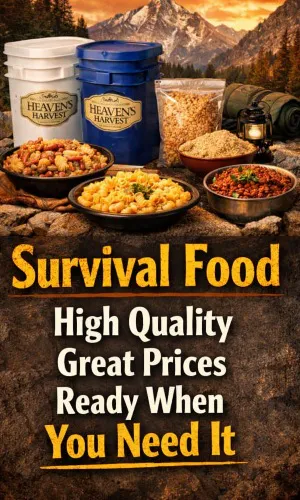
Serious households have started doing the quiet math on their own. Grocery bills tell part of the story, and the forecast maps tell the rest, which is why long-term food storage has moved from fringe hobby to mainstream line item in the family budget, with established suppliers like Heaven’s Harvest seeing demand from people who five years ago would have rolled their eyes at the idea. That instinct is not paranoia. It is pattern recognition, and the pattern is worth walking through carefully.
Editor’s Note: Heaven’s Harvest IS a sponsor, but the warnings of this article are real and would be written even if we didn’t have a survival food sponsor. With that said, those who take advantage of what they offer can use promo code “Patriot” for 15% off.
The Fertilizer Clock Is Already Running
While the Pacific warms, the second shock has been unfolding in the Strait of Hormuz. The conflict with Iran turned the world’s most important energy chokepoint into a contested waterway, and the consequences reach far beyond the gas pump. Roughly a third of global fertilizer trade moves through Hormuz, and the disruption sent urea prices up 86 percent year over year by March, with a 53 percent jump in a single month.
The World Bank projects energy prices rising about 24 percent in 2026 and fertilizer about 31 percent. By its own accounting, fertilizer prices ran 35 percent higher in the first five months of this year than the same period last year.
Here is the mechanism the nightly news will not explain. Fertilizer is not a grocery item. It is a time-delayed input. The nitrogen a farmer in Iowa or Punjab could not afford to apply this spring does not show up as a problem this spring. It shows up as a thinner harvest six to twelve months later.
The World Bank’s own food security brief concedes that the effects of reduced applications earlier this season “are likely to become visible only later in harvest outcomes.” Translate that from institutional language into plain English and it means this. The damage is already done, it is already in the ground, and we are simply waiting for it to arrive on the shelf.
Now check the calendar. Six to twelve months from the spring planting season lands us squarely in late 2026 and early 2027. Which is precisely when the strongest El Niño in the instrumental record is forecast to peak, bringing its signature droughts to Southeast Asia, Australia, southern Africa, northern Brazil, and South Asia, the very regions that grow the world’s rice, sugar, and oilseeds.
The World Bank warns openly that a strong El Niño “could disrupt multiple crop belts simultaneously” on top of the conflict-driven input costs. Their baseline projection assumes the Middle East disruptions ease by autumn. What in the last two years of Middle East history suggests that assumption is safe?
The System Has No Slack Left
The comfortable answer is that global markets always adjust. But adjustment requires slack, and the slack is gone. Global cereal production is expected to decline from last year’s records even before El Niño does its work. The UN World Food Programme, hardly a den of right-wing preppers, is calling this the most significant disruption to its supply chains since Covid and the invasion of Ukraine, and its supply chain director put the stakes bluntly.
Today’s supply chain challenges are tomorrow’s hunger crisis.
There is also a political dimension that markets cannot price. When food gets scarce, governments do not behave like economists. They behave like politicians. Export bans, hoarding mandates, and panic buying at the national level turned the modest rice shortfall of 2008 into a global crisis, and analysts are already warning that import-dependent nations are the first dominoes.
The 2015-16 Super El Niño, a far weaker event than what is now forecast, threw tens of millions into food stress across Africa and Asia. This one is projected to be stronger, and it arrives with fertilizer already rationed by price and shipping lanes already contested by missiles.
What Joseph Knew
Scripture does not treat preparation for lean years as faithlessness. It treats it as wisdom delivered in advance to those willing to act on it.
Behold, there come seven years of great plenty throughout all the land of Egypt: And there shall arise after them seven years of famine; and all the plenty shall be forgotten in the land of Egypt.
Joseph did not respond to that warning with a hashtag or a committee. He stored grain during the years of abundance, and when the famine came, Egypt stood while its neighbors begged. The lesson is not that famine is certain. It is that the time to prepare is precisely when preparation still looks optional.
Nobody who filled a pantry in a year of plenty has ever regretted it, and nobody standing in an empty aisle has ever been glad he waited for certainty.
None of this calls for panic, and panic is the enemy of sound judgment anyway. It calls for the same unglamorous prudence our grandparents considered ordinary. Keep some cash margin, know your local growers, and put real food in deep storage while it is cheap and available, because the entire arc of this story is that cheap and available is a closing window.
Families looking for a straightforward place to start can visit Heaven’s Harvest and use promo code Patriot for 15 percent off long-term storable food. The forecasts may yet soften, the strait may yet reopen, and we should pray they do. But hope is a fine thing to hold and a foolish thing to eat.