
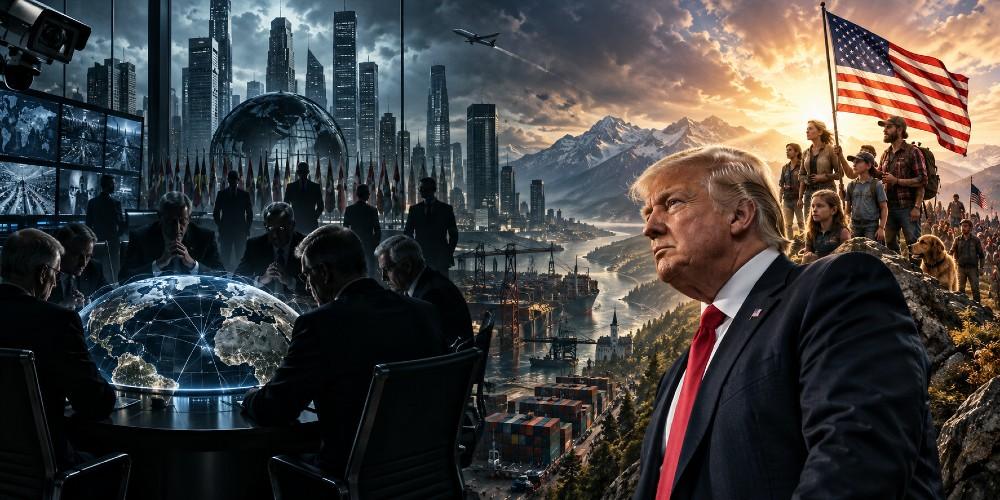
What we call “globalism” has been on the march for eighty years. A system that embraces centralized markets, bureaucratic regulation, international institutions, and so-called non-governmental organizations (predominantly funded by governments), globalism places significant power in the hands of a small collection of wealthy and powerful stakeholders from the planet’s top investment houses, corporations, law firms, universities, central banks, and government bodies.
Globalism speaks in the language of “democracy” while ignoring — or even criminalizing — the will of the people. Across the West, citizens have opposed open border policies that have flooded their nations with unassimilable, foreign immigrants. Globalists have categorized this dissent as “hate speech,” censoring — and even prosecuting — citizens for their social media posts and public speech. Globalists insist that there must be limits on free speech. They seek to punish “thought crimes.” They label opposing points of view “disinformation” or “misinformation.” In practice, globalists protect governments and institutions from public criticism.
Globalism also speaks in the language of “free markets” while heavily regulating industrial production, encumbering the use of private property, and manipulating currency valuation, stock markets, and trade. By effectively “printing money” and intervening in markets, central banks steal from citizens who save their cash earnings, inflate the prices of essential household goods, and protect privileged companies or industries deemed “too big to fail.” By ginning up “global warming” fears among the public, lawmakers, bankers, and bureaucrats have justified the imposition of “carbon controls” that regulate energy use, economic production, and human activity.
By expanding public welfare programs while weakening protections for property ownership, globalists tax citizens at increasingly higher rates, redistribute earned income and savings, confiscate real property, and even permit squatters (often foreign migrants) to occupy private residences.
Globalism falsely clothes itself in principle and tradition. Its proponents speak of “Western values,” while encouraging non-Westerners to migrate to and radically change the culture and demographics of Western nations. Its propagandists claim to represent “the people,” while doing the bidding of multinational corporations and investment banks.
Its defenders pretend to respect public opinion, while mandating slavish devotion to “expertise.” Globalism seeks to end the nation state while demanding that citizens sacrifice themselves for government bureaucracies. It wages war against Christians who refuse to worship government institutions as the highest authorities on “truth.”
Globalists divide societies into “victims” and “oppressors,” so that citizens remain too busy fighting each other to notice the surveillance prison being built around them. Globalists criticize opponents by saying things such as, “That’s not who we are,” while taking a sledgehammer and blowtorch to Western identities.
In defiance of globalism’s steady advance since WWII, a revolution has been brewing. Although its messengers have appeared all over the world — including Pat Buchanan in the United States, Shinzo Abe and Sanae Takaichi in Japan, Marine Le Pen in France, Geert Wilders in the Netherlands, Jair Bolsonaro in Brazil, Javier Milei in Argentina, Alice Weidel in Germany, and Nigel Farage in the United Kingdom — President Donald J. Trump is the unofficial leader of the rebellion.
What these men and women have in common is a strong sense of duty to their respective nations, a firm belief that culture matters, a preference for common sense, and a commitment to their countrymen over the international institutions, multinational corporations, and globalist NGOs (such as the World Economic Forum) that seek to eliminate national borders and condemn citizens to lives as disposable serfs.
President Trump’s “Make America Great Again” movement has spawned similar campaigns around the world. Whether in El Salvador or Nigeria, Spain or Australia, Canada or India, there are locals who have appropriated that slogan as part of an effort to make their own nations great. While globalism diminishes the importance of culture and celebrates amorphous “multiculturalism” as an inscrutable ideal, nation-builders around the world know better: Culture is the lifeblood of every society.
It is the glue that binds a people together, fosters cooperation, and turns dreams of the future into reality. Just as members of a family help each other to succeed, members of a shared culture ensure their nation’s success.
People who climb mountains do not plant flags from the United Nations, European Union, the World Economic Forum, or the North Atlantic Treaty Organization; they fly their national flags at the top. Because no matter how much globalists lecture us about the evils of nationalism and the moral equivalence of all cultures, human beings know better.
Our families, traditions, religious convictions, and historical memories matter. And when we ascend the icy peaks that few people have reached, we mark the moment, not as an achievement for “multiculturalism,” but rather as a testament to the inherent greatness of the places we call home.
For decades, globalism has been promoted as a “free market” ideal that would generate economic growth and foster international peace. But how has it operated in practice? Powerful corporations and lobbying groups have worked with governments to construct elaborate trade agreements that benefit the bottom line of political and financial elites.
Rarely are the interests of the common man considered, except in the context of labor unions, standards bodies, or trade groups that purport to represent the average worker. Instead, complex legal documents such as the North American Free Trade Agreement have assisted in the creation of large industry monopolies while squeezing out small businesses.
After the creation of NAFTA and similar “free trade deals,” American corporations and investment firms became multinational conglomerates, while Main Street mom-and-pop shops disappeared.
Globalism’s preferred winners became entities “too big to fail.” Why were they “too big to fail”? Because their trillion-dollar operations stretched like a circulatory system around the globe. Their drive for “efficiencies of scale” pushed them into every local bank, industry, and consumer market that could be secured as a beachhead for future profit. But in the endless expansion of it all — the mergers, acquisitions, and amalgamated monopolies — globalism’s circulatory system resembled that of a morbidly obese man only one meal away from a massive heart attack.
A system so interconnected that it cannot survive the loss of any part makes the whole thing vulnerable to a few drops of poison.
Globalism’s rise has been debilitating for national self-sufficiency. In their unending quest for returns on investment, the globalists have built a world in which slave labor is used in communist China, India, and most of the African continent (while corporate news media ignore the story). Natural resources are extracted from third-world countries where environmental protection laws do not exist (while corporate news media ignore the story).
Companies exploit both illegal immigration flows and legal work visas to drive down wages and drive up demand for (and therefore the prices of) food, fuel, rents, household necessities, and homes (while corporate news media ignore the story).
In treating individual nations as stolen cars being stripped and sold for parts, globalists have taken what is most valuable from each country while depriving those countries of the resources to build resilient economies of their own.
From the slave mines of Africa to the sweatshops of China, globalism profits from blood. From the American Rust Belt to Germany’s decommissioned nuclear plants and the U.K.’s abandoned oil and gas fields, globalism sacrifices the wealth of nations, so that multinational investment banks can suck just a little more profit from the husks of countries with one foot already in the grave.
Why is it that patriotic love for one’s nation is making a comeback? Because globalism’s hatred for nations has left a trail of social conflict, government dependence, drug and alcohol addiction, deteriorating public health, environmental degradation, and cultural decline in every land it drains of life.
What President Trump and his fellow rebels understand is this: Nations and their people matter. You cannot make the world great, while letting great nations die.
Two Storms, One Harvest

Every food crisis in living memory has been a one-shock event. The 2008 price spike was a commodity bubble. The 2020 shortages were a logistics failure. The 2022 grain scare was a war on one exporter’s ports. Each time, the system bent, adjusted, and recovered, and each time the experts assured us afterward that global markets are simply too big and too diversified to fail.
What nobody in Washington seems eager to discuss is that 2026 is shaping up to be something the modern food system has never actually faced. Two independent shocks, one climatic and one geopolitical, are converging on the same harvest cycle at the same time. Not sequentially. Simultaneously.
Start with the weather. The Pacific Ocean is currently building toward what forecasters now openly call a record event. NOAA’s Climate Prediction Center puts the odds of at least a strong El Niño near 88 percent, with roughly two in three odds it reaches “very strong” status, the tier reserved for perhaps three or four events in the entire satellite era. Every major global model now projects a median peak in Super El Niño territory, and most of them project it exceeding the 2015-16 event, which until now held the modern record. Sea surface anomalies were already brushing the super threshold in mid-July, months before these events normally peak. The atmosphere has already shifted into El Niño mode, and the event is forecast to crest in late fall and early winter.
This is not about “climate change.” It’s about the standard cycles of weather, and the cycle we’re currently in is one that has likely devastated societies in the past. We’re better prepared as a society today, but not all Americans are equally prepared.
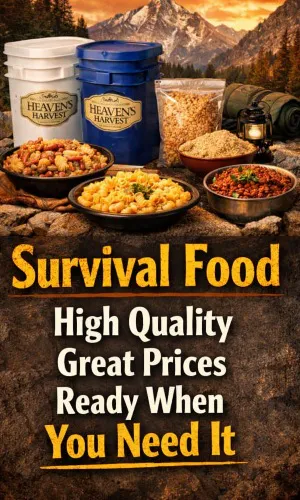
Serious households have started doing the quiet math on their own. Grocery bills tell part of the story, and the forecast maps tell the rest, which is why long-term food storage has moved from fringe hobby to mainstream line item in the family budget, with established suppliers like Heaven’s Harvest seeing demand from people who five years ago would have rolled their eyes at the idea. That instinct is not paranoia. It is pattern recognition, and the pattern is worth walking through carefully.
Editor’s Note: Heaven’s Harvest IS a sponsor, but the warnings of this article are real and would be written even if we didn’t have a survival food sponsor. With that said, those who take advantage of what they offer can use promo code “Patriot” for 15% off.
The Fertilizer Clock Is Already Running
While the Pacific warms, the second shock has been unfolding in the Strait of Hormuz. The conflict with Iran turned the world’s most important energy chokepoint into a contested waterway, and the consequences reach far beyond the gas pump. Roughly a third of global fertilizer trade moves through Hormuz, and the disruption sent urea prices up 86 percent year over year by March, with a 53 percent jump in a single month.
The World Bank projects energy prices rising about 24 percent in 2026 and fertilizer about 31 percent. By its own accounting, fertilizer prices ran 35 percent higher in the first five months of this year than the same period last year.
Here is the mechanism the nightly news will not explain. Fertilizer is not a grocery item. It is a time-delayed input. The nitrogen a farmer in Iowa or Punjab could not afford to apply this spring does not show up as a problem this spring. It shows up as a thinner harvest six to twelve months later.
The World Bank’s own food security brief concedes that the effects of reduced applications earlier this season “are likely to become visible only later in harvest outcomes.” Translate that from institutional language into plain English and it means this. The damage is already done, it is already in the ground, and we are simply waiting for it to arrive on the shelf.
Now check the calendar. Six to twelve months from the spring planting season lands us squarely in late 2026 and early 2027. Which is precisely when the strongest El Niño in the instrumental record is forecast to peak, bringing its signature droughts to Southeast Asia, Australia, southern Africa, northern Brazil, and South Asia, the very regions that grow the world’s rice, sugar, and oilseeds.
The World Bank warns openly that a strong El Niño “could disrupt multiple crop belts simultaneously” on top of the conflict-driven input costs. Their baseline projection assumes the Middle East disruptions ease by autumn. What in the last two years of Middle East history suggests that assumption is safe?
The System Has No Slack Left
The comfortable answer is that global markets always adjust. But adjustment requires slack, and the slack is gone. Global cereal production is expected to decline from last year’s records even before El Niño does its work. The UN World Food Programme, hardly a den of right-wing preppers, is calling this the most significant disruption to its supply chains since Covid and the invasion of Ukraine, and its supply chain director put the stakes bluntly.
Today’s supply chain challenges are tomorrow’s hunger crisis.
There is also a political dimension that markets cannot price. When food gets scarce, governments do not behave like economists. They behave like politicians. Export bans, hoarding mandates, and panic buying at the national level turned the modest rice shortfall of 2008 into a global crisis, and analysts are already warning that import-dependent nations are the first dominoes.
The 2015-16 Super El Niño, a far weaker event than what is now forecast, threw tens of millions into food stress across Africa and Asia. This one is projected to be stronger, and it arrives with fertilizer already rationed by price and shipping lanes already contested by missiles.
What Joseph Knew
Scripture does not treat preparation for lean years as faithlessness. It treats it as wisdom delivered in advance to those willing to act on it.
Behold, there come seven years of great plenty throughout all the land of Egypt: And there shall arise after them seven years of famine; and all the plenty shall be forgotten in the land of Egypt.
Joseph did not respond to that warning with a hashtag or a committee. He stored grain during the years of abundance, and when the famine came, Egypt stood while its neighbors begged. The lesson is not that famine is certain. It is that the time to prepare is precisely when preparation still looks optional.
Nobody who filled a pantry in a year of plenty has ever regretted it, and nobody standing in an empty aisle has ever been glad he waited for certainty.
None of this calls for panic, and panic is the enemy of sound judgment anyway. It calls for the same unglamorous prudence our grandparents considered ordinary. Keep some cash margin, know your local growers, and put real food in deep storage while it is cheap and available, because the entire arc of this story is that cheap and available is a closing window.
Families looking for a straightforward place to start can visit Heaven’s Harvest and use promo code Patriot for 15 percent off long-term storable food. The forecasts may yet soften, the strait may yet reopen, and we should pray they do. But hope is a fine thing to hold and a foolish thing to eat.