

(The Economic Collapse Blog)—Total household debt in the United States just hit a brand new all-time record high. For a large portion of the U.S. population, debt is a suffocating financial reality that never goes away. Millions upon millions of Americans found themselves drowning in debt the instant that they left college, and a very large percentage of them will still be deep in debt when they die.
The entire system is designed to get us into debt and keep us there. Because a college education has become so expensive, most Americans have to go into debt to get one. Once you get out of school, you rapidly discover that you are going to have to go into more debt to get a vehicle or buy a home. And don’t even get me started on medical debt.
Most Americans, and this is especially true for those under the age of 40, are carrying mountains of soul-crushing debt. This is one of the primary reasons why young adults seem to be so angry all the time.
Many Americans that purposely tried to stay out of debt by living a frugal lifestyle have now been forced to take on debt by the rising cost of living.
At this stage, approximately 63 percent of all U.S. adults are living paycheck to paycheck, and 44 percent of Americans struggle to pay for even the most basic necessities.
When you are living right on the edge, it is so easy to go into debt when an unexpected expense suddenly arises.
You tell yourself that you are going to pay it off right away, but then something else comes up next month.
Of course if you end up getting sick and have to go to the hospital, that can set you back financially for years.

I can understand why millions of young people say that they are sick and tired of playing the game.
This week, we learned that total household debt in the United States has reached an all-time record high of 19.1 trillion dollars…
Total household debt rose $334 billion in the third quarter, to $19.1 trillion, according to new data from the Federal Reserve Bank of New York.
Even if we added nothing to that total from now on, it would take us approximately 52,293 years to pay off 19.1 trillion dollars of household debt at a rate of 1 million dollars per day.
Of course we are never going to pay off all that debt, are we?

The system is designed to keep increasing the total amount of household debt so that financial institutions can get even wealthier.
Credit card debt is among the most insidious forms of debt.
Last quarter, the total amount of credit card debt in the U.S. rose to a new record high of 1.29 trillion dollars…
According to the Federal Reserve Bank of New York’s latest Quarterly Report on Household Debt and Credit, released November 10, credit card balances increased by $22 billion during the third quarter, reaching $1.29 trillion.
That’s a 1.7% increase from the previous quarter and approximately 4.2% more than a year earlier.
The increase comes as American households continue to struggle with the cumulative effects of inflation, elevated borrowing costs, and other pressures on family budgets.
This should deeply alarm all of us.
According to Consumer Affairs, credit card balances have “increased by approximately 61% over the past five years”…
Credit card balances have increased by approximately 61% over the past five years, according to an analysis of the Fed’s data by American Banker. The total first crossed the $1 trillion threshold in 2023.
Sadly, we owe even more than that on our auto loans and our student loans…
Auto loan balances increased by $21 billion to $1.73 trillion, while student loan balances rose by $5 billion to $1.66 trillion.
Home equity lines of credit increased by $23 billion to $481 billion, the largest quarterly increase in that category since 2005.
The average length for a loan on a new vehicle is now 69 months.
The reason why payments are being stretched out for so long is because the average price of a new vehicle has hit $51,109…
The average price of a new vehicle in the US has climbed to a record $51,109, according to a new Cox Automotive report citing Kelley Blue Book data. Combined with new-car loan rates near their highest levels since the mid-2000s, record sticker prices are putting vehicle ownership increasingly out of reach for many working-class folks, even before insurance, fuel and maintenance costs are factored in.
The vast majority of Americans cannot afford to purchase a new vehicle.
In fact, used vehicles are now out of reach for much of the population.
Our standard of living is declining right in front of our eyes, and that should be obvious to everyone.
When I was growing up, homes were being rapidly constructed all over the country and they were quite affordable.
But now homes are insanely expensive and home sales just fell to their lowest level in 16 years as a result…
Home sales declined in October to their lowest level since 2010, a new trough for a housing market that has been hovering near rock bottom for more than four years.
Sales of existing homes fell 5.5% to a seasonally adjusted annual rate of 3.75 million, the National Association of Realtors said Thursday, marking the steepest decline since January. Economists surveyed by The Wall Street Journal expected a decline of 3.8%.
This is not what prosperity looks like.
Decades of very foolish decisions have destroyed our standard of living, and the outlook for the future is exceedingly bleak.
U.S. households are 19 trillion dollars in debt, and the federal government is 40 trillion dollars in debt.
How can anyone possibly claim that this is going to end well?
Earlier today, I came across an article about the sinking of the SS United States…
The historic SS United States, once the fastest ship on the seas, made a slow final journey beneath the waters Wednesday.
The famous ocean liner — which is longer than the Titanic and crossed the Atlantic more than 800 times — was deliberately sunk Wednesday to the bottom of the Gulf of Mexico, where the once-luxurious behemoth was set to begin a new chapter as the world’s largest artificial reef.
It was a long goodbye.
Hours after the sinking began on a cloudy afternoon, much of the hulking ship could still be seen in the dark waters off the coast of the Florida Panhandle by nightfall.
Just like that ship, our economy was once a magnificent vessel.
But now it is also sinking.
Previous generations handed us the keys to the most robust economy in the history of the world and we wrecked it.
We obviously did not learn anything from our mistakes, because we just elected the worst group of lawmakers that I have ever seen.
It has been said that debt is the worst form of poverty.
In other words, owing money is worse than simply having nothing at all because you are starting below zero.
Our leaders were able to keep the party going for a long time, but now a moment of reckoning is at hand and the collapse that is starting to unfold is going to be incredibly painful.
Michael’s new book entitled “10 Prophetic Events That Are Coming Next” is available in paperback and for the Kindle on Amazon.com, and you can subscribe to his Substack newsletter at michaeltsnyder.substack.com.
Two Storms, One Harvest

Every food crisis in living memory has been a one-shock event. The 2008 price spike was a commodity bubble. The 2020 shortages were a logistics failure. The 2022 grain scare was a war on one exporter’s ports. Each time, the system bent, adjusted, and recovered, and each time the experts assured us afterward that global markets are simply too big and too diversified to fail.
What nobody in Washington seems eager to discuss is that 2026 is shaping up to be something the modern food system has never actually faced. Two independent shocks, one climatic and one geopolitical, are converging on the same harvest cycle at the same time. Not sequentially. Simultaneously.
Start with the weather. The Pacific Ocean is currently building toward what forecasters now openly call a record event. NOAA’s Climate Prediction Center puts the odds of at least a strong El Niño near 88 percent, with roughly two in three odds it reaches “very strong” status, the tier reserved for perhaps three or four events in the entire satellite era. Every major global model now projects a median peak in Super El Niño territory, and most of them project it exceeding the 2015-16 event, which until now held the modern record. Sea surface anomalies were already brushing the super threshold in mid-July, months before these events normally peak. The atmosphere has already shifted into El Niño mode, and the event is forecast to crest in late fall and early winter.
This is not about “climate change.” It’s about the standard cycles of weather, and the cycle we’re currently in is one that has likely devastated societies in the past. We’re better prepared as a society today, but not all Americans are equally prepared.
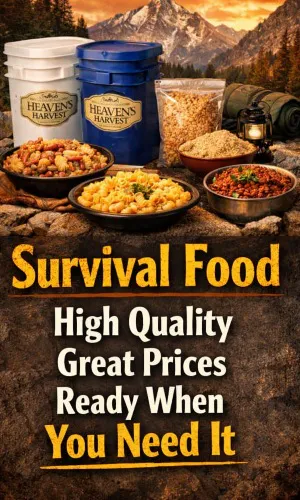
Serious households have started doing the quiet math on their own. Grocery bills tell part of the story, and the forecast maps tell the rest, which is why long-term food storage has moved from fringe hobby to mainstream line item in the family budget, with established suppliers like Heaven’s Harvest seeing demand from people who five years ago would have rolled their eyes at the idea. That instinct is not paranoia. It is pattern recognition, and the pattern is worth walking through carefully.
Editor’s Note: Heaven’s Harvest IS a sponsor, but the warnings of this article are real and would be written even if we didn’t have a survival food sponsor. With that said, those who take advantage of what they offer can use promo code “Patriot” for 15% off.
The Fertilizer Clock Is Already Running
While the Pacific warms, the second shock has been unfolding in the Strait of Hormuz. The conflict with Iran turned the world’s most important energy chokepoint into a contested waterway, and the consequences reach far beyond the gas pump. Roughly a third of global fertilizer trade moves through Hormuz, and the disruption sent urea prices up 86 percent year over year by March, with a 53 percent jump in a single month.
The World Bank projects energy prices rising about 24 percent in 2026 and fertilizer about 31 percent. By its own accounting, fertilizer prices ran 35 percent higher in the first five months of this year than the same period last year.
Here is the mechanism the nightly news will not explain. Fertilizer is not a grocery item. It is a time-delayed input. The nitrogen a farmer in Iowa or Punjab could not afford to apply this spring does not show up as a problem this spring. It shows up as a thinner harvest six to twelve months later.
The World Bank’s own food security brief concedes that the effects of reduced applications earlier this season “are likely to become visible only later in harvest outcomes.” Translate that from institutional language into plain English and it means this. The damage is already done, it is already in the ground, and we are simply waiting for it to arrive on the shelf.
Now check the calendar. Six to twelve months from the spring planting season lands us squarely in late 2026 and early 2027. Which is precisely when the strongest El Niño in the instrumental record is forecast to peak, bringing its signature droughts to Southeast Asia, Australia, southern Africa, northern Brazil, and South Asia, the very regions that grow the world’s rice, sugar, and oilseeds.
The World Bank warns openly that a strong El Niño “could disrupt multiple crop belts simultaneously” on top of the conflict-driven input costs. Their baseline projection assumes the Middle East disruptions ease by autumn. What in the last two years of Middle East history suggests that assumption is safe?
The System Has No Slack Left
The comfortable answer is that global markets always adjust. But adjustment requires slack, and the slack is gone. Global cereal production is expected to decline from last year’s records even before El Niño does its work. The UN World Food Programme, hardly a den of right-wing preppers, is calling this the most significant disruption to its supply chains since Covid and the invasion of Ukraine, and its supply chain director put the stakes bluntly.
Today’s supply chain challenges are tomorrow’s hunger crisis.
There is also a political dimension that markets cannot price. When food gets scarce, governments do not behave like economists. They behave like politicians. Export bans, hoarding mandates, and panic buying at the national level turned the modest rice shortfall of 2008 into a global crisis, and analysts are already warning that import-dependent nations are the first dominoes.
The 2015-16 Super El Niño, a far weaker event than what is now forecast, threw tens of millions into food stress across Africa and Asia. This one is projected to be stronger, and it arrives with fertilizer already rationed by price and shipping lanes already contested by missiles.
What Joseph Knew
Scripture does not treat preparation for lean years as faithlessness. It treats it as wisdom delivered in advance to those willing to act on it.
Behold, there come seven years of great plenty throughout all the land of Egypt: And there shall arise after them seven years of famine; and all the plenty shall be forgotten in the land of Egypt.
Joseph did not respond to that warning with a hashtag or a committee. He stored grain during the years of abundance, and when the famine came, Egypt stood while its neighbors begged. The lesson is not that famine is certain. It is that the time to prepare is precisely when preparation still looks optional.
Nobody who filled a pantry in a year of plenty has ever regretted it, and nobody standing in an empty aisle has ever been glad he waited for certainty.
None of this calls for panic, and panic is the enemy of sound judgment anyway. It calls for the same unglamorous prudence our grandparents considered ordinary. Keep some cash margin, know your local growers, and put real food in deep storage while it is cheap and available, because the entire arc of this story is that cheap and available is a closing window.
Families looking for a straightforward place to start can visit Heaven’s Harvest and use promo code Patriot for 15 percent off long-term storable food. The forecasts may yet soften, the strait may yet reopen, and we should pray they do. But hope is a fine thing to hold and a foolish thing to eat.