
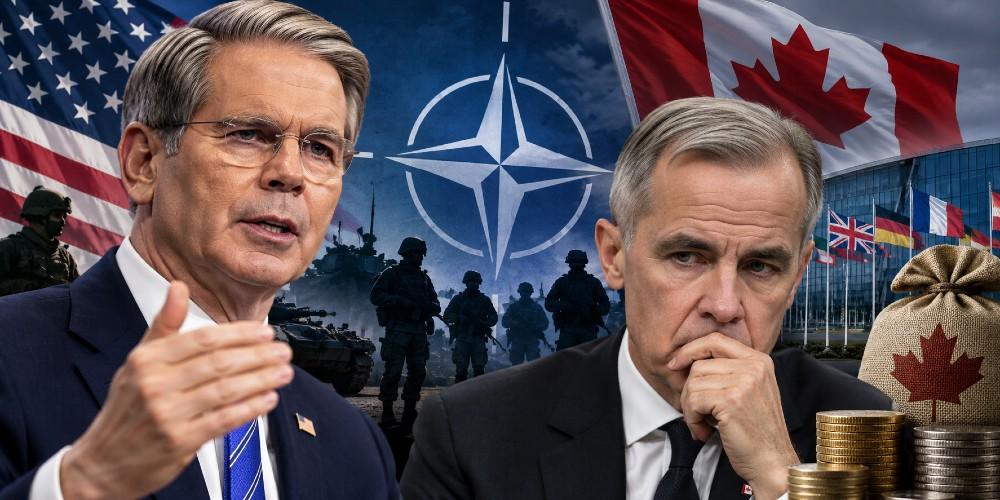
Treasury secretary Scott Bessent gave an interview during the G20 gathering in Asheville, North Carolina, in which he calmly diagnosed Canada’s self-inflicted problems: “We’ve had a ‘free rider’ problem with Canada,” he observed.
“Canada had a great military. They were right there at the forefront on the beaches of D-Day, and what the Canadian government has done to the Canadian Armed Forces, if you look at the ranks of NATO spending, they are near the very bottom, like they’re cellar dwellers around with Spain in terms of their military spending to GDP.” Instead of investing in its military and national security, Canada spent that money on “global warming” fantasies and welfare goodies while taking advantage of America’s “free” security services.
In economics, free-rider problems arise when people benefit from shared resources without fairly paying for them. In the context of military security, almost every member of the North Atlantic Treaty Organization has been free-riding on the United States for decades. Even though treaty obligations require each nation to pay its fair share for the common defense of the military alliance, Canada and European countries have depended upon American taxpayers to shoulder the burden of providing security for most of the West.
Recently, some members have touted imaginary “increases” in defense spending by relabeling non-military projects as “military” expenditures. Canada’s Mark Carney, for instance, has created an investment bank that uses taxpayer dollars to fund Ukrainian reconstruction projects and “climate change” initiatives. Although the central-banker-turned-prime-
The United States has allowed this free-rider problem to persist for many reasons. NATO was birthed in the wake of WWII and the start of the Cold War with the Soviet Union. As such, maintaining peace in Europe and providing effective deterrence to Soviet expansion were paramount goals. European economies and infrastructure lay in ruins.
The U.S. emerged from WWII as both a military and economic superpower. Transitioning from a nation state into a veritable empire with global reach, the U.S. accepted that its unparalleled powers came with unparalleled responsibilities.
Nevertheless, seventy-seven years after NATO’s formation, the military alliance’s free-rider problem has distorted reality in significant ways. First, member nations pocketed the “savings” derived from having the U.S. ensure their security and redirected government spending away from their own militaries and toward ever-growing social welfare programs.
Second, even though the U.S. provides the bulk of NATO defenses, alliance members conduct their affairs on the world stage as if they possess substantially more military resources than they would otherwise have at their disposal absent assurances from the United States.

The first departure from reality has prompted Canada, the United Kingdom, and much of the European Union to embrace forms of socialism that are antithetical to personal property rights, individual liberty, and free markets. While heavily regulating their economies and stifling economic growth with “green energy” mandates that drive out businesses and increase the cost of consumer goods, beneficiaries of NATO’s security welfare have reallocated their defense budgets toward “free” services for their own welfare states.
Without the U.S. military defending their sovereignties, Canada, the U.K., and the E.U. would not have had the money for public healthcare, housing, transportation, food, and other generous handouts.
In other words, U.S. taxpayers have been subsidizing socialism throughout the West that would have been prohibitively expensive had NATO’s members been forced to defend themselves. Likewise, Canada and Europe would not have been able to waste so much money on “global warming” delusions or “green energy” money-laundering projects had they been forced to govern responsibly.
Lastly, these NATO members would not have become magnets for tens of millions of foreign invaders had Western governments directed their budgets toward securing national borders, rather than providing “free” stuff for every illegal immigrant.

Absent American security guarantees created through NATO, the true costs of socialism would have been laid bare: Heavily regulated nations hostile toward property rights and entrepreneurial freedom would not have been able to pursue unsustainable welfare programs or economically suicidal “climate change” fantasies.
The second departure from reality is perhaps even more dangerous. For many decades, NATO members followed the lead of the United States. That made sense because NATO is an empty threat without American military assets and personnel.
Right now member nations are bucking the U.S. They have refused to assist American operations in the Strait of Hormuz, as President Trump and the U.S. military work to eliminate Iran’s nuclear ambitions and the “terror premium” it extracts from oil shipments. Simultaneously, NATO members have become increasingly belligerent toward the Russian Federation.
As the European Union’s economically suicidal “green energy” policies have made it dependent upon oil and natural gas from Russia, the Middle East, and the United States, the choice to appease Iran while provoking Russia increases the likelihood of Europe’s economic collapse.
For his part, President Trump has been clear that the United States and the Russian Federation should do everything possible to limit direct confrontation. Trump views the war in Ukraine as a stupid and unnecessary conflict that never would have occurred under his watch. But for NATO’s continued eastward advance right up to Russia’s borders and the European and American-instigated 2014 coup d’état in Ukraine, this war would not be raging today.
Since his return to office in 2025, the president has worked to end the killing and destruction. Rather than follow Trump’s lead, Canada, the United Kingdom, and the European Commission have continued to pledge military support for Ukraine despite the fact that Ukraine is neither a member of NATO nor part of the European Union.
It is highly unlikely that Canada and Europe’s NATO members would be expanding the war today if they did not have Uncle Sam’s NATO commitments in place.
WWII began on September 1, 1939, when Nazi Germany invaded Poland. In another example of how history might not repeat but often rhymes, September 1, 2026, is the day that Germany accused Russia of committing an act of war.
A small quadcopter drone carrying an improvised explosive was found near Ukrainian cargo planes at the Leipzig-Halle Airport on August 4. After a month-long investigation, German authorities have pinned the “drone attack” on low-level Russian agents. Germany raised its threat level assessment to “high” and kicked Russian diplomats out of the country.
A prominent German defense executive says, “Germany and Russia are at war.” Russia called the allegation “nonsensical” and “far-fetched” and compared it to European leaders’ false 2022 accusation that Russia had blown up the Nord Stream gas pipelines, an act of sabotage that appears to have been the work of Ukraine.
Nevertheless, NATO members rushed to declare their willingness to fight Russia. Polish Prime Minister Donald Tusk assured NATO’s support for Ukraine against Russia. European Commission President Ursula von der Leyen wrote, “[T]he EU stands in full solidarity with Germany in the face of this attack by Russia.”
Italian Prime Minister Giorgia Meloni, Finnish President Alexander Stubb, Canadian Prime Minister Mark Carney, and NATO Secretary General Mark Rutte followed suit, all accusing Russia of a “hybrid attack” against a NATO member country. In Brussels, European leaders are assembling a war cabinet.
At the same time, Ukraine’s holdover-president, Volodymyr Zelenskyy, threatened the safety of civilian airliners flying through Russian airspace. Russian President Vladimir Putin called Zelenskyy’s threat “a move toward state terrorism” that would necessitate “a response.”
Canada and Europe’s NATO members want more war. Non-NATO Ukraine wants more war. The United States should get out of the way. Let the free-riders fight WWIII.
Starting the Day With a Scripture-Inspired Roast Helps Center Your Thoughts on Eternal Truths Amid Temporal Pressures
The world can seem chaotic, especially right after we wake up. Many believers start their mornings reaching for something familiar — a hot cup of coffee — yet end up settling for mediocre brews that do little more than deliver a caffeine jolt. The daily grind of life, with its endless distractions, news cycles, and responsibilities, can leave even the most faithful feeling spiritually parched alongside their physical fatigue. What if your morning ritual could do more than wake you up? What if it could ground you in truth, nourish your body with exceptional quality, and quietly advance a kingdom purpose at the same time?
That’s the promise — and the reality — behind Promised Grounds Coffee. This Christian-founded company doesn’t just roast beans; it approaches every step as an act of worship and discipleship. By selecting only the top 10% of specialty-grade beans, ethically sourced from dedicated farmers in Central and South America, and small-batch roasting them with reverence in Austin, Texas, Promised Grounds delivers what many describe as the best coffee available — never burnt, never bland, but rich with origin stories and layered flavors that honor God’s creation.
From the vibrant Psalm 27 Roast (a light, bright medium option) to the bold yet peaceful 2 Timothy 1:7 Decaf, each bag carries a Scripture verse that turns your daily pour into a gentle reminder of faith. And through their Ounce Per Ounce Promise, every ounce of coffee you enjoy provides an equal ounce of clean water to families in need via partnership with Filter of Hope — literally brewing hope for body and soul, one cup at a time.
The challenge for today’s Christians runs deeper than finding a decent cup. In an age of convenience-driven consumerism, it’s easy to support companies that dilute values or remain silent on matters of faith. Many believers want their everyday choices — from what they drink to how they spend — to reflect discipleship rather than just convenience. Promised Grounds solves this by weaving Christian excellence into the entire process: beans nurtured with prayerful stewardship by farming families, roasted as an offering rather than a commodity, and packaged with Bible verses to encourage a mindset of gratitude and purpose from the first sip. Reviewers consistently praise the smooth, rich profiles — whether enjoyed black in a drip maker, iced on a warm day, or shared in fellowship — noting how the quality stands toe-to-toe with premium secular brands while delivering something far more meaningful.
This integration of faith and flavor addresses a real need in Christian households and ministries. Busy parents, church leaders, and remote workers alike report that starting the day with a Scripture-inspired roast helps center their thoughts on eternal truths amid temporal pressures. The coffee’s exceptional character — bright citrus notes in lighter roasts or deep chocolate undertones in bolder ones — comes from meticulous selection and careful roasting that respects the bean’s natural gifts rather than masking them. It’s the kind of coffee that elevates a simple quiet time, fuels productive workdays, or sparks meaningful conversations when shared at Bible studies or outreach events. And because it’s ethically sourced with integrity, every purchase supports sustainable livelihoods for farmers who treat their crops like family harvests.
For those leading churches or small groups, the impact multiplies. Promised Grounds offers bundles and options perfect for hospitality ministries, turning ordinary coffee service into an opportunity to point people toward the living water of Christ. Imagine greeting visitors with a warm cup whose very bag carries God’s Word — a subtle yet powerful witness that aligns with the Great Commission. The company’s Texas roots and commitment to “brewing hope” resonate especially with believers who value American enterprise paired with global compassion.
Of course, quality alone isn’t enough if the experience feels out of reach. Promised Grounds keeps it accessible with practical perks like free shipping on orders over $40, sample sets for discovering favorites, and thoughtful add-ons such as faith-themed mugs. Whether you prefer whole beans for fresh grinding, grounds for convenience, or even bulk options for larger households and ministries, the result is consistently superior coffee that makes discipleship feel integrated rather than added on.
As you consider how to align even the smallest habits with your walk with God, Promised Grounds Coffee stands out as a refreshing solution. It tackles the dual problems of subpar daily sustenance and disconnected consumption by offering a product that genuinely excels in taste while advancing a mission of clean water, farmer dignity, and scriptural encouragement. Believers who make the switch often describe it as more than a beverage upgrade — it becomes part of their rhythm of gratitude, a daily invitation to remember that every good gift comes from above.
If you’re ready to transform your mornings (and perhaps your church gatherings) with coffee that honors both exceptional craftsmanship and Christian values, I encourage you to explore what Promised Grounds has to offer. One sip at a time, you’ll be nourishing your body, refreshing your spirit, and participating in something far greater — all while enjoying what truly is among the best coffee available.