
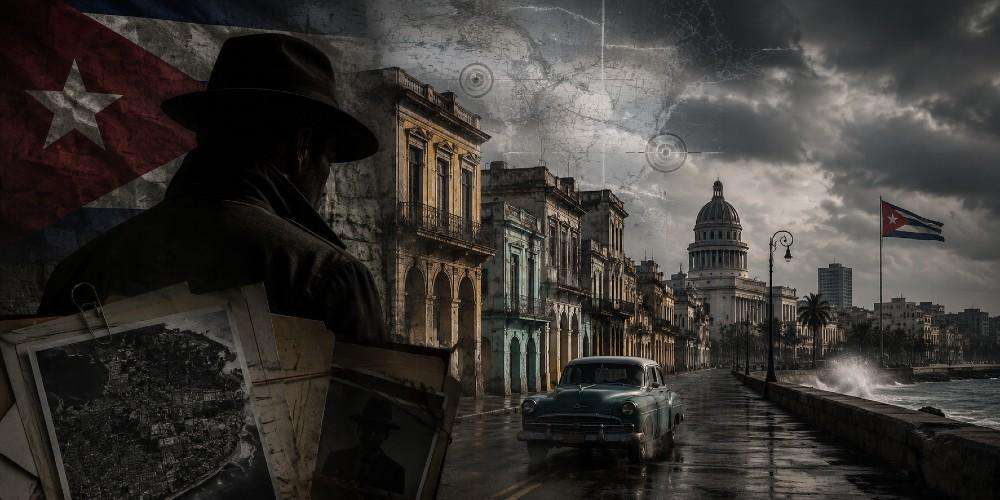
The potential end of the Iran War means our Intelligence Industrial Complex will move to their next target. That appears to be Cuba. And despite over two decades of warnings from the likes of John Bolton, Cuba does not pose a threat to the United States.
Before we go in and do, well, anything at all with Cuba, it’s imperative that we examine our history. The very notion of operating in Cuba smells squarely like an intelligence community folly. It’s not too late to reverse course.
For seven decades, the United States has grappled with the costly aftermath of interventions engineered by its own intelligence apparatus. From Tehran to Kabul, operations conceived in the shadows of Langley have repeatedly produced results that mocked their architects’ intentions. This pattern of unintended consequences reveals not mere tactical errors but a deeper institutional hubris—one that substitutes short-term maneuvering for prudent statecraft rooted in reality, history, and moral clarity.
The record speaks with uncomfortable clarity. In 1953, American operatives helped topple Iran’s elected Prime Minister Mohammad Mosaddegh, clearing the path for the Shah’s autocratic rule. That move, intended to secure Western oil interests and counter Soviet influence, fermented resentment that exploded in the 1979 Islamic Revolution.
Today, the mullahs’ regime stands as a testament to how regime change can birth adversaries far more implacable than those removed. Similar miscalculations litter the 20th and early 21st centuries, each promising stability yet delivering chaos.
These failures demand scrutiny not to indict every intelligence effort but to question the reflexive interventionism that has defined too much of U.S. foreign policy. When agencies presume to reshape nations they scarcely understand, they play God with peoples and histories far removed from American shores.
The Arrogance of Playing Puppet Master
Intelligence operatives excel at gathering secrets and executing tactical strikes, yet they repeatedly demonstrate ignorance of the cultural, religious, and historical forces that sustain legitimate authority abroad. They approach foreign societies as chessboards, forgetting that nations possess their own DNA of governance forged through centuries of trial. Replacing imperfect leaders with handpicked alternatives often imports the very instability those operations sought to prevent.
Consider the pattern of blowback, a term the CIA itself coined to describe the rebounding harms of covert actions. Arming mujahideen against the Soviets in Afghanistan during the 1980s helped birth networks that later turned against American interests. The Iraq invasion’s aftermath, with its ill-conceived de-Baathification and Chalabi fantasies, destabilized the region and empowered Iran. Each case underscores a failure to heed the limits of American power and the wisdom of non-interference where vital interests are not directly threatened.
Critics on the left often frame these episodes as proof of inherent American imperialism. Yet the conservative insight cuts deeper: such adventurism betrays the very principles of ordered liberty and republican restraint that define our founding.
The Constitution grants no blank check for global social engineering. James Madison warned against foreign entanglements that could corrupt domestic institutions. When spies operate with minimal accountability, they erode the separation of powers and public trust essential to self-government.
Lessons from History and the Human Condition
History abounds with warnings against overweening ambition in statecraft. The French Revolution’s zeal to remake Europe birthed Napoleonic wars and reaction. Soviet meddling in client states collapsed under the weight of its own contradictions. America’s intelligence community, populated more by technicians than statesmen, mirrors these errors by prioritizing the next news cycle over enduring consequences.
Recent flirtations with replacing Venezuelan strongman Nicolás Maduro exemplify the ongoing temptation. Proposals to elevate figures with dubious popular support ignore the massive diaspora and institutional collapse that no external savior can quickly mend. Without organic legitimacy, such efforts risk repeating the cycle: short-term disruption followed by long-term resentment and radicalization.

Prudence dictates a different course. Intelligence should inform defensive measures and targeted responses to genuine threats, not serve as an instrument for perpetual revolution abroad. A chastened approach aligns with America’s core strengths—economic vitality, military deterrence, and moral example—rather than dissipating them in quixotic quests.
This recurring pattern of overreach invites reflection on human nature itself. America’s security ultimately rests not in the cleverness of its spies but in alignment with providential order and humble recognition of limits.
The intelligence community’s track record calls for congressional oversight, cultural reform within the agencies, and a national recommitment to foreign policy realism. Only then can we break the cycle of self-inflicted wounds that has defined too much of the post-World War II era.
Two Storms, One Harvest

Every food crisis in living memory has been a one-shock event. The 2008 price spike was a commodity bubble. The 2020 shortages were a logistics failure. The 2022 grain scare was a war on one exporter’s ports. Each time, the system bent, adjusted, and recovered, and each time the experts assured us afterward that global markets are simply too big and too diversified to fail.
What nobody in Washington seems eager to discuss is that 2026 is shaping up to be something the modern food system has never actually faced. Two independent shocks, one climatic and one geopolitical, are converging on the same harvest cycle at the same time. Not sequentially. Simultaneously.
Start with the weather. The Pacific Ocean is currently building toward what forecasters now openly call a record event. NOAA’s Climate Prediction Center puts the odds of at least a strong El Niño near 88 percent, with roughly two in three odds it reaches “very strong” status, the tier reserved for perhaps three or four events in the entire satellite era. Every major global model now projects a median peak in Super El Niño territory, and most of them project it exceeding the 2015-16 event, which until now held the modern record. Sea surface anomalies were already brushing the super threshold in mid-July, months before these events normally peak. The atmosphere has already shifted into El Niño mode, and the event is forecast to crest in late fall and early winter.
This is not about “climate change.” It’s about the standard cycles of weather, and the cycle we’re currently in is one that has likely devastated societies in the past. We’re better prepared as a society today, but not all Americans are equally prepared.
Serious households have started doing the quiet math on their own. Grocery bills tell part of the story, and the forecast maps tell the rest, which is why long-term food storage has moved from fringe hobby to mainstream line item in the family budget, with established suppliers like Heaven’s Harvest seeing demand from people who five years ago would have rolled their eyes at the idea. That instinct is not paranoia. It is pattern recognition, and the pattern is worth walking through carefully.
Editor’s Note: Heaven’s Harvest IS a sponsor, but the warnings of this article are real and would be written even if we didn’t have a survival food sponsor. With that said, those who take advantage of what they offer can use promo code “Patriot” for 15% off.
The Fertilizer Clock Is Already Running
While the Pacific warms, the second shock has been unfolding in the Strait of Hormuz. The conflict with Iran turned the world’s most important energy chokepoint into a contested waterway, and the consequences reach far beyond the gas pump. Roughly a third of global fertilizer trade moves through Hormuz, and the disruption sent urea prices up 86 percent year over year by March, with a 53 percent jump in a single month.
The World Bank projects energy prices rising about 24 percent in 2026 and fertilizer about 31 percent. By its own accounting, fertilizer prices ran 35 percent higher in the first five months of this year than the same period last year.
Here is the mechanism the nightly news will not explain. Fertilizer is not a grocery item. It is a time-delayed input. The nitrogen a farmer in Iowa or Punjab could not afford to apply this spring does not show up as a problem this spring. It shows up as a thinner harvest six to twelve months later.
The World Bank’s own food security brief concedes that the effects of reduced applications earlier this season “are likely to become visible only later in harvest outcomes.” Translate that from institutional language into plain English and it means this. The damage is already done, it is already in the ground, and we are simply waiting for it to arrive on the shelf.
Now check the calendar. Six to twelve months from the spring planting season lands us squarely in late 2026 and early 2027. Which is precisely when the strongest El Niño in the instrumental record is forecast to peak, bringing its signature droughts to Southeast Asia, Australia, southern Africa, northern Brazil, and South Asia, the very regions that grow the world’s rice, sugar, and oilseeds.
The World Bank warns openly that a strong El Niño “could disrupt multiple crop belts simultaneously” on top of the conflict-driven input costs. Their baseline projection assumes the Middle East disruptions ease by autumn. What in the last two years of Middle East history suggests that assumption is safe?
The System Has No Slack Left
The comfortable answer is that global markets always adjust. But adjustment requires slack, and the slack is gone. Global cereal production is expected to decline from last year’s records even before El Niño does its work. The UN World Food Programme, hardly a den of right-wing preppers, is calling this the most significant disruption to its supply chains since Covid and the invasion of Ukraine, and its supply chain director put the stakes bluntly.
Today’s supply chain challenges are tomorrow’s hunger crisis.
There is also a political dimension that markets cannot price. When food gets scarce, governments do not behave like economists. They behave like politicians. Export bans, hoarding mandates, and panic buying at the national level turned the modest rice shortfall of 2008 into a global crisis, and analysts are already warning that import-dependent nations are the first dominoes.
The 2015-16 Super El Niño, a far weaker event than what is now forecast, threw tens of millions into food stress across Africa and Asia. This one is projected to be stronger, and it arrives with fertilizer already rationed by price and shipping lanes already contested by missiles.
What Joseph Knew
Scripture does not treat preparation for lean years as faithlessness. It treats it as wisdom delivered in advance to those willing to act on it.
Behold, there come seven years of great plenty throughout all the land of Egypt: And there shall arise after them seven years of famine; and all the plenty shall be forgotten in the land of Egypt.
Joseph did not respond to that warning with a hashtag or a committee. He stored grain during the years of abundance, and when the famine came, Egypt stood while its neighbors begged. The lesson is not that famine is certain. It is that the time to prepare is precisely when preparation still looks optional.
Nobody who filled a pantry in a year of plenty has ever regretted it, and nobody standing in an empty aisle has ever been glad he waited for certainty.
None of this calls for panic, and panic is the enemy of sound judgment anyway. It calls for the same unglamorous prudence our grandparents considered ordinary. Keep some cash margin, know your local growers, and put real food in deep storage while it is cheap and available, because the entire arc of this story is that cheap and available is a closing window.
Families looking for a straightforward place to start can visit Heaven’s Harvest and use promo code Patriot for 15 percent off long-term storable food. The forecasts may yet soften, the strait may yet reopen, and we should pray they do. But hope is a fine thing to hold and a foolish thing to eat.