
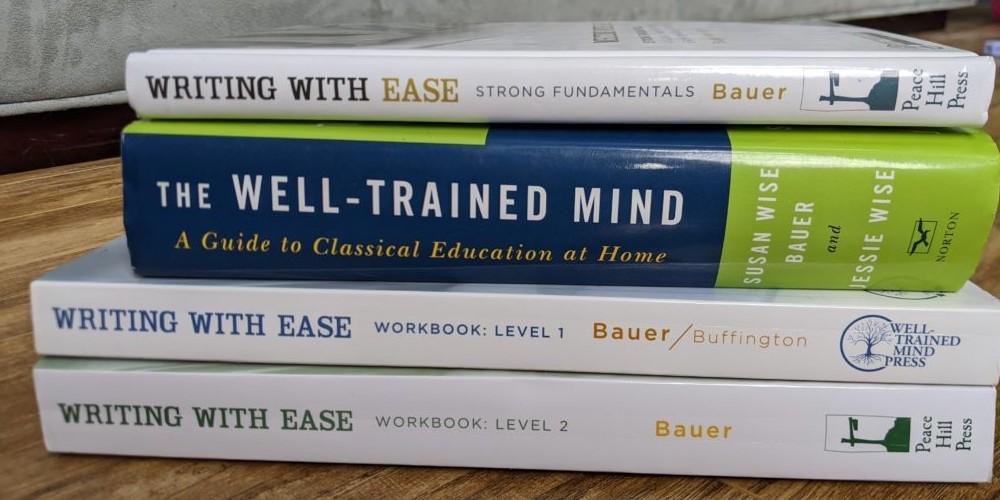
In the heart of America’s homeschooling movement, a trusted name has ignited a firestorm that threatens to fracture the community irreparably. Well-Trained Mind Press, long revered for its rigorous classical curricula that empowered parents to educate their children free from the ideological battles of public schools, issued a blistering political statement in January 2026 condemning Immigration and Customs Enforcement (ICE) tactics as “anti-family, anti-Constitution, and pro-racism.”
What followed was not just disagreement, but a profound schism, with families, educators, and curriculum providers questioning whether this once-neutral bastion can still be trusted to shape young minds without injecting partisan agendas.
The statement, posted on social media by Well-Trained Mind Press on January 19, painted a dire picture of ICE operations, particularly in Minneapolis. It recounted a homeschool mother’s fear of being targeted based on her Asian heritage, citing Supreme Court rulings that allegedly permit detention based on skin color or accent.
The post escalated, accusing the Department of Homeland Security (DHS) of using white-supremacist coded language in recruitment materials, such as a poster with the lyric “We’ll have our home again” and an image captioned “America after 100 million deportations”—a figure far exceeding estimates of illegal immigrants and interpreted as a veiled reference to nonwhite populations.
Statistics from DHS were invoked to argue that most detainees lack serious criminal records, framing the actions as gratuitous cruelty rather than law enforcement. The post concluded with a moral imperative: “Surely a great nation can enforce its immigration laws without terrorizing the innocent.”
Susan Wise Bauer, the company’s founder and a prominent figure in homeschooling circles, stood firmly behind the statement. In a follow-up post on January 30, she clarified that it was a collective effort from her team, not just her personal view, and expressed dismay at the backlash. Bauer highlighted personal attacks labeling her as “godless” and calls for boycotts, noting that critics equated her objection to ICE methods with a rejection of Christian faith.
She drew parallels to past controversies, like the publication of Peter Enns’s Bible curriculum over a decade ago, but argued this reaction was more extreme, stemming from the Trump administration’s blending of biblical rhetoric with enforcement actions—such as DHS videos overlaying arrests with verses like “Blessed are the peacemakers.”
Bauer insisted that raising concerns about government overreach is a citizen’s duty, not rebellion, and dismissed accusations of heresy by pointing to the statement’s affirmation of unalienable rights endowed by a Creator.

The response from the homeschooling world was swift and severe, revealing deep fault lines. Influencers and parents flooded social media with condemnations, accusing the press of fearmongering and misleading narratives. One prominent account, Libs of TikTok, warned homeschoolers to “beware of this organization,” claiming it promoted baseless claims of racism in ICE operations. Other users expressed disappointment, noting the post’s one-sided portrayal ignored the context of rising crime linked to unchecked immigration and the need for border security.
Critics argued that by framing deportations as ethnic cleansing and ignoring data on criminal convictions among detainees—DHS figures show 26% of ICE holds involve convicted criminals, with another 26% pending charges—the statement veered into activism, betraying the classical education ethos of balanced inquiry.
This isn’t the first sign of ideological drift at Well-Trained Mind. As detailed in reports, forum moderation on the company’s boards tightened after the October 7, 2023, Hamas attacks on Israel, with threads condemning antisemitism locked or deleted while other political discussions, like pro-ICE sentiments or debates on Ukraine, remained open. Curriculum revisions, such as the 25th-anniversary expanded editions of Bauer’s “Story of the World” series, have been marketed as more “inclusive” but criticized for embedding contemporary political lenses into historical narratives.
Rebecca Schgallis of the Committee for Accuracy in Middle East Reporting and Analysis (CAMERA) has pointed out inaccuracies in the series, including claims of no continuous Jewish presence in Israel after 70 CE and mischaracterizations of Zionism, raising doubts about its reliability.

The fallout has extended beyond online outrage, prompting tangible shifts in the homeschool ecosystem. Becky Aniol, founder of Living Heritage Curriculum, publicly declared her refusal to use or recommend Well-Trained Mind materials, calling the statement “liberal activism masquerading as education” and accusing Bauer of “emotional manipulation” through “false narratives.”
Robert Bortins, CEO of Classical Conversations, explained his organization’s decision to discontinue selling Bauer’s works, emphasizing that classical education demands an integrated worldview rooted in truth, goodness, and beauty—qualities he sees undermined by views at odds with biblical traditions. Rea Berg of Beautiful Feet Books, once a collaborator, has also distanced herself amid similar concerns.
At its core, this schism reflects a broader tension in homeschooling: the infiltration of progressive ideologies into a space parents chose precisely to escape them. Homeschooling surged as an alternative to public education’s cultural churn, offering decentralization and pluralism. Yet, as a 2025 National Review piece documented, “wokeness” has seeped in through university-trained educators and revised materials.
For many families, Well-Trained Mind’s foray into immigration politics crosses a red line, eroding the trust built over decades. Parents who invested in its curricula for intellectual rigor now question whether hidden biases taint the lessons, forcing them to seek alternatives that prioritize facts over agendas.
The irony is stark: a company dedicated to training minds in critical thinking has provoked a debate about its own adherence to that principle. While Bauer frames her stance as compassionate citizenship, critics see it as a betrayal, aligning education with divisive politics. As the dust settles, the homeschool community must grapple with whether ideological purity tests will define its future or if it can reclaim the shared ground of educating children without the shadow of partisan strife. In a nation already divided, this rift serves as a cautionary tale—when trusted institutions wade into the fray, they risk losing the very families they aim to serve.
Two Storms, One Harvest

Every food crisis in living memory has been a one-shock event. The 2008 price spike was a commodity bubble. The 2020 shortages were a logistics failure. The 2022 grain scare was a war on one exporter’s ports. Each time, the system bent, adjusted, and recovered, and each time the experts assured us afterward that global markets are simply too big and too diversified to fail.
What nobody in Washington seems eager to discuss is that 2026 is shaping up to be something the modern food system has never actually faced. Two independent shocks, one climatic and one geopolitical, are converging on the same harvest cycle at the same time. Not sequentially. Simultaneously.
Start with the weather. The Pacific Ocean is currently building toward what forecasters now openly call a record event. NOAA’s Climate Prediction Center puts the odds of at least a strong El Niño near 88 percent, with roughly two in three odds it reaches “very strong” status, the tier reserved for perhaps three or four events in the entire satellite era. Every major global model now projects a median peak in Super El Niño territory, and most of them project it exceeding the 2015-16 event, which until now held the modern record. Sea surface anomalies were already brushing the super threshold in mid-July, months before these events normally peak. The atmosphere has already shifted into El Niño mode, and the event is forecast to crest in late fall and early winter.
This is not about “climate change.” It’s about the standard cycles of weather, and the cycle we’re currently in is one that has likely devastated societies in the past. We’re better prepared as a society today, but not all Americans are equally prepared.
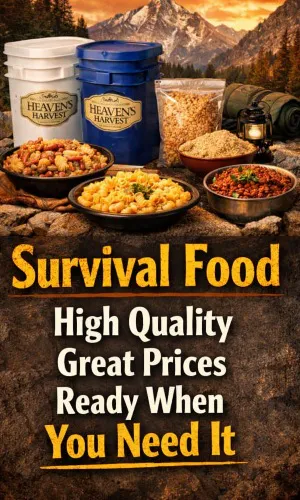
Serious households have started doing the quiet math on their own. Grocery bills tell part of the story, and the forecast maps tell the rest, which is why long-term food storage has moved from fringe hobby to mainstream line item in the family budget, with established suppliers like Heaven’s Harvest seeing demand from people who five years ago would have rolled their eyes at the idea. That instinct is not paranoia. It is pattern recognition, and the pattern is worth walking through carefully.
Editor’s Note: Heaven’s Harvest IS a sponsor, but the warnings of this article are real and would be written even if we didn’t have a survival food sponsor. With that said, those who take advantage of what they offer can use promo code “Patriot” for 15% off.
The Fertilizer Clock Is Already Running
While the Pacific warms, the second shock has been unfolding in the Strait of Hormuz. The conflict with Iran turned the world’s most important energy chokepoint into a contested waterway, and the consequences reach far beyond the gas pump. Roughly a third of global fertilizer trade moves through Hormuz, and the disruption sent urea prices up 86 percent year over year by March, with a 53 percent jump in a single month.
The World Bank projects energy prices rising about 24 percent in 2026 and fertilizer about 31 percent. By its own accounting, fertilizer prices ran 35 percent higher in the first five months of this year than the same period last year.
Here is the mechanism the nightly news will not explain. Fertilizer is not a grocery item. It is a time-delayed input. The nitrogen a farmer in Iowa or Punjab could not afford to apply this spring does not show up as a problem this spring. It shows up as a thinner harvest six to twelve months later.
The World Bank’s own food security brief concedes that the effects of reduced applications earlier this season “are likely to become visible only later in harvest outcomes.” Translate that from institutional language into plain English and it means this. The damage is already done, it is already in the ground, and we are simply waiting for it to arrive on the shelf.
Now check the calendar. Six to twelve months from the spring planting season lands us squarely in late 2026 and early 2027. Which is precisely when the strongest El Niño in the instrumental record is forecast to peak, bringing its signature droughts to Southeast Asia, Australia, southern Africa, northern Brazil, and South Asia, the very regions that grow the world’s rice, sugar, and oilseeds.
The World Bank warns openly that a strong El Niño “could disrupt multiple crop belts simultaneously” on top of the conflict-driven input costs. Their baseline projection assumes the Middle East disruptions ease by autumn. What in the last two years of Middle East history suggests that assumption is safe?
The System Has No Slack Left
The comfortable answer is that global markets always adjust. But adjustment requires slack, and the slack is gone. Global cereal production is expected to decline from last year’s records even before El Niño does its work. The UN World Food Programme, hardly a den of right-wing preppers, is calling this the most significant disruption to its supply chains since Covid and the invasion of Ukraine, and its supply chain director put the stakes bluntly.
Today’s supply chain challenges are tomorrow’s hunger crisis.
There is also a political dimension that markets cannot price. When food gets scarce, governments do not behave like economists. They behave like politicians. Export bans, hoarding mandates, and panic buying at the national level turned the modest rice shortfall of 2008 into a global crisis, and analysts are already warning that import-dependent nations are the first dominoes.
The 2015-16 Super El Niño, a far weaker event than what is now forecast, threw tens of millions into food stress across Africa and Asia. This one is projected to be stronger, and it arrives with fertilizer already rationed by price and shipping lanes already contested by missiles.
What Joseph Knew
Scripture does not treat preparation for lean years as faithlessness. It treats it as wisdom delivered in advance to those willing to act on it.
Behold, there come seven years of great plenty throughout all the land of Egypt: And there shall arise after them seven years of famine; and all the plenty shall be forgotten in the land of Egypt.
Joseph did not respond to that warning with a hashtag or a committee. He stored grain during the years of abundance, and when the famine came, Egypt stood while its neighbors begged. The lesson is not that famine is certain. It is that the time to prepare is precisely when preparation still looks optional.
Nobody who filled a pantry in a year of plenty has ever regretted it, and nobody standing in an empty aisle has ever been glad he waited for certainty.
None of this calls for panic, and panic is the enemy of sound judgment anyway. It calls for the same unglamorous prudence our grandparents considered ordinary. Keep some cash margin, know your local growers, and put real food in deep storage while it is cheap and available, because the entire arc of this story is that cheap and available is a closing window.
Families looking for a straightforward place to start can visit Heaven’s Harvest and use promo code Patriot for 15 percent off long-term storable food. The forecasts may yet soften, the strait may yet reopen, and we should pray they do. But hope is a fine thing to hold and a foolish thing to eat.