
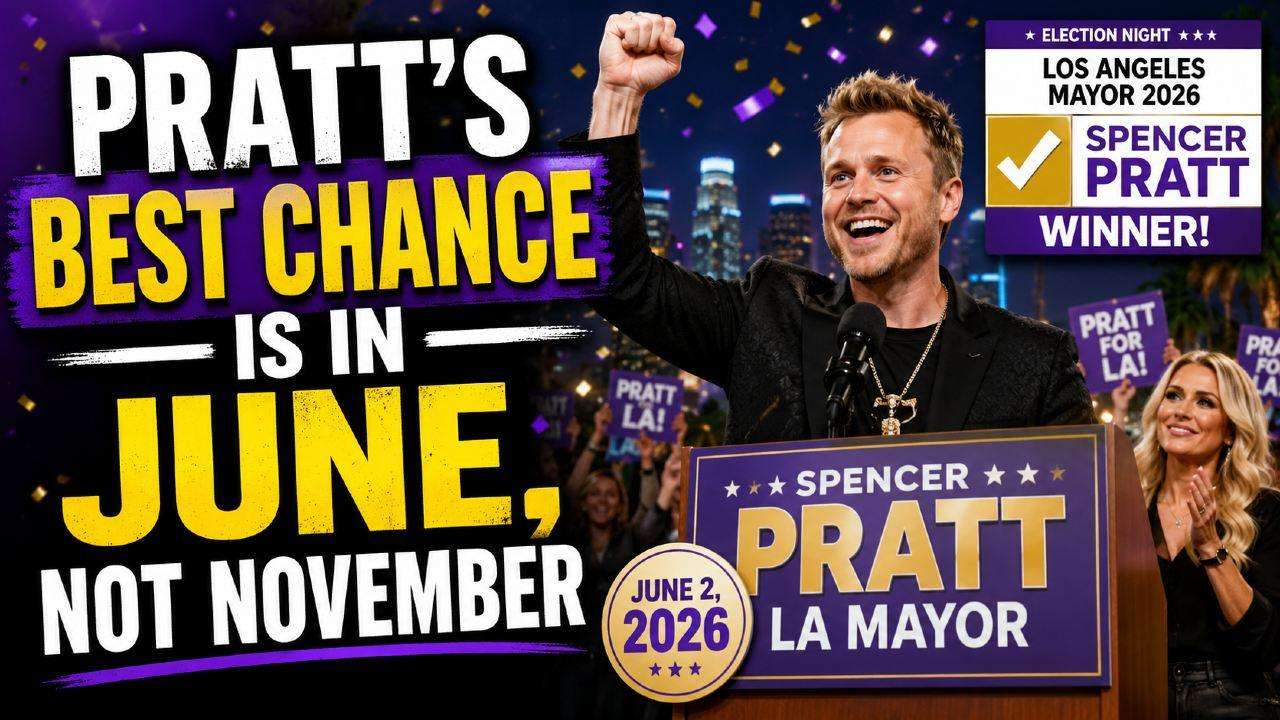
The political class scoffed when reality television personality Spencer Pratt announced his run for mayor of Los Angeles. Then they scoffed louder when he qualified for the debate stage. Then on May 6, the two-time former Hills star walked off that stage having flatlined the careers of two Democratic incumbents, and now the prediction markets are rearranging themselves like deck chairs on a ship that just hit an iceberg.
Within twenty-four hours of the debate, Polymarket users yanked Councilmember Nithya Raman’s odds down between 17 and 19 points. Bass clings to a 45 percent implied probability. Pratt sits in the low 20s and climbing.
Conservative commentators called it a rout. So did several voices on the left. The Los Angeles Times described Raman as “tongue-tied.” ABC7 called the dynamic on stage a “two-on-one tag-team attack” by Bass and Pratt against Raman, with Raman herself accusing the other two of coordinating to push her below second place so they could face each other in November.
Here is what nobody in Los Angeles wants to say out loud. June 2 is not Pratt’s worst-case scenario. It is his best one. And the conditions stacking up around that primary are the kind of conditions that produce political earthquakes nobody saw coming until the dust settled.
The Math the Establishment Refuses to Do
Start with the polling. Bass at 25 percent. Forty percent undecided. The most recent UCLA Luskin survey shows an incumbent mayor whose approval has been sagging since the Palisades fires consumed 7,000 structures and twelve lives in January 2025, and whose ill-timed trip to Ghana during the inferno became a permanent stain on her tenure. Her opponent during the debate did not let voters forget. Pratt accused Bass directly of burning down his house, his parents’ house, and his neighborhood.
Now factor in the field. Raman is not running to Bass’s right. She is running to her left, courting the Democratic Socialists of America base and casting Bass as insufficiently progressive on tenant protections and housing. That means Raman is not pulling votes from Pratt. She is pulling votes from Bass. Every percentage point Raman peels off the Bass coalition is a percentage point that does not belong to the incumbent on June 2.
Run the numbers honestly. If Bass holds 30 percent and Raman pulls 25 percent, that leaves 45 percent of the electorate available for someone else. Pratt does not need every undecided voter. He needs enough mad ones, and Los Angeles is not exactly running short on mad voters this cycle.
Why Low Turnout Is the Outsider’s Best Friend
The 2022 California primary saw 33.1 percent statewide turnout, with Los Angeles County clocking in at 28.48 percent. Compare that to November 2022, when LA mayoral turnout climbed to nearly 44 percent — the highest since Riordan won in 1993. The June 2026 primary will not match November intensity. It will not even come close.
- Hand-curated links from conservative and Christian sites — NO legacy media garbage links. Patriots get their news every day at JDRucker.com
Smaller electorates behave differently than larger ones. They are older. They own more property. They vote on fewer cues and more on grievance. They turn out angry, not enthusiastic. Pratt’s coalition — homeowners terrified of fire, residents disgusted by encampments, taxpayers furious at a $14 billion budget that produces only “incremental progress,” to use Raman’s own word — fits the low-turnout primary electorate like a glove. The Bass coalition relies on the broader Democratic turnout operation that activates only when the stakes feel existential to progressive voters. June 2 will not feel existential. Bass will be on the ballot reminding everyone she is the incumbent, which is precisely the problem.
The Bass-Raman Suicide Pact
The most consequential dynamic in this race has nothing to do with Pratt. It is the war Bass and Raman are waging on each other. Raman’s path to victory requires destroying Bass’s standing with Democratic voters. Bass’s path to a fourth term requires keeping Raman below the second-place finish line. Both spend money attacking each other. Neither has a serious answer for Pratt because neither believes Pratt is the real threat.
That is the same arithmetic that gave America President Donald Trump twice. The political class spent a decade assuming the celebrity outsider was a sideshow until he was sitting in the Oval Office. It is the same arithmetic that produced Eric Adams in New York, Glenn Youngkin in Virginia, and a dozen other elections where elites priced in zero probability of an outcome until the votes were counted.
November Is the Trap
Imagine the alternative. Pratt finishes second on June 2 with 22 to 28 percent of the vote and advances to a runoff with Bass. Suddenly the entire Democratic apparatus snaps awake. National money pours in. SEIU mobilizes. The DNC sends operatives. California Democrats nationalize the race as the firewall against MAGA in the second-largest city in America. Hollywood writes checks. The New York Times runs profiles of Pratt’s tweets from 2009. Karen Bass becomes the heroine of liberal resistance, and the 14 percent of LA voters registered Republican are joined by exactly nobody persuadable.

In November, Pratt’s R next to his name is a millstone. In June, in a nonpartisan primary where the ballot does not list parties and turnout is half what it will be in the fall, the R is invisible. The voters at that point are deciding between a competent-sounding outsider who said he would surround himself with the smartest people in the world and an incumbent who was in Ghana when their houses burned down.
The Honest Counterargument
Los Angeles has not elected a Republican mayor since Richard Riordan in 1993, and Riordan ran when the city was reeling from the 1992 riots and the recession. Pratt has never held office. He has fewer endorsements than any major candidate. The legacy press treats him as a punchline even after the debate. The structural disadvantages are real.
But every one of those disadvantages was true of the political outsiders who actually won. Riordan was a businessman dismissed as unserious. Adams was an outer-borough cop whose moderation was treated as a political miscalculation. Trump was a reality television host whose first run was reported as a publicity stunt for a season finale. The pattern repeats for a reason. The press misreads outsider candidates because the press cannot fathom the depth of voter contempt for incumbents. And no incumbent has earned more contempt this cycle than the mayor who watched Pacific Palisades burn from another continent.
What June 2 Actually Looks Like
For Pratt to win outright on June 2, he needs three things to happen. He needs Bass to stay below 35 percent, which her own polling already suggests is likely. He needs Raman to remain a credible second option draining Democratic votes, which Raman’s progressive identity and DSA backing virtually guarantees. And he needs the undecided 40 percent to break against the incumbent at a rate consistent with how undecideds historically break in races where voters are angry. None of those requirements is exotic. All of them are within the range of what just happened on May 6.
Will it happen? The honest answer is probably not. Los Angeles is a deep-blue city with a Democratic registration advantage that overwhelms most insurgencies. The smart money is still on a Bass-Pratt November runoff in which Bass survives with the help of every progressive donor in the country. But the smart money has been wrong before, and the conditions for an outright June 2 win are more aligned than at any point in the last three decades. The political class is not gaming out the Pratt scenario. They should be.
The Stone the Builders Rejected
There is a passage in Matthew 21 about a stone the builders rejected becoming the chief cornerstone. It is not about Spencer Pratt, obviously. But the principle has a way of recurring in American politics, where the candidates the credentialed class dismisses as unserious have an inconvenient habit of becoming the people who govern. The stone which the builders rejected, the same is become the head of the corner: this is the Lord’s doing, and it is marvellous in our eyes.
Los Angeles voters spent the last four years watching their city decay under leadership the smart people promised would fix everything. The smart people are now arguing about whether Pratt should even be allowed on the debate stage. The voters who actually have to live in Los Angeles get a different question on June 2. They get to decide whether four more years of incremental progress is what they want, or whether they want to try something the political class swears cannot possibly work. The conditions for the second answer have not been this favorable since before most of those voters were born. June 2 is the day to find out if anyone is paying attention.
Two Storms, One Harvest

Every food crisis in living memory has been a one-shock event. The 2008 price spike was a commodity bubble. The 2020 shortages were a logistics failure. The 2022 grain scare was a war on one exporter’s ports. Each time, the system bent, adjusted, and recovered, and each time the experts assured us afterward that global markets are simply too big and too diversified to fail.
What nobody in Washington seems eager to discuss is that 2026 is shaping up to be something the modern food system has never actually faced. Two independent shocks, one climatic and one geopolitical, are converging on the same harvest cycle at the same time. Not sequentially. Simultaneously.
Start with the weather. The Pacific Ocean is currently building toward what forecasters now openly call a record event. NOAA’s Climate Prediction Center puts the odds of at least a strong El Niño near 88 percent, with roughly two in three odds it reaches “very strong” status, the tier reserved for perhaps three or four events in the entire satellite era. Every major global model now projects a median peak in Super El Niño territory, and most of them project it exceeding the 2015-16 event, which until now held the modern record. Sea surface anomalies were already brushing the super threshold in mid-July, months before these events normally peak. The atmosphere has already shifted into El Niño mode, and the event is forecast to crest in late fall and early winter.
This is not about “climate change.” It’s about the standard cycles of weather, and the cycle we’re currently in is one that has likely devastated societies in the past. We’re better prepared as a society today, but not all Americans are equally prepared.
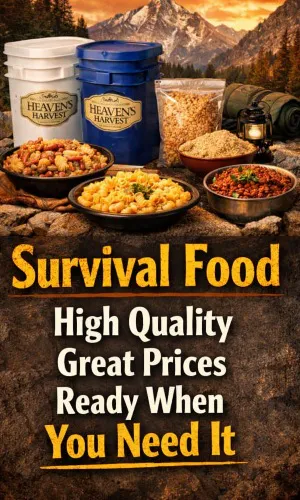
Serious households have started doing the quiet math on their own. Grocery bills tell part of the story, and the forecast maps tell the rest, which is why long-term food storage has moved from fringe hobby to mainstream line item in the family budget, with established suppliers like Heaven’s Harvest seeing demand from people who five years ago would have rolled their eyes at the idea. That instinct is not paranoia. It is pattern recognition, and the pattern is worth walking through carefully.
Editor’s Note: Heaven’s Harvest IS a sponsor, but the warnings of this article are real and would be written even if we didn’t have a survival food sponsor. With that said, those who take advantage of what they offer can use promo code “Patriot” for 15% off.
The Fertilizer Clock Is Already Running
While the Pacific warms, the second shock has been unfolding in the Strait of Hormuz. The conflict with Iran turned the world’s most important energy chokepoint into a contested waterway, and the consequences reach far beyond the gas pump. Roughly a third of global fertilizer trade moves through Hormuz, and the disruption sent urea prices up 86 percent year over year by March, with a 53 percent jump in a single month.
The World Bank projects energy prices rising about 24 percent in 2026 and fertilizer about 31 percent. By its own accounting, fertilizer prices ran 35 percent higher in the first five months of this year than the same period last year.
Here is the mechanism the nightly news will not explain. Fertilizer is not a grocery item. It is a time-delayed input. The nitrogen a farmer in Iowa or Punjab could not afford to apply this spring does not show up as a problem this spring. It shows up as a thinner harvest six to twelve months later.
The World Bank’s own food security brief concedes that the effects of reduced applications earlier this season “are likely to become visible only later in harvest outcomes.” Translate that from institutional language into plain English and it means this. The damage is already done, it is already in the ground, and we are simply waiting for it to arrive on the shelf.
Now check the calendar. Six to twelve months from the spring planting season lands us squarely in late 2026 and early 2027. Which is precisely when the strongest El Niño in the instrumental record is forecast to peak, bringing its signature droughts to Southeast Asia, Australia, southern Africa, northern Brazil, and South Asia, the very regions that grow the world’s rice, sugar, and oilseeds.
The World Bank warns openly that a strong El Niño “could disrupt multiple crop belts simultaneously” on top of the conflict-driven input costs. Their baseline projection assumes the Middle East disruptions ease by autumn. What in the last two years of Middle East history suggests that assumption is safe?
The System Has No Slack Left
The comfortable answer is that global markets always adjust. But adjustment requires slack, and the slack is gone. Global cereal production is expected to decline from last year’s records even before El Niño does its work. The UN World Food Programme, hardly a den of right-wing preppers, is calling this the most significant disruption to its supply chains since Covid and the invasion of Ukraine, and its supply chain director put the stakes bluntly.
Today’s supply chain challenges are tomorrow’s hunger crisis.
There is also a political dimension that markets cannot price. When food gets scarce, governments do not behave like economists. They behave like politicians. Export bans, hoarding mandates, and panic buying at the national level turned the modest rice shortfall of 2008 into a global crisis, and analysts are already warning that import-dependent nations are the first dominoes.
The 2015-16 Super El Niño, a far weaker event than what is now forecast, threw tens of millions into food stress across Africa and Asia. This one is projected to be stronger, and it arrives with fertilizer already rationed by price and shipping lanes already contested by missiles.
What Joseph Knew
Scripture does not treat preparation for lean years as faithlessness. It treats it as wisdom delivered in advance to those willing to act on it.
Behold, there come seven years of great plenty throughout all the land of Egypt: And there shall arise after them seven years of famine; and all the plenty shall be forgotten in the land of Egypt.
Joseph did not respond to that warning with a hashtag or a committee. He stored grain during the years of abundance, and when the famine came, Egypt stood while its neighbors begged. The lesson is not that famine is certain. It is that the time to prepare is precisely when preparation still looks optional.
Nobody who filled a pantry in a year of plenty has ever regretted it, and nobody standing in an empty aisle has ever been glad he waited for certainty.
None of this calls for panic, and panic is the enemy of sound judgment anyway. It calls for the same unglamorous prudence our grandparents considered ordinary. Keep some cash margin, know your local growers, and put real food in deep storage while it is cheap and available, because the entire arc of this story is that cheap and available is a closing window.
Families looking for a straightforward place to start can visit Heaven’s Harvest and use promo code Patriot for 15 percent off long-term storable food. The forecasts may yet soften, the strait may yet reopen, and we should pray they do. But hope is a fine thing to hold and a foolish thing to eat.