

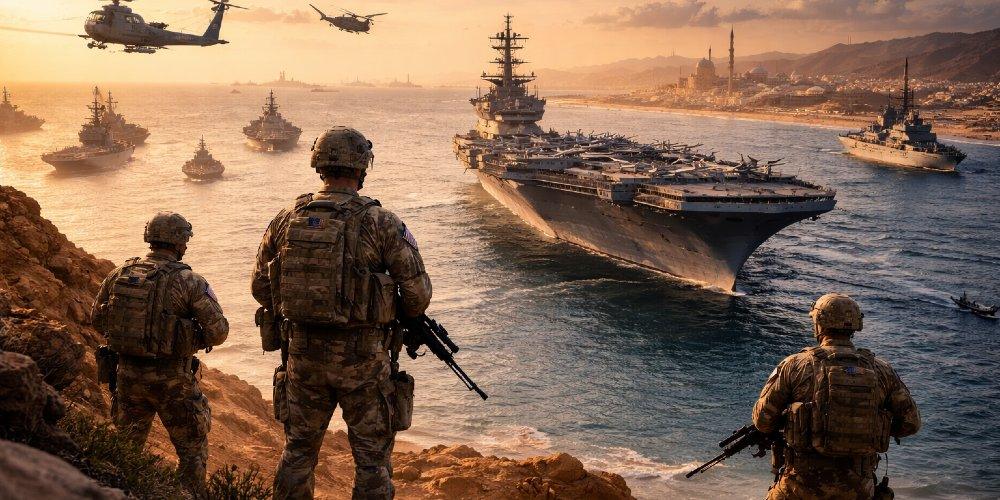
The guns have gone quiet — for now. But President Trump made clear Wednesday night that American military power is not going anywhere until the ink on a final agreement is dry and every condition within it is honored.
In a Truth Social post that combined characteristic plainspokenness with an unmistakable edge of warning, Trump announced that all U.S. ships, aircraft, military personnel, ammunition, and weaponry will remain positioned in and around Iran until a “REAL AGREEMENT” is fully complied with. Should compliance falter, the president was blunt about what follows: “the ‘Shootin’ Starts,’ bigger, and better, and stronger than anyone has ever seen before.”
The post arrives in the wake of a dramatic 24 hours that saw the United States and Iran step back from the brink. Less than two hours before Trump’s self-imposed 8 p.m. ET deadline on Tuesday — behind which stood the threat of wide-scale destruction of Iranian infrastructure — the two countries reached a two-week ceasefire deal. Trump credited Pakistan’s Prime Minister Shehbaz Sharif and Field Marshal Asim Munir with requesting that he hold off the “destructive force being sent tonight,” and agreed to suspend bombing subject to Iran’s complete, immediate, and safe reopening of the Strait of Hormuz.
The non-negotiable terms, Trump reiterated in Wednesday’s post, were agreed to long ago, regardless of what he dismissed as “fake rhetoric to the contrary”: no nuclear weapons for Iran, and the Strait of Hormuz open and safe for passage.
Those conditions matter enormously. Shortly after the war erupted, Iran moved to choke off traffic in the Strait of Hormuz, a key waterway through which nearly 20 percent of the world’s oil and natural gas travels. Benchmark oil prices jumped more than 50 percent since late February, from roughly $71 per barrel before the first wave of attacks to approximately $110 per barrel. The economic consequences were not abstractions — Americans felt them at every gas station in the country.
The ceasefire framework itself remains tentative and complex. Iran provided a 10-point peace proposal, which Trump called “a workable basis on which to negotiate,” while stating that “almost all of the various points of past contention have been agreed to between the United States and Iran.”
Yet the two sides have already offered competing narratives of what was actually agreed. Iran’s Supreme National Security Council released a statement claiming that the U.S. had accepted a 10-point plan that included “continued Iranian control over the Strait of Hormuz,” a characterization the United States did not confirm. White House press secretary Karoline Leavitt clarified that Trump’s demand is for the strait to be reopened “immediately, without limitation, including tolls.”
That last word — tolls — is no small wrinkle. The peace plan, as described by a regional officer to the Associated Press, would allow Iran and Oman to charge ships transiting the Strait of Hormuz, with funds directed toward Iran’s reconstruction. Secretary of State Rubio had previously warned that any such tolling system would be “illegal” and “dangerous for the world.” Whether that point has been conceded, deferred, or simply papered over remains unclear.

The first round of negotiations during the ceasefire is set to take place in Islamabad, with the U.S. team led by Vice President JD Vance, Special Envoy Steve Witkoff, and Jared Kushner. Pakistan’s Prime Minister Sharif has extended an invitation to both delegations, calling the leaders of both nations to “further negotiate for a conclusive agreement to settle all disputes,” and expressing hope that the Islamabad talks will succeed in “achieving sustainable peace.”
Trump’s posture throughout all of this has been consistent with the logic he has applied to negotiations from trade to treaties: establish overwhelming leverage, press it to the threshold of rupture, then convert the resulting fear into a framework. Whether that framework holds is the open question. The ceasefire is two weeks long. Defense Secretary Pete Hegseth declared at a press briefing Wednesday morning that “the strait is open,” while Joint Chiefs Chairman Dan Caine said, “I believe so, based on the diplomatic negotiation.”
Measured confidence, not certainty.
The president, for his part, projected something closer to satisfaction. In the same Truth Social post announcing that the military would remain in position, he described American forces as “loading up and resting, looking forward, actually, to its next Conquest,” before closing with three words that have become the defining refrain of this administration: “AMERICA IS BACK!”
The scripture that comes to mind is not from Proverbs but from Ecclesiastes: “There is a time for war, and a time for peace.” Whether this fragile ceasefire marks the hinge between the two, or merely a pause before the former resumes, the next thirteen days will go a long way toward answering that question. What is not in doubt is the administration’s conviction that the military advantage is real, the leverage is genuine, and the moment — if it is to be seized — belongs to the United States.
Preparing for the Unexpected: Your Essential Partner in Health Readiness
In an increasingly unpredictable world—where supply chain disruptions, natural disasters, and global travel can leave us vulnerable to sudden health challenges—being prepared isn’t just smart; it’s essential.
That’s where Jase Medical steps in, offering innovative solutions that empower individuals and families to take control of their health with emergency medication kits designed for real-life scenarios. As someone who’s always advocated for proactive wellness, I was impressed by how Jase Medical combines expert medical guidance with convenient, customizable options to ensure you’re never caught off guard.
At the heart of their offerings is the Jase Case, a comprehensive emergency antibiotic kit priced at just $289.95. This powerhouse contains five life-saving antibiotics and five vital symptom-relief medications, capable of treating over 50 common infections—from respiratory issues and skin conditions to traveler’s diarrhea and more.
What sets it apart? It’s fully customizable with 28 add-on options, including a specialized KidCase for children ages 2-11, making it ideal for families.
Whether you’re stocking up for home emergencies or preparing for remote adventures, the Jase Case provides peace of mind with medications that boast extended shelf lives—up to five years or longer when stored properly, with studies showing 90% potency retention even after 20 years.
For those on the move, the Jase Go travel med kit at $129.95 is a game-changer. Curated by physicians, it addresses over 30 common travel ailments, from digestive upsets to minor injuries, ensuring explorers, hikers, and globetrotters can handle health hiccups without derailing their plans.
And for targeted concerns, Jase Medical offers specialized kits like the UTI Kit ($99.95), which includes test strips and treatments for urinary tract infections, vaginal candidiasis, and even jock itch, or the Parasites Kit (starting at $199.95), featuring compounded Ivermectin and Mebendazole to combat internal and external parasitic infections.
But Jase Medical isn’t just about one-off kits; their Jase Daily service provides an extended supply of your ongoing prescriptions, supporting hundreds of medications for chronic conditions like diabetes, heart health, high blood pressure, mental health, and more. This ensures long-term preparedness, safeguarding against factory shutdowns or extreme weather that could interrupt your regular supply.
The process couldn’t be simpler or more reassuring. Start by customizing your order online, then benefit from a thorough review by a team of world-class physicians who ensure safety and accuracy. In most cases, prescriptions are issued after a quick consultation—sometimes just a call to clarify allergies or needs—and your kit arrives discreetly at your door. While they don’t accept traditional health insurance, many customers use HSA cards, and refills are available for added convenience.
What truly stands out is the real-world impact. As radio host Glenn Beck puts it, “The supply lines for antibiotics already are stressed to the max. Please have some antibiotics on hand… You can do it through Jase.”
One satisfied customer shared, “It could have been a nightmare. Instead, the best trip we’ve had,” after their kit turned a potential health crisis into a minor blip during a family vacation.
In a time when health uncertainties loom larger than ever, Jase Medical isn’t just selling products—it’s delivering empowerment. Don’t wait for the next disruption; visit Patriot.TV/meds today to build your personalized emergency plan and step into a more secure tomorrow. Your health, and your family’s, deserves nothing less.