
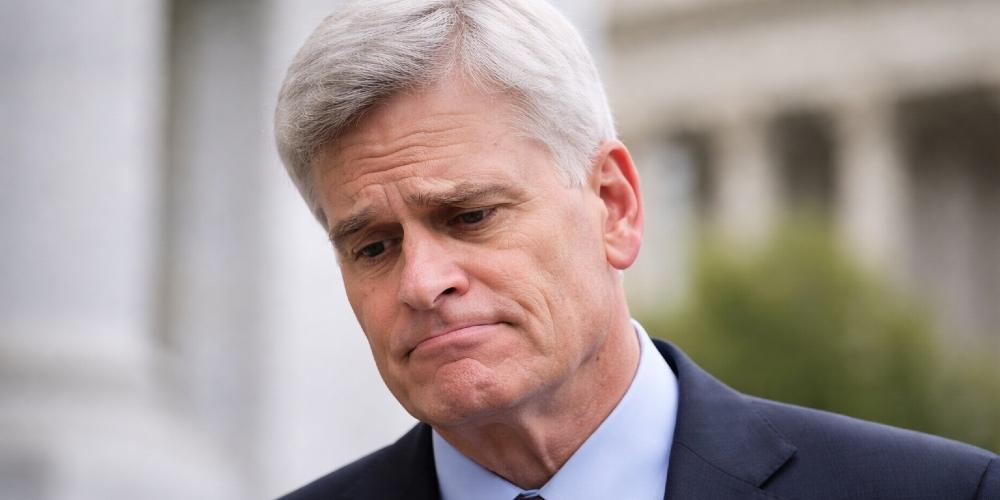
There is a particular kind of political tragedy that is entirely self-authored — the kind where a man makes a series of deliberate, defiant choices, watches the consequences approach in plain sight for years, and then expresses outrage that the bill has finally arrived. Senator Bill Cassidy of Louisiana is living that tragedy right now, five weeks before a Republican primary that may well end his Senate career — and he has no one to blame but the face he sees in the mirror each morning.
According to reporting from TLD, Cassidy is currently “furious” at the National Republican Senatorial Committee and Senate Majority Leader John Thune, believing they haven’t sufficiently bankrolled his reelection bid. This is the same NRSC that helped raise more than $650,000 for him at a January event, and that cut video ads on his behalf. None of that was enough to mollify the senator. The response he received from NRSC Executive Director Jennifer DeCasper — blunt, profanity-laced, and entirely to the point — was perhaps the most honest political communication he’s gotten in years: he shouldn’t have voted to convict Donald Trump.
That vote, cast in February 2021, is the original sin from which everything else in this story flows.
The Vote Heard ‘Round Louisiana
When Cassidy joined six other Republican senators in voting to convict the then-former president, he did not do so quietly or apologetically. He was emphatic. “Our Constitution and our country is more important than any one person. I voted to convict President Trump because he is guilty,” he declared.
The Louisiana Republican Party responded within hours — not with disappointment, but with something closer to institutional fury. The state party’s executive committee unanimously voted to censure him. The Republican Party of East Baton Rouge Parish, in an action it had never taken before, declared Cassidy “an object of shame,” stating that his vote was “a betrayal of the people of Louisiana.”
Mike Bayham, the secretary of the LAGOP, put it simply: “Bill Cassidy is a senator without a party as of today.”
That phrase — a senator without a party — has proven to be one of the more prophetic political descriptions of the past several years. And now, five years later, the same Mike Bayham, still watching the Louisiana Senate race as a neutral observer, has told Politico that Cassidy is exactly what he predicted: a politician without a natural base.
The Architecture of Political Isolation
Here is what makes Cassidy’s position genuinely remarkable: he didn’t just cast a vote. He embraced a posture. In 2023, after Trump was indicted on classified documents charges, Cassidy called for Trump to drop out of the 2024 presidential race. After Trump secured the Republican nomination, Cassidy declined to endorse him. He had earlier signaled openness to the No Labels third-party effort — a movement whose sole animating purpose was to drain votes from the Republican nominee. He told multiple interviewers that Trump could not win a general election. He was not, in other words, a senator who made one difficult vote under pressure and moved on. He was a senator who spent several years actively working to ensure his own party’s presidential candidate would lose.

And now that candidate has won — twice — and is the most popular figure in the Louisiana Republican Party by a wide margin. Trump carried Louisiana by 24 points in the 2024 presidential election. The state has not sent a Democrat to the U.S. Senate since Mary Landrieu lost to Cassidy himself in 2014. These are not the political conditions under which one survives a closed Republican primary after voting to remove a president the base regards as something close to a political martyr.
The jungle primary system that once protected Cassidy — allowing independents and crossover Democrats to prop up a senator the Republican base had already abandoned — is gone. Following the enactment of House Bill 17 in 2024, this will be the first U.S. Senate election in Louisiana to utilize party primaries instead of a single blanket primary since 2010. The electorate that will determine Cassidy’s fate on May 16 is the one constituency that has never forgiven him.
A Three-Way Race, One Certain Loser
Into this environment come two credible challengers. Rep. Julia Letlow carries the most powerful political asset in Louisiana Republican politics: President Donald Trump and Governor Jeff Landry both endorsed Letlow. Trump called her a “Total Winner” and urged her to run in a January post on Truth Social. State Treasurer John Fleming is himself no stranger to the conservative movement — a founding member of the House Freedom Caucus, Fleming has built his campaign on the argument that he stood with Trump when others walked away.
The polling — such as it is, in a race where every campaign has commissioned its own numbers — tells a consistent story about Cassidy’s ceiling, if not about who leads among his opponents. A JMC Analytics poll commissioned by the Fleming campaign found Fleming at 26 percent, Letlow at 25, and Cassidy at 22. A BDPC Strategic Campaign Services poll found Letlow leading at 29 percent, Fleming at 23, and Cassidy at 19. A survey by American Pulse Research placed Letlow at 31 percent, Fleming at 25, and Cassidy third at 21. Even Cassidy’s own campaign-commissioned poll, from Public Opinion Strategies, showed him at only 35 percent — the kind of number that, for an incumbent, signals deep structural weakness.

No poll is showing Cassidy above 35 percent, which is a strong indication that most Republican voters in Louisiana have decided they do not want to return him to the Senate. In a three-way race where no one is expected to clear 50 percent on May 16, Cassidy faces the genuine prospect of finishing third — of being mathematically eliminated before a runoff even begins, denied the chance to make his case to a broader electorate.
Republican insiders now assess that even if Cassidy survives to a runoff, he likely loses it. The Letlow campaign’s pollster, Fabrizio Lee & Associates, found that once voters are told of Trump’s endorsement, Letlow’s support expands dramatically — from 27 percent to 48 percent in one survey, with Cassidy collapsing to 19.
The Spending That Cannot Buy Forgiveness
Cassidy has not been passive. He has spent with the kind of ferocity that suggests a man who understands, on some level, that money is the only card he has left. Cassidy and his allied groups began the year with approximately $26 million in the bank, and his campaign and the Louisiana Freedom Fund have poured more than $14 million into the race on advertising, most of it attacking Julia Letlow.
The attack strategy has focused on Letlow’s past involvement with diversity, equity, and inclusion initiatives during her time in university administration — a line of attack that requires voters to believe Cassidy is the more authentic conservative in this race. That is a difficult argument to make to a Louisiana Republican primary voter who remembers not just the impeachment vote, but the years of rhetorical distance Cassidy deliberately placed between himself and the man that voter twice sent to the White House.
Money, it turns out, cannot purchase a reputation. It can amplify a message, but when the message is trust me, I’m really a conservative, fourteen million dollars of amplification doesn’t make it ring true. Cassidy’s attacks on Letlow have had some effect — “They defined her before she introduced herself,” one neutral Republican legislator told Politico — but they haven’t moved Cassidy’s own numbers in any meaningful direction. He remains where he has been: trapped in the low-to-mid twenties, spending profligately against opponents who remind voters, simply by existing, of the choice Cassidy made in February 2021.
A Lesson in the Cost of Calculated Apostasy
Conservatives should resist the temptation to view this race merely as a MAGA loyalty test. The deeper issue is one of democratic accountability — the idea that elected representatives are answerable to the people who sent them to Washington. Louisiana Republicans sent Cassidy to the Senate not once but twice. They did so alongside Donald Trump, whose agenda Cassidy voted to advance in 89 percent of cases during his first term. And then, in a single consequential vote — amplified by years of subsequent commentary designed to further distance himself from his own constituency — Cassidy told those voters that his judgment superseded theirs.
There is something worth considering in the book of Galatians: “Be not deceived; God is not mocked: for whatsoever a man soweth, that shall he also reap” (Galatians 6:7, KJV). The principle is not theological alone — it is one of the oldest and most reliable laws of political life. Choices have costs. Betrayals, however principled the betrayer considers them, are remembered. The voters of Louisiana have long memories and, now, a closed primary.
Bill Cassidy made his choice in 2021 with full knowledge of what it would cost him. He said the Constitution mattered more than any one person. That is a defensible position. But it is not a position that entitles a man to the support of the party he chose to wound, to the committee infrastructure he chose to antagonize, or to the voters he chose to lecture. He is, as his own party officials declared five years ago, a senator without a country. On May 16, Louisiana Republicans will have the opportunity to make that description permanent.
Two Storms, One Harvest

Every food crisis in living memory has been a one-shock event. The 2008 price spike was a commodity bubble. The 2020 shortages were a logistics failure. The 2022 grain scare was a war on one exporter’s ports. Each time, the system bent, adjusted, and recovered, and each time the experts assured us afterward that global markets are simply too big and too diversified to fail.
What nobody in Washington seems eager to discuss is that 2026 is shaping up to be something the modern food system has never actually faced. Two independent shocks, one climatic and one geopolitical, are converging on the same harvest cycle at the same time. Not sequentially. Simultaneously.
Start with the weather. The Pacific Ocean is currently building toward what forecasters now openly call a record event. NOAA’s Climate Prediction Center puts the odds of at least a strong El Niño near 88 percent, with roughly two in three odds it reaches “very strong” status, the tier reserved for perhaps three or four events in the entire satellite era. Every major global model now projects a median peak in Super El Niño territory, and most of them project it exceeding the 2015-16 event, which until now held the modern record. Sea surface anomalies were already brushing the super threshold in mid-July, months before these events normally peak. The atmosphere has already shifted into El Niño mode, and the event is forecast to crest in late fall and early winter.
This is not about “climate change.” It’s about the standard cycles of weather, and the cycle we’re currently in is one that has likely devastated societies in the past. We’re better prepared as a society today, but not all Americans are equally prepared.
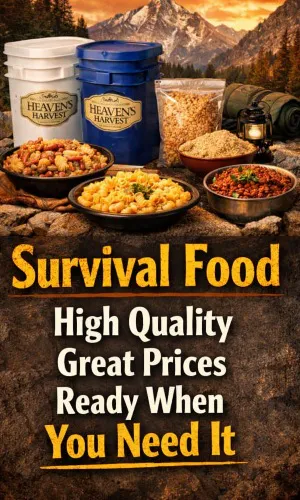
Serious households have started doing the quiet math on their own. Grocery bills tell part of the story, and the forecast maps tell the rest, which is why long-term food storage has moved from fringe hobby to mainstream line item in the family budget, with established suppliers like Heaven’s Harvest seeing demand from people who five years ago would have rolled their eyes at the idea. That instinct is not paranoia. It is pattern recognition, and the pattern is worth walking through carefully.
Editor’s Note: Heaven’s Harvest IS a sponsor, but the warnings of this article are real and would be written even if we didn’t have a survival food sponsor. With that said, those who take advantage of what they offer can use promo code “Patriot” for 15% off.
The Fertilizer Clock Is Already Running
While the Pacific warms, the second shock has been unfolding in the Strait of Hormuz. The conflict with Iran turned the world’s most important energy chokepoint into a contested waterway, and the consequences reach far beyond the gas pump. Roughly a third of global fertilizer trade moves through Hormuz, and the disruption sent urea prices up 86 percent year over year by March, with a 53 percent jump in a single month.
The World Bank projects energy prices rising about 24 percent in 2026 and fertilizer about 31 percent. By its own accounting, fertilizer prices ran 35 percent higher in the first five months of this year than the same period last year.
Here is the mechanism the nightly news will not explain. Fertilizer is not a grocery item. It is a time-delayed input. The nitrogen a farmer in Iowa or Punjab could not afford to apply this spring does not show up as a problem this spring. It shows up as a thinner harvest six to twelve months later.
The World Bank’s own food security brief concedes that the effects of reduced applications earlier this season “are likely to become visible only later in harvest outcomes.” Translate that from institutional language into plain English and it means this. The damage is already done, it is already in the ground, and we are simply waiting for it to arrive on the shelf.
Now check the calendar. Six to twelve months from the spring planting season lands us squarely in late 2026 and early 2027. Which is precisely when the strongest El Niño in the instrumental record is forecast to peak, bringing its signature droughts to Southeast Asia, Australia, southern Africa, northern Brazil, and South Asia, the very regions that grow the world’s rice, sugar, and oilseeds.
The World Bank warns openly that a strong El Niño “could disrupt multiple crop belts simultaneously” on top of the conflict-driven input costs. Their baseline projection assumes the Middle East disruptions ease by autumn. What in the last two years of Middle East history suggests that assumption is safe?
The System Has No Slack Left
The comfortable answer is that global markets always adjust. But adjustment requires slack, and the slack is gone. Global cereal production is expected to decline from last year’s records even before El Niño does its work. The UN World Food Programme, hardly a den of right-wing preppers, is calling this the most significant disruption to its supply chains since Covid and the invasion of Ukraine, and its supply chain director put the stakes bluntly.
Today’s supply chain challenges are tomorrow’s hunger crisis.
There is also a political dimension that markets cannot price. When food gets scarce, governments do not behave like economists. They behave like politicians. Export bans, hoarding mandates, and panic buying at the national level turned the modest rice shortfall of 2008 into a global crisis, and analysts are already warning that import-dependent nations are the first dominoes.
The 2015-16 Super El Niño, a far weaker event than what is now forecast, threw tens of millions into food stress across Africa and Asia. This one is projected to be stronger, and it arrives with fertilizer already rationed by price and shipping lanes already contested by missiles.
What Joseph Knew
Scripture does not treat preparation for lean years as faithlessness. It treats it as wisdom delivered in advance to those willing to act on it.
Behold, there come seven years of great plenty throughout all the land of Egypt: And there shall arise after them seven years of famine; and all the plenty shall be forgotten in the land of Egypt.
Joseph did not respond to that warning with a hashtag or a committee. He stored grain during the years of abundance, and when the famine came, Egypt stood while its neighbors begged. The lesson is not that famine is certain. It is that the time to prepare is precisely when preparation still looks optional.
Nobody who filled a pantry in a year of plenty has ever regretted it, and nobody standing in an empty aisle has ever been glad he waited for certainty.
None of this calls for panic, and panic is the enemy of sound judgment anyway. It calls for the same unglamorous prudence our grandparents considered ordinary. Keep some cash margin, know your local growers, and put real food in deep storage while it is cheap and available, because the entire arc of this story is that cheap and available is a closing window.
Families looking for a straightforward place to start can visit Heaven’s Harvest and use promo code Patriot for 15 percent off long-term storable food. The forecasts may yet soften, the strait may yet reopen, and we should pray they do. But hope is a fine thing to hold and a foolish thing to eat.