
(Zero Hedge)—The Trump administration has dumped 248 internal USAID files onto the shuttered agency’s website, and the trove of memos, emails, briefings and videos lays out how the Biden-era aid agency worked with Meta, YouTube, Google and a web of contractors to police what the world could say online.
Edward Coristine, the DOGE staffer known as “Big Balls,” announced the release Tuesday night, pointing readers to USAID.gov, where the full set sits in a roughly 1.1-gigabyte download. The page says previous administrations used the agency to push “a radical agenda at odds with American values,” and that the files are out “in the interest of transparency and accountability.”
ENTER ORWELL: Found in one of the files, a recording that states: “If you can identify neutral parties within government to partner with, then bringing in the fact-checking piece to debunk information in a way that aligns with the objectives of government partners, again, just grafts onto existing programming,” the presenter says, after calling the “greatest advantage” of working through fact-checkers and investigative journalists the chance “to do this work in closed spaces.”
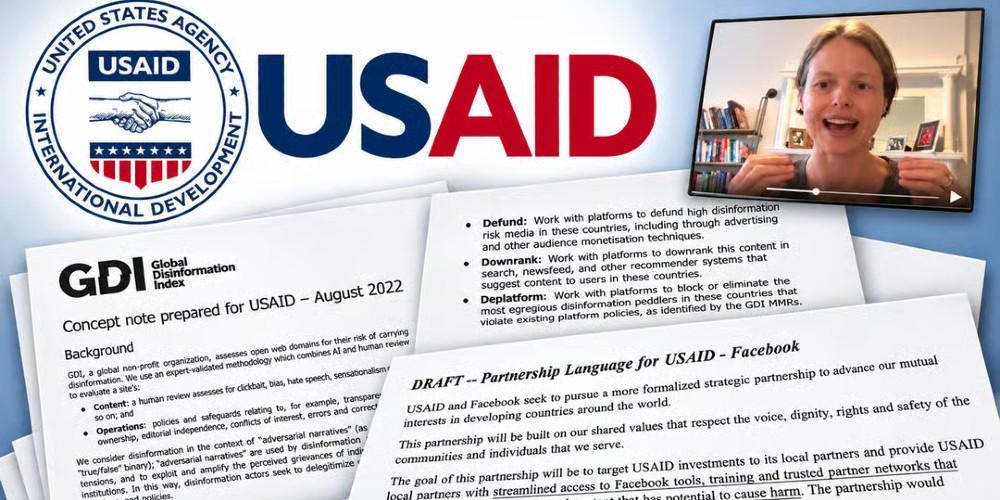
“Defund. Downrank. Deplatform.”
The files include an August 2022 concept note from the Global Disinformation Index, the British group behind an advertiser blacklist of news sites. Its proposed interventions for the platforms were “Defund,” “Downrank” and “Deplatform,” and it boasted that its list of more than 2,500 sites was built into the systems of 13 ad-tech companies. GDI’s co-founders had been introduced to USAID two months earlier by an official at the Office of the Director of National Intelligence, who called GDI “the best organization I know.”
A February 22, 2022 memo to then-Administrator Samantha Power argued that USAID should “co-own” the government’s foreign disinformation work, and described a roughly 20-person Information Domain Task Team.
Power’s door was open to Silicon Valley’s top brass: the files hold a meeting request from then-YouTube CEO Susan Wojcicki, a request for a sit-down with Meta’s Nick Clegg, and readouts of Power’s meetings with Meta’s president of global affairs and Microsoft’s Brad Smith.
Trusted flaggers
In an August 17, 2022 email about YouTube’s Trusted Flagger program, an executive at USAID contractor Internews wrote that USAID was likely funding many staff around the world to flag content to the platforms through trusted-partner programs, and declined to hand over a list of the partners’ contacts. Data Republican, combing the files, counted USAID-funded social media “monitors” in 20 countries.
A draft partnership with Facebook sought streamlined access to the company’s tools, ad credits, CrowdTangle and its Trusted Partner channel, while an undated “Big Tech Engagement Action Plan” proposed a private “inclusion list” of approved organizations that would get preferential treatment on the platforms. That idea, the plan itself notes, drew objections inside the State Department over free expression.
End Wokeness pulled two lines from a 2022 seminar in the archive: “Highlighting migrant crime = disinfo” and “Disinformation is NOT true or false.”
“FOIA+ or litigation lens”
By the time Missouri v. Biden produced an injunction against the administration’s pressure on social media companies, USAID was circulating talking points for staff. Staff were told to check with counsel before engaging the platforms, and to put a “FOIA+ or litigation lens on” what they wrote.
Sen. Eric Schmitt, who brought that case as Missouri’s attorney general, said USAID was one of the agencies the lawsuit exposed.
Wall Street Apes, who said he went through all 248 files, put the programs’ spending in the hundreds of millions, listing $79.8 million for Russian-language TV and digital content in Ukraine, $75 million for an Internews media program there, $20 million for OCCRP’s investigative reporting across Europe and Eurasia, and a proposed $300 million “Countering Chinese Influence Fund.”
Tim Pool posted a file he said showed “Youtube conspired with the Government to suppress dissent.”
Youtube conspired with the Government to suppress dissent pic.twitter.com/vKkd6LZu5c
— Tim Pool (@Timcast) November 25, 2026

When DOGE shut the agency down, Rep. Ro Khanna and other Democrats said the closure “cost lives.” Data Republican’s verdict, after the files dropped, was that “USAID was a global regime change machine,” and Elon Musk, who led the DOGE effort that took the agency apart, replied with one word.
USAID was formally shuttered after a court victory, its remaining programs folded into the State Department. The files run from a 2013 spreadsheet of Facebook pages in Sri Lanka to emails and briefers from 2024, Power’s last full year running the agency.
Starting the Day With a Scripture-Inspired Roast Helps Center Your Thoughts on Eternal Truths Amid Temporal Pressures
The world can seem chaotic, especially right after we wake up. Many believers start their mornings reaching for something familiar — a hot cup of coffee — yet end up settling for mediocre brews that do little more than deliver a caffeine jolt. The daily grind of life, with its endless distractions, news cycles, and responsibilities, can leave even the most faithful feeling spiritually parched alongside their physical fatigue. What if your morning ritual could do more than wake you up? What if it could ground you in truth, nourish your body with exceptional quality, and quietly advance a kingdom purpose at the same time?
That’s the promise — and the reality — behind Promised Grounds Coffee. This Christian-founded company doesn’t just roast beans; it approaches every step as an act of worship and discipleship. By selecting only the top 10% of specialty-grade beans, ethically sourced from dedicated farmers in Central and South America, and small-batch roasting them with reverence in Austin, Texas, Promised Grounds delivers what many describe as the best coffee available — never burnt, never bland, but rich with origin stories and layered flavors that honor God’s creation.
From the vibrant Psalm 27 Roast (a light, bright medium option) to the bold yet peaceful 2 Timothy 1:7 Decaf, each bag carries a Scripture verse that turns your daily pour into a gentle reminder of faith. And through their Ounce Per Ounce Promise, every ounce of coffee you enjoy provides an equal ounce of clean water to families in need via partnership with Filter of Hope — literally brewing hope for body and soul, one cup at a time.
The challenge for today’s Christians runs deeper than finding a decent cup. In an age of convenience-driven consumerism, it’s easy to support companies that dilute values or remain silent on matters of faith. Many believers want their everyday choices — from what they drink to how they spend — to reflect discipleship rather than just convenience. Promised Grounds solves this by weaving Christian excellence into the entire process: beans nurtured with prayerful stewardship by farming families, roasted as an offering rather than a commodity, and packaged with Bible verses to encourage a mindset of gratitude and purpose from the first sip. Reviewers consistently praise the smooth, rich profiles — whether enjoyed black in a drip maker, iced on a warm day, or shared in fellowship — noting how the quality stands toe-to-toe with premium secular brands while delivering something far more meaningful.
This integration of faith and flavor addresses a real need in Christian households and ministries. Busy parents, church leaders, and remote workers alike report that starting the day with a Scripture-inspired roast helps center their thoughts on eternal truths amid temporal pressures. The coffee’s exceptional character — bright citrus notes in lighter roasts or deep chocolate undertones in bolder ones — comes from meticulous selection and careful roasting that respects the bean’s natural gifts rather than masking them. It’s the kind of coffee that elevates a simple quiet time, fuels productive workdays, or sparks meaningful conversations when shared at Bible studies or outreach events. And because it’s ethically sourced with integrity, every purchase supports sustainable livelihoods for farmers who treat their crops like family harvests.
For those leading churches or small groups, the impact multiplies. Promised Grounds offers bundles and options perfect for hospitality ministries, turning ordinary coffee service into an opportunity to point people toward the living water of Christ. Imagine greeting visitors with a warm cup whose very bag carries God’s Word — a subtle yet powerful witness that aligns with the Great Commission. The company’s Texas roots and commitment to “brewing hope” resonate especially with believers who value American enterprise paired with global compassion.
Of course, quality alone isn’t enough if the experience feels out of reach. Promised Grounds keeps it accessible with practical perks like free shipping on orders over $40, sample sets for discovering favorites, and thoughtful add-ons such as faith-themed mugs. Whether you prefer whole beans for fresh grinding, grounds for convenience, or even bulk options for larger households and ministries, the result is consistently superior coffee that makes discipleship feel integrated rather than added on.
As you consider how to align even the smallest habits with your walk with God, Promised Grounds Coffee stands out as a refreshing solution. It tackles the dual problems of subpar daily sustenance and disconnected consumption by offering a product that genuinely excels in taste while advancing a mission of clean water, farmer dignity, and scriptural encouragement. Believers who make the switch often describe it as more than a beverage upgrade — it becomes part of their rhythm of gratitude, a daily invitation to remember that every good gift comes from above.
If you’re ready to transform your mornings (and perhaps your church gatherings) with coffee that honors both exceptional craftsmanship and Christian values, I encourage you to explore what Promised Grounds has to offer. One sip at a time, you’ll be nourishing your body, refreshing your spirit, and participating in something far greater — all while enjoying what truly is among the best coffee available.