
(Daily Signal)—What will the world look like in 2035?
More Muslim than Christian, according to a new projection.
In just 9 years, there will be 2.57 billion Muslims and 2.52 billion Christians worldwide, predicts the Pew Research Center. By 2070, Pew projects Muslims will make up 36% of the world’s population and Christians 29%.
The third-largest group, at 17%, will be the religiously unaffiliated—agnostics, atheists, and those who don’t adhere to a particular religious tradition.
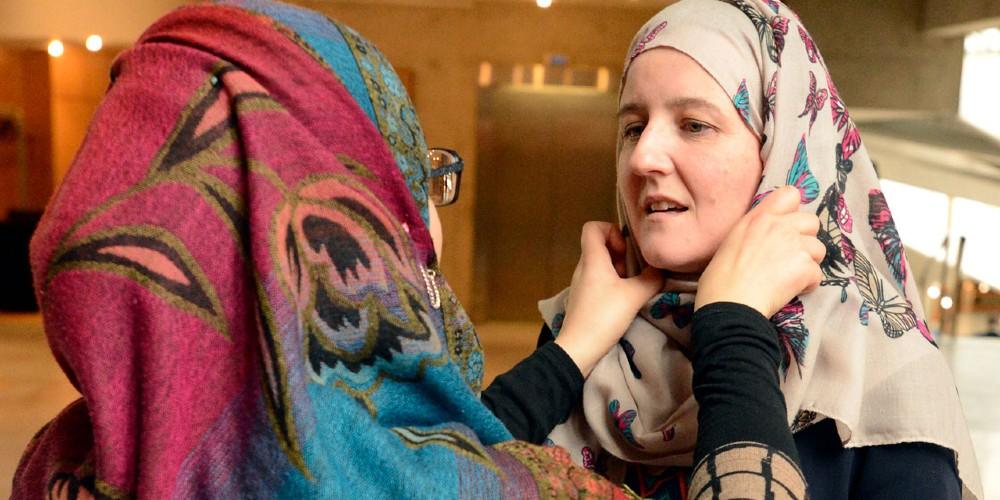
And those changing demographics, particularly the surge of Muslims in European nations, are going to make for a radically different West.
Take France, which has been roiled by assimilation challenges. Just this month, prominent French author Michel Houellebecq was placed under judicial investigation following a complaint from the Union of Mosques of France.
Houellebecq’s sin? Saying, among other things, that the native French wanted Muslims “to stop stealing from and assaulting them … for their violence to decrease, for them to respect the law and other people,” according to a translation in The New York Times.
He continued, “Or, another good solution, for them to leave.”
JD’s manually curated links for God-fearing MAGA patriots
France’s Muslim Population Projected to Reach 20% by 2070
If demographic trends continue, assuming no shift in assimilation, Houellebecq certainly won’t be the last person facing such an investigation.
In 2020, France’s population was 46% Christian, 42% religiously unaffiliated, and 9% Muslim. But Christianity is projected to decline, even as Islam and secularism are projected to grow: In 2070, France will be a mere 25% Christian, 20% Muslim, and over half religiously unaffiliated (53%).
It’s a similar story in the U.K., where the Muslims are poised to grow from 6.4% of the population to 16%, even as Christians decrease from about half of the population to a quarter. The religiously unaffiliated are projected to surge from 40% of the population to 53%.
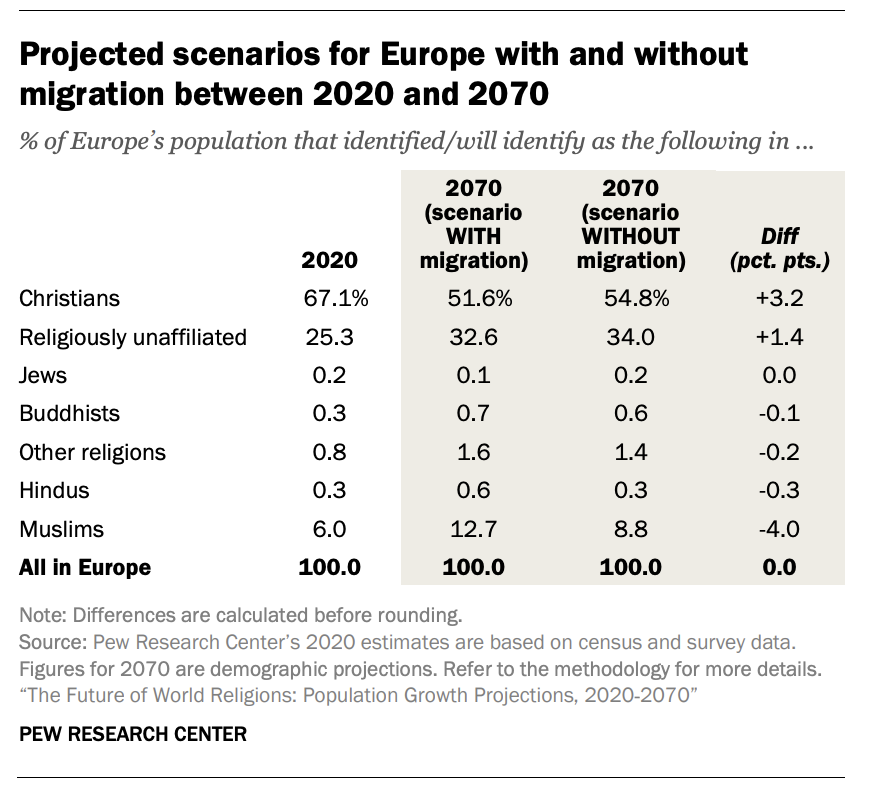
Overall, Europe will become nearly 52% Christian (down from 67%), 33% religiously unaffiliated (up from 25%), and 13% Muslim (up from 6%) by 2070.

The trend—an increase in the religiously unaffiliated and Muslims and a decrease in Christians—is also projected to occur in Canada, Australia, and the United States.
In the United States, Christians will no longer be the majority by 2070. Instead, Christians will be about 48% of the population (down from 64% in 2020), the religiously unaffiliated will be 41% of the population (up from 30% in 2020), and Muslims will be 3.7% of the population (up from 1.2% in 2020).
Surveys of Muslims in Britain and France Raise Assimilation Concerns
The changing demographics, particularly in nations where Muslims will increase, could have major implications for the politics and norms of Western countries. Two relatively recent surveys suggest that many Muslims in France and the U.K. aren’t assimilating.
Consider the findings of a 2024 survey, commissioned by the think tank Henry Jackson Society, that compared the views of the general British public with those of British Muslims on a host of issues—and highlighted just how much the opinions of British Muslims differed from the general public.
Almost a third of British Muslims (32%) supported making Islam the national religion of the U.K., and 32% supported implementing sharia law. Over half (52%) of British Muslims thought it should be illegal to show a picture of the Prophet Muhammad. Unsurprisingly, these views were not shared by the general British public: Among that population, 12% favored making Islam the national religion, 9% backed sharia law, and 16% agreed it should be illegal to show pictures of Muhammad.
A 2025 French survey similarly found concerning views among some Muslims. The Institut français d’opinion publique “found that 57 percent of 15 to 24-year-olds believe that Islamic Sharia laws should take precedence over the secular laws of the French Republic,” and “42 percent of young Muslims said that they had sympathy towards radical Islamist groups,” reported Breitbart.
Global Muslim Views on Sharia Law
There’s other evidence to suggest that many Muslims hold views that differ significantly from prevailing norms in Western countries. A new Heritage Foundation report, “Liberty and Justice Without Illusions or Appeasement: Islam and the American Constitutional Order,” outlines some of the laws in Muslim nations in the Middle East and North Africa that would shock many in Western nations. The report states:
- Blasphemy is a crime in 18 (90 percent) of the 20 countries in the Middle East and North Africa.
- Apostasy is a crime in 13 (65 percent) of those same 20 countries.
- Worldwide, 79 (40 percent) of 198 countries and territories had blasphemy laws in 2019; 22 (11 percent) outlawed apostasy.
- Seven countries—Nigeria, Pakistan, Iran, Afghanistan, Somalia, Mauritania, and Saudi Arabia—impose the death penalty for blasphemy.
As the report authors—Heritage Foundation vice presidents Jay Richards, Roger Severino, and Victoria Coates—write, “These laws reflect conventional Islamic beliefs that do not magically disappear once a Muslim immigrant enters the West.”
A 2013 Pew Research Center survey, which involved more than 38,000 face-to-face interviews with Muslims in 39 countries and territories, also found that many Muslims hold views that clash with Western norms. In many countries in South and Southeast Asia, sub-Saharan Africa, and the Middle East and North Africa, sizable majorities of Muslims favor making sharia the law of the land.
And that backing of sharia extends to what Westerners might consider some of its most extreme precepts. In 10 nations, “at least half of Muslims who favor making sharia the law of the land also favor stoning unfaithful spouses,” notes the Pew Research Center report. In at least six nations, half or more of sharia supporters also backed the death penalty for those who left Islam and converted to another faith.
Of course, many Muslims don’t share such extreme views. But the fact that a sizable number do points to the critical reality of Western nations being thoughtful regarding immigration and assimilation. Pew’s 2070 projections for Europe presume continued immigration by Muslims to Europe: If immigration were halted, Muslims, who have more children than Christians and agnostics, would make up 9% of Europeans by 2070, not 13%.
Projections, of course, are not infallible. Any reader of history is aware of how often what couldn’t happen does indeed happen, and what seemed inevitable is found to be quite evitable. Religious revivals have changed the course of history significantly many times before and no doubt will many times again.
But if the West is moving to a post-Christian future, wise citizens will be wary. Much of our cultural, legal, and political foundation is based on Judeo-Christian principles, and if a majority of the population no longer shares those values, it could result in significant upheaval. It will be vital not just to encourage assimilation but also for people to make the case for Western values—or risk the end of Western civilization.
Starting the Day With a Scripture-Inspired Roast Helps Center Your Thoughts on Eternal Truths Amid Temporal Pressures
The world can seem chaotic, especially right after we wake up. Many believers start their mornings reaching for something familiar — a hot cup of coffee — yet end up settling for mediocre brews that do little more than deliver a caffeine jolt. The daily grind of life, with its endless distractions, news cycles, and responsibilities, can leave even the most faithful feeling spiritually parched alongside their physical fatigue. What if your morning ritual could do more than wake you up? What if it could ground you in truth, nourish your body with exceptional quality, and quietly advance a kingdom purpose at the same time?
That’s the promise — and the reality — behind Promised Grounds Coffee. This Christian-founded company doesn’t just roast beans; it approaches every step as an act of worship and discipleship. By selecting only the top 10% of specialty-grade beans, ethically sourced from dedicated farmers in Central and South America, and small-batch roasting them with reverence in Austin, Texas, Promised Grounds delivers what many describe as the best coffee available — never burnt, never bland, but rich with origin stories and layered flavors that honor God’s creation.
From the vibrant Psalm 27 Roast (a light, bright medium option) to the bold yet peaceful 2 Timothy 1:7 Decaf, each bag carries a Scripture verse that turns your daily pour into a gentle reminder of faith. And through their Ounce Per Ounce Promise, every ounce of coffee you enjoy provides an equal ounce of clean water to families in need via partnership with Filter of Hope — literally brewing hope for body and soul, one cup at a time.
The challenge for today’s Christians runs deeper than finding a decent cup. In an age of convenience-driven consumerism, it’s easy to support companies that dilute values or remain silent on matters of faith. Many believers want their everyday choices — from what they drink to how they spend — to reflect discipleship rather than just convenience. Promised Grounds solves this by weaving Christian excellence into the entire process: beans nurtured with prayerful stewardship by farming families, roasted as an offering rather than a commodity, and packaged with Bible verses to encourage a mindset of gratitude and purpose from the first sip. Reviewers consistently praise the smooth, rich profiles — whether enjoyed black in a drip maker, iced on a warm day, or shared in fellowship — noting how the quality stands toe-to-toe with premium secular brands while delivering something far more meaningful.
This integration of faith and flavor addresses a real need in Christian households and ministries. Busy parents, church leaders, and remote workers alike report that starting the day with a Scripture-inspired roast helps center their thoughts on eternal truths amid temporal pressures. The coffee’s exceptional character — bright citrus notes in lighter roasts or deep chocolate undertones in bolder ones — comes from meticulous selection and careful roasting that respects the bean’s natural gifts rather than masking them. It’s the kind of coffee that elevates a simple quiet time, fuels productive workdays, or sparks meaningful conversations when shared at Bible studies or outreach events. And because it’s ethically sourced with integrity, every purchase supports sustainable livelihoods for farmers who treat their crops like family harvests.
For those leading churches or small groups, the impact multiplies. Promised Grounds offers bundles and options perfect for hospitality ministries, turning ordinary coffee service into an opportunity to point people toward the living water of Christ. Imagine greeting visitors with a warm cup whose very bag carries God’s Word — a subtle yet powerful witness that aligns with the Great Commission. The company’s Texas roots and commitment to “brewing hope” resonate especially with believers who value American enterprise paired with global compassion.
Of course, quality alone isn’t enough if the experience feels out of reach. Promised Grounds keeps it accessible with practical perks like free shipping on orders over $40, sample sets for discovering favorites, and thoughtful add-ons such as faith-themed mugs. Whether you prefer whole beans for fresh grinding, grounds for convenience, or even bulk options for larger households and ministries, the result is consistently superior coffee that makes discipleship feel integrated rather than added on.
As you consider how to align even the smallest habits with your walk with God, Promised Grounds Coffee stands out as a refreshing solution. It tackles the dual problems of subpar daily sustenance and disconnected consumption by offering a product that genuinely excels in taste while advancing a mission of clean water, farmer dignity, and scriptural encouragement. Believers who make the switch often describe it as more than a beverage upgrade — it becomes part of their rhythm of gratitude, a daily invitation to remember that every good gift comes from above.
If you’re ready to transform your mornings (and perhaps your church gatherings) with coffee that honors both exceptional craftsmanship and Christian values, I encourage you to explore what Promised Grounds has to offer. One sip at a time, you’ll be nourishing your body, refreshing your spirit, and participating in something far greater — all while enjoying what truly is among the best coffee available.