
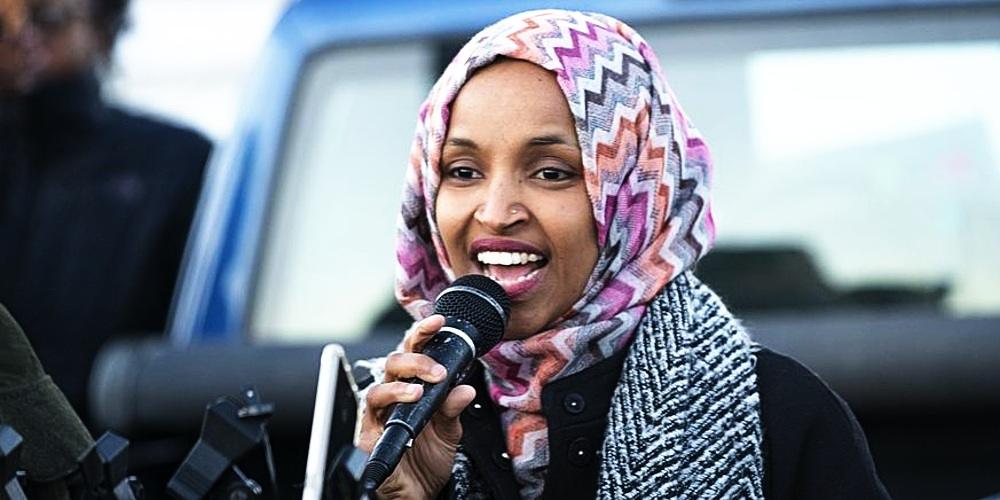
 (DCNF)—A Somali-born historian who researched the role of Rep. Ilhan Omar’s father in the bloody regime of dictator Siad Barre found his trip to Minnesota canceled this week, allegedly due to the potential for clan violence.
Mohamed Haji Ingiriis, a Somali-born fellow at King’s College in London, was scheduled to receive a Somali Hero Award in Minneapolis on Nov. 14 for his scholarship. But the event organizers warded him off at the last minute, Ingiriis told the Daily Caller News Foundation, saying that any Somali who has been critical of the congresswoman cannot safely travel to Minneapolis.
The organizers revoked his airline ticket and pulled the award, alleges Ingiriis, who earned his African history PhD at the University of Oxford. Deleted Facebook posts indexed by Google indicate his participation was canceled.
Ali Gaashaan, the president of the Somali Hero Awards, denied Ingiriis’s version of events in texts to the DCNF. Gaashaan said that he “has never heard threats of violence against any critic” of Omar.
Presented with a report by Alpha News detailing online threats by a man tied to Omar, Gaashaan alleged that Alpha News and the DCNF have “an extreme right-wing agenda.” Asked why Ingiriis’s participation in the event was canceled, Gaashaan did not reply.
In the course of researching the Barre regime, Ingiriis uncovered information that undermines the heart of Omar’s meteoric rise in politics — her origin story as a Somali refugee escaping persecution.
“Of the many titles I hold … one represents a part of my identity that I hold particularly close to my heart: refugee,” she wrote in 2024.
That may be a macabre inversion of the truth.
According to Ingiriis’s research, Omar’s father’s name is Nur Said Elmi, despite her claims to the contrary. In 1989, Barre’s military dictatorship in Somalia began to crumble after years of violent rebellion by rival clans. Many senior military officers deserted. But Colonel Nur Said Elmi remained loyal.
Omar described him as an “educator” in her memoir.
That’s technically true: Nur Said oversaw the military training school in Baidoa, a large city in southern Somalia. He remained through the final days of Barre’s rule until it collapsed in 1991, suggesting he was deeply tied to the regime. Another clue: The colonel had earlier commanded a military brigade stationed in Barre’s hometown of Garbahaarrey, where the dictator’s body is now buried.
When Barre’s totalitarian grip on power faced usurpation from a rebel group called the Somali National Movement (SNM) made up of a rival clan, the Isaaqs, his government systematically executed them, rebels and civilians alike, including women and children. In 1988 he firebombed the city of Hargeisa where Isaaqs lived and worked, reducing it to rubble.

There is no evidence that Nur Said was at the site of Barre’s genocide in northern Somalia or committed war crimes, Ingriis said. But there is reason to investigate his actions given his high-ranking position in Barre’s government.
“You don’t get to that level and that rank with that sort of a regime by being the nice guy,” said Saeed Ibrahim, editor-in-chief of the Somaliland Chronicle.
Either way, Nur Said’s claim to refugee status was bogus, said Ingiriis.
“It is not legitimate because he was an ambassador of the military regime that caused this,” he said.
The present investigation by the American government into Omar originated in the Human Rights Violations and War Crimes Unit of Homeland Security Investigations (HSI), per a Newsmax report.
DHS did not respond to a request for comment.
Nur Said cannot respond to the allegations, having died of COVID-19 complications in 2020. An obituary in Sahan Journal, a Minnesota outlet geared to immigrants, identified him as Nur Omar Mohamed and as “an esteemed senior officer in the Somali National Army” with a “prestigious career as a colonel who led a successful regiment in the Somali-Ethiopian war during the late 1970s.”
Omar’s office did not respond to detailed questions about Ingiriis’s research into her father or his canceled award, about the Department of Justice legal case against her, about reports of violent threats, or about her ex-husband. The government’s investigation burst into public view when federal agents searched Omar’s home on Oct. 12. The case allegedly involves allegations that she entered into a sham marriage with a man named Ahmed Nur Said Elmi to help him obtain a green card.
The FBI and DHS investigated the marriage during the Obama administration and uncovered evidence that it was fraudulent, but no charges were filed, the New York Times reported.
When Barre’s regime fell, gunmen penetrated the secluded compound where Omar lived, per a 2016 Minneapolis City Pages article. Nur Said first hid out with contacts in Nairobi, Kenya.
He was then processed as a refugee by the United Nations in the Utange, Kenya, refugee camp, arriving to the U.S. in 1995 as a refugee.
By 2001, the UN prepared an investigation into the war crimes of the government that her father had served.
Heavy rain had excavated mass graves in northern Somalia, in an area now known as Somaliland. Barre’s men had tied the corpses together in groups of ten before chucking them into the ground, the UN investigation shows.
Barre could not tolerate a separate Somaliland because his legitimacy partly derived from his vision of a “Greater Somalia” that transcended clan rivalries, different colonial histories, and diverging dialects, said Ibrahim. The regime referred to the regions of Kenya, Ethiopia and Djibouti housing some ethnic Somalis as “occupied territories.”
Omar too has opposed independence for Somaliland, the area where Barre — the leader to whom her father pledged allegiance — executed as many as 200,000 people.
“Somalia is one. We are brothers and sisters, and our land will not be balkanized,” she said in the Somali language in Minnesota in 2024, according to the English translation that Omar said is the most accurate. “Our lands were taken from us before, and God willing, we may one day seek them, but what we have now will not be balkanized.”
Omar’s office also did not respond to questions about the investigation into her background originating in the DHS war crimes unit or about her statements about reclaiming “taken” lands in 2024.
Two of Omar’s reported siblings were photographed with the architect of the Isaaq genocide, war criminal Mohamed Said Hersi “Morgan,” the New York Post reported. Morgan’s “death letter” calling for a “campaign of obliteration” against the Isaaq “virus” served as key proof for the UN that a genocide had occurred.
Much is still unknown about the activities of Omar’s father. Documents were destroyed when the presidential palace was ransacked in the final days of the regime.
As he prepared the 2001 report, the UN investigator could only spend one week in Baidoa, where Nur Said had been stationed.
‘Smiled and Giggled’
Omar refers to her father as Nur Omar Mohamed. He also went by Abdullahi Omar Mohamed, the name he used when he enlisted at Utange refugee camp in Kenya after finally fleeing Somalia, per Ingiriis.
The congresswoman has adopted “Abdullahi” and “Omar” as her middle name and surname.
A Department of Justice court filing referred to Omar as Ilhan Nur Said Elmi. But the 47-page document is heavily redacted and does not reveal any evidence that might indicate that she used a pseudonym. If accurate, according to patronymic Somali naming conventions, her name would indicate that she is the daughter of someone named Nur Said Elmi. Her ex-husband’s name, Ahmed Nur Said Elmi, indicates he is the son of someone named Nur Said Elmi.
If confirmed, the discovery that Omar’s father was actually named Nur Said would indicate that her ex-husband, Ahmed Nur Said Elmi, may be her brother. He described himself as a “gay man” in a recent academic paper, the DCNF first reported.
In an interview with MS NOW in October, she called the accusation that she married her brother “insane” but stopped short of giving a flat-out denial.
“You’re not related to him at all?” journalist Chris Hayes asked. “There’s not a weird kernel of truth that’s through some game?”
“Not to my knowledge,” Omar replied.
Some of Barre’s men lived comfortable lives in the West for decades.
The U.S. government may have tolerated Barre’s men being in the U.S. because of its prior support for the Barre regime, Igiriis said.
The Reagan administration sought to bring the socialist Barre into the American fold after his decision to invade Ethiopia caused a falling out with his Soviet backers. The U.S. military trained more than 300 officers of Barre’s military in the 1980s through a Pentagon program called International Military Education and Training (IMET) at Fort Leavenworth.
Nur Said worked for the U.S. Postal Service for ten years, Omar’s memoir shares.
Omar’s memoir recounts a trip with her father to Puntland, a northern region of Somalia where he was born, and where he introduced her to government ministers.
“Happier than I had seen him since I was seven, Aabe [father] smiled and giggled all the time,” Omar wrote.
All content created by the Daily Caller News Foundation, an independent and nonpartisan newswire service, is available without charge to any legitimate news publisher that can provide a large audience. All republished articles must include our logo, our reporter’s byline and their DCNF affiliation. For any questions about our guidelines or partnering with us, please contact [email protected].
Starting the Day With a Scripture-Inspired Roast Helps Center Your Thoughts on Eternal Truths Amid Temporal Pressures
The world can seem chaotic, especially right after we wake up. Many believers start their mornings reaching for something familiar — a hot cup of coffee — yet end up settling for mediocre brews that do little more than deliver a caffeine jolt. The daily grind of life, with its endless distractions, news cycles, and responsibilities, can leave even the most faithful feeling spiritually parched alongside their physical fatigue. What if your morning ritual could do more than wake you up? What if it could ground you in truth, nourish your body with exceptional quality, and quietly advance a kingdom purpose at the same time?
That’s the promise — and the reality — behind Promised Grounds Coffee. This Christian-founded company doesn’t just roast beans; it approaches every step as an act of worship and discipleship. By selecting only the top 10% of specialty-grade beans, ethically sourced from dedicated farmers in Central and South America, and small-batch roasting them with reverence in Austin, Texas, Promised Grounds delivers what many describe as the best coffee available — never burnt, never bland, but rich with origin stories and layered flavors that honor God’s creation.
From the vibrant Psalm 27 Roast (a light, bright medium option) to the bold yet peaceful 2 Timothy 1:7 Decaf, each bag carries a Scripture verse that turns your daily pour into a gentle reminder of faith. And through their Ounce Per Ounce Promise, every ounce of coffee you enjoy provides an equal ounce of clean water to families in need via partnership with Filter of Hope — literally brewing hope for body and soul, one cup at a time.
The challenge for today’s Christians runs deeper than finding a decent cup. In an age of convenience-driven consumerism, it’s easy to support companies that dilute values or remain silent on matters of faith. Many believers want their everyday choices — from what they drink to how they spend — to reflect discipleship rather than just convenience. Promised Grounds solves this by weaving Christian excellence into the entire process: beans nurtured with prayerful stewardship by farming families, roasted as an offering rather than a commodity, and packaged with Bible verses to encourage a mindset of gratitude and purpose from the first sip. Reviewers consistently praise the smooth, rich profiles — whether enjoyed black in a drip maker, iced on a warm day, or shared in fellowship — noting how the quality stands toe-to-toe with premium secular brands while delivering something far more meaningful.
This integration of faith and flavor addresses a real need in Christian households and ministries. Busy parents, church leaders, and remote workers alike report that starting the day with a Scripture-inspired roast helps center their thoughts on eternal truths amid temporal pressures. The coffee’s exceptional character — bright citrus notes in lighter roasts or deep chocolate undertones in bolder ones — comes from meticulous selection and careful roasting that respects the bean’s natural gifts rather than masking them. It’s the kind of coffee that elevates a simple quiet time, fuels productive workdays, or sparks meaningful conversations when shared at Bible studies or outreach events. And because it’s ethically sourced with integrity, every purchase supports sustainable livelihoods for farmers who treat their crops like family harvests.
For those leading churches or small groups, the impact multiplies. Promised Grounds offers bundles and options perfect for hospitality ministries, turning ordinary coffee service into an opportunity to point people toward the living water of Christ. Imagine greeting visitors with a warm cup whose very bag carries God’s Word — a subtle yet powerful witness that aligns with the Great Commission. The company’s Texas roots and commitment to “brewing hope” resonate especially with believers who value American enterprise paired with global compassion.
Of course, quality alone isn’t enough if the experience feels out of reach. Promised Grounds keeps it accessible with practical perks like free shipping on orders over $40, sample sets for discovering favorites, and thoughtful add-ons such as faith-themed mugs. Whether you prefer whole beans for fresh grinding, grounds for convenience, or even bulk options for larger households and ministries, the result is consistently superior coffee that makes discipleship feel integrated rather than added on.
As you consider how to align even the smallest habits with your walk with God, Promised Grounds Coffee stands out as a refreshing solution. It tackles the dual problems of subpar daily sustenance and disconnected consumption by offering a product that genuinely excels in taste while advancing a mission of clean water, farmer dignity, and scriptural encouragement. Believers who make the switch often describe it as more than a beverage upgrade — it becomes part of their rhythm of gratitude, a daily invitation to remember that every good gift comes from above.
If you’re ready to transform your mornings (and perhaps your church gatherings) with coffee that honors both exceptional craftsmanship and Christian values, I encourage you to explore what Promised Grounds has to offer. One sip at a time, you’ll be nourishing your body, refreshing your spirit, and participating in something far greater — all while enjoying what truly is among the best coffee available.