

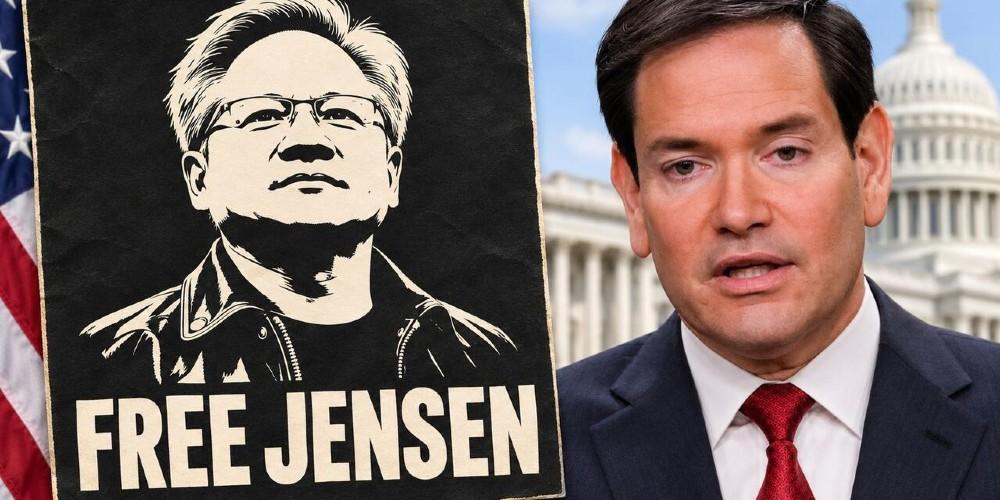
(Zero Hedge)—The classified memo whose leak set off Jensen Huang’s fall at Nvidia was Marco Rubio’s work, and Rubio built it from a CIA report that he recast “in his own more assertive terms,” according to a person familiar with the matter who spoke to the Washington Post for a report published Friday.
According to the report, CIA officials are “not yet convinced” that the intelligence gathered on Alice Huang – including intercepted communications – show she was knowingly passing information to Beijing, a source told CNN. Some officials at the Office of the Director of National Intelligence have called the spy label “over-torqued,” according to the network, while others say her access to Huang, and through him to President Trump, made her a counterintelligence risk whether or not she ever passed anything on.
The memo, overseen by Rubio as secretary of state and national security adviser, went to senior officials in the spring, before Trump’s May trip to Beijing, and Rubio also warned Trump in person, as we reported. Attorney General Todd Blanche said Nov. 12 that neither the Justice Department nor the FBI has confirmed whether Alice Huang was a spy, as we noted. Beijing denies it.
Commentator Arnaud Bertrand put the two reports side by side: if the CIA’s own analysts weren’t convinced, the “spy” framing was Rubio’s, not the agency’s.
A shadow war for Trump’s ear
According to the Post, the entire affair was the climax of a long fight over who sets Trump’s China policy. Huang won unusual access to the president and approval to sell AI chips to China, and China hawks across both parties, in the administration, Congress and the think tanks, had spent years trying to break that hold.
“They wanted to destroy the influence Jensen had over the president,” one former official told the paper, which called Huang’s exit a major win for that camp.
At the G7 in Paris, Rubio repeatedly declined to discuss his role. Asked whether the allegations changed his view of AI talks with Beijing, he said, “I work for the American people.”
Three bipartisan chip bills are now riding in the Senate’s version of the annual defense bill: the AI Overwatch Act from Sens. Jim Banks and Elizabeth Warren, which would give Congress power over chip export licenses, the Chip Security Act, aimed at smuggling, and Sen. Pete Ricketts’ MATCH Act, which would press allies to stop selling chipmaking tools to China, the South China Morning Post reported Nov. 11. House Democratic leader Hakeem Jeffries said he would work to “make sure that those provisions make it into the final version.”
The open-weights theory
Huang was also Washington’s loudest corporate defender of open-weight AI: his first-ever X post, in July, was a letter arguing that open models are essential to American AI leadership, as we detailed. Physicist and investor Steve Hsu wrote that he had heard “on very good authority” that Nvidia was planning “to go hard at producing frontier class open models”, so as not to depend on OpenAI or Anthropic to drive the industry forward.
Glenn Greenwald put the suspicion bluntly: “I don’t know who wanted Jensen Huang out but I know that whoever it was wields extreme levels of power.”
The tip from inside tech
The New York Times investigation that first tied Huang to Alice Huang also started outside government. Times reporter Tripp Mickle said on the paper’s The Daily podcast on Nov. 10 that he and Ana Swanson got a message last August from “a tech industry contact” telling them to “drop everything and look at this company called Megaspeed.” He did not name the contact.
Megaspeed is the Singapore-based renter of Nvidia computing power where Alice Huang once worked. That same August, Nvidia’s general counsel Tim Teter emailed the Commerce Department agents building a chip-smuggling case against Megaspeed, after which Commerce paused its work and the case moved to the Justice Department, as we reported. Nvidia has said it contacts officials to “answer their questions.”
Others went straight for Anthropic’s Dario Amodei, a leading advocate of tight AI rules and chip export limits. “Dario might be behind this whole Jensen Huang thing,” read one widely shared post, pointing to the $40 million Anthropic has given Public First Action, a group pushing for AI safeguards and export controls. Anthropic has said those gifts cannot be used to influence any election.
Dario might be behind this whole Jensen Huang thing.
Anthropic donated $40M to PublicFirstAction, which was founded by former U.S. Representative Brad Carson and Chris Stewart to advocate for AI safeguards and chip export controls.
Representative Brian Mast is leading the… pic.twitter.com/tWlnidNGtq
— Jinjing Liang (@JinjingLiang) November 12, 2026

A viral Chinese-language post went further and named an Anthropic co-founder as the Times’ tipster, citing only “open-source intelligence”; Mickle named no one. Nvidia, meanwhile, committed $10 billion to the private placement alongside Anthropic’s IPO, according to Anthropic’s amended filing, making Huang’s company one of the biggest buyers of the rival that supposedly knifed him.
Singapore pushes back
Researcher Brian Chau went after the Wall Street Journal, who pointed out the outlet’s correction noting that they fabricated statements from the Singapore government regarding an alleged investigation into Alice Huang.
Singapore’s Ministry of Home Affairs had already disputed the Journal’s Oct. 30 report that Singapore officials had concerns about Alice Huang’s ties to Huang and to Chinese intelligence. “Neither the Singapore Government nor its officials said this,” the ministry said Oct. 31, adding that its reply to the paper never mentioned her and only confirmed that the police investigation into Megaspeed is ongoing.
What’s left
Huang admitted he had been “unfaithful” to his wife, reports of further relationships followed, including one with a subordinate, and on Nov. 11 Nvidia’s board accepted his resignation “effective immediately”, according to the company’s 8-K, which gives no reason. CFO Colette Kress is interim CEO, and longtime director Harvey Jones became the board’s first-ever chair.
Prediction markets have other ideas: Arm CEO Rene Haas, Huang’s onetime protege, became the favorite on Polymarket after the board approached him on Friday. Elon Musk, on the prospect of bringing Huang on, posted in response to us:
Beijing says Washington is using the scandal to justify a chip “blockade.” The stock closed at $166.19 on Nov. 12, the day the resignation was announced, down 4.34% on the day and about 31% below its Oct. 6 record close of $239.24.
Whoever pulled the trigger, Nvidia reports quarterly results on Nov. 17 without Huang in the room, while the hawks’ three chip bills ride toward the final defense bill.
Starting the Day With a Scripture-Inspired Roast Helps Center Your Thoughts on Eternal Truths Amid Temporal Pressures
The world can seem chaotic, especially right after we wake up. Many believers start their mornings reaching for something familiar — a hot cup of coffee — yet end up settling for mediocre brews that do little more than deliver a caffeine jolt. The daily grind of life, with its endless distractions, news cycles, and responsibilities, can leave even the most faithful feeling spiritually parched alongside their physical fatigue. What if your morning ritual could do more than wake you up? What if it could ground you in truth, nourish your body with exceptional quality, and quietly advance a kingdom purpose at the same time?
That’s the promise — and the reality — behind Promised Grounds Coffee. This Christian-founded company doesn’t just roast beans; it approaches every step as an act of worship and discipleship. By selecting only the top 10% of specialty-grade beans, ethically sourced from dedicated farmers in Central and South America, and small-batch roasting them with reverence in Austin, Texas, Promised Grounds delivers what many describe as the best coffee available — never burnt, never bland, but rich with origin stories and layered flavors that honor God’s creation.
From the vibrant Psalm 27 Roast (a light, bright medium option) to the bold yet peaceful 2 Timothy 1:7 Decaf, each bag carries a Scripture verse that turns your daily pour into a gentle reminder of faith. And through their Ounce Per Ounce Promise, every ounce of coffee you enjoy provides an equal ounce of clean water to families in need via partnership with Filter of Hope — literally brewing hope for body and soul, one cup at a time.
The challenge for today’s Christians runs deeper than finding a decent cup. In an age of convenience-driven consumerism, it’s easy to support companies that dilute values or remain silent on matters of faith. Many believers want their everyday choices — from what they drink to how they spend — to reflect discipleship rather than just convenience. Promised Grounds solves this by weaving Christian excellence into the entire process: beans nurtured with prayerful stewardship by farming families, roasted as an offering rather than a commodity, and packaged with Bible verses to encourage a mindset of gratitude and purpose from the first sip. Reviewers consistently praise the smooth, rich profiles — whether enjoyed black in a drip maker, iced on a warm day, or shared in fellowship — noting how the quality stands toe-to-toe with premium secular brands while delivering something far more meaningful.
This integration of faith and flavor addresses a real need in Christian households and ministries. Busy parents, church leaders, and remote workers alike report that starting the day with a Scripture-inspired roast helps center their thoughts on eternal truths amid temporal pressures. The coffee’s exceptional character — bright citrus notes in lighter roasts or deep chocolate undertones in bolder ones — comes from meticulous selection and careful roasting that respects the bean’s natural gifts rather than masking them. It’s the kind of coffee that elevates a simple quiet time, fuels productive workdays, or sparks meaningful conversations when shared at Bible studies or outreach events. And because it’s ethically sourced with integrity, every purchase supports sustainable livelihoods for farmers who treat their crops like family harvests.
For those leading churches or small groups, the impact multiplies. Promised Grounds offers bundles and options perfect for hospitality ministries, turning ordinary coffee service into an opportunity to point people toward the living water of Christ. Imagine greeting visitors with a warm cup whose very bag carries God’s Word — a subtle yet powerful witness that aligns with the Great Commission. The company’s Texas roots and commitment to “brewing hope” resonate especially with believers who value American enterprise paired with global compassion.
Of course, quality alone isn’t enough if the experience feels out of reach. Promised Grounds keeps it accessible with practical perks like free shipping on orders over $40, sample sets for discovering favorites, and thoughtful add-ons such as faith-themed mugs. Whether you prefer whole beans for fresh grinding, grounds for convenience, or even bulk options for larger households and ministries, the result is consistently superior coffee that makes discipleship feel integrated rather than added on.
As you consider how to align even the smallest habits with your walk with God, Promised Grounds Coffee stands out as a refreshing solution. It tackles the dual problems of subpar daily sustenance and disconnected consumption by offering a product that genuinely excels in taste while advancing a mission of clean water, farmer dignity, and scriptural encouragement. Believers who make the switch often describe it as more than a beverage upgrade — it becomes part of their rhythm of gratitude, a daily invitation to remember that every good gift comes from above.
If you’re ready to transform your mornings (and perhaps your church gatherings) with coffee that honors both exceptional craftsmanship and Christian values, I encourage you to explore what Promised Grounds has to offer. One sip at a time, you’ll be nourishing your body, refreshing your spirit, and participating in something far greater — all while enjoying what truly is among the best coffee available.