
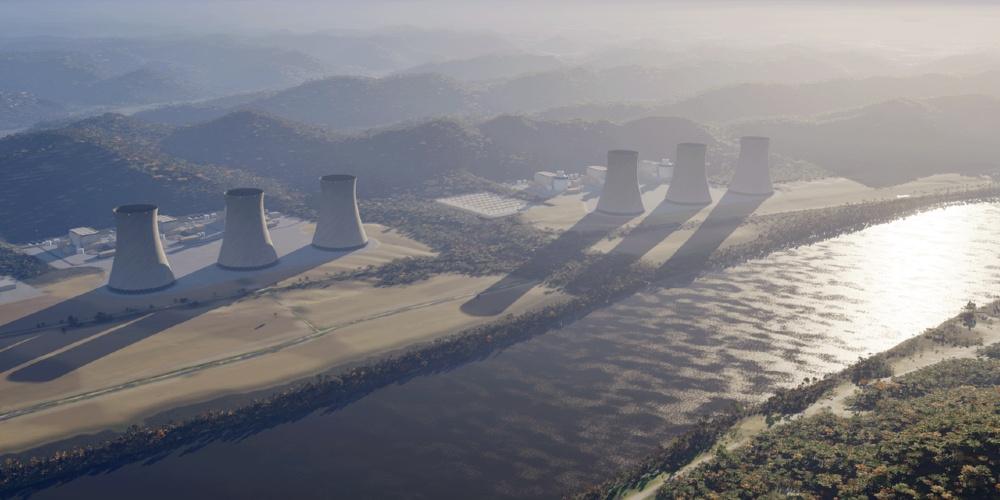
(Zero Hedge)—The Nuclear Company (TNC) unveiled plans on October 21st for Prosperity One, a campus on the Ohio River in Lewis County, Kentucky, with room for up to six Westinghouse AP1000 reactors.
At roughly 6.6 GW, a fully built Prosperity One would top Georgia’s four-unit Plant Vogtle as the largest nuclear plant in the country. That’s more than a third of the roughly 18 GW of generating capacity Kentucky currently has.
It would also be Kentucky’s first commercial reactor. The state only lifted its decades-old restrictions on new nuclear construction in 2017.
The first phase calls for two units, and TNC wants federal approvals in hand to start construction in 2028.
That’s ambitious for a project that hasn’t filed anything with the NRC or PJM yet…
The Carrs Bottom site near Vanceburg was once assembled for a coal plant that was later abandoned, and it sits half a mile from a 765 kV line feeding PJM. The land belongs to lifelong Lewis County resident Sam Howard, who is partnering on the project.
“I have nine grandchildren, and all of them live in Lewis County,” Howard said. “I want them to have the opportunity to stay.”
We’ve been tracking TNC for a while. In April, we reported the startup was preparing to propose an AP1000 at one of three South Carolina sites, noting that the $80 billion Westinghouse deal struck with Washington six months earlier had produced zero visible shovels in the dirt.
Weeks later, TNC and Brookfield, which owns 51% of Westinghouse, teamed up on a new company to develop Westinghouse reactor projects. Its first job is the possible completion of VC Summer Units 2 and 3, the two half-built AP1000s abandoned in 2017 after South Carolina utilities sank about $9 billion into them.
- Hand-curated links from conservative and Christian sites — NO legacy media garbage links. Patriots get their news every day at JDRucker.com
Cost overruns at the miserably managed Vogtle and Summer projects drove Westinghouse into bankruptcy that same year. Fast forward almost 10 years, and now the company is looking to IPO at almost $50 billion.
In May, we noted Brookfield was working toward a final investment decision by 2027, which would mean paying state-owned Santee Cooper $2.7 billion for the unfinished units. Brookfield has since told Santee Cooper’s board it will make that call by March 31, 2028.
Kentucky is a bigger undertaking. Prosperity One is a greenfield site rather than an expansion of an existing plant, and TNC is betting that building the same reactor over and over will bring costs down.
Vogtle Unit 4 came online roughly 30% cheaper and faster than Unit 3, according to Heatmap. Joe Klecha, TNC’s chief nuclear officer and a Vogtle construction veteran, expects at least that much at Prosperity One: “The 30%, I would say, is the floor on the savings from the first unit to the second unit.”

That squares with the McKinsey work we covered in July, which credited identical units at the UAE’s Barakah plant with cutting costs “from construction of the first unit to the fourth by roughly 40 percent.”
The NRC has done some of the work already. On October 14th, it renewed the AP1000’s design certification through 2066, folding in lessons from the nearly 200 license amendments approved during Vogtle’s construction and startup.
Chairman Ho Nieh said the update “provides the regulatory foundation for America to move from building individual reactors to deploying them at scale.”
Now find a buyer
What TNC doesn’t have yet is a customer. It hasn’t disclosed a cost estimate, a financing plan, or who will own the plant, though it says it’s negotiating offtake agreements and expects deals by next year.
In June, the DOE offered a $17.5 billion conditional commitment for long-lead AP1000 equipment, built around up to five two-reactor sites. Prosperity One’s two-unit first phase would match that structure.
Then there’s Korea. When Seoul’s $120 billion reactor pledge was announced last month, Commerce Secretary Howard Lutnick said the units were “going in Kentucky,” among other states.
Brookfield says those AP1000s will go on federal land, but TNC hasn’t said whether Prosperity One is connected.
Two Storms, One Harvest

Every food crisis in living memory has been a one-shock event. The 2008 price spike was a commodity bubble. The 2020 shortages were a logistics failure. The 2022 grain scare was a war on one exporter’s ports. Each time, the system bent, adjusted, and recovered, and each time the experts assured us afterward that global markets are simply too big and too diversified to fail.
What nobody in Washington seems eager to discuss is that 2026 is shaping up to be something the modern food system has never actually faced. Two independent shocks, one climatic and one geopolitical, are converging on the same harvest cycle at the same time. Not sequentially. Simultaneously.
Start with the weather. The Pacific Ocean is currently building toward what forecasters now openly call a record event. NOAA’s Climate Prediction Center puts the odds of at least a strong El Niño near 88 percent, with roughly two in three odds it reaches “very strong” status, the tier reserved for perhaps three or four events in the entire satellite era. Every major global model now projects a median peak in Super El Niño territory, and most of them project it exceeding the 2015-16 event, which until now held the modern record. Sea surface anomalies were already brushing the super threshold in mid-July, months before these events normally peak. The atmosphere has already shifted into El Niño mode, and the event is forecast to crest in late fall and early winter.
This is not about “climate change.” It’s about the standard cycles of weather, and the cycle we’re currently in is one that has likely devastated societies in the past. We’re better prepared as a society today, but not all Americans are equally prepared.
Serious households have started doing the quiet math on their own. Grocery bills tell part of the story, and the forecast maps tell the rest, which is why long-term food storage has moved from fringe hobby to mainstream line item in the family budget, with established suppliers like Heaven’s Harvest seeing demand from people who five years ago would have rolled their eyes at the idea. That instinct is not paranoia. It is pattern recognition, and the pattern is worth walking through carefully.
Editor’s Note: Heaven’s Harvest IS a sponsor, but the warnings of this article are real and would be written even if we didn’t have a survival food sponsor. With that said, those who take advantage of what they offer can use promo code “Patriot” for 15% off.
The Fertilizer Clock Is Already Running
While the Pacific warms, the second shock has been unfolding in the Strait of Hormuz. The conflict with Iran turned the world’s most important energy chokepoint into a contested waterway, and the consequences reach far beyond the gas pump. Roughly a third of global fertilizer trade moves through Hormuz, and the disruption sent urea prices up 86 percent year over year by March, with a 53 percent jump in a single month.
The World Bank projects energy prices rising about 24 percent in 2026 and fertilizer about 31 percent. By its own accounting, fertilizer prices ran 35 percent higher in the first five months of this year than the same period last year.
Here is the mechanism the nightly news will not explain. Fertilizer is not a grocery item. It is a time-delayed input. The nitrogen a farmer in Iowa or Punjab could not afford to apply this spring does not show up as a problem this spring. It shows up as a thinner harvest six to twelve months later.
The World Bank’s own food security brief concedes that the effects of reduced applications earlier this season “are likely to become visible only later in harvest outcomes.” Translate that from institutional language into plain English and it means this. The damage is already done, it is already in the ground, and we are simply waiting for it to arrive on the shelf.
Now check the calendar. Six to twelve months from the spring planting season lands us squarely in late 2026 and early 2027. Which is precisely when the strongest El Niño in the instrumental record is forecast to peak, bringing its signature droughts to Southeast Asia, Australia, southern Africa, northern Brazil, and South Asia, the very regions that grow the world’s rice, sugar, and oilseeds.
The World Bank warns openly that a strong El Niño “could disrupt multiple crop belts simultaneously” on top of the conflict-driven input costs. Their baseline projection assumes the Middle East disruptions ease by autumn. What in the last two years of Middle East history suggests that assumption is safe?
The System Has No Slack Left
The comfortable answer is that global markets always adjust. But adjustment requires slack, and the slack is gone. Global cereal production is expected to decline from last year’s records even before El Niño does its work. The UN World Food Programme, hardly a den of right-wing preppers, is calling this the most significant disruption to its supply chains since Covid and the invasion of Ukraine, and its supply chain director put the stakes bluntly.
Today’s supply chain challenges are tomorrow’s hunger crisis.
There is also a political dimension that markets cannot price. When food gets scarce, governments do not behave like economists. They behave like politicians. Export bans, hoarding mandates, and panic buying at the national level turned the modest rice shortfall of 2008 into a global crisis, and analysts are already warning that import-dependent nations are the first dominoes.
The 2015-16 Super El Niño, a far weaker event than what is now forecast, threw tens of millions into food stress across Africa and Asia. This one is projected to be stronger, and it arrives with fertilizer already rationed by price and shipping lanes already contested by missiles.
What Joseph Knew
Scripture does not treat preparation for lean years as faithlessness. It treats it as wisdom delivered in advance to those willing to act on it.
Behold, there come seven years of great plenty throughout all the land of Egypt: And there shall arise after them seven years of famine; and all the plenty shall be forgotten in the land of Egypt.
Joseph did not respond to that warning with a hashtag or a committee. He stored grain during the years of abundance, and when the famine came, Egypt stood while its neighbors begged. The lesson is not that famine is certain. It is that the time to prepare is precisely when preparation still looks optional.
Nobody who filled a pantry in a year of plenty has ever regretted it, and nobody standing in an empty aisle has ever been glad he waited for certainty.
None of this calls for panic, and panic is the enemy of sound judgment anyway. It calls for the same unglamorous prudence our grandparents considered ordinary. Keep some cash margin, know your local growers, and put real food in deep storage while it is cheap and available, because the entire arc of this story is that cheap and available is a closing window.
Families looking for a straightforward place to start can visit Heaven’s Harvest and use promo code Patriot for 15 percent off long-term storable food. The forecasts may yet soften, the strait may yet reopen, and we should pray they do. But hope is a fine thing to hold and a foolish thing to eat.