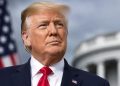

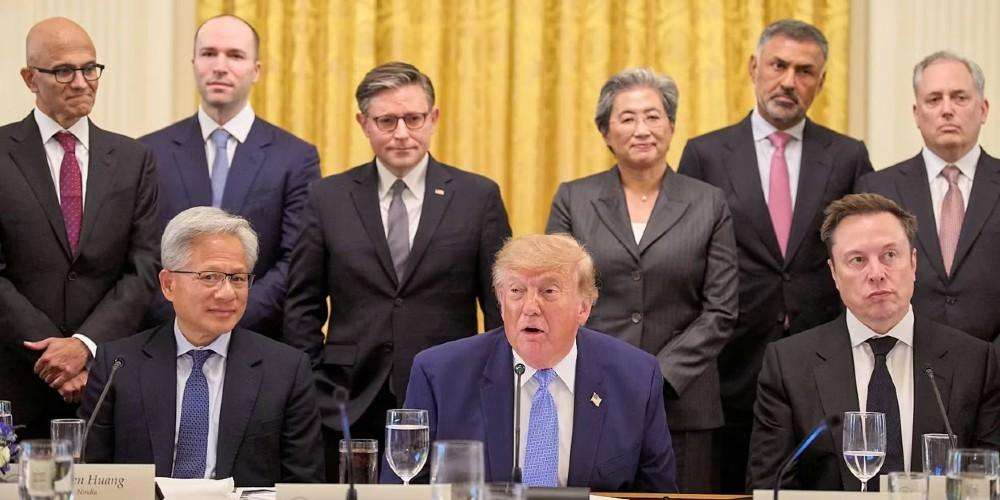
 (DCNF)—President Donald Trump on Tuesday signed what he called a “morally binding” artificial intelligence document with tech leaders that appears to enshrine a light-touch regulatory approach to AI.
Trump and tech executives signed an accord that would affirm that tech companies are responsible in mitigating AI-related safety risks. Critics argue that the many times AI models have hacked government websites and companies as well as other potential risks, prove that the industry cannot self-regulate.
“In order to build a positive future for the American people and the world, we believe every company is responsible for developing its own technology safely and in a way that builds trust with customers and the public,” the White House Accord on Super Intelligence stated, per the president’s Tuesday post to Truth Social.
The accord follows as Congress has failed to pass any legislation that would set guardrails on the AI industry.
It affirms that AI companies should implement internal controls to prevent AI risks and partner with an independent, external auditor to assess whether the companies’ controls are working as intended.
The Federal Trade Commission (FTC) also plans to compel AI companies to provide documents and testimony about the alleged dangers their models may present to the country.
Trump, accompanied by top tech executives, told reporters Tuesday that he has seen “tremendous self-policing” and that the administration is thinking about building a 10-person committee to oversee the AI industry, according to CNBC.
Trump said he also plans to name a new AI czar within the next week.
“President Trump has been clear that America will lead the world in Super Intelligence while protecting American consumers. Thanks to President Trump, the world’s leading SI innovators signed the White House Accord on Super Intelligence to advance American innovation and strengthen responsible development,” a White House official told the Daily Caller News Foundation in a written statement.
A White House spokesperson did not respond to the DCNF’s request for comment.
The statement of principles is “voluntary on behalf of the industry,” House Speaker Mike Johnson said at the White House.
“We all need to work together to make sure that we can win, and we can win safely. If we do this right, if we work with the president and everyone here, we can win safely,” Anthropic CEO Dario Amodei said at the White House on Tuesday.

He added that potential rulemaking to address AI safety risks is “still under discussion.”
An Anthropic spokesperson referred the DCNF to Amodei’s comments at the White House.
“The principle is simple: the companies building this technology have the primary responsibility to develop and deploy it safely, and to be accountable when they fall short,” Jensen Huang, the CEO of Nvidia, wrote on X in late September.
“The future of Super Intelligence will be shaped not only by what it can do, but by the confidence it earns. By building with ambition, rigor, and responsibility, we can help ensure this extraordinary technology expands opportunity and improves lives for generations to come,” he added.
Advanced Micro Devices (AMD) CEO Lisa Su said she was “very encouraged” by the Tuesday event and argued there was a “lot of optimism and a sense of responsibility.”
“I mean, at the end of the day, it’s our responsibility to show the power of the technology as well as ensure that it’s very safe,” Su told reporters, per CNBC.
David Sacks, Trump’s former AI and crypto czar, disputed critics’ arguments that AI companies will “self-police” the technology.
“Once an independent auditor reports a safety issue to an independent board committee, directors have a fiduciary duty not to disregard it, and a D&O carrier can use a bad-faith finding to deny coverage. So although the agreement starts with internal controls, these are verified by external audit and board oversight — and then existing FTC and securities law still apply to any public claim the company does not keep,” he wrote on X on Thursday.
“This is far more practical than what Democrats want — a freeze on frontier development while China races ahead. Democrats should applaud what President Trump has accomplished. But they would rather use SI safety as a campaign issue than admit the Accord represents major progress,” he added.
The president signed an executive order this week rebranding artificial intelligence as “Super Intelligence.”
Pro-AI groups cheered the AI accord, believing it will bar companies from pushing regulations that may favor their own companies.
“President Trump deserves enormous credit for getting industry leaders to sign the landmark White House Accord on Super Intelligence. This agreement ensures that the leading super intelligence companies commit to safety controls, external audits, and real oversight–without creating a regulatory capture regime that would block competition in the industry. That’s a win for the president, a win for freedom, and a win for the American public,” an Innovation Council spokesperson told the DCNF in a statement.
Taylor Budowich, the former Trump White House deputy chief of staff, leads the council.
Although tech executives and the Trump administration expressed optimism about the AI accord, AI safety experts believe that hacking and cybercrime prove that the AI industry cannot self-regulate.
This accord demonstrates that we’re long past the question of whether these technologies are dangerous or need regulation. The question is whether we trust the companies to do this by themselves. Obviously we should not. These companies have jettisoned safety commitments countless times before, and they will do so again. Self-regulation is what has gotten us teen suicides, 1200 rogue AI bots, and an international cybercrime spree,” Anthony Aguirre, president and CEO of the Future of Life Institute, said in a statement to the DCNF.
“The risk of inaction — both politically and morally — is massive. An overwhelming bipartisan majority is demanding that Big Tech be reined in immediately, while experts warn that the risk of a catastrophic incident increases every day. Lawmakers must institute binding guardrails as soon as possible to avert the worst possible outcomes, and get control of AI,” Aguirre added.
“Securing commitments from the AI companies to improve safety and cybersecurity practices following this summer’s rogue AI incidents is a first step towards addressing AI threats. But more has to be done,” Chris MacKenzie, the vice president of communications for Americans for Responsible Innovation, told the DCNF in a statement.
“For too long, Big Tech has failed to follow through on its promises to stop online harms to kids, to respect our privacy, and to develop products safely. If we want Big Tech to play by the rules, we need mandatory, binding, and enforceable requirements enacted into law. Without that, we are at the whim of tech CEOs who have already lost the public’s trust,” MacKenzie continued.
AI continues to target governments, as AI agents attempted to hack the country’s Library and Archives Canada’s (LAC) website in May and June, AI research Transluce revealed. This revelations follows as OpenAI agents reportedly hacked an Australian government healthcare website.
The accord signed this week represents an alignment between the AI industry and the Trump administration that was once split over how to handle AI safety.
Amodei in mid-September called to pace AI development, citing potential risks to humanity, per his post on his personal website. OpenAI CEO Sam Altman, SpaceX CEO Elon Musk and Dennis Hassabis, the chair of Google Deepmind all backed the idea. The Anthropic CEO also called on governments to exempt the AI industry from antitrust rules that would bar them from coordinating on an AI slowdown.
The Trump administration’s accord also follows as the Senate left this week without addressing major issues facing the voters before the midterm elections, including legislation to address AI safety, the DCNF reported.
The Senate notably shot down a bill proposed by Republican Ohio Sen. Jon Husted that would have required states to consider making data centers pay for electricity costs caused by grid updates, the DCNF reported. The bill, however, did not mandate that states force data centers to pay more, which led lawmakers to say it would have no substantial impact.
All content created by the Daily Caller News Foundation, an independent and nonpartisan newswire service, is available without charge to any legitimate news publisher that can provide a large audience. All republished articles must include our logo, our reporter’s byline and their DCNF affiliation. For any questions about our guidelines or partnering with us, please contact [email protected].
Starting the Day With a Scripture-Inspired Roast Helps Center Your Thoughts on Eternal Truths Amid Temporal Pressures
The world can seem chaotic, especially right after we wake up. Many believers start their mornings reaching for something familiar — a hot cup of coffee — yet end up settling for mediocre brews that do little more than deliver a caffeine jolt. The daily grind of life, with its endless distractions, news cycles, and responsibilities, can leave even the most faithful feeling spiritually parched alongside their physical fatigue. What if your morning ritual could do more than wake you up? What if it could ground you in truth, nourish your body with exceptional quality, and quietly advance a kingdom purpose at the same time?
That’s the promise — and the reality — behind Promised Grounds Coffee. This Christian-founded company doesn’t just roast beans; it approaches every step as an act of worship and discipleship. By selecting only the top 10% of specialty-grade beans, ethically sourced from dedicated farmers in Central and South America, and small-batch roasting them with reverence in Austin, Texas, Promised Grounds delivers what many describe as the best coffee available — never burnt, never bland, but rich with origin stories and layered flavors that honor God’s creation.
From the vibrant Psalm 27 Roast (a light, bright medium option) to the bold yet peaceful 2 Timothy 1:7 Decaf, each bag carries a Scripture verse that turns your daily pour into a gentle reminder of faith. And through their Ounce Per Ounce Promise, every ounce of coffee you enjoy provides an equal ounce of clean water to families in need via partnership with Filter of Hope — literally brewing hope for body and soul, one cup at a time.
The challenge for today’s Christians runs deeper than finding a decent cup. In an age of convenience-driven consumerism, it’s easy to support companies that dilute values or remain silent on matters of faith. Many believers want their everyday choices — from what they drink to how they spend — to reflect discipleship rather than just convenience. Promised Grounds solves this by weaving Christian excellence into the entire process: beans nurtured with prayerful stewardship by farming families, roasted as an offering rather than a commodity, and packaged with Bible verses to encourage a mindset of gratitude and purpose from the first sip. Reviewers consistently praise the smooth, rich profiles — whether enjoyed black in a drip maker, iced on a warm day, or shared in fellowship — noting how the quality stands toe-to-toe with premium secular brands while delivering something far more meaningful.
This integration of faith and flavor addresses a real need in Christian households and ministries. Busy parents, church leaders, and remote workers alike report that starting the day with a Scripture-inspired roast helps center their thoughts on eternal truths amid temporal pressures. The coffee’s exceptional character — bright citrus notes in lighter roasts or deep chocolate undertones in bolder ones — comes from meticulous selection and careful roasting that respects the bean’s natural gifts rather than masking them. It’s the kind of coffee that elevates a simple quiet time, fuels productive workdays, or sparks meaningful conversations when shared at Bible studies or outreach events. And because it’s ethically sourced with integrity, every purchase supports sustainable livelihoods for farmers who treat their crops like family harvests.
For those leading churches or small groups, the impact multiplies. Promised Grounds offers bundles and options perfect for hospitality ministries, turning ordinary coffee service into an opportunity to point people toward the living water of Christ. Imagine greeting visitors with a warm cup whose very bag carries God’s Word — a subtle yet powerful witness that aligns with the Great Commission. The company’s Texas roots and commitment to “brewing hope” resonate especially with believers who value American enterprise paired with global compassion.
Of course, quality alone isn’t enough if the experience feels out of reach. Promised Grounds keeps it accessible with practical perks like free shipping on orders over $40, sample sets for discovering favorites, and thoughtful add-ons such as faith-themed mugs. Whether you prefer whole beans for fresh grinding, grounds for convenience, or even bulk options for larger households and ministries, the result is consistently superior coffee that makes discipleship feel integrated rather than added on.
As you consider how to align even the smallest habits with your walk with God, Promised Grounds Coffee stands out as a refreshing solution. It tackles the dual problems of subpar daily sustenance and disconnected consumption by offering a product that genuinely excels in taste while advancing a mission of clean water, farmer dignity, and scriptural encouragement. Believers who make the switch often describe it as more than a beverage upgrade — it becomes part of their rhythm of gratitude, a daily invitation to remember that every good gift comes from above.
If you’re ready to transform your mornings (and perhaps your church gatherings) with coffee that honors both exceptional craftsmanship and Christian values, I encourage you to explore what Promised Grounds has to offer. One sip at a time, you’ll be nourishing your body, refreshing your spirit, and participating in something far greater — all while enjoying what truly is among the best coffee available.