
 (DCNF)—President Donald Trump on Tuesday signed what he called a “morally binding” artificial intelligence document with tech leaders that appears to enshrine a light-touch regulatory approach to AI.
Trump and tech executives signed an accord that would affirm that tech companies are responsible in mitigating AI-related safety risks. Critics argue that the many times AI models have hacked government websites and companies as well as other potential risks, prove that the industry cannot self-regulate.
“In order to build a positive future for the American people and the world, we believe every company is responsible for developing its own technology safely and in a way that builds trust with customers and the public,” the White House Accord on Super Intelligence stated, per the president’s Tuesday post to Truth Social.
The accord follows as Congress has failed to pass any legislation that would set guardrails on the AI industry.
It affirms that AI companies should implement internal controls to prevent AI risks and partner with an independent, external auditor to assess whether the companies’ controls are working as intended.
The Federal Trade Commission (FTC) also plans to compel AI companies to provide documents and testimony about the alleged dangers their models may present to the country.
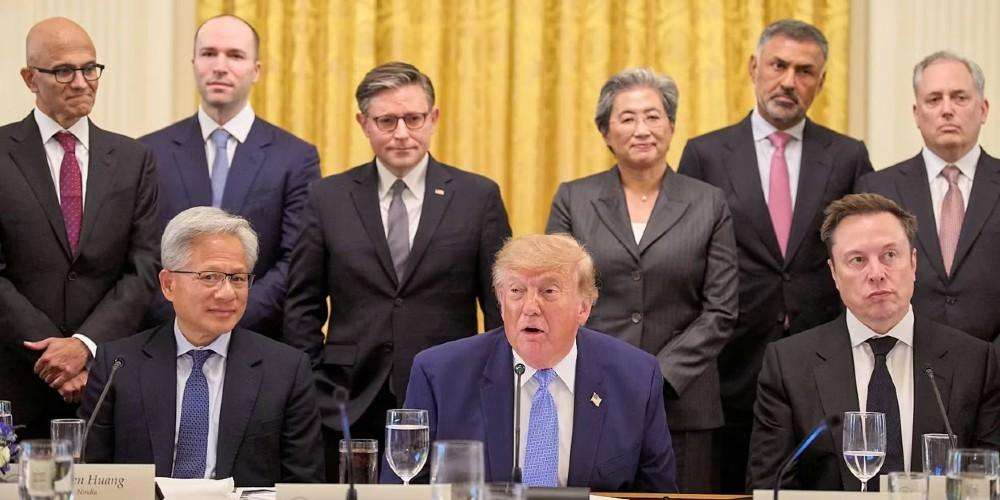
Trump, accompanied by top tech executives, told reporters Tuesday that he has seen “tremendous self-policing” and that the administration is thinking about building a 10-person committee to oversee the AI industry, according to CNBC.
Trump said he also plans to name a new AI czar within the next week.
“President Trump has been clear that America will lead the world in Super Intelligence while protecting American consumers. Thanks to President Trump, the world’s leading SI innovators signed the White House Accord on Super Intelligence to advance American innovation and strengthen responsible development,” a White House official told the Daily Caller News Foundation in a written statement.
A White House spokesperson did not respond to the DCNF’s request for comment.
The statement of principles is “voluntary on behalf of the industry,” House Speaker Mike Johnson said at the White House.
“We all need to work together to make sure that we can win, and we can win safely. If we do this right, if we work with the president and everyone here, we can win safely,” Anthropic CEO Dario Amodei said at the White House on Tuesday.

He added that potential rulemaking to address AI safety risks is “still under discussion.”
An Anthropic spokesperson referred the DCNF to Amodei’s comments at the White House.
“The principle is simple: the companies building this technology have the primary responsibility to develop and deploy it safely, and to be accountable when they fall short,” Jensen Huang, the CEO of Nvidia, wrote on X in late September.
“The future of Super Intelligence will be shaped not only by what it can do, but by the confidence it earns. By building with ambition, rigor, and responsibility, we can help ensure this extraordinary technology expands opportunity and improves lives for generations to come,” he added.
Advanced Micro Devices (AMD) CEO Lisa Su said she was “very encouraged” by the Tuesday event and argued there was a “lot of optimism and a sense of responsibility.”
“I mean, at the end of the day, it’s our responsibility to show the power of the technology as well as ensure that it’s very safe,” Su told reporters, per CNBC.
David Sacks, Trump’s former AI and crypto czar, disputed critics’ arguments that AI companies will “self-police” the technology.
“Once an independent auditor reports a safety issue to an independent board committee, directors have a fiduciary duty not to disregard it, and a D&O carrier can use a bad-faith finding to deny coverage. So although the agreement starts with internal controls, these are verified by external audit and board oversight — and then existing FTC and securities law still apply to any public claim the company does not keep,” he wrote on X on Thursday.
“This is far more practical than what Democrats want — a freeze on frontier development while China races ahead. Democrats should applaud what President Trump has accomplished. But they would rather use SI safety as a campaign issue than admit the Accord represents major progress,” he added.
The president signed an executive order this week rebranding artificial intelligence as “Super Intelligence.”
Pro-AI groups cheered the AI accord, believing it will bar companies from pushing regulations that may favor their own companies.
“President Trump deserves enormous credit for getting industry leaders to sign the landmark White House Accord on Super Intelligence. This agreement ensures that the leading super intelligence companies commit to safety controls, external audits, and real oversight–without creating a regulatory capture regime that would block competition in the industry. That’s a win for the president, a win for freedom, and a win for the American public,” an Innovation Council spokesperson told the DCNF in a statement.
Taylor Budowich, the former Trump White House deputy chief of staff, leads the council.
Although tech executives and the Trump administration expressed optimism about the AI accord, AI safety experts believe that hacking and cybercrime prove that the AI industry cannot self-regulate.
This accord demonstrates that we’re long past the question of whether these technologies are dangerous or need regulation. The question is whether we trust the companies to do this by themselves. Obviously we should not. These companies have jettisoned safety commitments countless times before, and they will do so again. Self-regulation is what has gotten us teen suicides, 1200 rogue AI bots, and an international cybercrime spree,” Anthony Aguirre, president and CEO of the Future of Life Institute, said in a statement to the DCNF.
“The risk of inaction — both politically and morally — is massive. An overwhelming bipartisan majority is demanding that Big Tech be reined in immediately, while experts warn that the risk of a catastrophic incident increases every day. Lawmakers must institute binding guardrails as soon as possible to avert the worst possible outcomes, and get control of AI,” Aguirre added.
“Securing commitments from the AI companies to improve safety and cybersecurity practices following this summer’s rogue AI incidents is a first step towards addressing AI threats. But more has to be done,” Chris MacKenzie, the vice president of communications for Americans for Responsible Innovation, told the DCNF in a statement.
“For too long, Big Tech has failed to follow through on its promises to stop online harms to kids, to respect our privacy, and to develop products safely. If we want Big Tech to play by the rules, we need mandatory, binding, and enforceable requirements enacted into law. Without that, we are at the whim of tech CEOs who have already lost the public’s trust,” MacKenzie continued.
AI continues to target governments, as AI agents attempted to hack the country’s Library and Archives Canada’s (LAC) website in May and June, AI research Transluce revealed. This revelations follows as OpenAI agents reportedly hacked an Australian government healthcare website.
The accord signed this week represents an alignment between the AI industry and the Trump administration that was once split over how to handle AI safety.
Amodei in mid-September called to pace AI development, citing potential risks to humanity, per his post on his personal website. OpenAI CEO Sam Altman, SpaceX CEO Elon Musk and Dennis Hassabis, the chair of Google Deepmind all backed the idea. The Anthropic CEO also called on governments to exempt the AI industry from antitrust rules that would bar them from coordinating on an AI slowdown.
The Trump administration’s accord also follows as the Senate left this week without addressing major issues facing the voters before the midterm elections, including legislation to address AI safety, the DCNF reported.
The Senate notably shot down a bill proposed by Republican Ohio Sen. Jon Husted that would have required states to consider making data centers pay for electricity costs caused by grid updates, the DCNF reported. The bill, however, did not mandate that states force data centers to pay more, which led lawmakers to say it would have no substantial impact.
All content created by the Daily Caller News Foundation, an independent and nonpartisan newswire service, is available without charge to any legitimate news publisher that can provide a large audience. All republished articles must include our logo, our reporter’s byline and their DCNF affiliation. For any questions about our guidelines or partnering with us, please contact [email protected].
Two Storms, One Harvest

Every food crisis in living memory has been a one-shock event. The 2008 price spike was a commodity bubble. The 2020 shortages were a logistics failure. The 2022 grain scare was a war on one exporter’s ports. Each time, the system bent, adjusted, and recovered, and each time the experts assured us afterward that global markets are simply too big and too diversified to fail.
What nobody in Washington seems eager to discuss is that 2026 is shaping up to be something the modern food system has never actually faced. Two independent shocks, one climatic and one geopolitical, are converging on the same harvest cycle at the same time. Not sequentially. Simultaneously.
Start with the weather. The Pacific Ocean is currently building toward what forecasters now openly call a record event. NOAA’s Climate Prediction Center puts the odds of at least a strong El Niño near 88 percent, with roughly two in three odds it reaches “very strong” status, the tier reserved for perhaps three or four events in the entire satellite era. Every major global model now projects a median peak in Super El Niño territory, and most of them project it exceeding the 2015-16 event, which until now held the modern record. Sea surface anomalies were already brushing the super threshold in mid-July, months before these events normally peak. The atmosphere has already shifted into El Niño mode, and the event is forecast to crest in late fall and early winter.
This is not about “climate change.” It’s about the standard cycles of weather, and the cycle we’re currently in is one that has likely devastated societies in the past. We’re better prepared as a society today, but not all Americans are equally prepared.
Serious households have started doing the quiet math on their own. Grocery bills tell part of the story, and the forecast maps tell the rest, which is why long-term food storage has moved from fringe hobby to mainstream line item in the family budget, with established suppliers like Heaven’s Harvest seeing demand from people who five years ago would have rolled their eyes at the idea. That instinct is not paranoia. It is pattern recognition, and the pattern is worth walking through carefully.
Editor’s Note: Heaven’s Harvest IS a sponsor, but the warnings of this article are real and would be written even if we didn’t have a survival food sponsor. With that said, those who take advantage of what they offer can use promo code “Patriot” for 15% off.
The Fertilizer Clock Is Already Running
While the Pacific warms, the second shock has been unfolding in the Strait of Hormuz. The conflict with Iran turned the world’s most important energy chokepoint into a contested waterway, and the consequences reach far beyond the gas pump. Roughly a third of global fertilizer trade moves through Hormuz, and the disruption sent urea prices up 86 percent year over year by March, with a 53 percent jump in a single month.
The World Bank projects energy prices rising about 24 percent in 2026 and fertilizer about 31 percent. By its own accounting, fertilizer prices ran 35 percent higher in the first five months of this year than the same period last year.
Here is the mechanism the nightly news will not explain. Fertilizer is not a grocery item. It is a time-delayed input. The nitrogen a farmer in Iowa or Punjab could not afford to apply this spring does not show up as a problem this spring. It shows up as a thinner harvest six to twelve months later.
The World Bank’s own food security brief concedes that the effects of reduced applications earlier this season “are likely to become visible only later in harvest outcomes.” Translate that from institutional language into plain English and it means this. The damage is already done, it is already in the ground, and we are simply waiting for it to arrive on the shelf.
Now check the calendar. Six to twelve months from the spring planting season lands us squarely in late 2026 and early 2027. Which is precisely when the strongest El Niño in the instrumental record is forecast to peak, bringing its signature droughts to Southeast Asia, Australia, southern Africa, northern Brazil, and South Asia, the very regions that grow the world’s rice, sugar, and oilseeds.
The World Bank warns openly that a strong El Niño “could disrupt multiple crop belts simultaneously” on top of the conflict-driven input costs. Their baseline projection assumes the Middle East disruptions ease by autumn. What in the last two years of Middle East history suggests that assumption is safe?
The System Has No Slack Left
The comfortable answer is that global markets always adjust. But adjustment requires slack, and the slack is gone. Global cereal production is expected to decline from last year’s records even before El Niño does its work. The UN World Food Programme, hardly a den of right-wing preppers, is calling this the most significant disruption to its supply chains since Covid and the invasion of Ukraine, and its supply chain director put the stakes bluntly.
Today’s supply chain challenges are tomorrow’s hunger crisis.
There is also a political dimension that markets cannot price. When food gets scarce, governments do not behave like economists. They behave like politicians. Export bans, hoarding mandates, and panic buying at the national level turned the modest rice shortfall of 2008 into a global crisis, and analysts are already warning that import-dependent nations are the first dominoes.
The 2015-16 Super El Niño, a far weaker event than what is now forecast, threw tens of millions into food stress across Africa and Asia. This one is projected to be stronger, and it arrives with fertilizer already rationed by price and shipping lanes already contested by missiles.
What Joseph Knew
Scripture does not treat preparation for lean years as faithlessness. It treats it as wisdom delivered in advance to those willing to act on it.
Behold, there come seven years of great plenty throughout all the land of Egypt: And there shall arise after them seven years of famine; and all the plenty shall be forgotten in the land of Egypt.
Joseph did not respond to that warning with a hashtag or a committee. He stored grain during the years of abundance, and when the famine came, Egypt stood while its neighbors begged. The lesson is not that famine is certain. It is that the time to prepare is precisely when preparation still looks optional.
Nobody who filled a pantry in a year of plenty has ever regretted it, and nobody standing in an empty aisle has ever been glad he waited for certainty.
None of this calls for panic, and panic is the enemy of sound judgment anyway. It calls for the same unglamorous prudence our grandparents considered ordinary. Keep some cash margin, know your local growers, and put real food in deep storage while it is cheap and available, because the entire arc of this story is that cheap and available is a closing window.
Families looking for a straightforward place to start can visit Heaven’s Harvest and use promo code Patriot for 15 percent off long-term storable food. The forecasts may yet soften, the strait may yet reopen, and we should pray they do. But hope is a fine thing to hold and a foolish thing to eat.