

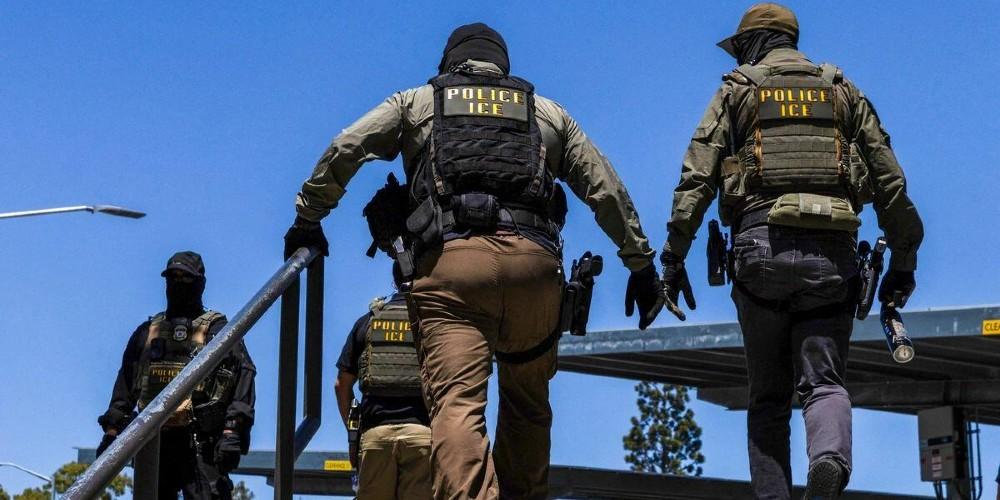
(Zero Hedge)—The Trump administration’s immigration crackdown ran into two separate legal challenges Thursday, as Denver sued to keep armed Immigration and Customs Enforcement agents away from polling places while a federal appeals court rejected the government’s attempt to subject millions of illegal immigrants already living inside the United States to mandatory detention without bond hearings.
The disputes involve different statutes and different courts, but the underlying fight is increasingly the same: how far can the executive branch push immigration enforcement under existing federal law before judges conclude that Congress never gave it the authority being claimed?
On one front, Denver and several national advocacy groups filed suit in federal court in Washington seeking to stop ICE officers from carrying out immigration enforcement at voting locations ahead of November’s midterm elections.
On the other, the Fourth Circuit Court of Appeals ruled 2-1 that immigrants who have been living inside the United States for years – even if they originally entered illegally – cannot automatically be placed into mandatory detention under the provision the administration has been invoking.
Together, the cases put fresh judicial pressure on one of the administration’s signature second-term policies.
Denver Takes ICE To Court Over The Polls
The City and County of Denver joined the League of United Latin American Citizens, Common Cause and UnidosUS in challenging what the plaintiffs characterize as a federal policy permitting armed ICE officers to conduct enforcement operations at polling locations.
The lawsuit, filed Sept. 10 in the U.S. District Court for the District of Columbia, invokes a rarely litigated Civil War-era federal statute, 18 U.S.C. § 592, that generally prohibits federal officials from bringing “troops or armed men” to places where elections are being conducted, except when needed to repel armed enemies of the United States.
The plaintiffs argue that even the prospect of armed immigration officers appearing at voting sites could deter voters, disrupt election workers and force municipalities to divert resources toward preparing for confrontations with federal agents. Denver officials are already training election personnel on how to identify federal agents, document encounters and de-escalate potential conflicts, according to the complaint.
The complaint also alleges that armed agents have already appeared at polling locations in San Antonio, Ventura County, California, and Syracuse, New York.
The lawsuit follows comments by Homeland Security Secretary Markwayne Mullin, who said ICE would not patrol polling places but would not exclude them from normal enforcement activity.
Mullin said agents could enter a voting location if there were a security threat or if officers were serving a warrant on a person they had been tracking, while the administration’s position is not that polling places are enforcement targets. It is that they are not automatically enforcement-free zones either.
DHS has similarly said ICE is not planning operations targeting polling sites, while maintaining that officers could make an arrest there if an active public-safety threat or targeted enforcement action required it.

That distinction is now headed for federal court – where the plaintiffs want a judge to declare the policy unlawful and prevent armed federal immigration officers from carrying out enforcement at polling locations and other places where votes are collected. The case arrives as election officials around the country prepare for a midterm season already saturated with litigation over voting rules, federal-state authority and election administration.
Fourth Circuit Rejects ICE Detention Theory
Hours away from the political fight over polling sites, the Fourth Circuit delivered a more immediate legal setback for the administration’s detention policy.
In Lopez Garcia v. Guadian, a divided three-judge panel held that two immigrants who had lived in the United States for years could not be mandatorily detained without an opportunity to seek release on bond.
The dispute centers on two sections of federal immigration law.
The administration contends that immigrants who entered the country without being legally admitted remain “applicants for admission” under Section 1225 of the Immigration and Nationality Act and therefore can be detained without bond while removal proceedings play out. The detainees argued – and the Fourth Circuit majority agreed – that immigrants already established inside the United States instead fall under Section 1226, which generally allows for bond consideration.
Judge Nicole Berner, joined by Senior Judge Barbara Keenan, said the latter interpretation better fits the text, structure and historical application of the statute. The court noted that Section 1226 had for decades generally governed detention of noncitizens already inside the country, while Section 1225 had traditionally been associated with people seeking admission at the border.
Berner warned that accepting the government’s interpretation could expose millions of people to mandatory detention without bond and said such a reading would imply Congress quietly authorized an unprecedented expansion of immigration detention when it rewrote immigration law in 1996.
The majority eventually compared the implications to some of the darkest chapters of American detention policy, including the confinement of Chinese immigrants in the late 19th century and the internment of roughly 120,000 people of Japanese ancestry during World War II.
The court ultimately affirmed habeas relief for Oscar Enrique Lopez Garcia and Juan Jose Rivera, ruling that both had to be given an opportunity to argue for release at a bond hearing.
The Dissent: Congress Meant What It Wrote
Judge Allison Jones Rushing rejected the majority’s reasoning – with her dissent focusing heavily on the wording Congress adopted in its sweeping 1996 immigration overhaul. Earlier immigration laws explicitly referred to “arriving” immigrants, ports of arrival and people attempting to enter the country. Congress removed much of that language in 1996 and instead defined a broader category of “applicants for admission.”
If Congress intended mandatory detention to remain limited to people physically arriving at the border, she argued, lawmakers could simply have retained the older language. Instead, Congress deliberately adopted terminology broad enough to include people physically present in the United States who had never been lawfully admitted. The statute treats anyone present without admission as an applicant for admission, and an applicant is by definition seeking admission, she wrote. “It’s that simple.”
The majority, she added, “clearly has strong views about what it considers the ‘moral implications'” of denying bond, but those views do not rewrite the text.
That statutory disagreement is no longer confined to one court – meanwhile, the Fourth Circuit has now joined the First, Second, Third, Sixth, Seventh, Ninth, Tenth and Eleventh Circuits on the side of bond eligibility for immigrants already living inside the country.
The Fifth and Eighth Circuits have taken the opposite view, concluding that the government’s mandatory-detention interpretation is consistent with the statute.
That 9-2 split puts the issue squarely in territory the Supreme Court often steps in to resolve.
ICE’s Next Battle May Be At The Supreme Court
The two developments illustrate the rapidly expanding legal front surrounding the administration’s immigration agenda. Denver’s lawsuit asks whether federal immigration officers can carry their normal enforcement authority into one of the most legally protected environments in American civic life: the polling place.
The Fourth Circuit case asks a different but potentially far larger question – whether the government can automatically detain broad categories of immigrants already living in the country without first giving them access to a bond hearing.
DHS maintains that the administration is enforcing immigration law as Congress wrote it. The Fourth Circuit majority says the government is attempting to extract sweeping detention powers from statutory language that does not clearly provide them.
And Denver is effectively making the same structural argument from another direction: whatever authority ICE may have to execute immigration law, Congress imposed special limits around elections. So while the administration continues expanding immigration enforcement on the ground, the courts are increasingly being asked to define the perimeter.
For ICE, that means the next phase of the immigration fight may be determined less by how many agents Washington deploys – and more by how the Supreme Court ultimately reads statutes Congress wrote decades ago.
Two Storms, One Harvest

Every food crisis in living memory has been a one-shock event. The 2008 price spike was a commodity bubble. The 2020 shortages were a logistics failure. The 2022 grain scare was a war on one exporter’s ports. Each time, the system bent, adjusted, and recovered, and each time the experts assured us afterward that global markets are simply too big and too diversified to fail.
What nobody in Washington seems eager to discuss is that 2026 is shaping up to be something the modern food system has never actually faced. Two independent shocks, one climatic and one geopolitical, are converging on the same harvest cycle at the same time. Not sequentially. Simultaneously.
Start with the weather. The Pacific Ocean is currently building toward what forecasters now openly call a record event. NOAA’s Climate Prediction Center puts the odds of at least a strong El Niño near 88 percent, with roughly two in three odds it reaches “very strong” status, the tier reserved for perhaps three or four events in the entire satellite era. Every major global model now projects a median peak in Super El Niño territory, and most of them project it exceeding the 2015-16 event, which until now held the modern record. Sea surface anomalies were already brushing the super threshold in mid-July, months before these events normally peak. The atmosphere has already shifted into El Niño mode, and the event is forecast to crest in late fall and early winter.
This is not about “climate change.” It’s about the standard cycles of weather, and the cycle we’re currently in is one that has likely devastated societies in the past. We’re better prepared as a society today, but not all Americans are equally prepared.
Serious households have started doing the quiet math on their own. Grocery bills tell part of the story, and the forecast maps tell the rest, which is why long-term food storage has moved from fringe hobby to mainstream line item in the family budget, with established suppliers like Heaven’s Harvest seeing demand from people who five years ago would have rolled their eyes at the idea. That instinct is not paranoia. It is pattern recognition, and the pattern is worth walking through carefully.
Editor’s Note: Heaven’s Harvest IS a sponsor, but the warnings of this article are real and would be written even if we didn’t have a survival food sponsor. With that said, those who take advantage of what they offer can use promo code “Patriot” for 15% off.
The Fertilizer Clock Is Already Running
While the Pacific warms, the second shock has been unfolding in the Strait of Hormuz. The conflict with Iran turned the world’s most important energy chokepoint into a contested waterway, and the consequences reach far beyond the gas pump. Roughly a third of global fertilizer trade moves through Hormuz, and the disruption sent urea prices up 86 percent year over year by March, with a 53 percent jump in a single month.
The World Bank projects energy prices rising about 24 percent in 2026 and fertilizer about 31 percent. By its own accounting, fertilizer prices ran 35 percent higher in the first five months of this year than the same period last year.
Here is the mechanism the nightly news will not explain. Fertilizer is not a grocery item. It is a time-delayed input. The nitrogen a farmer in Iowa or Punjab could not afford to apply this spring does not show up as a problem this spring. It shows up as a thinner harvest six to twelve months later.
The World Bank’s own food security brief concedes that the effects of reduced applications earlier this season “are likely to become visible only later in harvest outcomes.” Translate that from institutional language into plain English and it means this. The damage is already done, it is already in the ground, and we are simply waiting for it to arrive on the shelf.
Now check the calendar. Six to twelve months from the spring planting season lands us squarely in late 2026 and early 2027. Which is precisely when the strongest El Niño in the instrumental record is forecast to peak, bringing its signature droughts to Southeast Asia, Australia, southern Africa, northern Brazil, and South Asia, the very regions that grow the world’s rice, sugar, and oilseeds.
The World Bank warns openly that a strong El Niño “could disrupt multiple crop belts simultaneously” on top of the conflict-driven input costs. Their baseline projection assumes the Middle East disruptions ease by autumn. What in the last two years of Middle East history suggests that assumption is safe?
The System Has No Slack Left
The comfortable answer is that global markets always adjust. But adjustment requires slack, and the slack is gone. Global cereal production is expected to decline from last year’s records even before El Niño does its work. The UN World Food Programme, hardly a den of right-wing preppers, is calling this the most significant disruption to its supply chains since Covid and the invasion of Ukraine, and its supply chain director put the stakes bluntly.
Today’s supply chain challenges are tomorrow’s hunger crisis.
There is also a political dimension that markets cannot price. When food gets scarce, governments do not behave like economists. They behave like politicians. Export bans, hoarding mandates, and panic buying at the national level turned the modest rice shortfall of 2008 into a global crisis, and analysts are already warning that import-dependent nations are the first dominoes.
The 2015-16 Super El Niño, a far weaker event than what is now forecast, threw tens of millions into food stress across Africa and Asia. This one is projected to be stronger, and it arrives with fertilizer already rationed by price and shipping lanes already contested by missiles.
What Joseph Knew
Scripture does not treat preparation for lean years as faithlessness. It treats it as wisdom delivered in advance to those willing to act on it.
Behold, there come seven years of great plenty throughout all the land of Egypt: And there shall arise after them seven years of famine; and all the plenty shall be forgotten in the land of Egypt.
Joseph did not respond to that warning with a hashtag or a committee. He stored grain during the years of abundance, and when the famine came, Egypt stood while its neighbors begged. The lesson is not that famine is certain. It is that the time to prepare is precisely when preparation still looks optional.
Nobody who filled a pantry in a year of plenty has ever regretted it, and nobody standing in an empty aisle has ever been glad he waited for certainty.
None of this calls for panic, and panic is the enemy of sound judgment anyway. It calls for the same unglamorous prudence our grandparents considered ordinary. Keep some cash margin, know your local growers, and put real food in deep storage while it is cheap and available, because the entire arc of this story is that cheap and available is a closing window.
Families looking for a straightforward place to start can visit Heaven’s Harvest and use promo code Patriot for 15 percent off long-term storable food. The forecasts may yet soften, the strait may yet reopen, and we should pray they do. But hope is a fine thing to hold and a foolish thing to eat.