

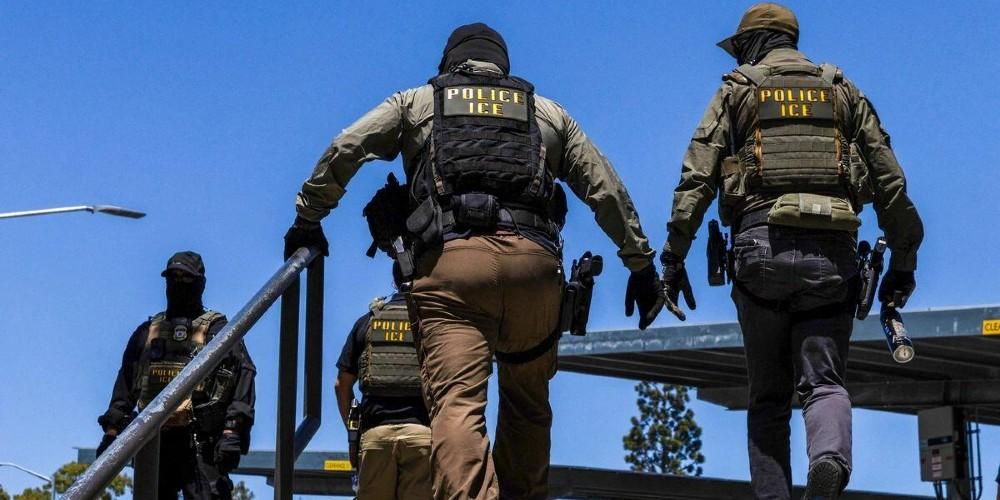
(Zero Hedge)—The Trump administration’s immigration crackdown ran into two separate legal challenges Thursday, as Denver sued to keep armed Immigration and Customs Enforcement agents away from polling places while a federal appeals court rejected the government’s attempt to subject millions of illegal immigrants already living inside the United States to mandatory detention without bond hearings.
The disputes involve different statutes and different courts, but the underlying fight is increasingly the same: how far can the executive branch push immigration enforcement under existing federal law before judges conclude that Congress never gave it the authority being claimed?
On one front, Denver and several national advocacy groups filed suit in federal court in Washington seeking to stop ICE officers from carrying out immigration enforcement at voting locations ahead of November’s midterm elections.
On the other, the Fourth Circuit Court of Appeals ruled 2-1 that immigrants who have been living inside the United States for years – even if they originally entered illegally – cannot automatically be placed into mandatory detention under the provision the administration has been invoking.
Together, the cases put fresh judicial pressure on one of the administration’s signature second-term policies.
Denver Takes ICE To Court Over The Polls
The City and County of Denver joined the League of United Latin American Citizens, Common Cause and UnidosUS in challenging what the plaintiffs characterize as a federal policy permitting armed ICE officers to conduct enforcement operations at polling locations.
The lawsuit, filed Sept. 10 in the U.S. District Court for the District of Columbia, invokes a rarely litigated Civil War-era federal statute, 18 U.S.C. § 592, that generally prohibits federal officials from bringing “troops or armed men” to places where elections are being conducted, except when needed to repel armed enemies of the United States.
The plaintiffs argue that even the prospect of armed immigration officers appearing at voting sites could deter voters, disrupt election workers and force municipalities to divert resources toward preparing for confrontations with federal agents. Denver officials are already training election personnel on how to identify federal agents, document encounters and de-escalate potential conflicts, according to the complaint.

The complaint also alleges that armed agents have already appeared at polling locations in San Antonio, Ventura County, California, and Syracuse, New York.
The lawsuit follows comments by Homeland Security Secretary Markwayne Mullin, who said ICE would not patrol polling places but would not exclude them from normal enforcement activity.
Mullin said agents could enter a voting location if there were a security threat or if officers were serving a warrant on a person they had been tracking, while the administration’s position is not that polling places are enforcement targets. It is that they are not automatically enforcement-free zones either.
DHS has similarly said ICE is not planning operations targeting polling sites, while maintaining that officers could make an arrest there if an active public-safety threat or targeted enforcement action required it.

That distinction is now headed for federal court – where the plaintiffs want a judge to declare the policy unlawful and prevent armed federal immigration officers from carrying out enforcement at polling locations and other places where votes are collected. The case arrives as election officials around the country prepare for a midterm season already saturated with litigation over voting rules, federal-state authority and election administration.
Fourth Circuit Rejects ICE Detention Theory
Hours away from the political fight over polling sites, the Fourth Circuit delivered a more immediate legal setback for the administration’s detention policy.
In Lopez Garcia v. Guadian, a divided three-judge panel held that two immigrants who had lived in the United States for years could not be mandatorily detained without an opportunity to seek release on bond.
The dispute centers on two sections of federal immigration law.
The administration contends that immigrants who entered the country without being legally admitted remain “applicants for admission” under Section 1225 of the Immigration and Nationality Act and therefore can be detained without bond while removal proceedings play out. The detainees argued – and the Fourth Circuit majority agreed – that immigrants already established inside the United States instead fall under Section 1226, which generally allows for bond consideration.
Judge Nicole Berner, joined by Senior Judge Barbara Keenan, said the latter interpretation better fits the text, structure and historical application of the statute. The court noted that Section 1226 had for decades generally governed detention of noncitizens already inside the country, while Section 1225 had traditionally been associated with people seeking admission at the border.
Berner warned that accepting the government’s interpretation could expose millions of people to mandatory detention without bond and said such a reading would imply Congress quietly authorized an unprecedented expansion of immigration detention when it rewrote immigration law in 1996.
The majority eventually compared the implications to some of the darkest chapters of American detention policy, including the confinement of Chinese immigrants in the late 19th century and the internment of roughly 120,000 people of Japanese ancestry during World War II.
The court ultimately affirmed habeas relief for Oscar Enrique Lopez Garcia and Juan Jose Rivera, ruling that both had to be given an opportunity to argue for release at a bond hearing.
The Dissent: Congress Meant What It Wrote
Judge Allison Jones Rushing rejected the majority’s reasoning – with her dissent focusing heavily on the wording Congress adopted in its sweeping 1996 immigration overhaul. Earlier immigration laws explicitly referred to “arriving” immigrants, ports of arrival and people attempting to enter the country. Congress removed much of that language in 1996 and instead defined a broader category of “applicants for admission.”
If Congress intended mandatory detention to remain limited to people physically arriving at the border, she argued, lawmakers could simply have retained the older language. Instead, Congress deliberately adopted terminology broad enough to include people physically present in the United States who had never been lawfully admitted. The statute treats anyone present without admission as an applicant for admission, and an applicant is by definition seeking admission, she wrote. “It’s that simple.”
The majority, she added, “clearly has strong views about what it considers the ‘moral implications'” of denying bond, but those views do not rewrite the text.
That statutory disagreement is no longer confined to one court – meanwhile, the Fourth Circuit has now joined the First, Second, Third, Sixth, Seventh, Ninth, Tenth and Eleventh Circuits on the side of bond eligibility for immigrants already living inside the country.
The Fifth and Eighth Circuits have taken the opposite view, concluding that the government’s mandatory-detention interpretation is consistent with the statute.
That 9-2 split puts the issue squarely in territory the Supreme Court often steps in to resolve.
ICE’s Next Battle May Be At The Supreme Court
The two developments illustrate the rapidly expanding legal front surrounding the administration’s immigration agenda. Denver’s lawsuit asks whether federal immigration officers can carry their normal enforcement authority into one of the most legally protected environments in American civic life: the polling place.
The Fourth Circuit case asks a different but potentially far larger question – whether the government can automatically detain broad categories of immigrants already living in the country without first giving them access to a bond hearing.
DHS maintains that the administration is enforcing immigration law as Congress wrote it. The Fourth Circuit majority says the government is attempting to extract sweeping detention powers from statutory language that does not clearly provide them.
And Denver is effectively making the same structural argument from another direction: whatever authority ICE may have to execute immigration law, Congress imposed special limits around elections. So while the administration continues expanding immigration enforcement on the ground, the courts are increasingly being asked to define the perimeter.
For ICE, that means the next phase of the immigration fight may be determined less by how many agents Washington deploys – and more by how the Supreme Court ultimately reads statutes Congress wrote decades ago.
Starting the Day With a Scripture-Inspired Roast Helps Center Your Thoughts on Eternal Truths Amid Temporal Pressures
The world can seem chaotic, especially right after we wake up. Many believers start their mornings reaching for something familiar — a hot cup of coffee — yet end up settling for mediocre brews that do little more than deliver a caffeine jolt. The daily grind of life, with its endless distractions, news cycles, and responsibilities, can leave even the most faithful feeling spiritually parched alongside their physical fatigue. What if your morning ritual could do more than wake you up? What if it could ground you in truth, nourish your body with exceptional quality, and quietly advance a kingdom purpose at the same time?
That’s the promise — and the reality — behind Promised Grounds Coffee. This Christian-founded company doesn’t just roast beans; it approaches every step as an act of worship and discipleship. By selecting only the top 10% of specialty-grade beans, ethically sourced from dedicated farmers in Central and South America, and small-batch roasting them with reverence in Austin, Texas, Promised Grounds delivers what many describe as the best coffee available — never burnt, never bland, but rich with origin stories and layered flavors that honor God’s creation.
From the vibrant Psalm 27 Roast (a light, bright medium option) to the bold yet peaceful 2 Timothy 1:7 Decaf, each bag carries a Scripture verse that turns your daily pour into a gentle reminder of faith. And through their Ounce Per Ounce Promise, every ounce of coffee you enjoy provides an equal ounce of clean water to families in need via partnership with Filter of Hope — literally brewing hope for body and soul, one cup at a time.
The challenge for today’s Christians runs deeper than finding a decent cup. In an age of convenience-driven consumerism, it’s easy to support companies that dilute values or remain silent on matters of faith. Many believers want their everyday choices — from what they drink to how they spend — to reflect discipleship rather than just convenience. Promised Grounds solves this by weaving Christian excellence into the entire process: beans nurtured with prayerful stewardship by farming families, roasted as an offering rather than a commodity, and packaged with Bible verses to encourage a mindset of gratitude and purpose from the first sip. Reviewers consistently praise the smooth, rich profiles — whether enjoyed black in a drip maker, iced on a warm day, or shared in fellowship — noting how the quality stands toe-to-toe with premium secular brands while delivering something far more meaningful.
This integration of faith and flavor addresses a real need in Christian households and ministries. Busy parents, church leaders, and remote workers alike report that starting the day with a Scripture-inspired roast helps center their thoughts on eternal truths amid temporal pressures. The coffee’s exceptional character — bright citrus notes in lighter roasts or deep chocolate undertones in bolder ones — comes from meticulous selection and careful roasting that respects the bean’s natural gifts rather than masking them. It’s the kind of coffee that elevates a simple quiet time, fuels productive workdays, or sparks meaningful conversations when shared at Bible studies or outreach events. And because it’s ethically sourced with integrity, every purchase supports sustainable livelihoods for farmers who treat their crops like family harvests.
For those leading churches or small groups, the impact multiplies. Promised Grounds offers bundles and options perfect for hospitality ministries, turning ordinary coffee service into an opportunity to point people toward the living water of Christ. Imagine greeting visitors with a warm cup whose very bag carries God’s Word — a subtle yet powerful witness that aligns with the Great Commission. The company’s Texas roots and commitment to “brewing hope” resonate especially with believers who value American enterprise paired with global compassion.
Of course, quality alone isn’t enough if the experience feels out of reach. Promised Grounds keeps it accessible with practical perks like free shipping on orders over $40, sample sets for discovering favorites, and thoughtful add-ons such as faith-themed mugs. Whether you prefer whole beans for fresh grinding, grounds for convenience, or even bulk options for larger households and ministries, the result is consistently superior coffee that makes discipleship feel integrated rather than added on.
As you consider how to align even the smallest habits with your walk with God, Promised Grounds Coffee stands out as a refreshing solution. It tackles the dual problems of subpar daily sustenance and disconnected consumption by offering a product that genuinely excels in taste while advancing a mission of clean water, farmer dignity, and scriptural encouragement. Believers who make the switch often describe it as more than a beverage upgrade — it becomes part of their rhythm of gratitude, a daily invitation to remember that every good gift comes from above.
If you’re ready to transform your mornings (and perhaps your church gatherings) with coffee that honors both exceptional craftsmanship and Christian values, I encourage you to explore what Promised Grounds has to offer. One sip at a time, you’ll be nourishing your body, refreshing your spirit, and participating in something far greater — all while enjoying what truly is among the best coffee available.