

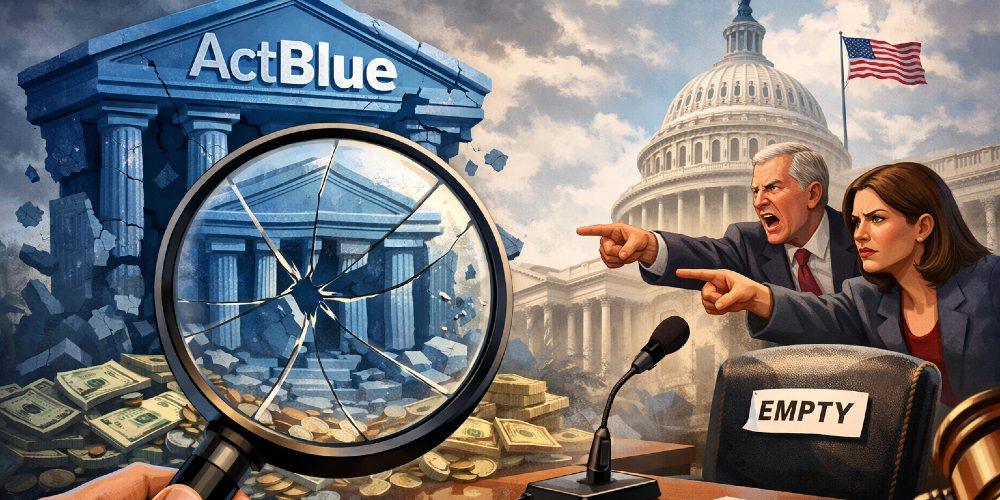
The Democrat Party has spent years demanding transparency, accountability, and the sanctity of elections from its political opponents. It has prosecuted those arguments with relentless fervor — right up until the moment those same standards were applied to its own fundraising apparatus. Now, ActBlue, the left’s premier small-dollar donation engine, stands accused of misleading Congress about its ability to keep foreign money out of American elections, and three of the most powerful committee chairmen in the House are running out of patience.
On Tuesday, House Administration Committee Chairman Bryan Steil (R-WI), House Judiciary Committee Chairman Jim Jordan (R-OH), and House Oversight Committee Chairman James Comer (R-KY) sent a formal letter to ActBlue CEO Regina Wallace-Jones demanding documents the organization has resisted handing over despite a standing subpoena. The letter gives ActBlue two weeks — until April 28 — to comply, warning that Congress is “prepared to use available mechanisms to enforce our subpoenas” if the organization continues to stonewall.
The stakes here are not merely procedural. This is a story about whether one of the most consequential financial pipelines in American political history was built on a foundation of legal fiction.
What ActBlue Told Congress — and What Its Lawyers Feared
In November 2023, facing growing Republican scrutiny, Wallace-Jones wrote to the House Administration Committee assuring lawmakers that ActBlue’s compliance measures were exhaustive.
“Our approach is multilayered, with checks and confirmations occurring throughout the donation process to verify donors and donor information. These measures, which include compliance measures, technological tools, and manual reviews, help to ensure the identity of donors, root out potential foreign contributions, and protect donors from financial fraud.”
Those were reassuring words. The problem is that ActBlue’s own lawyers at Covington & Burling apparently did not believe them. According to internal memos first reported by the New York Times, the law firm warned that Wallace-Jones’ letter presented “an overly optimistic version” of the organization’s actual donation-screening capabilities. The memos noted that donors using third-party apps — Apple Pay, PayPal, Venmo — were not, in practice, being asked to submit U.S. passport information as the letter implied. The firm warned of “a substantial risk that some of the funds received were impermissible contributions from foreign nationals.”
The legal analysis did not stop there. Covington specifically outlined the “potential legal risks associated with statements to Congress that may be alleged to be false or misleading,” noting that an aggressive prosecutor could view Wallace-Jones’ 2023 letter not merely as an inaccuracy, but as an active effort to conceal illegal contributions. Under federal law, lying to Congress carries penalties of up to five years in prison and $250,000 in fines. More significantly, if the violations were deemed “knowing and willful,” the Justice Department would have direct criminal jurisdiction.
The Exodus Nobody Wanted to Talk About
What followed the Covington memos was not a quiet internal review. It was, by most accounts, an organizational meltdown. The legal warnings reportedly triggered panic at the highest levels of ActBlue, leading to a wave of resignations across the company’s legal department — including the entire general counsel’s office. ActBlue also severed its relationship with Covington & Burling entirely in March 2025. Wallace-Jones later blamed the split on “more than a year of navigating tardiness, unpreparedness, and counsel that borders” on inadequacy — a characterization that conveniently shifts the narrative away from the substance of what those lawyers actually said.
Republicans are now demanding two specific documents from that turbulent period. The first is the resignation letter of former General Counsel Aaron Ting, which they believe centers on liabilities created by ActBlue’s donation security practices. The second is a communication from former legal counsel Zain Ahmad relating to what Republicans describe as an ignored whistleblower complaint about those same practices. Both documents were previously requested and never produced.

“There is considerable reason to believe that ActBlue may have deliberately withheld this responsive material to impede our investigation,”
the committee chairs wrote Tuesday.
Fundraising Through the Fire
If ActBlue’s leadership is concerned about the investigation, it has a peculiar way of showing it. The organization announced on the same day as the congressional letter that it raised a record $568 million in the first quarter of 2026 — a 50 percent increase over the same period in the 2022 midterms. That includes $391 million directed toward federal candidates, even as the DOJ and three House committees are probing whether the very infrastructure channeling those funds has been compromised by illegal foreign money.
One is tempted to ask whether the organization’s boast of record fundraising is confidence — or defiance. ActBlue’s chief technology officer, Jason Wong, published a blog post the same day asserting that the platform’s “engineering team has built robust safeguards into every layer of the platform.” That is almost word-for-word the same assurance the company’s CEO gave Congress in 2023 — the very assurance its own lawyers privately said was inaccurate.
The Larger Question No One in the Media Is Asking
ActBlue processed more than $3.8 billion in contributions during the 2024 presidential election cycle. Even if — as the organization’s board member Kimberly Peeler-Allen insists — less than one percent of transactions showed signs of foreign origin, that figure represents nearly $38 million in potentially illegal contributions flowing into American elections. That is not a rounding error. That is a number that should make every American, regardless of party, demand a full accounting.

Federal law is unambiguous on this point: foreign nationals and non-permanent residents are prohibited from contributing to federal candidates or political action committees. The concern is not abstract. It strikes at the bedrock principle that American elections belong to Americans. Scripture affirms what common sense already tells us — that those entrusted with power over others bear a solemn obligation to exercise it honestly. As the Apostle Paul wrote to the Romans, “Let every soul be subject unto the higher powers” — a command that runs in both directions, requiring not only citizens to obey the law, but institutions wielding civic power to operate within it.
The self-styled champions of “democracy” who populate ActBlue’s leadership and donor base have long treated any Republican scrutiny of election integrity as tantamount to authoritarianism. The irony is almost too rich to catalogue: the same party that spent years insisting that foreign interference is an existential threat to democracy apparently built its primary fundraising engine on a system that its own attorneys believed was permitting exactly that — and then told Congress otherwise.
What Comes Next
With a two-week deadline now formally on the record, ActBlue faces a choice between compliance and contempt. Given the organization’s track record of subpoena-dodging since Republicans first began requesting documents in 2023, there is little reason for optimism that they will suddenly embrace transparency. The committee chairmen have made clear they are prepared to escalate. The DOJ and FBI are separately conducting their own investigations, and the clock on the Trump administration’s demand for a formal report on ActBlue’s practices has long since run.
What ActBlue cannot do is spend its way out of a congressional subpoena, no matter how many millions it raises in a quarter. The question is whether Washington’s oversight machinery will prove equal to the task of holding one of the most powerful institutions in Democratic politics accountable — or whether the investigation will quietly fade as so many others have before it. Based on the seriousness with which Steil, Jordan, and Comer appear to be approaching this, that quiet fade seems less likely than it once did.
Two Storms, One Harvest

Every food crisis in living memory has been a one-shock event. The 2008 price spike was a commodity bubble. The 2020 shortages were a logistics failure. The 2022 grain scare was a war on one exporter’s ports. Each time, the system bent, adjusted, and recovered, and each time the experts assured us afterward that global markets are simply too big and too diversified to fail.
What nobody in Washington seems eager to discuss is that 2026 is shaping up to be something the modern food system has never actually faced. Two independent shocks, one climatic and one geopolitical, are converging on the same harvest cycle at the same time. Not sequentially. Simultaneously.
Start with the weather. The Pacific Ocean is currently building toward what forecasters now openly call a record event. NOAA’s Climate Prediction Center puts the odds of at least a strong El Niño near 88 percent, with roughly two in three odds it reaches “very strong” status, the tier reserved for perhaps three or four events in the entire satellite era. Every major global model now projects a median peak in Super El Niño territory, and most of them project it exceeding the 2015-16 event, which until now held the modern record. Sea surface anomalies were already brushing the super threshold in mid-July, months before these events normally peak. The atmosphere has already shifted into El Niño mode, and the event is forecast to crest in late fall and early winter.
This is not about “climate change.” It’s about the standard cycles of weather, and the cycle we’re currently in is one that has likely devastated societies in the past. We’re better prepared as a society today, but not all Americans are equally prepared.
Serious households have started doing the quiet math on their own. Grocery bills tell part of the story, and the forecast maps tell the rest, which is why long-term food storage has moved from fringe hobby to mainstream line item in the family budget, with established suppliers like Heaven’s Harvest seeing demand from people who five years ago would have rolled their eyes at the idea. That instinct is not paranoia. It is pattern recognition, and the pattern is worth walking through carefully.
Editor’s Note: Heaven’s Harvest IS a sponsor, but the warnings of this article are real and would be written even if we didn’t have a survival food sponsor. With that said, those who take advantage of what they offer can use promo code “Patriot” for 15% off.
The Fertilizer Clock Is Already Running
While the Pacific warms, the second shock has been unfolding in the Strait of Hormuz. The conflict with Iran turned the world’s most important energy chokepoint into a contested waterway, and the consequences reach far beyond the gas pump. Roughly a third of global fertilizer trade moves through Hormuz, and the disruption sent urea prices up 86 percent year over year by March, with a 53 percent jump in a single month.
The World Bank projects energy prices rising about 24 percent in 2026 and fertilizer about 31 percent. By its own accounting, fertilizer prices ran 35 percent higher in the first five months of this year than the same period last year.
Here is the mechanism the nightly news will not explain. Fertilizer is not a grocery item. It is a time-delayed input. The nitrogen a farmer in Iowa or Punjab could not afford to apply this spring does not show up as a problem this spring. It shows up as a thinner harvest six to twelve months later.
The World Bank’s own food security brief concedes that the effects of reduced applications earlier this season “are likely to become visible only later in harvest outcomes.” Translate that from institutional language into plain English and it means this. The damage is already done, it is already in the ground, and we are simply waiting for it to arrive on the shelf.
Now check the calendar. Six to twelve months from the spring planting season lands us squarely in late 2026 and early 2027. Which is precisely when the strongest El Niño in the instrumental record is forecast to peak, bringing its signature droughts to Southeast Asia, Australia, southern Africa, northern Brazil, and South Asia, the very regions that grow the world’s rice, sugar, and oilseeds.
The World Bank warns openly that a strong El Niño “could disrupt multiple crop belts simultaneously” on top of the conflict-driven input costs. Their baseline projection assumes the Middle East disruptions ease by autumn. What in the last two years of Middle East history suggests that assumption is safe?
The System Has No Slack Left
The comfortable answer is that global markets always adjust. But adjustment requires slack, and the slack is gone. Global cereal production is expected to decline from last year’s records even before El Niño does its work. The UN World Food Programme, hardly a den of right-wing preppers, is calling this the most significant disruption to its supply chains since Covid and the invasion of Ukraine, and its supply chain director put the stakes bluntly.
Today’s supply chain challenges are tomorrow’s hunger crisis.
There is also a political dimension that markets cannot price. When food gets scarce, governments do not behave like economists. They behave like politicians. Export bans, hoarding mandates, and panic buying at the national level turned the modest rice shortfall of 2008 into a global crisis, and analysts are already warning that import-dependent nations are the first dominoes.
The 2015-16 Super El Niño, a far weaker event than what is now forecast, threw tens of millions into food stress across Africa and Asia. This one is projected to be stronger, and it arrives with fertilizer already rationed by price and shipping lanes already contested by missiles.
What Joseph Knew
Scripture does not treat preparation for lean years as faithlessness. It treats it as wisdom delivered in advance to those willing to act on it.
Behold, there come seven years of great plenty throughout all the land of Egypt: And there shall arise after them seven years of famine; and all the plenty shall be forgotten in the land of Egypt.
Joseph did not respond to that warning with a hashtag or a committee. He stored grain during the years of abundance, and when the famine came, Egypt stood while its neighbors begged. The lesson is not that famine is certain. It is that the time to prepare is precisely when preparation still looks optional.
Nobody who filled a pantry in a year of plenty has ever regretted it, and nobody standing in an empty aisle has ever been glad he waited for certainty.
None of this calls for panic, and panic is the enemy of sound judgment anyway. It calls for the same unglamorous prudence our grandparents considered ordinary. Keep some cash margin, know your local growers, and put real food in deep storage while it is cheap and available, because the entire arc of this story is that cheap and available is a closing window.
Families looking for a straightforward place to start can visit Heaven’s Harvest and use promo code Patriot for 15 percent off long-term storable food. The forecasts may yet soften, the strait may yet reopen, and we should pray they do. But hope is a fine thing to hold and a foolish thing to eat.