
Washington has seen its share of carefully timed scandals — revelations that arrive precisely when a political figure needs to change the subject, redirect public sympathy, or rehabilitate a damaged image. The question now swirling through conservative circles in the aftermath of the Bryon Noem story is a pointed one: Is this latest bombshell a genuine family tragedy, or a strategic detonation?
Consider the timing. Kristi Noem was fired as Secretary of Homeland Security on March 5, 2026 — the first Cabinet secretary to leave her post — amid what an administration official described as “a culmination of her many unfortunate leadership failures,” including the fallout from a fatal immigration enforcement operation in Minnesota, a controversial $220 million non-bid advertising contract, allegations of infidelity, and what was characterized as constant feuding with the heads of other agencies. She was not gracefully transitioned. She was pushed. And then, barely three weeks later, a story lands in the Daily Mail alleging that her husband Bryon has been living a secret double life involving cross-dressing and contact with online fetish performers — and Kristi Noem’s spokesman rushes out a statement casting her as a devastated, blindsided wife.
The sympathetic framing arrived almost too quickly and too cleanly.
The Setup
Kristi and Bryon Noem have been married since 1992. While Kristi built a career in Republican politics — serving in the South Dakota legislature, as the state’s governor, and ultimately as head of the DHS — Bryon made a “fortune in the insurance industry.” By all public appearances, they were the embodiment of the conservative family ideal: faith, fidelity, and the heartland. Kristi leaned into it. She leaned into it hard.
GLAAD has profiled Noem as part of its Accountability Project cataloging anti-LGBTQ rhetoric and discriminatory actions. She opposed marriage equality for same-sex couples and supported anti-transgender legislation. She signed the Religious Freedom Restoration Act in South Dakota. She fought to keep biological males out of women’s sports. The wholesome, God-fearing, flag-waving family was not a peripheral part of her brand — it was the brand.
Which makes the revelation about her husband all the more extraordinary, and all the more politically useful, depending on how one reads what followed.
The Convenient Victim
Photos allegedly obtained by the Daily Mail appeared to show Bryon Noem in feminine clothing, wearing what appeared to be a makeshift breast plate, engaging in what the New York Post described as a “bimbofication” fetish involving online contact with multiple women. According to reports, the images were part of hundreds of messages exchanged between Bryon and three women.
A spokesperson for Kristi Noem told the New York Post that “Ms. Noem is devastated. The family was blindsided by this, and they ask for privacy and prayers at the time.” President Trump, for his part, expressed bewilderment. “They confirmed it? Wow, well, I feel badly for the family if that’s the case, that’s too bad,” Trump told the Daily Mail. “I haven’t seen anything. I don’t know anything about it.”
And there it was: the pivot. Overnight, the story shifted from Kristi Noem as a disgraced, fired Cabinet secretary to Kristi Noem as a wronged wife deserving of compassion. One does not need to be a seasoned opposition researcher to recognize how neatly this narrative realignment serves her interests.
What Washington Already Knew
Here is where the “blindsided” claim begins to strain credulity. Political commentator Ryan James Girdusky stated that as far back as August 2025, there was Washington gossip that a top Cabinet official — rumored to be Noem — had been casually telling people that her husband was gay. Girdusky confirmed in the wake of the Daily Mail story that he had indeed been referring to Noem, but had withheld her name out of respect for her family’s privacy.
If that account is accurate, then the claim that the family was “blindsided” is, to put it generously, a creative interpretation of events. One cannot both have disclosed her husband’s private life to a reporter — however informally — and then claim total shock when photographs surface confirming that private life.
Far-right activist Laura Loomer stated on social media that Noem had known about her husband’s situation, suggesting the arrangement was mutual and widely known within administration circles. “Literally everyone in the admin has known this forever,” Loomer wrote. “I’m shocked it didn’t come out earlier.” Loomer’s claim lines up with the Girdusky account. Two independent sources pointing in the same direction tend to form something more substantial than rumor.

The Lewandowski Problem
One cannot assess the Bryon Noem story without confronting the Corey Lewandowski story that preceded it. For years, Washington had treated the affair between Kristi Noem and her top adviser as an open secret — denied by both parties, but persistent enough that it survived repeated attempts at suppression. After the first report surfaced, Noem called the rumor a “disgusting lie,” writing that “these old, tired attacks on conservative women are based on a falsehood that we can’t achieve anything without a man’s help.” A characteristically sharp deflection, redirecting the charge from personal misconduct to ideological persecution.
Lewandowski’s alleged outsized influence at DHS — including what reports described as a “culture of chaos” in which he exercised unauthorized authority over career federal employees — contributed significantly to the circumstances that led to Noem’s firing. At DHS, Lewandowski was known as Noem’s right-hand man, with their alleged relationship frequently described as “D.C.’s worst-kept secret.”
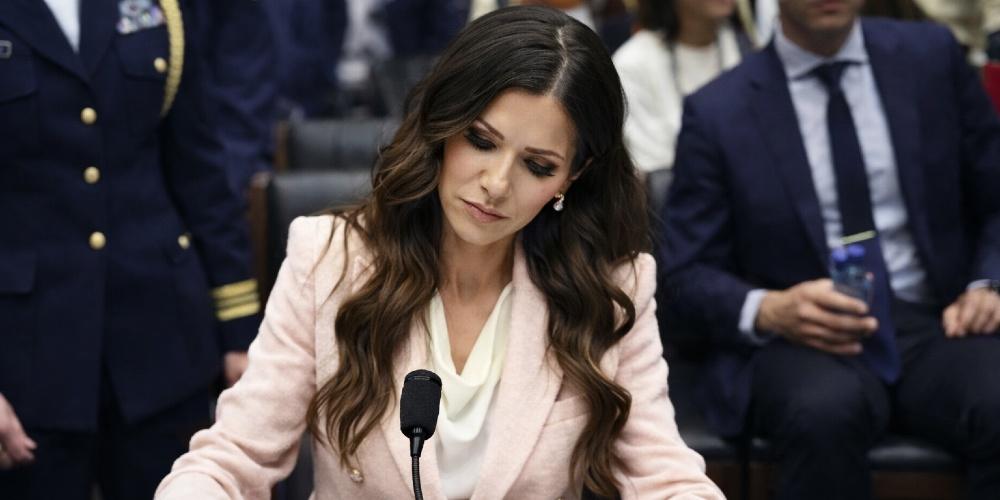
During her congressional testimony in early March, Noem was directly asked by Representative Sydney Kamlager-Dove of California whether she had ever had sexual relations with Lewandowski. Noem called the question “tabloid garbage” and declined to deny it directly under oath. Her husband, Bryon, was reportedly present in the hearing room that day.
Now: imagine being Bryon Noem. You have watched your wife deflect questions about an alleged affair under oath. You have sat in a congressional hearing room while a congresswoman asked whether your wife had slept with her top aide. And in the months that followed — if the Girdusky account holds — your wife had already told a reporter that you were gay, providing convenient political cover for the estrangement of a marriage that had apparently become, in private, something quite different from the image it projected.
The Blackmail Dimension
There is a dimension to this story that transcends the tabloid and enters the domain of legitimate national security concern. Security experts cited by published reports warned that Bryon’s online conduct could have posed a blackmail risk, given his connection to a high-profile political figure. A former Soviet spy, Jack Barsky, said the situation raised serious concerns along those lines. National security experts told the Daily Mail that Bryon’s online activity, including comments about his wife, could have left Kristi Noem vulnerable to blackmail. “If a media organization can find this out, you can assume with a high degree of confidence that a hostile intelligence service knows this as well,” one former intelligence official was quoted saying.
This is not a trivial point. The Secretary of Homeland Security — the person responsible for defending the American homeland from foreign intelligence penetration — may have had, living under her own roof, a vulnerability that any competent adversary intelligence service could have identified and exploited. If Kristi Noem was indeed aware of her husband’s private life, as multiple accounts suggest, the question is not merely about personal integrity. It is about whether she disclosed a known security risk to the appropriate authorities, or whether she simply buried it in the interest of maintaining the family’s public image.
Reading the Wreckage
What we are left with is a story that does not fully cohere in any direction. The “devastated, blindsided wife” narrative is difficult to square with the reports that Noem herself had been telling people about her husband’s situation months before the Daily Mail published. This is why people “in the know” now believe the leak came from her camp to garner the type of sympathy that Hillary Clinton and Huma Abedin received after their husbands were caught in scandals.
Both emerged from the scandals with political careers intact.
Now, the rumor that is being spread to apparently counter the Noem-camp-leak theory is that one of the women Bryon Noem had allegedly paid grew so frustrated about a late payment that she posted about it on social media before the story went wider. This doesn’t jibe with what’s known of the Noem family finances; why would Bryon accidentally slow-pay someone with such private information about him?
The conspiracy theory exists for a reason. Washington is a city where nothing happens by accident that can happen by design. When a political figure’s image undergoes a clean rehabilitation within days of a public fall — moving from embarrassing ouster to sympathetic victim — it is not unreasonable to ask who controls the information, who benefits from its release, and whether the timing was entirely beyond anyone’s control.
Bryon Noem, for his part, did not deny the photos or the communications when approached by the Daily Mail. He told the New York Times that he intended to share his side of the story: “I will at some point. Today is not the day. I appreciate your heart.” That is a man who has not been fully heard — and whose account, when it arrives, may reshape this story in ways that neither its subjects nor its consumers are currently prepared for.
The Lesson Beneath the Spectacle
Proverbs tells us that “pride goeth before destruction, and an haughty spirit before a fall” (Proverbs 16:18, KJV). There is something almost archetypal in the Noem saga — a politician who built an identity on wholesome conservatism, traditional marriage, and cultural resistance to gender ideology, only to have both her marriage and her tenure collapse simultaneously and publicly. Whatever the truth about who leaked what and when, the underlying facts are these: the image was always more constructed than real, and constructed images eventually meet reality.
The harder question conservatives should be asking is not whether Kristi Noem is the villain or the victim of this particular week’s story. It is whether the political class — right and left alike — has developed such a sophisticated relationship with narrative management that authentic accountability has become nearly impossible to achieve. When every scandal can be reframed, every leak weaponized, and every personal failing converted into a sympathy campaign, voters are left sifting through rubble trying to determine what actually happened and who actually bears responsibility.
Did Kristi Noem leak her husband’s story to save her career? The evidence is circumstantial and the definitive answer elusive. What is not elusive is this: a great deal of what was presented to the American public about the Noem family — their faith, their fidelity, their frontier conservatism — appears to have been considerably less than the whole truth. And in politics, as in Scripture, it is the truth that tends, eventually, to make itself known.
Two Storms, One Harvest

Every food crisis in living memory has been a one-shock event. The 2008 price spike was a commodity bubble. The 2020 shortages were a logistics failure. The 2022 grain scare was a war on one exporter’s ports. Each time, the system bent, adjusted, and recovered, and each time the experts assured us afterward that global markets are simply too big and too diversified to fail.
What nobody in Washington seems eager to discuss is that 2026 is shaping up to be something the modern food system has never actually faced. Two independent shocks, one climatic and one geopolitical, are converging on the same harvest cycle at the same time. Not sequentially. Simultaneously.
Start with the weather. The Pacific Ocean is currently building toward what forecasters now openly call a record event. NOAA’s Climate Prediction Center puts the odds of at least a strong El Niño near 88 percent, with roughly two in three odds it reaches “very strong” status, the tier reserved for perhaps three or four events in the entire satellite era. Every major global model now projects a median peak in Super El Niño territory, and most of them project it exceeding the 2015-16 event, which until now held the modern record. Sea surface anomalies were already brushing the super threshold in mid-July, months before these events normally peak. The atmosphere has already shifted into El Niño mode, and the event is forecast to crest in late fall and early winter.
This is not about “climate change.” It’s about the standard cycles of weather, and the cycle we’re currently in is one that has likely devastated societies in the past. We’re better prepared as a society today, but not all Americans are equally prepared.
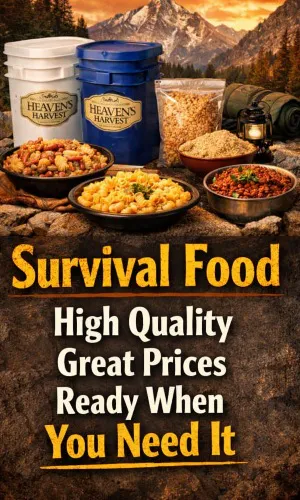
Serious households have started doing the quiet math on their own. Grocery bills tell part of the story, and the forecast maps tell the rest, which is why long-term food storage has moved from fringe hobby to mainstream line item in the family budget, with established suppliers like Heaven’s Harvest seeing demand from people who five years ago would have rolled their eyes at the idea. That instinct is not paranoia. It is pattern recognition, and the pattern is worth walking through carefully.
Editor’s Note: Heaven’s Harvest IS a sponsor, but the warnings of this article are real and would be written even if we didn’t have a survival food sponsor. With that said, those who take advantage of what they offer can use promo code “Patriot” for 15% off.
The Fertilizer Clock Is Already Running
While the Pacific warms, the second shock has been unfolding in the Strait of Hormuz. The conflict with Iran turned the world’s most important energy chokepoint into a contested waterway, and the consequences reach far beyond the gas pump. Roughly a third of global fertilizer trade moves through Hormuz, and the disruption sent urea prices up 86 percent year over year by March, with a 53 percent jump in a single month.
The World Bank projects energy prices rising about 24 percent in 2026 and fertilizer about 31 percent. By its own accounting, fertilizer prices ran 35 percent higher in the first five months of this year than the same period last year.
Here is the mechanism the nightly news will not explain. Fertilizer is not a grocery item. It is a time-delayed input. The nitrogen a farmer in Iowa or Punjab could not afford to apply this spring does not show up as a problem this spring. It shows up as a thinner harvest six to twelve months later.
The World Bank’s own food security brief concedes that the effects of reduced applications earlier this season “are likely to become visible only later in harvest outcomes.” Translate that from institutional language into plain English and it means this. The damage is already done, it is already in the ground, and we are simply waiting for it to arrive on the shelf.
Now check the calendar. Six to twelve months from the spring planting season lands us squarely in late 2026 and early 2027. Which is precisely when the strongest El Niño in the instrumental record is forecast to peak, bringing its signature droughts to Southeast Asia, Australia, southern Africa, northern Brazil, and South Asia, the very regions that grow the world’s rice, sugar, and oilseeds.
The World Bank warns openly that a strong El Niño “could disrupt multiple crop belts simultaneously” on top of the conflict-driven input costs. Their baseline projection assumes the Middle East disruptions ease by autumn. What in the last two years of Middle East history suggests that assumption is safe?
The System Has No Slack Left
The comfortable answer is that global markets always adjust. But adjustment requires slack, and the slack is gone. Global cereal production is expected to decline from last year’s records even before El Niño does its work. The UN World Food Programme, hardly a den of right-wing preppers, is calling this the most significant disruption to its supply chains since Covid and the invasion of Ukraine, and its supply chain director put the stakes bluntly.
Today’s supply chain challenges are tomorrow’s hunger crisis.
There is also a political dimension that markets cannot price. When food gets scarce, governments do not behave like economists. They behave like politicians. Export bans, hoarding mandates, and panic buying at the national level turned the modest rice shortfall of 2008 into a global crisis, and analysts are already warning that import-dependent nations are the first dominoes.
The 2015-16 Super El Niño, a far weaker event than what is now forecast, threw tens of millions into food stress across Africa and Asia. This one is projected to be stronger, and it arrives with fertilizer already rationed by price and shipping lanes already contested by missiles.
What Joseph Knew
Scripture does not treat preparation for lean years as faithlessness. It treats it as wisdom delivered in advance to those willing to act on it.
Behold, there come seven years of great plenty throughout all the land of Egypt: And there shall arise after them seven years of famine; and all the plenty shall be forgotten in the land of Egypt.
Joseph did not respond to that warning with a hashtag or a committee. He stored grain during the years of abundance, and when the famine came, Egypt stood while its neighbors begged. The lesson is not that famine is certain. It is that the time to prepare is precisely when preparation still looks optional.
Nobody who filled a pantry in a year of plenty has ever regretted it, and nobody standing in an empty aisle has ever been glad he waited for certainty.
None of this calls for panic, and panic is the enemy of sound judgment anyway. It calls for the same unglamorous prudence our grandparents considered ordinary. Keep some cash margin, know your local growers, and put real food in deep storage while it is cheap and available, because the entire arc of this story is that cheap and available is a closing window.
Families looking for a straightforward place to start can visit Heaven’s Harvest and use promo code Patriot for 15 percent off long-term storable food. The forecasts may yet soften, the strait may yet reopen, and we should pray they do. But hope is a fine thing to hold and a foolish thing to eat.