
Editor’s note: This is a lightly edited transcript of today’s video from Daily Signal senior contributor Victor Davis Hanson. Subscribe to our YouTube channel to see more of his videos.
Hello, this is Victor Davis Hanson for the Daily Signal.
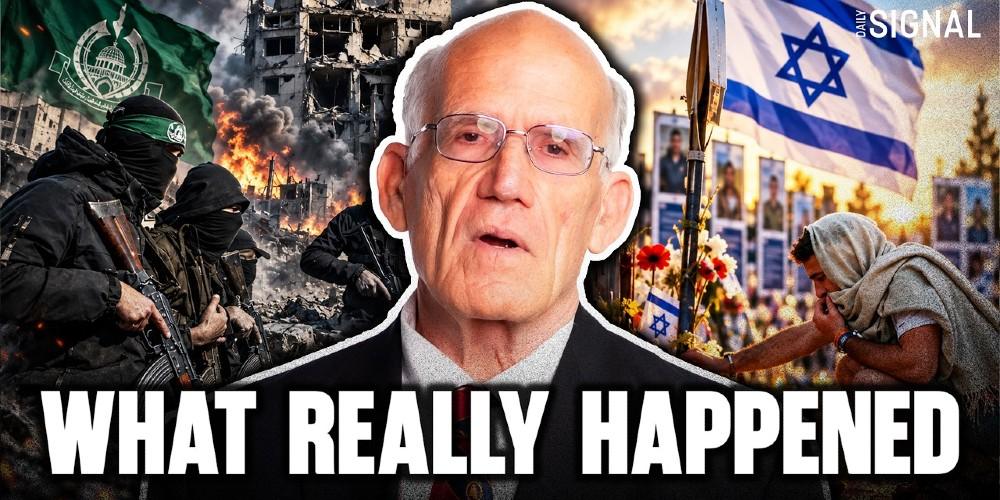
This week marks the third anniversary of the Oct. 7 slaughter of Israelis, civilians, some people in the [Israel Defense Forces], and foreign residents. … Women, men, children, young adults, some of them attending a rock concert.
Remember the facts. Without warning, over 4,000 terrorists from Hamas stormed in over the fence, I can’t call it a wall, it looks to me more like a fence, stormed in and waged a surprise attack against Israel. They were accompanied by 200 civilians that tagged along on the expectation that the terrorists would be killing, wounding, torturing, taking hostages, and the civilians could rape, mutilate, and steal, and bring loot, and all of that was accomplished.
We also forget that there was another thousand terrorists who, in support of this invasion, had launched 4,300 rockets into civilian centers. In fact, that would be the first salvo, which in the next few days would account for a total of 13,000 rockets. Remember, 13,000 rockets all fired at Israeli civilian centers. They attacked 23 different little hamlets. Almost 1,200 died. They took 251 hostages. They got in 14 miles, 14 miles inside 1948 Israel.
So, what are the facts about why did they do this?
Well, we can ask that question because there had not been an Israeli inside Gaza since 2006, for almost, at the time of the assault, 17, 18 years. Israel was supplying the majority of the water, fuel, and power for Gaza even though they had left and turned it over to them.
Gaza had staged one election, in the words of the great Muslim scholar Bernard Lewis, “One election, one time.” They had killed off many of the architects of the opposition. They had thrown Palestinian Authority activists off buildings. They had eliminated them. They never held another election. They tortured or killed internal dissidents.
In this period in which Hamas had complete autonomy over Gaza, they received somewhere between $45 and $50 billion in aid, roughly from 2006 to the present day. Forty to 50 billion. That would have allowed this choice piece of Mediterranean real estate to build luxury hotels, to bring in European and Gulf advisers, and in other words, to create a Qatar or an Oman or a Dubai.
They didn’t want to do that. They diverted about $1 billion to $2 billion and built the largest labyrinth of tunnels probably in the world, not subways, but I mean military tunnels, about 500 miles. It cost them 6,000 tons of cement, 2,000 tons of metal. The entries and the exits were placed under schools, mosques, and hospitals, forcing the Israelis to attack those exits and entries and then incur collateral damage.
Remember one other thing: They were prepared to send more terrorists and more soldiers deeper into Israel if the IDF had not responded belatedly, though they did. They did respond and stop them. They confiscated over 10,000 weapons. Where those weapons came from, you can imagine, but most of them were from Iran or China.
I want to leave you with a couple of questions. Number one, would there have been this cry of genocide, this hatred of Israel? It was always there, but would there have been an American action, all of the things about Iran, had they just not attacked on Oct. 7?

What if Hamas had said the following: “We have a peace deal with Israel. We’re going to create our own nation here. We have twenty thousand workers inside Israel at competitive wages worldwide. We’re going to use that revenue and that expertise that they’re going to gain by working with Israelis to create a successful autonomous nation. We’re gonna show the Palestinian Authority on the West Bank that we can be preeminent in the Middle East.”
They didn’t do that. Instead, they wanted to slaughter Jews, men, women, children, mutilate, behead, rape, torture, take hostages.
I have another second question. What was Israel supposed to do after this had happened, given that they had an overwhelming military that could dominate almost any country? I shouldn’t say almost every country in the Middle East. With this enormous military power and this egregious assault on Israel, it was really one of the few assaults ever conducted inside 1948 Israel.
What were they supposed to do? Were they supposed to say to the Hamas leadership that was gloating in the global media, “Would you please turn over the architects who planned this, the forty or fifty people?” They did. Did they say, “We would like all the perpetrators as well”? They did. Did they say, “We would like you to return all 251 hostages”? They did. Did they say, “We would like you to stop sending rockets, especially the rockets, all of them, intended to kill our own civilians”? They did.
And what was the Hamas reaction? Jubilation. Jubilation. This was the high point of Iranian subsidies. They were getting billions of dollars from international relief organizations, and the Biden administration had refunded them through the U.N. They were getting weapons from China. They had help and solidarity from Hezbollah and the Houthis. They were at a crescendo of pride and arrogance.
What did Israel do? They waited three weeks before invading. And what was the reaction to that patience and that demand that this could be resolved peaceably if they would turn over all the perpetrators and release the hostages? It was absolute hatred and contempt.
I saw it when I walked across my home campus where I work. On Oct. 8, 9, and 10, I saw students yelling, “From the river to the sea.” They were not objecting to Israeli entrance in Gaza. They weren’t objecting, I should say they were celebrating that they thought Oct. 7 was the entree, the beginning, the alpha of a larger multipronged assault whose ultimate aim was to kill as many Jews as possible.
So, why do people react that way given the circumstances? Why don’t they, the world, condemn these killers, these mutilators, these beheaders? And why do they keep saying that Israel is a genocidal enemy when they waited and waited and waited before going in?
Well, Israel is not the Israel of the 1950s and ’60s, a small, poor nation that is a victim of repeated assaults. It’s a powerful 10-million-person, 10-and-a-half-million-person nation that has high tech, an overwhelmingly strong economy, an attraction of science and technology in the Middle East.
In other words, in the words of DEI, they are a victimizer or oppressor just because of their, quote, “privilege.”
DEI played a lot of it. In the world that’s gone mad, in Europe, the United States, Israel, Israelis were white and Palestinians were nonwhite and therefore victims. Doesn’t matter what the reality was. That was the binary.
Antisemitism played a role. We have half of our people for some reason going to colleges where they’re all indoctrinated. We have immigration now where we’re letting in 5 million people from the Middle East in the first and second generations from what we can tell by Hasan Piker or Zohran Mamdani or Ilhan Omar or Abdul El-Sayed, is that they have very little affection for their host.
They despise Israel, and they want Israel destroyed, and they work and act and fund to that purpose.
Add it all up on this commemorative week of Oct. 7, and to sane and sober people, it makes no sense. But sane and sober people, unfortunately, in the West today are in a minority.
We publish a variety of perspectives. Nothing written here is to be construed as representing the views of the Daily Signal.
Starting the Day With a Scripture-Inspired Roast Helps Center Your Thoughts on Eternal Truths Amid Temporal Pressures
The world can seem chaotic, especially right after we wake up. Many believers start their mornings reaching for something familiar — a hot cup of coffee — yet end up settling for mediocre brews that do little more than deliver a caffeine jolt. The daily grind of life, with its endless distractions, news cycles, and responsibilities, can leave even the most faithful feeling spiritually parched alongside their physical fatigue. What if your morning ritual could do more than wake you up? What if it could ground you in truth, nourish your body with exceptional quality, and quietly advance a kingdom purpose at the same time?
That’s the promise — and the reality — behind Promised Grounds Coffee. This Christian-founded company doesn’t just roast beans; it approaches every step as an act of worship and discipleship. By selecting only the top 10% of specialty-grade beans, ethically sourced from dedicated farmers in Central and South America, and small-batch roasting them with reverence in Austin, Texas, Promised Grounds delivers what many describe as the best coffee available — never burnt, never bland, but rich with origin stories and layered flavors that honor God’s creation.
From the vibrant Psalm 27 Roast (a light, bright medium option) to the bold yet peaceful 2 Timothy 1:7 Decaf, each bag carries a Scripture verse that turns your daily pour into a gentle reminder of faith. And through their Ounce Per Ounce Promise, every ounce of coffee you enjoy provides an equal ounce of clean water to families in need via partnership with Filter of Hope — literally brewing hope for body and soul, one cup at a time.
The challenge for today’s Christians runs deeper than finding a decent cup. In an age of convenience-driven consumerism, it’s easy to support companies that dilute values or remain silent on matters of faith. Many believers want their everyday choices — from what they drink to how they spend — to reflect discipleship rather than just convenience. Promised Grounds solves this by weaving Christian excellence into the entire process: beans nurtured with prayerful stewardship by farming families, roasted as an offering rather than a commodity, and packaged with Bible verses to encourage a mindset of gratitude and purpose from the first sip. Reviewers consistently praise the smooth, rich profiles — whether enjoyed black in a drip maker, iced on a warm day, or shared in fellowship — noting how the quality stands toe-to-toe with premium secular brands while delivering something far more meaningful.
This integration of faith and flavor addresses a real need in Christian households and ministries. Busy parents, church leaders, and remote workers alike report that starting the day with a Scripture-inspired roast helps center their thoughts on eternal truths amid temporal pressures. The coffee’s exceptional character — bright citrus notes in lighter roasts or deep chocolate undertones in bolder ones — comes from meticulous selection and careful roasting that respects the bean’s natural gifts rather than masking them. It’s the kind of coffee that elevates a simple quiet time, fuels productive workdays, or sparks meaningful conversations when shared at Bible studies or outreach events. And because it’s ethically sourced with integrity, every purchase supports sustainable livelihoods for farmers who treat their crops like family harvests.
For those leading churches or small groups, the impact multiplies. Promised Grounds offers bundles and options perfect for hospitality ministries, turning ordinary coffee service into an opportunity to point people toward the living water of Christ. Imagine greeting visitors with a warm cup whose very bag carries God’s Word — a subtle yet powerful witness that aligns with the Great Commission. The company’s Texas roots and commitment to “brewing hope” resonate especially with believers who value American enterprise paired with global compassion.
Of course, quality alone isn’t enough if the experience feels out of reach. Promised Grounds keeps it accessible with practical perks like free shipping on orders over $40, sample sets for discovering favorites, and thoughtful add-ons such as faith-themed mugs. Whether you prefer whole beans for fresh grinding, grounds for convenience, or even bulk options for larger households and ministries, the result is consistently superior coffee that makes discipleship feel integrated rather than added on.
As you consider how to align even the smallest habits with your walk with God, Promised Grounds Coffee stands out as a refreshing solution. It tackles the dual problems of subpar daily sustenance and disconnected consumption by offering a product that genuinely excels in taste while advancing a mission of clean water, farmer dignity, and scriptural encouragement. Believers who make the switch often describe it as more than a beverage upgrade — it becomes part of their rhythm of gratitude, a daily invitation to remember that every good gift comes from above.
If you’re ready to transform your mornings (and perhaps your church gatherings) with coffee that honors both exceptional craftsmanship and Christian values, I encourage you to explore what Promised Grounds has to offer. One sip at a time, you’ll be nourishing your body, refreshing your spirit, and participating in something far greater — all while enjoying what truly is among the best coffee available.