

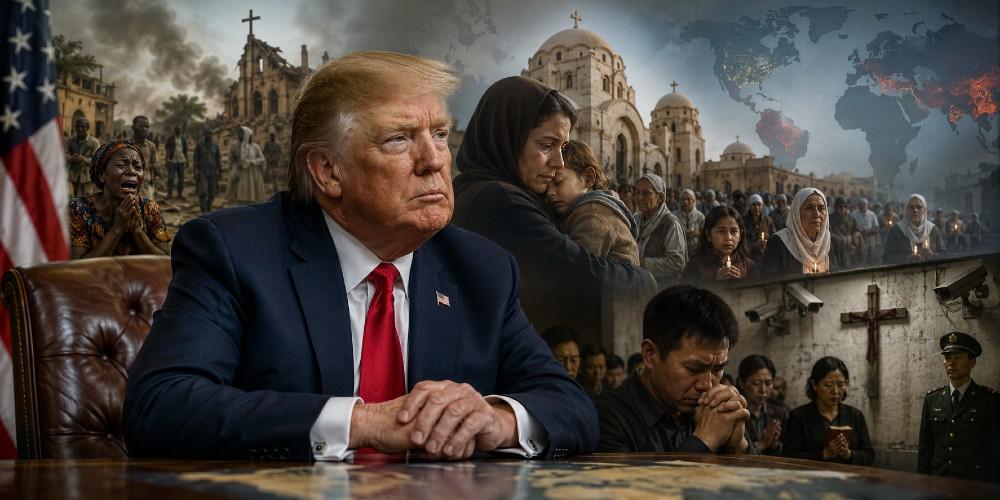
With global threats multiplying and alliances strained under competing ideologies, President Donald Trump has elevated the defense of persecuted Christians from a moral footnote to a practical guide for U.S. foreign policy. Far from naive idealism, this approach recognizes a sobering reality: where Christians face systematic violence and repression, America’s adversaries reveal their true nature, and partners expose their weaknesses.
By treating Christian persecution as an indicator of broader dangers—jihadism, authoritarian control, and institutional failure—Trump’s second term offers a calibrated strategy that serves both justice and national security.
This marks a shift from the first term’s more direct advocacy, which sometimes complicated relations with key players. Challenges arose in balancing principle against pragmatism, from sanctions on Turkey to debates over aid to Egypt. Yet the core insight remains: ignoring the plight of the world’s most persecuted faith community carries strategic costs as much as moral ones.
Trump’s current administration appears intent on reading the signals persecution provides rather than attempting wholesale fixes in every hotspot.
Nowhere does this roadmap prove more urgent than in Nigeria. Fulani militants and jihadist groups like Boko Haram and ISIS-West Africa Province have turned Christian villages into killing fields, with Christmas massacres claiming hundreds of lives in Plateau State while attackers reportedly shouted Islamic slogans. Labeling such horrors as ethnic conflict obscures the religious animus at work.
A government unable to secure its own people against repeated church attacks and village burnings fails the basic test of sovereignty. For Washington, this instability directly threatens counterterrorism goals in West Africa. Intelligence sharing, security reforms, and conditioned assistance can advance both Christian safety and regional stability simultaneously.
Egypt presents a different but related test. Home to millions of Coptic Christians, the nation struggles with targeted violence, church burnings, and legal discrimination despite its strategic value against regional extremism.
Washington’s substantial aid relationship need not end, but measurable reforms—prosecuting sectarian attacks, streamlining church permits, and advancing legal equality—should become non-negotiable benchmarks. Patterns of tolerated extralegal violence against minorities mirror the governance failures that make any partner unreliable over time.
JD’s manually curated links for God-fearing MAGA patriots
China reveals the pattern most starkly. The Communist Party’s fear of Christianity drives demolitions of crosses, detentions of pastors, and rewriting of scripture to align with state ideology. Facial recognition in churches and mass surveillance echo tactics first refined against Uyghurs.
This repression flows from the same totalitarian logic that rejects independent civil society or higher loyalties. A regime viewing faithful Christians as threats cannot be trusted to respect democratic norms or international rules anywhere it projects power. Sanctioning key enforcers like the United Front Work Department fits naturally into broader competition with Beijing.
Critics may decry this focus as narrow or preferential, yet the data tells otherwise. Christian persecution frequently marks the fault lines where lawlessness, ideological control, and expansionist aggression intersect. Addressing it requires no new doctrines of exceptionalism—only clear-eyed analysis of how these threats manifest. Trump’s approach avoids the pitfalls of both indifference and overreach, instead leveraging persecution patterns to inform decisions on partnerships, sanctions, and military posture.
History offers ample warning. From the Ottoman Empire’s Armenian Genocide to modern-day displacements across the Middle East and Africa, societies that target Christians often descend into wider chaos. America’s founding commitment to religious liberty, rooted in the understanding that rights come from God rather than government, demands consistency abroad where feasible.

As Jesus declared in Matthew 25:40, “Inasmuch as ye have done it unto one of the least of these my brethren, ye have done it unto me.” This truth calls believers to action while prudent statesmen recognize its strategic implications.
Success will not come through grand pronouncements alone but through consistent application: asking which actors persecute Christians, whether they threaten U.S. interests, and how American leverage can produce results. Trump’s second-term test lies not in rhetorical volume but in whether policy follows where the evidence of persecution leads—toward stronger defenses against common enemies and wiser stewardship of alliances.
This framework rejects the false choice between realism and principle. By treating the suffering of Christians as a diagnostic tool, American foreign policy gains clarity in a disordered world. The roadmap points toward threats that must be confronted, partners that must improve, and opportunities to advance both faith and freedom on the global stage.
Starting the Day With a Scripture-Inspired Roast Helps Center Your Thoughts on Eternal Truths Amid Temporal Pressures
The world can seem chaotic, especially right after we wake up. Many believers start their mornings reaching for something familiar — a hot cup of coffee — yet end up settling for mediocre brews that do little more than deliver a caffeine jolt. The daily grind of life, with its endless distractions, news cycles, and responsibilities, can leave even the most faithful feeling spiritually parched alongside their physical fatigue. What if your morning ritual could do more than wake you up? What if it could ground you in truth, nourish your body with exceptional quality, and quietly advance a kingdom purpose at the same time?
That’s the promise — and the reality — behind Promised Grounds Coffee. This Christian-founded company doesn’t just roast beans; it approaches every step as an act of worship and discipleship. By selecting only the top 10% of specialty-grade beans, ethically sourced from dedicated farmers in Central and South America, and small-batch roasting them with reverence in Austin, Texas, Promised Grounds delivers what many describe as the best coffee available — never burnt, never bland, but rich with origin stories and layered flavors that honor God’s creation.
From the vibrant Psalm 27 Roast (a light, bright medium option) to the bold yet peaceful 2 Timothy 1:7 Decaf, each bag carries a Scripture verse that turns your daily pour into a gentle reminder of faith. And through their Ounce Per Ounce Promise, every ounce of coffee you enjoy provides an equal ounce of clean water to families in need via partnership with Filter of Hope — literally brewing hope for body and soul, one cup at a time.
The challenge for today’s Christians runs deeper than finding a decent cup. In an age of convenience-driven consumerism, it’s easy to support companies that dilute values or remain silent on matters of faith. Many believers want their everyday choices — from what they drink to how they spend — to reflect discipleship rather than just convenience. Promised Grounds solves this by weaving Christian excellence into the entire process: beans nurtured with prayerful stewardship by farming families, roasted as an offering rather than a commodity, and packaged with Bible verses to encourage a mindset of gratitude and purpose from the first sip. Reviewers consistently praise the smooth, rich profiles — whether enjoyed black in a drip maker, iced on a warm day, or shared in fellowship — noting how the quality stands toe-to-toe with premium secular brands while delivering something far more meaningful.
This integration of faith and flavor addresses a real need in Christian households and ministries. Busy parents, church leaders, and remote workers alike report that starting the day with a Scripture-inspired roast helps center their thoughts on eternal truths amid temporal pressures. The coffee’s exceptional character — bright citrus notes in lighter roasts or deep chocolate undertones in bolder ones — comes from meticulous selection and careful roasting that respects the bean’s natural gifts rather than masking them. It’s the kind of coffee that elevates a simple quiet time, fuels productive workdays, or sparks meaningful conversations when shared at Bible studies or outreach events. And because it’s ethically sourced with integrity, every purchase supports sustainable livelihoods for farmers who treat their crops like family harvests.
For those leading churches or small groups, the impact multiplies. Promised Grounds offers bundles and options perfect for hospitality ministries, turning ordinary coffee service into an opportunity to point people toward the living water of Christ. Imagine greeting visitors with a warm cup whose very bag carries God’s Word — a subtle yet powerful witness that aligns with the Great Commission. The company’s Texas roots and commitment to “brewing hope” resonate especially with believers who value American enterprise paired with global compassion.
Of course, quality alone isn’t enough if the experience feels out of reach. Promised Grounds keeps it accessible with practical perks like free shipping on orders over $40, sample sets for discovering favorites, and thoughtful add-ons such as faith-themed mugs. Whether you prefer whole beans for fresh grinding, grounds for convenience, or even bulk options for larger households and ministries, the result is consistently superior coffee that makes discipleship feel integrated rather than added on.
As you consider how to align even the smallest habits with your walk with God, Promised Grounds Coffee stands out as a refreshing solution. It tackles the dual problems of subpar daily sustenance and disconnected consumption by offering a product that genuinely excels in taste while advancing a mission of clean water, farmer dignity, and scriptural encouragement. Believers who make the switch often describe it as more than a beverage upgrade — it becomes part of their rhythm of gratitude, a daily invitation to remember that every good gift comes from above.
If you’re ready to transform your mornings (and perhaps your church gatherings) with coffee that honors both exceptional craftsmanship and Christian values, I encourage you to explore what Promised Grounds has to offer. One sip at a time, you’ll be nourishing your body, refreshing your spirit, and participating in something far greater — all while enjoying what truly is among the best coffee available.