

Government is not your friend. It cares about its own preservation, not yours. That’s why citizens who resist the government’s authority are tried for treason, while governments that resist the people’s authority award themselves immunity. Ostensibly, governments are formed to protect the lives and liberties of citizens.
In practice, governments sacrifice their citizens’ lives and liberties whenever expedient (see, e.g., open borders and mass migration, COVID lockdowns and experimental “vaccines” that are neither safe nor effective, the “global warming” hoax and “green energy”-induced inflation, and the reckless European push for WWIII against the Russian Federation).
Over the course of human history, there have been “good” governments — which is to say, there have been governments remembered more for their accomplishments than for their crimes or failures. Even those governments included venal, mendacious, immoral, and outright murderous officials among their ranks. But when the right historical conditions arise — when the ingredients of culture, virtue, legal tradition, and circumstance come together — governments are remembered for leading their countries through calamity, war, depression, and heartbreak.
Every once in a while, governments accomplish something that inspires not only citizens but also people around the world. When kings, presidents, or prime ministers unite their countrymen in common cause — whether that be resisting Nazi conquest or voyaging to the moon — their governments are often remembered as “good.” Governments that conjure dreams for their people to pursue are sometimes even remembered as “great.” But for every Camelot, there are a hundred Iron Curtains. Both dreams and nightmares spring from the same place: a government’s “best intentions.”
As Americans, we used to know this. Our schools taught young students about the political virtues of our Founding Fathers. Our towns celebrated personal freedom and condemned government tyranny. Local self-government allowed every citizen’s voice to be heard, while regulation and bureaucracy were widely despised. Americans understood that the best government is the one that governs least.
Why? Because liberty exists in the space between personal sovereignty and government jurisdiction. The more that governments control, the less that we do. Governments do not build rights; they build prisons. Governments do not brighten freedom’s light; they dim that light with every law and regulation.
One of the things that long separated America from the rest of the West (those nations founded on the civilizational pillars of Athens and Jerusalem) was an inherent distrust of government. Whereas Europe celebrated its various monarchies, America celebrated the defeat of kings. There was nothing scary about this proposition. Members of Congress and local officials of all political stripes walked in Fourth of July parades commemorating revolution against government tyranny.
Citizen militias were as common as high school gun clubs because self-defense was correctly understood to include defense against government overreach. In fact, the Second Amendment’s protections for an American’s God-given right to self-preservation has always been an instrumental check on government’s natural impulse toward tyranny.
JD’s manually curated links for God-fearing MAGA patriots
A well-armed citizenry makes it more difficult for a government to ignore its constitutional restraints by infringing upon the rights and liberties of its citizens. (If citizens of the U.K. were well-armed, the British government would never have been able to arrest sixty-five thousand people for “speech-related offenses” over the last five years.)
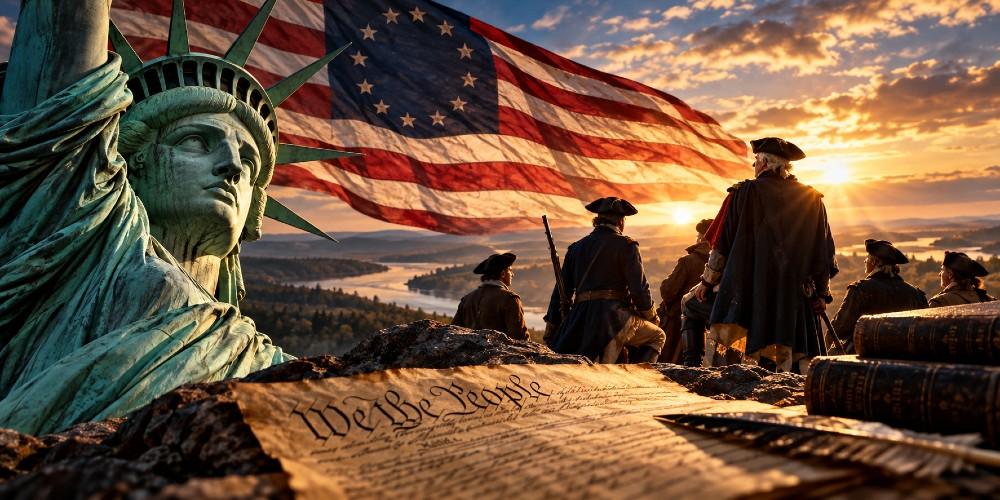
For most of the last century, successive generations of American politicians have quietly deconstructed what it means to be an American and replaced it with something foreign. Instead of recognizing that American families inherited their freedoms from ancestors who fought and died for them, politicians have reinvented America as just some nebulous “idea” available to anyone in the world. But America is much more than an idea; it is home to a people whose ancestors risked everything — again and again — to build the greatest country in the world.
What Americans did on this continent has never been done before, and it will likely never be done again. Our ancestors built the foundations of self-government that enabled them to reject the bonds of empire. Their self-rule, self-reliance, self-resilience, and personal ingenuity put America on the path toward unprecedented prosperity.
Our American ancestors crossed mountains, rivers, and uncharted territories to settle a dangerous frontier. They fought against nature, hostile enemies, and each other as they connected the continent from coast to coast — one stream, trail, and railroad at a time.

For two centuries, people left their home countries for the United States of America because it was the one place in the world where a person’s grit and determination could forge a new destiny. This is real history involving real people who matter. Of course America is a land of ideas and ideals, but it is also the product of blood, sweat, and tears.
But we don’t hear that anymore, do we? Outside of President Trump’s energetic efforts to celebrate America’s two-hundred-fiftieth birthday this year, politicians never recognize the Herculean achievements of past Americans.
The Founding Fathers were probably the most intelligent, virtuous, and wise collection of men to come together at any critical point in human history. Without them, there is no declaration to the world that all men are created equal and endowed with God-given rights that include life, liberty, and the pursuit of spiritual happiness.
Without them, there is no American system of economics that values innovation and production over government-created monopolies, slavery, conquest, and central bank money-printing. Without them, America is just Canada, a part of the British Empire with subjects who still bow down to a king.
For such an extraordinary group of men, isn’t it strange how infrequently our politicians discuss their lives, their accomplishments, and their religious and political beliefs? For something as historically significant as the American Revolution, isn’t it equally strange how few television shows and movies have been produced about America’s most consequential war? It is almost as if the political Establishment and the media Establishment would prefer for Americans to forget that their country was birthed in the spirit of liberty and the rejection of Big Government tyranny.
It is as if the political and media Establishments would prefer for us to forget all the American heroes who built this country, fought and died to secure it, and bequeathed it to those of us charged with protecting it today. If you take out the people and their sacrifices, it’s much easier to repeat the mindless refrain that America is “just an idea” open to everybody.
These increasingly less subtle attacks on our heritage make sense if the goal is to make America weak enough for globalists to destroy. For years, Independence Day celebrations have become more about fireworks than defeating empires and tyranny. Now the political and media Establishments have pushed the celebration of Juneteenth into direct conflict with the Fourth of July.
Just as the “1619 Project” was advanced to rewrite America’s origin story from one of liberty to slavery, Juneteenth was promoted to divide Americans against each other and erase Independence Day altogether. If the Fourth of July is just a “white” holiday, then the celebration of freedom’s triumph over tyranny is recast as a racist celebration of “white supremacy.”
Lutheran pastor Martin Niemöller’s “First They Came” confessional admonished his fellow intellectuals for their complicity with the Nazi Party. The Nazis came for one group after the next, and those who stayed silent realized only too late that there was nobody left to speak out for them. But it’s not just disappearing people that should worry us.
We should be equally concerned when governments come for our weapons, founding principles, common history, secure borders, and free speech.
If we are not careful, America will follow much of the West in recognizing — only too late — that we allowed government tyrants to take our freedoms. The only answer to globalist tyranny is to treat every day as Independence Day.
Starting the Day With a Scripture-Inspired Roast Helps Center Your Thoughts on Eternal Truths Amid Temporal Pressures
The world can seem chaotic, especially right after we wake up. Many believers start their mornings reaching for something familiar — a hot cup of coffee — yet end up settling for mediocre brews that do little more than deliver a caffeine jolt. The daily grind of life, with its endless distractions, news cycles, and responsibilities, can leave even the most faithful feeling spiritually parched alongside their physical fatigue. What if your morning ritual could do more than wake you up? What if it could ground you in truth, nourish your body with exceptional quality, and quietly advance a kingdom purpose at the same time?
That’s the promise — and the reality — behind Promised Grounds Coffee. This Christian-founded company doesn’t just roast beans; it approaches every step as an act of worship and discipleship. By selecting only the top 10% of specialty-grade beans, ethically sourced from dedicated farmers in Central and South America, and small-batch roasting them with reverence in Austin, Texas, Promised Grounds delivers what many describe as the best coffee available — never burnt, never bland, but rich with origin stories and layered flavors that honor God’s creation.
From the vibrant Psalm 27 Roast (a light, bright medium option) to the bold yet peaceful 2 Timothy 1:7 Decaf, each bag carries a Scripture verse that turns your daily pour into a gentle reminder of faith. And through their Ounce Per Ounce Promise, every ounce of coffee you enjoy provides an equal ounce of clean water to families in need via partnership with Filter of Hope — literally brewing hope for body and soul, one cup at a time.
The challenge for today’s Christians runs deeper than finding a decent cup. In an age of convenience-driven consumerism, it’s easy to support companies that dilute values or remain silent on matters of faith. Many believers want their everyday choices — from what they drink to how they spend — to reflect discipleship rather than just convenience. Promised Grounds solves this by weaving Christian excellence into the entire process: beans nurtured with prayerful stewardship by farming families, roasted as an offering rather than a commodity, and packaged with Bible verses to encourage a mindset of gratitude and purpose from the first sip. Reviewers consistently praise the smooth, rich profiles — whether enjoyed black in a drip maker, iced on a warm day, or shared in fellowship — noting how the quality stands toe-to-toe with premium secular brands while delivering something far more meaningful.
This integration of faith and flavor addresses a real need in Christian households and ministries. Busy parents, church leaders, and remote workers alike report that starting the day with a Scripture-inspired roast helps center their thoughts on eternal truths amid temporal pressures. The coffee’s exceptional character — bright citrus notes in lighter roasts or deep chocolate undertones in bolder ones — comes from meticulous selection and careful roasting that respects the bean’s natural gifts rather than masking them. It’s the kind of coffee that elevates a simple quiet time, fuels productive workdays, or sparks meaningful conversations when shared at Bible studies or outreach events. And because it’s ethically sourced with integrity, every purchase supports sustainable livelihoods for farmers who treat their crops like family harvests.
For those leading churches or small groups, the impact multiplies. Promised Grounds offers bundles and options perfect for hospitality ministries, turning ordinary coffee service into an opportunity to point people toward the living water of Christ. Imagine greeting visitors with a warm cup whose very bag carries God’s Word — a subtle yet powerful witness that aligns with the Great Commission. The company’s Texas roots and commitment to “brewing hope” resonate especially with believers who value American enterprise paired with global compassion.
Of course, quality alone isn’t enough if the experience feels out of reach. Promised Grounds keeps it accessible with practical perks like free shipping on orders over $40, sample sets for discovering favorites, and thoughtful add-ons such as faith-themed mugs. Whether you prefer whole beans for fresh grinding, grounds for convenience, or even bulk options for larger households and ministries, the result is consistently superior coffee that makes discipleship feel integrated rather than added on.
As you consider how to align even the smallest habits with your walk with God, Promised Grounds Coffee stands out as a refreshing solution. It tackles the dual problems of subpar daily sustenance and disconnected consumption by offering a product that genuinely excels in taste while advancing a mission of clean water, farmer dignity, and scriptural encouragement. Believers who make the switch often describe it as more than a beverage upgrade — it becomes part of their rhythm of gratitude, a daily invitation to remember that every good gift comes from above.
If you’re ready to transform your mornings (and perhaps your church gatherings) with coffee that honors both exceptional craftsmanship and Christian values, I encourage you to explore what Promised Grounds has to offer. One sip at a time, you’ll be nourishing your body, refreshing your spirit, and participating in something far greater — all while enjoying what truly is among the best coffee available.