

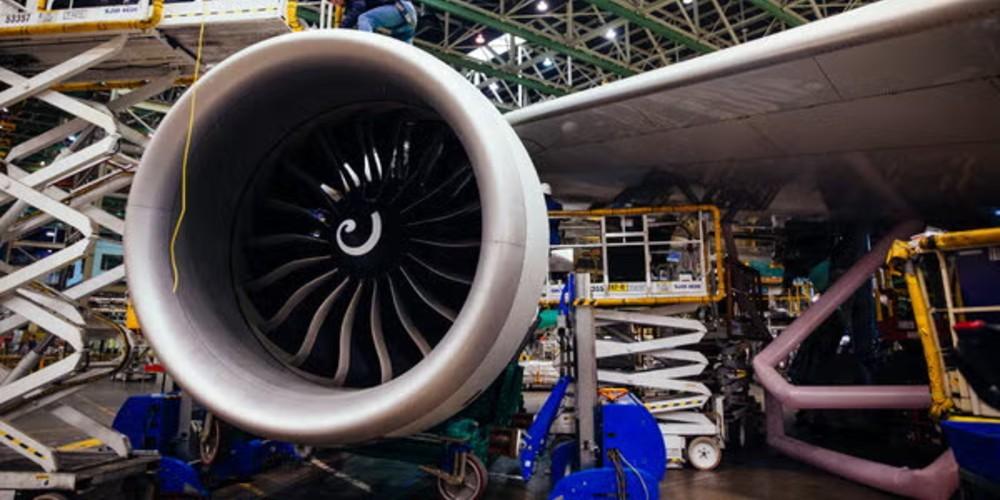
 (DCNF)—America’s aerospace industry is dusting off decades-old technology to protect critical components in jet engines.
The industry is scrambling to replace yttrium, a rare earth metal used in heat-resistant coatings that protect turbine blades, vanes and other jet-engine components from extreme temperatures, Reuters reported. China’s stranglehold on the metal has accelerated that search, with Beijing directly supplying about 70% of U.S. yttrium imports between 2021 and 2024, according to the U.S. Geological Survey (USGS).
“There’s a huge shortage of yttrium, which is used for making turbine coating inside every jet engine,” REAlloys Inc. Chief Growth Officer Anupam Ghildyal told the Daily Caller News Foundation. “Without that, they can’t build jet engines.
The shortage is forcing aerospace suppliers to reconsider technologies dating to the 1970s and 1980s. Suppliers are testing zirconium-dioxide coatings stabilized with magnesium or calcium instead of yttrium, while some companies are also attempting to recycle coating material, according to Reuters.
Chinese yttrium shipments to the United States plunged after Beijing imposed export controls, while prices rose and some coating suppliers rationed material or temporarily halted production, Reuters reported in February. GE Aerospace, Pratt & Whitney and Honeywell declined to comment to Reuters at the time, though aerospace supply-chain specialist Kevin Michaels said low inventories had not yet reduced engine production.
Oerlikon Surface Solutions, a major supplier of aerospace and turbine coatings, uses yttrium in thermal-barrier coatings designed to protect engine components from extreme heat.
China’s restrictions have pushed Oerlikon to seek alternative supplies. Dattatraya Kamatkar, global head of sourcing at Oerlikon Surface Solutions, told Manufacturing Dive in April that the company had to “get creative” securing yttrium oxide, including recycling material from its manufacturing process and working with U.S. suppliers and the federal government to secure additional supplies.
The pressure extends beyond aircraft engines. GE Vernova, one of the world’s largest gas-turbine manufacturers, began working with the U.S. government to increase its yttrium stocks after China’s restrictions disrupted supplies, Reuters reported in December. CEO Scott Strazik said the company had enough inventory to carry it into 2026 and that managing yttrium availability had become a daily focus. GE Vernova is also investing in alternative materials to reduce its dependence on the rare earth.

Honeywell, a major supplier of thermal-barrier coatings for aircraft and industrial gas-turbine engines, uses yttrium-containing materials to protect critical engine components from extreme heat. The company says its predominant aerospace coating is 6% to 8% yttria-stabilized zirconia, a ceramic material containing yttrium.
Those coatings are not confined to Honeywell’s own engines. Honeywell’s current catalog lists coating services for components used in several major GE Aerospace and CFM engine families, including the GE90, GEnx, LEAP and CF34, as well as the military F110. Honeywell describes itself as a developer, supplier and repair and overhaul center whose thermal-barrier coatings are used by aircraft and industrial turbine-engine producers and operators.
“A permanent magnet and rare earth supply chain is only as strong as its weakest link, and nearly every stage today sits in the hands of a strategic adversary,” Abigail Hunter, executive director of SAFE’s Center for Critical Minerals Strategy, told DCNF.
Oerlikon, Honeywell, GE Vernova, GE Aerospace and Pratt & Whitney did not respond to the DCNF’s requests for comment.

China’s Stranglehold
America’s rare-earth vulnerability did not begin with a shortage of rocks in the ground. It developed as the capacity to turn those rocks into usable industrial materials became concentrated overseas.
The distinction, Ghildyal said, is between possessing rare-earth-bearing material and being able to process it. North America has mineral resources, but the United States allowed much of the infrastructure needed to separate, refine and convert those materials into usable products to develop elsewhere. Rare-earth processing is particularly difficult because producers must separate elements with similar chemical properties and, depending on the deposit, manage radioactive materials associated with the ore.
“China has a monopoly of rare earth minerals,” Ghildyal told the DCNF.
Over time, China came to dominate both ends of that supply chain. China accounted for more than 70% of global rare-earth extraction and 87% of processing, according to the U.S. Geological Survey (USGS). It also accounted for all reported production of dysprosium and terbium, two heavy rare earths tracked by the agency.
The United States was consequently left dependent not merely on foreign mines, but on foreign processing capacity. USGS found that the U.S. remained 67% net-import reliant for rare-earth compounds and metals in 2025. The agency also cautions that conventional trade statistics can obscure that dependence because minerals can pass through intermediary countries after being processed elsewhere before ultimately reaching American manufacturers.
Yttrium became a particularly stark example of that imbalance. The United States produced no commercial-scale primary yttrium in 2025 and remained 100% net-import reliant, according to USGS. China directly supplied 70% of U.S. yttrium imports between 2021 and 2024, followed by Germany at 11%, Austria at 8% and South Korea at 4%.
The restrictions turned America’s longstanding processing weakness into an immediate bottleneck for manufacturers that needed those materials. Suppliers serving U.S. aerospace and semiconductor companies were turning away some customers as shortages worsened earlier this year, Reuters reported. Yttrium prices climbed while some North American coating manufacturers rationed supplies or temporarily halted production.
Beijing maintains that the controls are intended to safeguard China’s national security and interests and fulfill international obligations, including nonproliferation. China’s Ministry of Commerce requires exporters of covered rare-earth products to obtain licenses before shipping them abroad, and the U.S. Geological Survey reported that China had begun issuing general export licenses to selected exporters by the end of 2025.
The episode underscored the underlying problem Ghildyal described: finding more rare earths does not by itself break America’s dependence on foreign processing. The United States also needs infrastructure capable of separating and refining those minerals at commercial scale. USGS reported that federal funding flowed to new U.S. heavy-rare-earth separation and recycling projects in 2025, including a $150 million loan for a heavy-rare-earth separation facility at Mountain Pass, California, as Washington sought to expand domestic processing capacity.
“We have a near-total dependence on China for these vital industrial inputs, and China still holds all the cards,” Hunter told the DCNF.
All content created by the Daily Caller News Foundation, an independent and nonpartisan newswire service, is available without charge to any legitimate news publisher that can provide a large audience. All republished articles must include our logo, our reporter’s byline and their DCNF affiliation. For any questions about our guidelines or partnering with us, please contact [email protected].
Starting the Day With a Scripture-Inspired Roast Helps Center Your Thoughts on Eternal Truths Amid Temporal Pressures
The world can seem chaotic, especially right after we wake up. Many believers start their mornings reaching for something familiar — a hot cup of coffee — yet end up settling for mediocre brews that do little more than deliver a caffeine jolt. The daily grind of life, with its endless distractions, news cycles, and responsibilities, can leave even the most faithful feeling spiritually parched alongside their physical fatigue. What if your morning ritual could do more than wake you up? What if it could ground you in truth, nourish your body with exceptional quality, and quietly advance a kingdom purpose at the same time?
That’s the promise — and the reality — behind Promised Grounds Coffee. This Christian-founded company doesn’t just roast beans; it approaches every step as an act of worship and discipleship. By selecting only the top 10% of specialty-grade beans, ethically sourced from dedicated farmers in Central and South America, and small-batch roasting them with reverence in Austin, Texas, Promised Grounds delivers what many describe as the best coffee available — never burnt, never bland, but rich with origin stories and layered flavors that honor God’s creation.
From the vibrant Psalm 27 Roast (a light, bright medium option) to the bold yet peaceful 2 Timothy 1:7 Decaf, each bag carries a Scripture verse that turns your daily pour into a gentle reminder of faith. And through their Ounce Per Ounce Promise, every ounce of coffee you enjoy provides an equal ounce of clean water to families in need via partnership with Filter of Hope — literally brewing hope for body and soul, one cup at a time.
The challenge for today’s Christians runs deeper than finding a decent cup. In an age of convenience-driven consumerism, it’s easy to support companies that dilute values or remain silent on matters of faith. Many believers want their everyday choices — from what they drink to how they spend — to reflect discipleship rather than just convenience. Promised Grounds solves this by weaving Christian excellence into the entire process: beans nurtured with prayerful stewardship by farming families, roasted as an offering rather than a commodity, and packaged with Bible verses to encourage a mindset of gratitude and purpose from the first sip. Reviewers consistently praise the smooth, rich profiles — whether enjoyed black in a drip maker, iced on a warm day, or shared in fellowship — noting how the quality stands toe-to-toe with premium secular brands while delivering something far more meaningful.
This integration of faith and flavor addresses a real need in Christian households and ministries. Busy parents, church leaders, and remote workers alike report that starting the day with a Scripture-inspired roast helps center their thoughts on eternal truths amid temporal pressures. The coffee’s exceptional character — bright citrus notes in lighter roasts or deep chocolate undertones in bolder ones — comes from meticulous selection and careful roasting that respects the bean’s natural gifts rather than masking them. It’s the kind of coffee that elevates a simple quiet time, fuels productive workdays, or sparks meaningful conversations when shared at Bible studies or outreach events. And because it’s ethically sourced with integrity, every purchase supports sustainable livelihoods for farmers who treat their crops like family harvests.
For those leading churches or small groups, the impact multiplies. Promised Grounds offers bundles and options perfect for hospitality ministries, turning ordinary coffee service into an opportunity to point people toward the living water of Christ. Imagine greeting visitors with a warm cup whose very bag carries God’s Word — a subtle yet powerful witness that aligns with the Great Commission. The company’s Texas roots and commitment to “brewing hope” resonate especially with believers who value American enterprise paired with global compassion.
Of course, quality alone isn’t enough if the experience feels out of reach. Promised Grounds keeps it accessible with practical perks like free shipping on orders over $40, sample sets for discovering favorites, and thoughtful add-ons such as faith-themed mugs. Whether you prefer whole beans for fresh grinding, grounds for convenience, or even bulk options for larger households and ministries, the result is consistently superior coffee that makes discipleship feel integrated rather than added on.
As you consider how to align even the smallest habits with your walk with God, Promised Grounds Coffee stands out as a refreshing solution. It tackles the dual problems of subpar daily sustenance and disconnected consumption by offering a product that genuinely excels in taste while advancing a mission of clean water, farmer dignity, and scriptural encouragement. Believers who make the switch often describe it as more than a beverage upgrade — it becomes part of their rhythm of gratitude, a daily invitation to remember that every good gift comes from above.
If you’re ready to transform your mornings (and perhaps your church gatherings) with coffee that honors both exceptional craftsmanship and Christian values, I encourage you to explore what Promised Grounds has to offer. One sip at a time, you’ll be nourishing your body, refreshing your spirit, and participating in something far greater — all while enjoying what truly is among the best coffee available.