
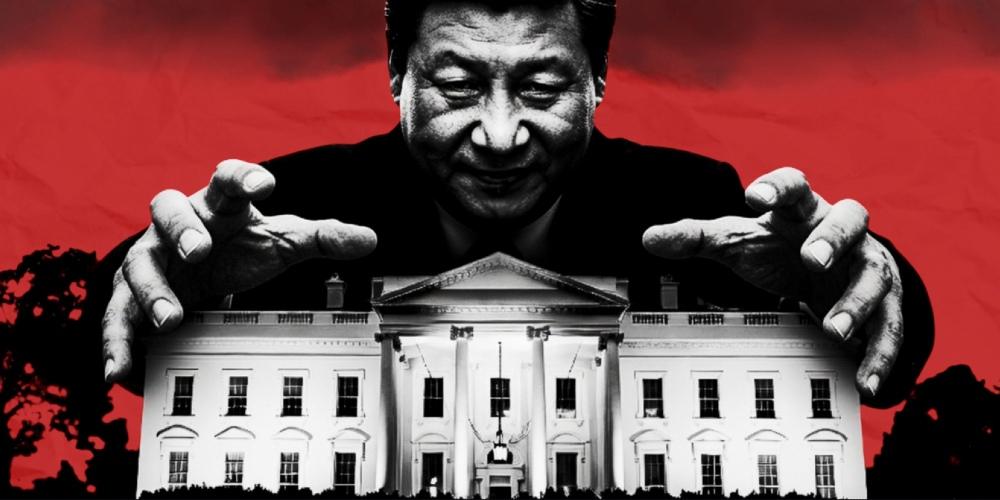
 (DCNF)—A senior Chinese Communist Party (CCP) intelligence official is the new owner of a historic building overlooking the White House Complex, a Daily Caller News Foundation investigation discovered.
Located approximately 650 feet northeast of the White House grounds, the 100-year-old Securities Building on 15th Street was purchased on July 21, 2026 for $8.4 million by the Philip Qiu and Family Foundation, filings show. The building’s new owner, Philip Qiu, has held numerous positions within Chinese intelligence and state security arms, according to university records and DCNF translations of Chinese government announcements.
Qiu did not respond to multiple requests for comment.
“The CCP is like a kind, but firm parent,” Qiu said in 2021, according to a DCNF translation of an announcement from a Chinese intel arm. “It has guided our people out of hardship, led China’s sons and daughters to build a new country and is steering us toward great national rejuvenation.”
Qiu’s ownership of The Securities Building poses an urgent national security threat and must be investigated by federal authorities, multiple intelligence experts told the DCNF.
“This property allows access for big splashy intel ops as well as for more classic ops — like a listening post or Stingray-like systems to collect phone calls, text messages, and digital exhaust,” Bryan Dean Wright, former CIA operations officer, told the DCNF. “That’s all great for collecting targeting information to later ‘bump’ or recruit targets out in the world, who otherwise work inside a key U.S. government building.”
“But what’s especially alarming are emerging ops that properties like this allow — like hidden drone swarms or shipping container missiles,” said Wright, who hosts The Wright Report podcast. “This kind of property is where the next 9/11 will come from. It’s coming.”
‘Special Forces Training’
Qiu, whose Chinese name is Qiu Feili, has held at least four Chinese government positions, beginning with a “career as a detective in the Criminal Investigation Team in Shanghai,” a 2024 University of New Haven (UNH) Instagram post states.
Shanghai’s criminal investigation team is a unit within Shanghai’s Public Security Bureau (PSB), which functions as a local subordinate of “China’s FBI,” the Ministry of Public Security (MPS), according to DCNF translations of Chinese government reports.
While it is unclear how long Qiu worked in the Shanghai PSB, he had already received combat training by October 2011, when he enrolled in a Shanghai Jiaotong University (SJTU) master’s program, according to DCNF translations of SJTU announcements.
SJTU photos show students carrying rifles and wearing camouflage fatigues during a team-building wargame at the program’s outset.
“Classmate Qiu Feili, who has undergone special forces training, served as a commander in the Red-Blue Battle, and not only directed his troops to successfully capture enemy positions, but also killed one-third of the opposing forces with 42 shots, achieving the best individual sniper record,” according to a DCNF translation of SJTU’s announcement concerning the training exercise.

Qiu has continued to support and cooperate with China’s security apparatus in recent years including through his role as honorary chairman of the Hong Kong Immigration Department Staff Association, with which he organized events introducing Hong Kong students to the Shanghai SWAT team in 2023 and 2024, according to DCNF translations of Chinese government announcements and accompanying photos.
The Shanghai native has also held at least three positions in arms of a CCP influence and intelligence agency called the United Front Work Department (UFWD), according to DCNF translations of Chinese government announcements. The UFWD’s operations are a “blend of engagement, influence activities, and intelligence operations” that Beijing uses to steer foreign policy and “gain access to advanced foreign technology,” according to the House Select Committee on the CCP.
Among other roles, Qiu has served on the executive committee of the Shanghai branch of the UFWD’s All-China Federation Of Returned Overseas Chinese (ACFROC), according to a DCNF translation of a Chinese government announcement.
Qiu’s highest-ranking united front position is as chairman of ACFROC’s Shanghai Overseas Chinese Foundation (SOCF), which promotes overseas “cultural exchanges” and operates as the “only charity in the Shanghai UFWD system,” according to DCNF translations of Chinese government announcements. The former Shanghai detective joined SOCF as a director in May 2017 and has served as the foundation’s chairman since May 2021, according to DCNF translations of SOCF’s announcements.
“[SOCF] will continue to execute General Secretary Xi Jinping’s directive to ‘comprehensively implement the party’s overseas Chinese affairs policy, unite the hearts of overseas Chinese and serve overall interests,’” Qiu said during a 2021 foundation meeting, according to a DCNF translation of a SOCF announcement.
“With overseas Chinese hearts turned toward the party and pursuing a common dream, [SOCF] will actively embody responsibility and commitment to the overseas Chinese community in public welfare, charity and people-to-people exchanges,” Qiu continued. “[We] will strive to build SOCF into a charity with social influence to contribute the strength of the overseas Chinese community toward realizing the shared Chinese Dream.”
As chairman, Qiu has referred to the CCP as “our party” during SOCF party-building events he organized and has also represented the foundation’s party branch during Shanghai ACFROC party meetings, according to DCNF translations of Chinese government announcements and accompanying photos. A “party branch” is the smallest “grass-roots” CCP organization and is required of Chinese institutions containing three or more party members, according to a DCNF translation of an announcement from the Supreme People’s Procuratorate, which is China’s agency for legal supervision.
SOCF has also employed several other individuals belonging to Chinese intelligence arms including its secretary general, who has served as a director of the Shanghai International Culture Association (SICA), which, according to Alex Joske, former analyst at the Australian Strategic Policy Institute, is a front for China’s premier civilian intelligence agency, the Ministry of State Security (MSS).
“The MSS is roughly the CIA, with a dash of the FBI,” Wright told the DCNF. “The MPS, however, is a mash-up of DHS and FBI. The key difference is the MPS is generally the overt, visible, heavy hand of the state and party.”
As for the UFWD, it “provides cover” for MSS operations “sort of like what the State Department allegedly does for the CIA abroad when a spy pretends to be a diplomat,” Wright continued. “Bottom line: there is no real line between intel and non-intel agencies or officers in China. Anybody can be compelled for any role at any time — you don’t say no to President Xi.”
Qiu’s connections to MPS, UFWD and MSS arms should set off alarm bells in our nation’s capital, Gordon Chang, author and China expert, told the DCNF.
“No Chinese citizen should be permitted to own, lease, or occupy any real estate that gives him or her the ability to surveil any sensitive federal installation,” Chang said. “No ifs, ands, or buts.”
![]() ‘Screamingly Obvious’
‘Screamingly Obvious’
The Philip Qiu and Family Foundation is headquartered within another historic property half a mile north of the White House that is shared with six other entities controlled by Qiu — including the CCP-tied Chinese American Museum in Washington, D.C. (CAMDC), according to business filings and DCNF translations of Chinese government announcements.
CAMDC is a 501(c)(3) nonprofit aiming to “advance the understanding, knowledge, and appreciation of the Chinese American experience,” according to a statement on CAMDC’s website.
Qiu co-founded CAMDC in 2017 with SOCF’s former chairman, Chen Xiaoping, whose English name is Neil Chen.
As with Qiu, Chen has also held multiple Chinese government positions, including with Shanghai branches of ACFROC and the Chinese People’s Political Consultative Conference (CPPCC), according to DCNF translations of Chinese government and state media reports. CPPCC delegates “serve as proxies for CCP interests,” according to the U.S.-China Economic and Security Review Commission.
CAMDC and Chen did not respond to multiple requests for comment.
Although CAMDC claims that the “museum and its programs are not funded, controlled, or influenced by any foreign government,” the Chinese government has co-sponsored at least eight of the museum’s programs, according to CAMDC’s website and DCNF translations of Chinese government reports.
Four of those programs received support from UFWD-controlled religious entities.
Since 2023, CAMDC has co-sponsored three Buddhist events in Washington, D.C. — including one held at the Library of Congress — with Shanghai’s Longhua Temple, which is overseen by the UFWD’s Bureau Of Ethnic And Religious Affairs Committee, according to DCNF translations of Chinese government announcements.
All three events were headlined by Longhua’s abbot, Zhao Cheng, who is both a Shanghai CPPCC standing committee member and the deputy director of the UFWD’s municipal Ethnic And Religious Affairs Committee, according to a DCNF translation of a Chinese government announcement.
The security risks posed by Qiu’s ownership of properties near the White House are “screamingly obvious,” Michael Lucci, founder and CEO of State Armor, told the DCNF. State Armor is a national security-focused policy and advocacy organization operating as a nonprofit entity, with an affiliated 501(c)(4) social welfare organization known as State Armor Action.
“CCP intelligence agents have been caught buying property around military installations and critical infrastructure where they commit espionage in preparation of sabotage,” Lucci warned. “Now, even more of our most important national assets are being put at risk by the proximity of a man who has multiple CCP intelligence and security affiliations just 200 meters from executive facilities that should be completely off limits from adversary actors. We need government action to force the sale of the commercial property controlled by the CCP associate and a ban on this happening in the future.”
All content created by the Daily Caller News Foundation, an independent and nonpartisan newswire service, is available without charge to any legitimate news publisher that can provide a large audience. All republished articles must include our logo, our reporter’s byline and their DCNF affiliation. For any questions about our guidelines or partnering with us, please contact [email protected].
Two Storms, One Harvest

Every food crisis in living memory has been a one-shock event. The 2008 price spike was a commodity bubble. The 2020 shortages were a logistics failure. The 2022 grain scare was a war on one exporter’s ports. Each time, the system bent, adjusted, and recovered, and each time the experts assured us afterward that global markets are simply too big and too diversified to fail.
What nobody in Washington seems eager to discuss is that 2026 is shaping up to be something the modern food system has never actually faced. Two independent shocks, one climatic and one geopolitical, are converging on the same harvest cycle at the same time. Not sequentially. Simultaneously.
Start with the weather. The Pacific Ocean is currently building toward what forecasters now openly call a record event. NOAA’s Climate Prediction Center puts the odds of at least a strong El Niño near 88 percent, with roughly two in three odds it reaches “very strong” status, the tier reserved for perhaps three or four events in the entire satellite era. Every major global model now projects a median peak in Super El Niño territory, and most of them project it exceeding the 2015-16 event, which until now held the modern record. Sea surface anomalies were already brushing the super threshold in mid-July, months before these events normally peak. The atmosphere has already shifted into El Niño mode, and the event is forecast to crest in late fall and early winter.
This is not about “climate change.” It’s about the standard cycles of weather, and the cycle we’re currently in is one that has likely devastated societies in the past. We’re better prepared as a society today, but not all Americans are equally prepared.
Serious households have started doing the quiet math on their own. Grocery bills tell part of the story, and the forecast maps tell the rest, which is why long-term food storage has moved from fringe hobby to mainstream line item in the family budget, with established suppliers like Heaven’s Harvest seeing demand from people who five years ago would have rolled their eyes at the idea. That instinct is not paranoia. It is pattern recognition, and the pattern is worth walking through carefully.
Editor’s Note: Heaven’s Harvest IS a sponsor, but the warnings of this article are real and would be written even if we didn’t have a survival food sponsor. With that said, those who take advantage of what they offer can use promo code “Patriot” for 15% off.
The Fertilizer Clock Is Already Running
While the Pacific warms, the second shock has been unfolding in the Strait of Hormuz. The conflict with Iran turned the world’s most important energy chokepoint into a contested waterway, and the consequences reach far beyond the gas pump. Roughly a third of global fertilizer trade moves through Hormuz, and the disruption sent urea prices up 86 percent year over year by March, with a 53 percent jump in a single month.
The World Bank projects energy prices rising about 24 percent in 2026 and fertilizer about 31 percent. By its own accounting, fertilizer prices ran 35 percent higher in the first five months of this year than the same period last year.
Here is the mechanism the nightly news will not explain. Fertilizer is not a grocery item. It is a time-delayed input. The nitrogen a farmer in Iowa or Punjab could not afford to apply this spring does not show up as a problem this spring. It shows up as a thinner harvest six to twelve months later.
The World Bank’s own food security brief concedes that the effects of reduced applications earlier this season “are likely to become visible only later in harvest outcomes.” Translate that from institutional language into plain English and it means this. The damage is already done, it is already in the ground, and we are simply waiting for it to arrive on the shelf.
Now check the calendar. Six to twelve months from the spring planting season lands us squarely in late 2026 and early 2027. Which is precisely when the strongest El Niño in the instrumental record is forecast to peak, bringing its signature droughts to Southeast Asia, Australia, southern Africa, northern Brazil, and South Asia, the very regions that grow the world’s rice, sugar, and oilseeds.
The World Bank warns openly that a strong El Niño “could disrupt multiple crop belts simultaneously” on top of the conflict-driven input costs. Their baseline projection assumes the Middle East disruptions ease by autumn. What in the last two years of Middle East history suggests that assumption is safe?
The System Has No Slack Left
The comfortable answer is that global markets always adjust. But adjustment requires slack, and the slack is gone. Global cereal production is expected to decline from last year’s records even before El Niño does its work. The UN World Food Programme, hardly a den of right-wing preppers, is calling this the most significant disruption to its supply chains since Covid and the invasion of Ukraine, and its supply chain director put the stakes bluntly.
Today’s supply chain challenges are tomorrow’s hunger crisis.
There is also a political dimension that markets cannot price. When food gets scarce, governments do not behave like economists. They behave like politicians. Export bans, hoarding mandates, and panic buying at the national level turned the modest rice shortfall of 2008 into a global crisis, and analysts are already warning that import-dependent nations are the first dominoes.
The 2015-16 Super El Niño, a far weaker event than what is now forecast, threw tens of millions into food stress across Africa and Asia. This one is projected to be stronger, and it arrives with fertilizer already rationed by price and shipping lanes already contested by missiles.
What Joseph Knew
Scripture does not treat preparation for lean years as faithlessness. It treats it as wisdom delivered in advance to those willing to act on it.
Behold, there come seven years of great plenty throughout all the land of Egypt: And there shall arise after them seven years of famine; and all the plenty shall be forgotten in the land of Egypt.
Joseph did not respond to that warning with a hashtag or a committee. He stored grain during the years of abundance, and when the famine came, Egypt stood while its neighbors begged. The lesson is not that famine is certain. It is that the time to prepare is precisely when preparation still looks optional.
Nobody who filled a pantry in a year of plenty has ever regretted it, and nobody standing in an empty aisle has ever been glad he waited for certainty.
None of this calls for panic, and panic is the enemy of sound judgment anyway. It calls for the same unglamorous prudence our grandparents considered ordinary. Keep some cash margin, know your local growers, and put real food in deep storage while it is cheap and available, because the entire arc of this story is that cheap and available is a closing window.
Families looking for a straightforward place to start can visit Heaven’s Harvest and use promo code Patriot for 15 percent off long-term storable food. The forecasts may yet soften, the strait may yet reopen, and we should pray they do. But hope is a fine thing to hold and a foolish thing to eat.