
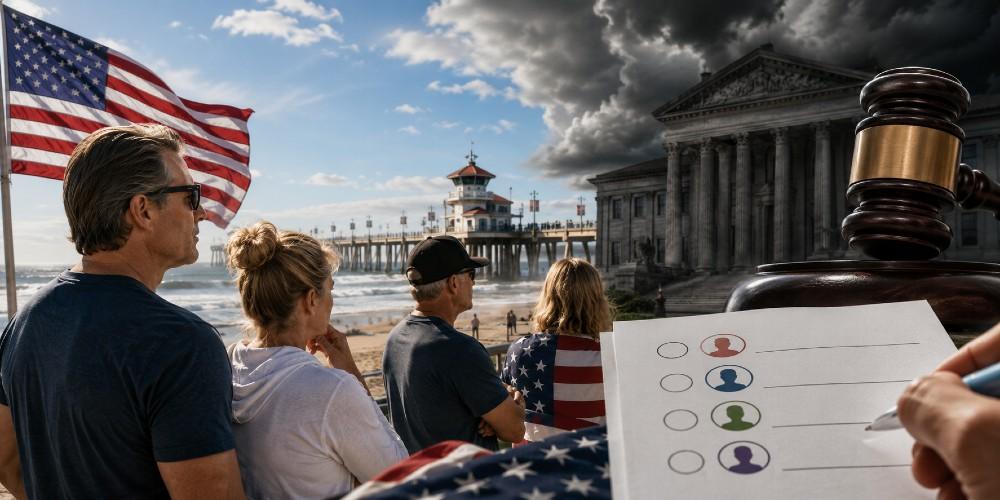
In the sun-drenched shores of Huntington Beach, a city that proudly flies the American flag and celebrates its independence, residents are sounding the alarm. A recent court ruling threatens to dismantle the at-large election system that has allowed this MAGA stronghold to maintain its distinctly conservative character amid California’s deep-blue political landscape. What’s at stake is not merely a procedural tweak but the very ability of a community to govern itself according to the will of its people.
Orange County Superior Court Judge Craig Griffin issued the order in late June, compelling the city to adopt ranked-choice voting for its City Council elections.
The decision follows a lawsuit brought under the California Voting Rights Act by a local resident and activist attorney Kevin Shenkman, claiming the current system dilutes Latino voting power. Yet for many in Huntington Beach, this feels less like justice and more like a calculated political maneuver to crack the city’s Republican supermajority.
Huntington Beach has long stood as a beacon of resistance in a state dominated by progressive policies. From pushing back against Sacramento’s overreach on issues like voter identification to hosting one of the largest Independence Day celebrations on the West Coast, the community embodies a commitment to local control and traditional American values. Now, that identity is under direct assault from within the courtroom.
Residents like Cindy Guinasso, a longtime local mother, expressed deep skepticism. “I’m not a fan,” she said, noting that ranked-choice voting has shown mixed results elsewhere and risks silencing the clear voice of the majority. Others worry it will erode the city’s tight-knit, community-driven governance.
Political consultant Jason Beck put it more bluntly: the change represents “a total play” to install Democrats on the all-Republican council. State Sen. Tony Strickland, a Republican and former Huntington Beach mayor, called the ruling “crazy” and “extremely liberal,” warning it undermines democracy in favor of partisan engineering.
Ranked-choice voting requires voters to rank candidates in order of preference, with the lowest vote-getters eliminated until a winner emerges with a majority. Proponents argue it promotes broader representation, but critics rightly point out its complexity and potential to distort outcomes in ways that favor organized minorities over the general will.
In a city where conservatives have built a functional, patriotic enclave, this shift looks suspiciously like a tool to import the dysfunction of places like San Francisco, where ranked-choice has taken root.
The lawsuit’s architect, Shenkman, has a track record of targeting Southern California municipalities with similar challenges to at-large systems. His victory here, secured through claims of racially polarized voting, sidesteps districting in favor of ranked-choice while consolidating elections—potentially shortening some council terms.
The judge acknowledged the disruption but deemed it necessary. Locals, however, see it as Sacramento’s long arm reaching into their affairs once again.
This episode fits a broader pattern. California’s left-leaning institutions have repeatedly targeted Huntington Beach for defying the state’s one-party orthodoxy. Whether through battles over flags, housing mandates, or election integrity, the message from the capital is clear: conform or be dismantled.
Huntington Beach’s success as a conservative paradise—fiscally responsible, culturally vibrant, and fiercely patriotic—makes it a threat that must be neutralized.

Political consultant Beck captured the frustration: Sacramento aims to “marginalize and minimalize” everything that makes Huntington Beach desirable. Residents fear losing the individuality that draws people fleeing the state’s failing cities. As one local noted, outsiders are pushing the city to become “more like the rest of California”—a prospect few who chose to live there embrace.
In the face of such institutional pressure, communities like Huntington Beach remind us of the importance of self-determination. As the Apostle Paul wrote in Galatians 5:1, “Stand fast therefore in the liberty wherewith Christ hath made us free, and be not entangled again with the yoke of bondage.”
This verse speaks directly to the current struggle, urging believers and freedom-loving citizens alike to resist encroachments on hard-won local autonomy.
The ruling exposes a deeper contradiction in progressive governance: claims of empowering minorities often mask efforts to empower one political faction at the expense of majority rule. If Huntington Beach’s system truly disenfranchised groups, why has the city elected Latino representatives under it?
The push for ranked-choice appears driven less by evidence of systemic exclusion and more by a desire to flip a red island in a blue sea.
As implementation looms—potentially as soon as November, pending logistical hurdles—Huntington Beach residents are mobilizing. Their fight is not just about ballots but about preserving a model of governance rooted in accountability, community, and constitutional principles.
In an era when coastal elites dictate terms from afar, this MAGA enclave’s stand offers a powerful counterexample: liberty thrives when power remains close to the people.
The coming months will test whether Huntington Beach can maintain its identity or succumb to the very forces it has long resisted. For conservatives watching from across the state and nation, the message is unmistakable: they’re coming after successful red strongholds because their existence challenges the narrative of inevitable progressive dominance.
The response must be vigilant defense of local sovereignty and unapologetic commitment to the values that built America’s greatest communities.
Two Storms, One Harvest

Every food crisis in living memory has been a one-shock event. The 2008 price spike was a commodity bubble. The 2020 shortages were a logistics failure. The 2022 grain scare was a war on one exporter’s ports. Each time, the system bent, adjusted, and recovered, and each time the experts assured us afterward that global markets are simply too big and too diversified to fail.
What nobody in Washington seems eager to discuss is that 2026 is shaping up to be something the modern food system has never actually faced. Two independent shocks, one climatic and one geopolitical, are converging on the same harvest cycle at the same time. Not sequentially. Simultaneously.
Start with the weather. The Pacific Ocean is currently building toward what forecasters now openly call a record event. NOAA’s Climate Prediction Center puts the odds of at least a strong El Niño near 88 percent, with roughly two in three odds it reaches “very strong” status, the tier reserved for perhaps three or four events in the entire satellite era. Every major global model now projects a median peak in Super El Niño territory, and most of them project it exceeding the 2015-16 event, which until now held the modern record. Sea surface anomalies were already brushing the super threshold in mid-July, months before these events normally peak. The atmosphere has already shifted into El Niño mode, and the event is forecast to crest in late fall and early winter.
This is not about “climate change.” It’s about the standard cycles of weather, and the cycle we’re currently in is one that has likely devastated societies in the past. We’re better prepared as a society today, but not all Americans are equally prepared.
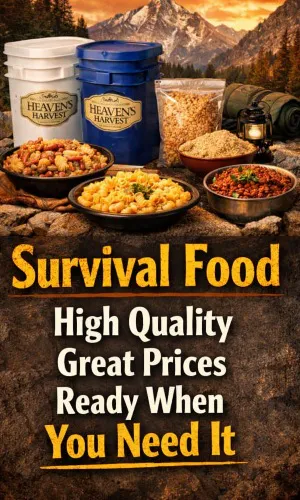
Serious households have started doing the quiet math on their own. Grocery bills tell part of the story, and the forecast maps tell the rest, which is why long-term food storage has moved from fringe hobby to mainstream line item in the family budget, with established suppliers like Heaven’s Harvest seeing demand from people who five years ago would have rolled their eyes at the idea. That instinct is not paranoia. It is pattern recognition, and the pattern is worth walking through carefully.
Editor’s Note: Heaven’s Harvest IS a sponsor, but the warnings of this article are real and would be written even if we didn’t have a survival food sponsor. With that said, those who take advantage of what they offer can use promo code “Patriot” for 15% off.
The Fertilizer Clock Is Already Running
While the Pacific warms, the second shock has been unfolding in the Strait of Hormuz. The conflict with Iran turned the world’s most important energy chokepoint into a contested waterway, and the consequences reach far beyond the gas pump. Roughly a third of global fertilizer trade moves through Hormuz, and the disruption sent urea prices up 86 percent year over year by March, with a 53 percent jump in a single month.
The World Bank projects energy prices rising about 24 percent in 2026 and fertilizer about 31 percent. By its own accounting, fertilizer prices ran 35 percent higher in the first five months of this year than the same period last year.
Here is the mechanism the nightly news will not explain. Fertilizer is not a grocery item. It is a time-delayed input. The nitrogen a farmer in Iowa or Punjab could not afford to apply this spring does not show up as a problem this spring. It shows up as a thinner harvest six to twelve months later.
The World Bank’s own food security brief concedes that the effects of reduced applications earlier this season “are likely to become visible only later in harvest outcomes.” Translate that from institutional language into plain English and it means this. The damage is already done, it is already in the ground, and we are simply waiting for it to arrive on the shelf.
Now check the calendar. Six to twelve months from the spring planting season lands us squarely in late 2026 and early 2027. Which is precisely when the strongest El Niño in the instrumental record is forecast to peak, bringing its signature droughts to Southeast Asia, Australia, southern Africa, northern Brazil, and South Asia, the very regions that grow the world’s rice, sugar, and oilseeds.
The World Bank warns openly that a strong El Niño “could disrupt multiple crop belts simultaneously” on top of the conflict-driven input costs. Their baseline projection assumes the Middle East disruptions ease by autumn. What in the last two years of Middle East history suggests that assumption is safe?
The System Has No Slack Left
The comfortable answer is that global markets always adjust. But adjustment requires slack, and the slack is gone. Global cereal production is expected to decline from last year’s records even before El Niño does its work. The UN World Food Programme, hardly a den of right-wing preppers, is calling this the most significant disruption to its supply chains since Covid and the invasion of Ukraine, and its supply chain director put the stakes bluntly.
Today’s supply chain challenges are tomorrow’s hunger crisis.
There is also a political dimension that markets cannot price. When food gets scarce, governments do not behave like economists. They behave like politicians. Export bans, hoarding mandates, and panic buying at the national level turned the modest rice shortfall of 2008 into a global crisis, and analysts are already warning that import-dependent nations are the first dominoes.
The 2015-16 Super El Niño, a far weaker event than what is now forecast, threw tens of millions into food stress across Africa and Asia. This one is projected to be stronger, and it arrives with fertilizer already rationed by price and shipping lanes already contested by missiles.
What Joseph Knew
Scripture does not treat preparation for lean years as faithlessness. It treats it as wisdom delivered in advance to those willing to act on it.
Behold, there come seven years of great plenty throughout all the land of Egypt: And there shall arise after them seven years of famine; and all the plenty shall be forgotten in the land of Egypt.
Joseph did not respond to that warning with a hashtag or a committee. He stored grain during the years of abundance, and when the famine came, Egypt stood while its neighbors begged. The lesson is not that famine is certain. It is that the time to prepare is precisely when preparation still looks optional.
Nobody who filled a pantry in a year of plenty has ever regretted it, and nobody standing in an empty aisle has ever been glad he waited for certainty.
None of this calls for panic, and panic is the enemy of sound judgment anyway. It calls for the same unglamorous prudence our grandparents considered ordinary. Keep some cash margin, know your local growers, and put real food in deep storage while it is cheap and available, because the entire arc of this story is that cheap and available is a closing window.
Families looking for a straightforward place to start can visit Heaven’s Harvest and use promo code Patriot for 15 percent off long-term storable food. The forecasts may yet soften, the strait may yet reopen, and we should pray they do. But hope is a fine thing to hold and a foolish thing to eat.