

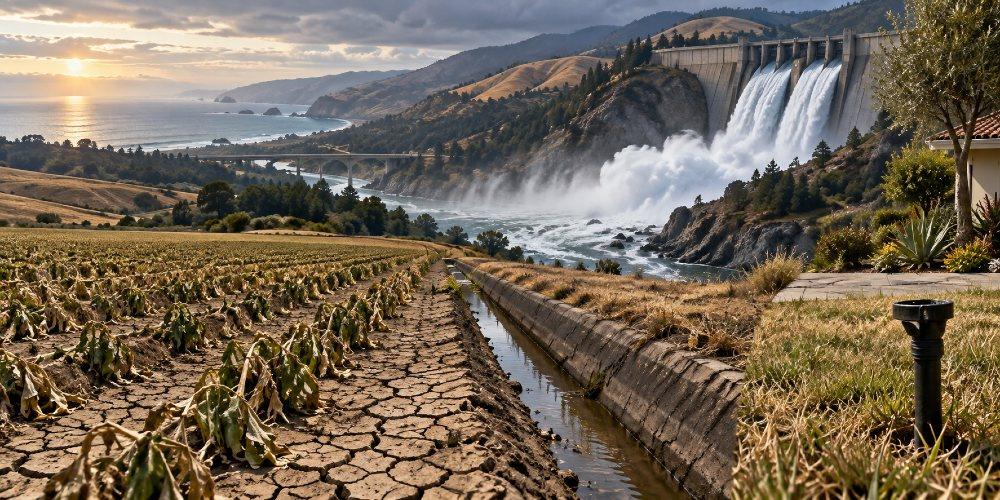
Mark Twain is supposed to have said whiskey is for drinking and water is for fighting. California’s ruling class has a third option. Let the water run into the Pacific, then lecture the rest of the state about shorter showers.
Joel Kotkin laid it out Friday in the New York Post, and the picture is not complicated. Sacramento will not store water when God sends it. Then Sacramento will police lawns, gardens, and bathrooms when the dry months come. That is not climate science. That is ideology with a clipboard.
For my people have committed two evils; they have forsaken me the fountain of living waters, and hewed them out cisterns, broken cisterns, that can hold no water.
The Ban Comes First. The Reservoir Comes Never
The state has already tightened watering rules on commercial properties. More limits on gardens and showers are expected. AB 1572 phases in a ban on using drinking water to irrigate “nonfunctional” decorative grass on government, commercial, and HOA common areas. Functional turf for kids and sports gets a pass. The strip of lawn along a parking lot does not. Recycled water is fine. Potable water is the enemy.
Fine. Waste is waste. The insult is what Sacramento refuses to do on the other side of the ledger.
In 2014, voters passed Proposition 1 and told the state to build storage. Twelve years later, three of the four major reservoir proposals are dead. They died the usual California death. Years of CEQA review. Activist lawsuits. A regulator who discovers, late in the process, that the fish need the water more than the farms.
The last project still breathing is Sites Reservoir, a planned 1.5-million-acre-foot off-stream lake in Glenn and Colusa counties. It would pull high Sacramento River flows in wet years and hold them for dry ones. No dam across a wild river. Flood capture. Drought insurance. The kind of thing a serious state would have finished a decade ago.
Instead, as Kotkin notes, a state agency earlier this year decided Sites could not use more than about 34 percent of its long-planned supplies in order to “save” the Sacramento-San Joaquin Delta and its marine inhabitants. Project director Jerry Brown has warned that stacked conditions on river diversions and pending Bay-Delta flow rules could cut the reservoir’s yield by as much as half. A half-empty promise at full price is not a reservoir. It is a monument to process.

Gavin Newsom still poses with the check. In June his office bragged about another $269 million and a total of $1.36 billion in state eligibility. Construction is still a maybe. The State Water Resources Control Board is looking at a November vote on the water right. Environmental groups already sued after a six-year public review. The streamlining law that was supposed to kill frivolous delay did what California streamlining always does. It streamlined the lawsuit.
They Will Not Fill the Barns in the Fat Years
Joseph told Pharaoh to store grain in the seven fat years so Egypt would not perish in the seven lean. California does the opposite. In the wet winter of 2017, Oroville spilled and a river of unused water ran out through San Francisco Bay. The same pattern repeats whenever the storms come. Most of the Sacramento River still goes to sea.
The excuse is the Delta smelt. No native smelt has been detected since 2018. The recovery plan failed. Scientists admit they still do not adequately understand the system. The Delta has been a working, dredged, diked, pumped landscape since the Gold Rush. Treating it as a cathedral that must be restored to some imagined 1848 purity is not conservation. It is a religion that happens to require other people’s showers.
Greens say climate change will make California ever more arid, which is their argument for doing nothing that would actually hold water. If the future is drier, you build more storage, not less. You build desalination. You recharge groundwater when the floods come. You do not flush the surplus and then fallow the San Joaquin Valley.

Planned supply cuts could take as many as 900,000 acres of farmland out of production. That is not a lifestyle choice. That is food. California still feeds a large share of the country. When those acres go brown, the shortage does not stay in Sacramento. It shows up in the grocery aisle.
Colorado River allocations are tightening at the same time. Rep. Harriet Hageman has already warned that blue-state water failures threaten food supplies well beyond California’s borders. Lake Powell has been scraping historic lows. California takes the largest Lower Basin share and still will not finish the storage voters funded on its own rivers.
The Washington Examiner put the dependence problem plainly. The state leans on water from outside its borders because it will not harness the water inside them. Record rain years come. The runoff still goes to the ocean. Activists keep the pumps throttled for fish that are already gone.
Desalination Was Available. Activists Killed It
Ed Ring of the California Policy Center told Kotkin the quiet part. Desalination could help, but you run into the bureaucracy and the environmental community. “We face shortages, but they really don’t want to do anything about it.”
Huntington Beach proved the point. Poseidon’s plant would have made tens of millions of gallons a day on an industrial site in Orange County. Newsom even backed it. The Coastal Commission killed it unanimously in 2022. Marine organisms. Ratepayer cost. The wrong project in the wrong place at the wrong time, they said, during a drought. San Diego already runs a similar plant. Orange County was told to stay thirsty.
This is the same state that built the Los Angeles Aqueduct, Hetch Hetchy, and the State Water Project. Those works made modern California possible. The men who built them understood that a desert civilization stores water or it dies. The people running Sacramento now treat that inheritance as original sin.
Californians asked the obvious question during the last flood winter. Where are the reservoirs the voters already paid for? They are in binders. They are in court. They are in a draft permit that lets the lake exist on paper so long as it cannot actually fill.
Kotkin’s forecast is the honest one. Fewer farms. Brown neighborhoods. Dead gardens. Shorter showers. Sacramento expects farms and families to take the cut like peasants while the unelected water board and the well-funded green machine decide how much of a wet year is allowed to be saved.
A state that will not store water in the rain has no moral standing to lecture anyone about the faucet. Build the reservoirs. Permit the plants. Stop sacrificing the Central Valley on an altar to a fish that is no longer there. Or keep flushing the gift down the Golden Gate and call the rationing compassion.
Starting the Day With a Scripture-Inspired Roast Helps Center Your Thoughts on Eternal Truths Amid Temporal Pressures
The world can seem chaotic, especially right after we wake up. Many believers start their mornings reaching for something familiar — a hot cup of coffee — yet end up settling for mediocre brews that do little more than deliver a caffeine jolt. The daily grind of life, with its endless distractions, news cycles, and responsibilities, can leave even the most faithful feeling spiritually parched alongside their physical fatigue. What if your morning ritual could do more than wake you up? What if it could ground you in truth, nourish your body with exceptional quality, and quietly advance a kingdom purpose at the same time?
That’s the promise — and the reality — behind Promised Grounds Coffee. This Christian-founded company doesn’t just roast beans; it approaches every step as an act of worship and discipleship. By selecting only the top 10% of specialty-grade beans, ethically sourced from dedicated farmers in Central and South America, and small-batch roasting them with reverence in Austin, Texas, Promised Grounds delivers what many describe as the best coffee available — never burnt, never bland, but rich with origin stories and layered flavors that honor God’s creation.
From the vibrant Psalm 27 Roast (a light, bright medium option) to the bold yet peaceful 2 Timothy 1:7 Decaf, each bag carries a Scripture verse that turns your daily pour into a gentle reminder of faith. And through their Ounce Per Ounce Promise, every ounce of coffee you enjoy provides an equal ounce of clean water to families in need via partnership with Filter of Hope — literally brewing hope for body and soul, one cup at a time.
The challenge for today’s Christians runs deeper than finding a decent cup. In an age of convenience-driven consumerism, it’s easy to support companies that dilute values or remain silent on matters of faith. Many believers want their everyday choices — from what they drink to how they spend — to reflect discipleship rather than just convenience. Promised Grounds solves this by weaving Christian excellence into the entire process: beans nurtured with prayerful stewardship by farming families, roasted as an offering rather than a commodity, and packaged with Bible verses to encourage a mindset of gratitude and purpose from the first sip. Reviewers consistently praise the smooth, rich profiles — whether enjoyed black in a drip maker, iced on a warm day, or shared in fellowship — noting how the quality stands toe-to-toe with premium secular brands while delivering something far more meaningful.
This integration of faith and flavor addresses a real need in Christian households and ministries. Busy parents, church leaders, and remote workers alike report that starting the day with a Scripture-inspired roast helps center their thoughts on eternal truths amid temporal pressures. The coffee’s exceptional character — bright citrus notes in lighter roasts or deep chocolate undertones in bolder ones — comes from meticulous selection and careful roasting that respects the bean’s natural gifts rather than masking them. It’s the kind of coffee that elevates a simple quiet time, fuels productive workdays, or sparks meaningful conversations when shared at Bible studies or outreach events. And because it’s ethically sourced with integrity, every purchase supports sustainable livelihoods for farmers who treat their crops like family harvests.
For those leading churches or small groups, the impact multiplies. Promised Grounds offers bundles and options perfect for hospitality ministries, turning ordinary coffee service into an opportunity to point people toward the living water of Christ. Imagine greeting visitors with a warm cup whose very bag carries God’s Word — a subtle yet powerful witness that aligns with the Great Commission. The company’s Texas roots and commitment to “brewing hope” resonate especially with believers who value American enterprise paired with global compassion.
Of course, quality alone isn’t enough if the experience feels out of reach. Promised Grounds keeps it accessible with practical perks like free shipping on orders over $40, sample sets for discovering favorites, and thoughtful add-ons such as faith-themed mugs. Whether you prefer whole beans for fresh grinding, grounds for convenience, or even bulk options for larger households and ministries, the result is consistently superior coffee that makes discipleship feel integrated rather than added on.
As you consider how to align even the smallest habits with your walk with God, Promised Grounds Coffee stands out as a refreshing solution. It tackles the dual problems of subpar daily sustenance and disconnected consumption by offering a product that genuinely excels in taste while advancing a mission of clean water, farmer dignity, and scriptural encouragement. Believers who make the switch often describe it as more than a beverage upgrade — it becomes part of their rhythm of gratitude, a daily invitation to remember that every good gift comes from above.
If you’re ready to transform your mornings (and perhaps your church gatherings) with coffee that honors both exceptional craftsmanship and Christian values, I encourage you to explore what Promised Grounds has to offer. One sip at a time, you’ll be nourishing your body, refreshing your spirit, and participating in something far greater — all while enjoying what truly is among the best coffee available.