
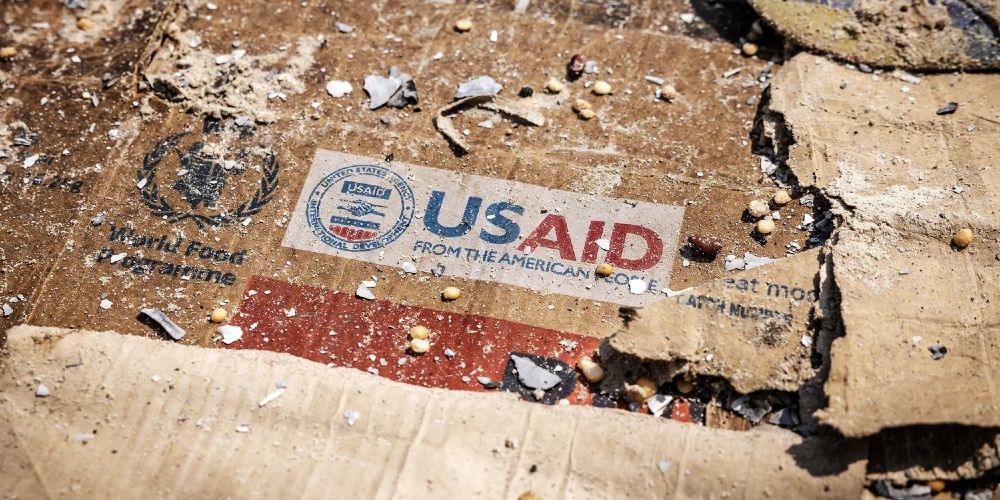
(Zero Hedge)—The Trump Administration’s recent DOGE file dump has triggered viral anger over USAID’s surprising (but not that surprising) efforts to work with Big Tech and social media companies to silence online dissent. Why was an agency supposedly tasked with managing aid to the poor and destitute involved in seemingly clandestine schemes to crush the alternative media?
Probably because the humanitarian projects were merely a cover for diverting cash into ideological goals that the general public would otherwise protest against. Keep in mind, from the very beginning any scrutiny of USAID was immediately met with accusations of barbarism – They said “millions were going to die because of DOGE…”
It’s the perfect cover, because few people have the “Big Balls” necessary to put a spotlight on a humanitarian agency and threaten to slash their operations. The risk of public fallout would dissuade all but the most uncompromising auditors.
It should be noted that mainstream media coverage of the file dump is thin and the sound of crickets is deafening. Those outlets that are covering the damning information are painting the data release as if it is a crime or conspiracy.
Former U.S. Agency for International Development (USAID) Administrator Samantha Power has spoken out against what she calls the “reckless release” of “cherry-picked files” for “partisan purposes.” The large cache of files from USAID supports previous claims by the administration that the agency was “weaponized to advance a radical agenda fundamentally at odds with American values.”

The files include emails, meeting agendas and draft proposals sent from and to officials working under the Biden administration that detail, in part, how they asked social media companies to moderate (control) public narratives. Companies were also sent proposals about deplatforming and downranking high-risk media outlets.
The real reasons why Democrats and bureaucratic insiders are so enraged by the latest file dump are obvious – It is confirmation that many of these people were involved in criminal mismanagement of US taxpayer dollars to fund direct violations of the First Amendment.
But the censorship regime is just the tip of the iceberg. The new info also confirms that USAID was a central hub for the global spread of progressive propaganda. If you are an American paying taxes, here are some of the interesting programs your money was being spent on from 2020 to 2024…
Democracy, Governance, Civil Society, And Elections
This $8.8B category includes extensive involvement in political processes and elections abroad. Analysis of the data highlights hundreds of millions specifically on election-related programs, including $817M across countries, including Ukraine, Libya, Ethiopia, Jordan, Georgia, Venezuela, and others). Evidence suggests these operations may have functioned as soft power or influence over foreign elections, rather than neutral aid.
Why else would billions of American dollars be spent on elections in foreign countries?
Media And “Counter-Disinformation”
At least $560 million were allotted to cover programs aimed at “media support” (keeping failing left-wing outlets afloat) and combating “disinformation” or “information manipulation.” Internal documents and analyses describe these operations as targeting narratives associated with populist or conservative movements in various countries, sometimes framed around protecting “liberal democracy.”
For anyone still wondering if the “Deep State” is left wing, right wing, or both…these documents confirm it’s left wing. There are no conservative NGOs or institutions on the list of USAID beneficiaries.
Gender, Women’s Empowerment, DEI, And LGBTQ Programs
An estimated $302 million was directed to gender/DEI projects and $51 million was funneled into LGBTQ-related projects. Examples include workplace DEI efforts in foreign countries, women’s economic empowerment projects, support for LGBTQ inclusion and advocacy, etc.

There are specific examples of small grants for transgender-themed operas, trans comics, a and LGBT musicals, though there is an intermingling of State Department public diplomacy grants with USAID awards where these projects are concerned. White House rescission materials and congressional materials have found portions of Development Assistance and Democracy Fund spending advancing “woke,” DEI, climate, and LGBTQ priorities over core development goals.
Again, why were American tax dollars being used for progressive propaganda programs under the guise of humanitarian aid?
South Africa Trans & Sex Worker HIV Programs
Part of a larger $37 million allotment, over $29 million in USAID/PEPFAR disbursements were spent on HIV programming targeting “key populations,” specifically sex workers and transgender people in South Africa.
The operation provided things like HIV testing and condoms, but hidden costs included hormone therapy (oestrogen + anti-androgens for transgender women; testosterone for transgender men). Also psychological support and support groups for clients seeking or receiving gender-affirming care USAID funding went into services that provided referrals for other interventions including transgender surgeries and speech therapy).
Health And Humanitarian Aid For “Refugees”
This is the kind of work that everyone was told USAID was created to do. However, wrapped up in the $90 billion in projects to help refugees from war-torn lands, considerable funding was redirected to support migrants trying to enter the United States.
USAID funds were funneled to migrants in Latin America and the Caribbean, many of whom were heading toward or transiting toward the United States, primarily through “root causes” programs, humanitarian assistance and integration efforts.

The Biden administration also pursued a multi-year strategy with a stated goal of “reducing irregular migration” from El Salvador, Guatemala, and Honduras by addressing poverty, violence, corruption, and lack of opportunity.
USAID was a major implementer and cumulative commitments were in the billions. Activities included economic development, governance, anti-violence programs, vocational training, and support for returned/repatriated migrants. In other words, instead of simply securing the southern border (which Trump has did effectively within months of entering office) the Democrats paid off foreign governments to convince people to stop coming to the US illegally. Clearly, this solution didn’t work.
The shutdown of USAID might have been one of the most profound and sweeping events in modern American history. Some canalysts suggest that USAID was the core of a progressive empire-building agenda effecting hundreds of countries and undermining US security, but more than that, it was at the forefront of social engineering and cultural warfare. Only good things can happen now that the agency is gone.
Two Storms, One Harvest

Every food crisis in living memory has been a one-shock event. The 2008 price spike was a commodity bubble. The 2020 shortages were a logistics failure. The 2022 grain scare was a war on one exporter’s ports. Each time, the system bent, adjusted, and recovered, and each time the experts assured us afterward that global markets are simply too big and too diversified to fail.
What nobody in Washington seems eager to discuss is that 2026 is shaping up to be something the modern food system has never actually faced. Two independent shocks, one climatic and one geopolitical, are converging on the same harvest cycle at the same time. Not sequentially. Simultaneously.
Start with the weather. The Pacific Ocean is currently building toward what forecasters now openly call a record event. NOAA’s Climate Prediction Center puts the odds of at least a strong El Niño near 88 percent, with roughly two in three odds it reaches “very strong” status, the tier reserved for perhaps three or four events in the entire satellite era. Every major global model now projects a median peak in Super El Niño territory, and most of them project it exceeding the 2015-16 event, which until now held the modern record. Sea surface anomalies were already brushing the super threshold in mid-July, months before these events normally peak. The atmosphere has already shifted into El Niño mode, and the event is forecast to crest in late fall and early winter.
This is not about “climate change.” It’s about the standard cycles of weather, and the cycle we’re currently in is one that has likely devastated societies in the past. We’re better prepared as a society today, but not all Americans are equally prepared.
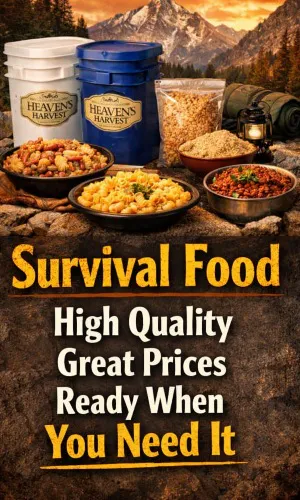
Serious households have started doing the quiet math on their own. Grocery bills tell part of the story, and the forecast maps tell the rest, which is why long-term food storage has moved from fringe hobby to mainstream line item in the family budget, with established suppliers like Heaven’s Harvest seeing demand from people who five years ago would have rolled their eyes at the idea. That instinct is not paranoia. It is pattern recognition, and the pattern is worth walking through carefully.
Editor’s Note: Heaven’s Harvest IS a sponsor, but the warnings of this article are real and would be written even if we didn’t have a survival food sponsor. With that said, those who take advantage of what they offer can use promo code “Patriot” for 15% off.
The Fertilizer Clock Is Already Running
While the Pacific warms, the second shock has been unfolding in the Strait of Hormuz. The conflict with Iran turned the world’s most important energy chokepoint into a contested waterway, and the consequences reach far beyond the gas pump. Roughly a third of global fertilizer trade moves through Hormuz, and the disruption sent urea prices up 86 percent year over year by March, with a 53 percent jump in a single month.
The World Bank projects energy prices rising about 24 percent in 2026 and fertilizer about 31 percent. By its own accounting, fertilizer prices ran 35 percent higher in the first five months of this year than the same period last year.
Here is the mechanism the nightly news will not explain. Fertilizer is not a grocery item. It is a time-delayed input. The nitrogen a farmer in Iowa or Punjab could not afford to apply this spring does not show up as a problem this spring. It shows up as a thinner harvest six to twelve months later.
The World Bank’s own food security brief concedes that the effects of reduced applications earlier this season “are likely to become visible only later in harvest outcomes.” Translate that from institutional language into plain English and it means this. The damage is already done, it is already in the ground, and we are simply waiting for it to arrive on the shelf.
Now check the calendar. Six to twelve months from the spring planting season lands us squarely in late 2026 and early 2027. Which is precisely when the strongest El Niño in the instrumental record is forecast to peak, bringing its signature droughts to Southeast Asia, Australia, southern Africa, northern Brazil, and South Asia, the very regions that grow the world’s rice, sugar, and oilseeds.
The World Bank warns openly that a strong El Niño “could disrupt multiple crop belts simultaneously” on top of the conflict-driven input costs. Their baseline projection assumes the Middle East disruptions ease by autumn. What in the last two years of Middle East history suggests that assumption is safe?
The System Has No Slack Left
The comfortable answer is that global markets always adjust. But adjustment requires slack, and the slack is gone. Global cereal production is expected to decline from last year’s records even before El Niño does its work. The UN World Food Programme, hardly a den of right-wing preppers, is calling this the most significant disruption to its supply chains since Covid and the invasion of Ukraine, and its supply chain director put the stakes bluntly.
Today’s supply chain challenges are tomorrow’s hunger crisis.
There is also a political dimension that markets cannot price. When food gets scarce, governments do not behave like economists. They behave like politicians. Export bans, hoarding mandates, and panic buying at the national level turned the modest rice shortfall of 2008 into a global crisis, and analysts are already warning that import-dependent nations are the first dominoes.
The 2015-16 Super El Niño, a far weaker event than what is now forecast, threw tens of millions into food stress across Africa and Asia. This one is projected to be stronger, and it arrives with fertilizer already rationed by price and shipping lanes already contested by missiles.
What Joseph Knew
Scripture does not treat preparation for lean years as faithlessness. It treats it as wisdom delivered in advance to those willing to act on it.
Behold, there come seven years of great plenty throughout all the land of Egypt: And there shall arise after them seven years of famine; and all the plenty shall be forgotten in the land of Egypt.
Joseph did not respond to that warning with a hashtag or a committee. He stored grain during the years of abundance, and when the famine came, Egypt stood while its neighbors begged. The lesson is not that famine is certain. It is that the time to prepare is precisely when preparation still looks optional.
Nobody who filled a pantry in a year of plenty has ever regretted it, and nobody standing in an empty aisle has ever been glad he waited for certainty.
None of this calls for panic, and panic is the enemy of sound judgment anyway. It calls for the same unglamorous prudence our grandparents considered ordinary. Keep some cash margin, know your local growers, and put real food in deep storage while it is cheap and available, because the entire arc of this story is that cheap and available is a closing window.
Families looking for a straightforward place to start can visit Heaven’s Harvest and use promo code Patriot for 15 percent off long-term storable food. The forecasts may yet soften, the strait may yet reopen, and we should pray they do. But hope is a fine thing to hold and a foolish thing to eat.