

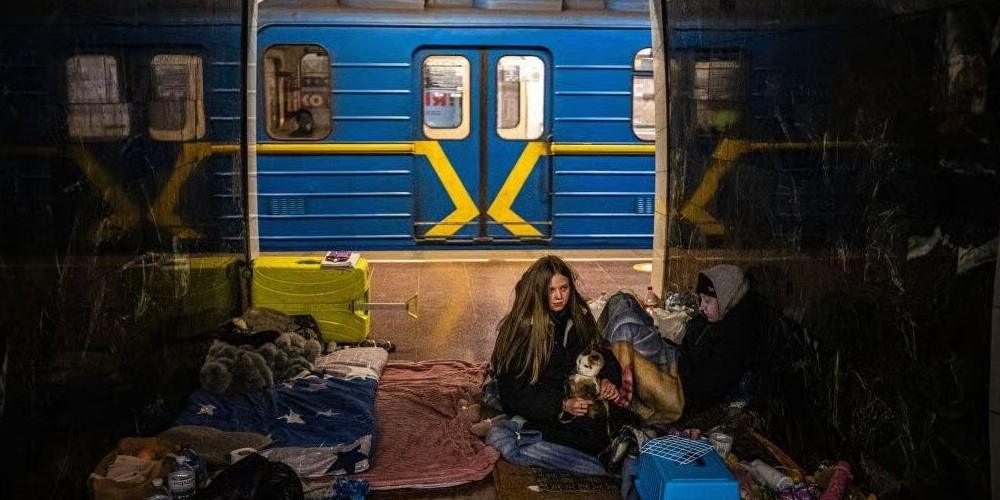
(Zero Hedge)—From Helsinki’s drainable swimming pools to German parking garages and Lithuanian basements, Europe’s governments are spending billions to get their citizens underground – and most of those citizens still can’t say where they would go.
Finland is the model the rest of the continent keeps visiting. Helsinki has about 5,500 shelters with room for close to a million people, in a city of roughly 700,000, and Finland has required shelters by law for more than 70 years, according to This is Finland. The Itäkeskus swimming hall, which sits under about 50 meters of solid rock and draws some 375,000 visitors a year, is one of them. Almost all of the city’s shelters can be taken into use immediately and must be fully operational within 72 hours. “It would be foolish not to use this capacity,” said Pasi Raatikainen, a senior civil defense planner at the Helsinki City Rescue Department.
On Saturday a Russian cargo ship, the Sparta II, was reportedly hit by drones in the Gulf of Finland and left burning and adrift, little more than a week after Helsinki warned Kyiv against expanding the war into those waters following a strike on a Russian warship.

Poland shows how far behind most of Europe started. A government survey published in 2023 found bomb shelters for about 300,000 people in a country of 38 million. President Andrzej Duda then signed a civil defense law that took effect on Jan. 1, 2025, and commits Warsaw to spending at least 0.3% of GDP a year on civil protection, about 24 billion zloty (€5.6 billion) over four years by Defense Minister Władysław Kosiniak-Kamysz’s count. “We have a large army,” he said, but “we must also have a resilient society.”
In a United Surveys by IBRiS poll for Wirtualna Polska taken Oct. 16-18, 58.7% of Poles said they didn’t know where their nearest shelter or hiding place was, and only 15.7% could name its exact location – even as the state points to more than 86,000 shelter locations.

Lithuania had 6,618 marked shelters as of July, enough for about 1.6 million people, or roughly 58% of the population, according to the Interior Ministry, which wants to reach 60% by 2027 and modernize at least 1,000 shelters by 2028. But in a Baltijos tyrimai survey for LRT in June, just 22% of Lithuanians said they knew exactly where their nearest shelter was, while 31% said they didn’t know and had never looked.

Germany had just 579 public shelters with space for about 480,000 people as of September 2025, according to ZDF, in a country of more than 80 million. The civil protection pact Interior Minister Alexander Dobrindt and Defense Minister Boris Pistorius presented in May puts €10 billion into civil protection through 2029, €3 billion of it for the THW disaster relief agency, and counts underground car parks, tunnels and cellars as shelters, with the federal NINA warning app to point people to the nearest one. Pistorius was blunt: “the aim can never be to have a shelter space for 80 million Germans” (translated).

Brussels has been nudging in the same direction. The European Commission’s preparedness strategy, unveiled in March 2025, urged households to keep essential supplies for at least 72 hours in an emergency.

The message has landed: 72% of EU citizens said they were highly worried about wars near the bloc’s borders in a European Parliament Eurobarometer survey published in February. Britain, meanwhile, has rolled out its own “Be Ready” campaign alongside a “Black Sky” plan for a total grid failure, as we reported this month.

The front-line states are borrowing straight from Ukraine. In June, Tallinn set up a modular shelter of reinforced concrete in a green space downtown, built to a standardized Ukrainian design and supplied by Citysec Industry, the first of its kind in public space in Estonia. “Ukraine’s experience clearly shows how important it is for people to have access to safe and readily available shelters,” said Deputy Mayor Tiit Terik.
Photo: Moodul-varjumiskoht Juhkentali tänaval. Author: Ken Mürk/ERR (Photo: Moodul-varjumiskoht Juhkentali tänaval. Author: Ken Mürk/ERR)
Switzerland, which built for nuclear war decades ago, is finding new buyers for the old concrete. The country had about 8,000 Cold War military bunkers, and roughly 1,000 were sold off after the Berlin Wall fell; the army stopped selling its old fortifications in 2023 and is weighing putting some back into service, according to Swissinfo. Lucerne’s state-owned utility spent CHF 30 million turning a 1968 civil defense shelter built for 1,200 people into a data center, and its head says inquiries have climbed since Iran struck data centers in the Gulf. “Sensitivity to the issue of physical data security is increasing,” said Marco Reinhard.

Across the Atlantic, Vice President JD Vance told Americans last week not to build a bunker or stock up on food and water, saying the administration doesn’t see a crisis coming. Europe’s governments, by their own budgets, see one close enough to dig for.
Starting the Day With a Scripture-Inspired Roast Helps Center Your Thoughts on Eternal Truths Amid Temporal Pressures
The world can seem chaotic, especially right after we wake up. Many believers start their mornings reaching for something familiar — a hot cup of coffee — yet end up settling for mediocre brews that do little more than deliver a caffeine jolt. The daily grind of life, with its endless distractions, news cycles, and responsibilities, can leave even the most faithful feeling spiritually parched alongside their physical fatigue. What if your morning ritual could do more than wake you up? What if it could ground you in truth, nourish your body with exceptional quality, and quietly advance a kingdom purpose at the same time?
That’s the promise — and the reality — behind Promised Grounds Coffee. This Christian-founded company doesn’t just roast beans; it approaches every step as an act of worship and discipleship. By selecting only the top 10% of specialty-grade beans, ethically sourced from dedicated farmers in Central and South America, and small-batch roasting them with reverence in Austin, Texas, Promised Grounds delivers what many describe as the best coffee available — never burnt, never bland, but rich with origin stories and layered flavors that honor God’s creation.
From the vibrant Psalm 27 Roast (a light, bright medium option) to the bold yet peaceful 2 Timothy 1:7 Decaf, each bag carries a Scripture verse that turns your daily pour into a gentle reminder of faith. And through their Ounce Per Ounce Promise, every ounce of coffee you enjoy provides an equal ounce of clean water to families in need via partnership with Filter of Hope — literally brewing hope for body and soul, one cup at a time.
The challenge for today’s Christians runs deeper than finding a decent cup. In an age of convenience-driven consumerism, it’s easy to support companies that dilute values or remain silent on matters of faith. Many believers want their everyday choices — from what they drink to how they spend — to reflect discipleship rather than just convenience. Promised Grounds solves this by weaving Christian excellence into the entire process: beans nurtured with prayerful stewardship by farming families, roasted as an offering rather than a commodity, and packaged with Bible verses to encourage a mindset of gratitude and purpose from the first sip. Reviewers consistently praise the smooth, rich profiles — whether enjoyed black in a drip maker, iced on a warm day, or shared in fellowship — noting how the quality stands toe-to-toe with premium secular brands while delivering something far more meaningful.
This integration of faith and flavor addresses a real need in Christian households and ministries. Busy parents, church leaders, and remote workers alike report that starting the day with a Scripture-inspired roast helps center their thoughts on eternal truths amid temporal pressures. The coffee’s exceptional character — bright citrus notes in lighter roasts or deep chocolate undertones in bolder ones — comes from meticulous selection and careful roasting that respects the bean’s natural gifts rather than masking them. It’s the kind of coffee that elevates a simple quiet time, fuels productive workdays, or sparks meaningful conversations when shared at Bible studies or outreach events. And because it’s ethically sourced with integrity, every purchase supports sustainable livelihoods for farmers who treat their crops like family harvests.
For those leading churches or small groups, the impact multiplies. Promised Grounds offers bundles and options perfect for hospitality ministries, turning ordinary coffee service into an opportunity to point people toward the living water of Christ. Imagine greeting visitors with a warm cup whose very bag carries God’s Word — a subtle yet powerful witness that aligns with the Great Commission. The company’s Texas roots and commitment to “brewing hope” resonate especially with believers who value American enterprise paired with global compassion.
Of course, quality alone isn’t enough if the experience feels out of reach. Promised Grounds keeps it accessible with practical perks like free shipping on orders over $40, sample sets for discovering favorites, and thoughtful add-ons such as faith-themed mugs. Whether you prefer whole beans for fresh grinding, grounds for convenience, or even bulk options for larger households and ministries, the result is consistently superior coffee that makes discipleship feel integrated rather than added on.
As you consider how to align even the smallest habits with your walk with God, Promised Grounds Coffee stands out as a refreshing solution. It tackles the dual problems of subpar daily sustenance and disconnected consumption by offering a product that genuinely excels in taste while advancing a mission of clean water, farmer dignity, and scriptural encouragement. Believers who make the switch often describe it as more than a beverage upgrade — it becomes part of their rhythm of gratitude, a daily invitation to remember that every good gift comes from above.
If you’re ready to transform your mornings (and perhaps your church gatherings) with coffee that honors both exceptional craftsmanship and Christian values, I encourage you to explore what Promised Grounds has to offer. One sip at a time, you’ll be nourishing your body, refreshing your spirit, and participating in something far greater — all while enjoying what truly is among the best coffee available.