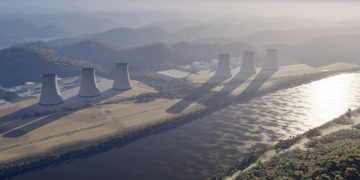

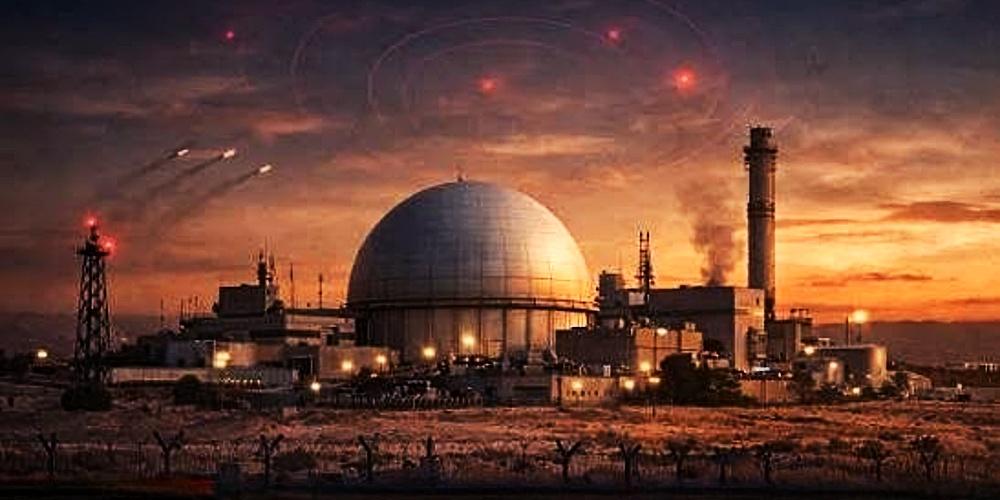
(The Economic Collapse Blog)—Iranian leaders are making all sorts of apocalyptic threats. If they are able to follow through on even some of those threats, the Middle East will soon be thrown into a state of complete and utter chaos. As you will see below, the U.S. and Israel are preparing for a massive campaign of airstrikes on Iran.
The Iranians are very well aware of this, and they are pledging to attack oil producing facilities, undersea Internet cables, international airports, desalination plants and the Dimona nuclear reactor in response. If Iran is not bluffing, we really could be facing an apocalyptic scenario in the Middle East.
On Monday, we learned that two U.S. officials just told CNN that the military is ready to hit Iran really hard once President Trump gives the order…
US forces in the Middle East are prepared to launch new, potentially major, military operations against Iran “within 96 hours of receiving” an order from President Donald Trump, according to two US officials.
Sufficient forces are now deployed in the region to carry out the potential attacks, the sources said. The scope of new US military operations would likely go beyond efforts to simply “mow the lawn” or maintain the status quo by striking radars, launchers and other Iranian assets that can be quickly reconstituted — as has been the case since Trump halted full combat operations earlier this year, the sources added.
“It will be a big effort,” one of the officials told CNN. That view has been echoed by other current and former US officials familiar with internal military planning discussions — some of whom say it is a question of when, not if, Trump will issue a go-order. They believe it could come any time before the end of the year, though most likely after the US midterm elections.
To me, this feels like a story that was leaked on purpose.
I think that the Trump administration wanted Iran to read this.
Once the USS Theodore Roosevelt arrives next month, we will have three aircraft carriers in the region…
Two US carrier strike groups, led by the USS George Washington and USS George H.W. Bush, are already operating in the region. A third, led by the USS Theodore Roosevelt, departed San Diego in late September and is heading toward the Middle East. Its arrival is expected in the coming weeks, with earlier reports pointing to November.
An amphibious readiness group led by the USS Makin Island is also heading to the region with more than 2,000 Marines from the 13th Marine Expeditionary Unit. The deployment, alongside the carrier movement, is expected to add approximately 9,000–10,000 sailors and Marines to the regional force.
The USS Boxer amphibious readiness group is already operating near the Strait of Hormuz. The expanded deployments come as the US continues its military operations and extends the presence of forces and equipment in the region.
The U.S. midterm elections are on November 3rd.
I know that there are people that disagree with me, but I still think that new airstrikes on Iran will not occur until after the midterms.
Israeli Prime Minister Benjamin Netanyahu wanted them to begin earlier, but President Trump was reportedly able to persuade him to wait…
Israeli Prime Minister Benjamin Netanyahu has been pushing to carry out new attacks against Iran, but US officials have requested he delay until the Trump administration is ready to conduct joint operations, according to two US officials and an Israeli security source.
“Netanyahu really wanted and tried to convince Trump for a joint attack in Iran before the elections, and Trump did not give a green light,” the Israeli security source told CNN.
On Tuesday, we shall see if Netanyahu gets another term or not.
Israeli voters are about to go to the polls, and it appears that it will be another tight election.
Yesterday, Netanyahu shared an AI-generated image of Tel Aviv being destroyed by a nuclear weapon…

Prime Minister Benjamin Netanyahu on Sunday posted an AI-generated image depicting a nuclear explosion in Tel Aviv, warning the public just two days before the election that voting for anyone other than him could expose Israelis to the danger of a “second Holocaust.”
Netanyahu was sharing the words of Yuval Bloomberg, a right-wing activist with roots in the tech sector who once wrote a book against the Oslo Accords. The post by Bloomberg, written last week, included the AI image of the large mushroom cloud rising above Tel Aviv as the city burned from a nuclear blast.
Israel faces a “real and tangible existential threat,” the post shared by Netanyahu said.
Netanyahu considers the conflict with Iran to be a war for survival.
The Iranians also view this as a war for survival, and they are prepared to pull out all the stops if they are attacked…
Iran will strike oil facilities, undersea cables, datacentres and AI facilities across as many as seven countries in the Gulf in the event of a fresh US-Israeli attack, Mohsen Rezaei, the secretary of Iran’s supreme national security council, has said.
Mehdi Mohammadi, an adviser to Mohammad Ghalibaf, the hardliner who led Iran’s negotiations with the US to end the conflict between the two countries, said Donald Trump and Benjamin Netanyahu had agreed in principle on an attack, but could not guarantee a successful outcome. He added: “We see the next conflict as an existential threat. The third war in two years means a threat to existence. Our strategy is ‘zero red lines’.”
Mohammadi said: “We break the temporal and spatial dimensions of the conflict. The war will continue longer and in a wider geographical area than the enemy anticipates.”
If there are “zero red lines”, no target will be off limits and the Iranians could conceivably use everything in their arsenal.
Iranian officials have put out a list of potential targets, and desalination plants all over the region are on that list…
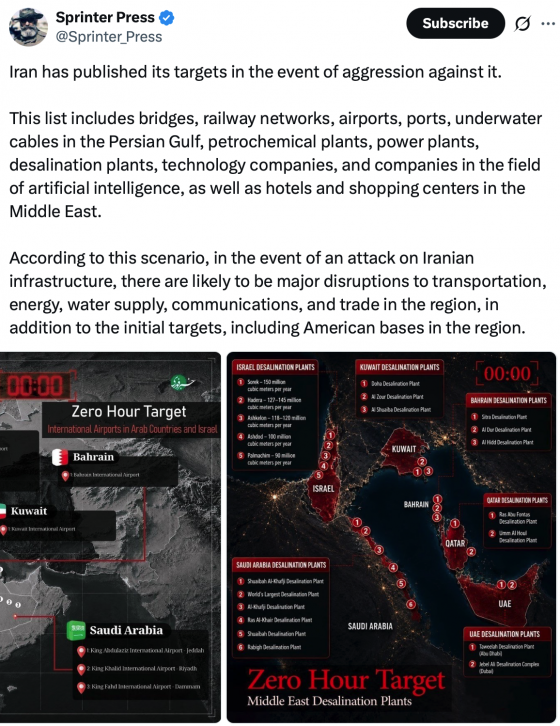
Desalination is the most important source of drinking water for many countries in the region.
I asked Google to give me specific percentages, and they were higher than I had anticipated…
- Qatar: Over 99%
- Bahrain: Over 90%
- Kuwait: 90%
- Oman: 86%
- Saudi Arabia: 70%
- Israel: 50%
- United Arab Emirates (UAE): 42%
Previously, attacking desalination plants had been a “red line” that Iran would not cross.
But now all bets are off.
The Iranians are also threatening to strike Israel like we have never seen before.
As I discussed yesterday, Ebrahim Azizi is telling us that it will “take less than an hour” to render Israel “uninhabitable”…
Ebrahim Azizi, head of the Iranian parliament’s National Security and Foreign Policy Commission, wrote in Hebrew on his social media account that any action against Iran’s security and national interests would make the occupied territories uninhabitable in less than an hour.
“Know that in the event of any action against our security and national interests, making the occupied territories uninhabitable will take less than an hour,” Azizi stressed.
One of the targets that Iran has threatened to strike in Israeli territory is the Dimona nuclear reactor…
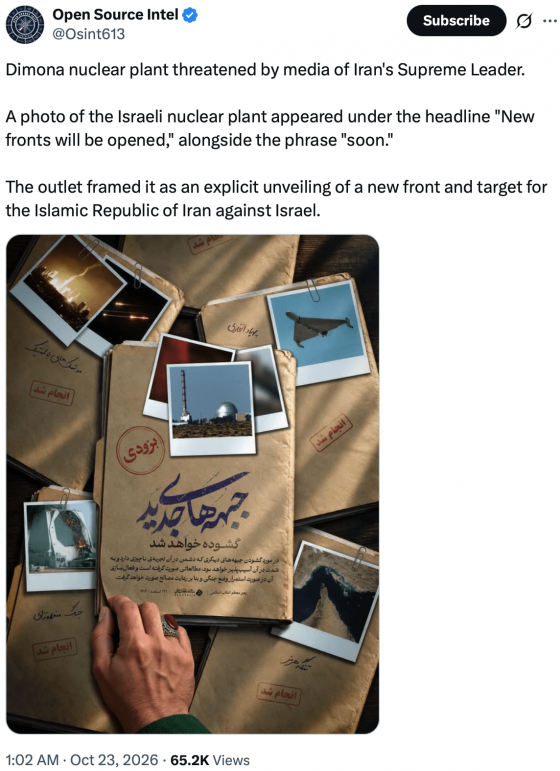
Striking an active nuclear reactor is a “red line” that nobody in the world has been willing to cross up to this point.
If the Iranians were to actually severely damage or destroy Dimona, that would create a major nuclear emergency in Israeli territory.
Needless to say, the war would go to an entirely different level at that stage.
There had been hope that some sort of a diplomatic breakthrough could be achieved when top officials from Saudi Arabia, Pakistan and Turkey visited Iran today…
Saudi Arabia’s Defense Minister Khalid bin Salman Al Saud, Pakistani Army chief Field Marshal Asim Munir and the chief of National Intelligence Organization of Turkey Ibrahim Kalin held a meeting with the Supreme National Security Council (SNSC) secretary Major General Mohsen Rezaei and President Masoud Pezeshkian as well as Foreign Minister Abbas Araghchi. The meeting was held in Saadabad Palace in the north of the Iranian capital.
Unfortunately, the Iranians made it very clear in advance that their nuclear program would not be on the agenda.
Iran is never going to make the nuclear concessions that the Trump administration is seeking.
So there will be more war.
All of the preparations have been made, and both sides have itchy trigger fingers.
Up to this point, both sides have been able to steadily escalate matters without causing the entire region to erupt in flames.
But one of these days someone will push things too far, and then we really will have an apocalyptic scenario on our hands.
Michael’s new book entitled “10 Prophetic Events That Are Coming Next” is available in paperback and for the Kindle on Amazon.com, and you can subscribe to his Substack newsletter at michaeltsnyder.substack.com.
Two Storms, One Harvest

Every food crisis in living memory has been a one-shock event. The 2008 price spike was a commodity bubble. The 2020 shortages were a logistics failure. The 2022 grain scare was a war on one exporter’s ports. Each time, the system bent, adjusted, and recovered, and each time the experts assured us afterward that global markets are simply too big and too diversified to fail.
What nobody in Washington seems eager to discuss is that 2026 is shaping up to be something the modern food system has never actually faced. Two independent shocks, one climatic and one geopolitical, are converging on the same harvest cycle at the same time. Not sequentially. Simultaneously.
Start with the weather. The Pacific Ocean is currently building toward what forecasters now openly call a record event. NOAA’s Climate Prediction Center puts the odds of at least a strong El Niño near 88 percent, with roughly two in three odds it reaches “very strong” status, the tier reserved for perhaps three or four events in the entire satellite era. Every major global model now projects a median peak in Super El Niño territory, and most of them project it exceeding the 2015-16 event, which until now held the modern record. Sea surface anomalies were already brushing the super threshold in mid-July, months before these events normally peak. The atmosphere has already shifted into El Niño mode, and the event is forecast to crest in late fall and early winter.
This is not about “climate change.” It’s about the standard cycles of weather, and the cycle we’re currently in is one that has likely devastated societies in the past. We’re better prepared as a society today, but not all Americans are equally prepared.
Serious households have started doing the quiet math on their own. Grocery bills tell part of the story, and the forecast maps tell the rest, which is why long-term food storage has moved from fringe hobby to mainstream line item in the family budget, with established suppliers like Heaven’s Harvest seeing demand from people who five years ago would have rolled their eyes at the idea. That instinct is not paranoia. It is pattern recognition, and the pattern is worth walking through carefully.
Editor’s Note: Heaven’s Harvest IS a sponsor, but the warnings of this article are real and would be written even if we didn’t have a survival food sponsor. With that said, those who take advantage of what they offer can use promo code “Patriot” for 15% off.
The Fertilizer Clock Is Already Running
While the Pacific warms, the second shock has been unfolding in the Strait of Hormuz. The conflict with Iran turned the world’s most important energy chokepoint into a contested waterway, and the consequences reach far beyond the gas pump. Roughly a third of global fertilizer trade moves through Hormuz, and the disruption sent urea prices up 86 percent year over year by March, with a 53 percent jump in a single month.
The World Bank projects energy prices rising about 24 percent in 2026 and fertilizer about 31 percent. By its own accounting, fertilizer prices ran 35 percent higher in the first five months of this year than the same period last year.
Here is the mechanism the nightly news will not explain. Fertilizer is not a grocery item. It is a time-delayed input. The nitrogen a farmer in Iowa or Punjab could not afford to apply this spring does not show up as a problem this spring. It shows up as a thinner harvest six to twelve months later.
The World Bank’s own food security brief concedes that the effects of reduced applications earlier this season “are likely to become visible only later in harvest outcomes.” Translate that from institutional language into plain English and it means this. The damage is already done, it is already in the ground, and we are simply waiting for it to arrive on the shelf.
Now check the calendar. Six to twelve months from the spring planting season lands us squarely in late 2026 and early 2027. Which is precisely when the strongest El Niño in the instrumental record is forecast to peak, bringing its signature droughts to Southeast Asia, Australia, southern Africa, northern Brazil, and South Asia, the very regions that grow the world’s rice, sugar, and oilseeds.
The World Bank warns openly that a strong El Niño “could disrupt multiple crop belts simultaneously” on top of the conflict-driven input costs. Their baseline projection assumes the Middle East disruptions ease by autumn. What in the last two years of Middle East history suggests that assumption is safe?
The System Has No Slack Left
The comfortable answer is that global markets always adjust. But adjustment requires slack, and the slack is gone. Global cereal production is expected to decline from last year’s records even before El Niño does its work. The UN World Food Programme, hardly a den of right-wing preppers, is calling this the most significant disruption to its supply chains since Covid and the invasion of Ukraine, and its supply chain director put the stakes bluntly.
Today’s supply chain challenges are tomorrow’s hunger crisis.
There is also a political dimension that markets cannot price. When food gets scarce, governments do not behave like economists. They behave like politicians. Export bans, hoarding mandates, and panic buying at the national level turned the modest rice shortfall of 2008 into a global crisis, and analysts are already warning that import-dependent nations are the first dominoes.
The 2015-16 Super El Niño, a far weaker event than what is now forecast, threw tens of millions into food stress across Africa and Asia. This one is projected to be stronger, and it arrives with fertilizer already rationed by price and shipping lanes already contested by missiles.
What Joseph Knew
Scripture does not treat preparation for lean years as faithlessness. It treats it as wisdom delivered in advance to those willing to act on it.
Behold, there come seven years of great plenty throughout all the land of Egypt: And there shall arise after them seven years of famine; and all the plenty shall be forgotten in the land of Egypt.
Joseph did not respond to that warning with a hashtag or a committee. He stored grain during the years of abundance, and when the famine came, Egypt stood while its neighbors begged. The lesson is not that famine is certain. It is that the time to prepare is precisely when preparation still looks optional.
Nobody who filled a pantry in a year of plenty has ever regretted it, and nobody standing in an empty aisle has ever been glad he waited for certainty.
None of this calls for panic, and panic is the enemy of sound judgment anyway. It calls for the same unglamorous prudence our grandparents considered ordinary. Keep some cash margin, know your local growers, and put real food in deep storage while it is cheap and available, because the entire arc of this story is that cheap and available is a closing window.
Families looking for a straightforward place to start can visit Heaven’s Harvest and use promo code Patriot for 15 percent off long-term storable food. The forecasts may yet soften, the strait may yet reopen, and we should pray they do. But hope is a fine thing to hold and a foolish thing to eat.