
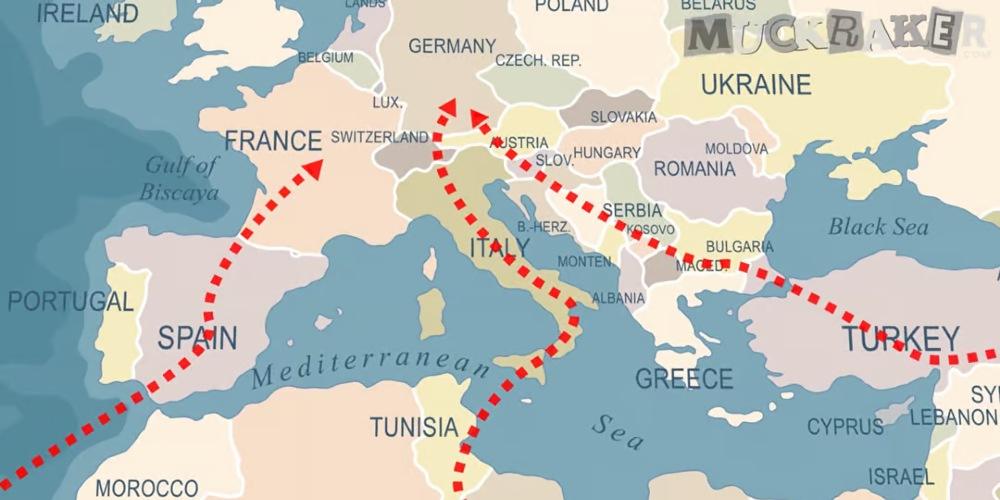
(Zero Hedge)—A new documentary from investigative outlet Muckraker traces the migrant route from West Africa through Spain and France to Britain, examining what the outlet describes as a network sustained by taxpayer-funded aid programs, NGOs, and even Western governments.
The 47-minute film, “Replacing Europe,” draws on months of reporting and undercover footage to investigate the logistics and top NGO players behind the nation-killing mass migration into Europe.
“The entire migration is a game,” says Sheikh M. Kromah, identified by Muckraker as a worker for the UN’s International Organization for Migration. He alleges that Spain has a financial incentive to maintain arrivals because reducing them could jeopardize EU funding.
Muckraker claims that publicly funded institutions help sustain the migration flows that European governments publicly promise to control. Its interviews raise questions about oversight, spending incentives and the boundary between humanitarian assistance and facilitating illegal alien border crossings into Europe.
The broader concern is whether mass migration, malassimilation, and soaring public costs of the European welfare state that cater to migrants could compound fiscal pressure and political instability.
Here is Muckraker’s report:
A UN migration worker admits Spain won’t stop the boats because the EU money is too good. A Catholic NGO pulling in €225 million a year moves arrivals to the mainland and pays them to stay. Activists paint a trail to the French border. And the journalists who filmed it were attacked and nearly arrested.
Investigative outlet Muckraker spent two months following the West African migration route from start to finish: from the smuggling hub of Nouadhibou, Mauritania, to Spain’s Canary Islands, across mainland Spain and France, and finally to the English Channel and the United Kingdom. The result is a new documentary, REPLACING EUROPE.
The film’s central finding is that the movement of tens of thousands of illegal immigrants into Europe is not chaos. It is a managed system, run by smugglers, publicly funded NGOs, activist networks and governments, several of which admit on camera that they profit from it.

Among the documentary’s findings:
- A worker for the UN’s International Organization for Migration says Spain deliberately lets the boats keep coming so it keeps receiving EU money.
- ACCEM, a Catholic NGO that took in about €225 million in 2024, mostly from the Spanish state, moves arrivals from the Canary Islands to the mainland, houses them in camps and pays them a monthly allowance.
- Migrants are flown by the hundreds from Gran Canaria to Madrid.
- In the Spanish border town of Irun, an activist group has painted a trail of footsteps guiding migrants past police and into France, where a city-run shelter takes in people with no papers.
- The UN’s own migration agency says the priority should be “facilitating, not restricting” migration.
Where It Starts: Mauritania
Most boats on the West African route leave from Senegal, Morocco, Western Sahara and above all Mauritania. Tens of thousands of the illegal immigrants who have landed in the Canary Islands departed from Mauritania’s coast.

In Nouadhibou, a local source told Muckraker that young migrant women are raped and held “like slaves,” and that captors call their families to demand ransom. Asked whether criminals or police were responsible, he said both: “The police do that… because they are working with the criminals who smuggle people.” He added that gun and drug traffickers travel among the migrants to get into Europe.
Muckraker also visited a migrant aid center in Nouadhibou run by OAMR (Organisation d’Appui et d’Assistance aux Migrants et Réfugiés), which works alongside the United Nations International Organization of Migration. A banner on the wall reads “Projet Julia Taft – Phase II”: a capacity-building project offering training, outreach and assistance to refugees, asylum seekers and migrants in Nouadhibou, with funding listed as “Ambassade des Etats-Unis en Mauritanie” — the U.S. Embassy. Asked whether the United States pays for the center’s bakery and computer lab too, staff answered yes.

The Julia Taft Refugee Fund is a State Department program run by the Bureau of Population, Refugees, and Migration. Created in 2000 and named for Julia Taft, who led that bureau under President Clinton, it lets U.S. embassies hand out small grants directly to local NGOs. The U.S. Embassy in Nouakchott’s 2022 call for proposals offered up to $50,000 per project and listed migrants among eligible beneficiaries alongside refugees and returnees.
Arrival: The Canary Islands
Off the island of El Hierro, Muckraker filmed a boat packed with migrants, almost all of them military-aged men, being towed in by Spain’s Maritime Rescue Service. One man was carried off on a stretcher, apparently lifeless.

Arrivals are taken to temporary camps. Residents described days with no work (“only eat and sleep”) and men who leave to drink and try to come back with knives. A migrant from Senegal described a darker practice on the crossing itself: passengers accused of witchcraft are tied up and thrown into the sea.

The UN Insider: “Migration Is a Game”
On the Canary Islands, Muckraker met Sheikh M. Kromah, who was then working for the UN’s International Organization for Migration (IOM) and has more than a decade in the migrant aid industry. Kromah has been photographed alongside Spain’s Minister of Inclusion, Social Security and Migration, Elma Saiz, and local officials on El Hierro.

“The entire migration is a game,” Kromah told Muckraker. “Everyone wants to have their share.” He said smuggling networks collect between €50,000 and €60,000 per boat.
Asked why Spain doesn’t stop the arrivals, he said the government doesn’t want to. Every year, he said, Spain receives a huge amount of money from the European Union to manage migration, and if the boats stopped, so would the money. The strategy, in his words, is to “minimize it, but not stop it completely, so that they keep getting the money.”
Kromah went further, claiming some of the money changes hands in cash, carried in suitcases into negotiating rooms. He said even the special police deployed to the islands, paid about three times a regular officer’s salary, “want the boats to come every day.”
“Everybody just wants to make money off everybody here,” he said. “So if you look at it, it’s a game.”
Flown to the Mainland
Then comes the transfer. At Gran Canaria airport, Muckraker found a few hundred African men waiting to be flown to Madrid. This process happens multiple times per week and is managed by ACCEM.

ACCEM: The NGO Running Spain’s Migrant Camps
One of the primary organizations responsible for moving illegal immigrants from the Canary Islands to mainland Spain, and housing them in camps once they arrive, is ACCEM.

ACCEM’s full name is the Asociación Comisión Católica Española de Migración, the Spanish Catholic Commission for Migration. According to its own 2024 annual report, as reported by Spanish outlet Infovaticana, ACCEM took in about €225 million in 2024, 88% of it from Spain’s central government. It employed 3,839 people and managed 9,812 reception places that year.
ACCEM makes no secret of its goals. In 2023, its president, Pilar Samanes Ara, cosigned a letter demanding more “safe and legal routes” for migrants into the European Union and Spain. The letter tied that demand directly to the UN’s 2030 Agenda, describing migration as “a transformative force for growth and development.”
Outside an ACCEM camp, Muckraker met a man from Senegal who had lived there for almost a year without a job. He said residents receive about €75 a month from ACCEM, plus bus or metro tickets. Even people who leave the camp without documents, he said, still get the money and a ticket. He knew of a friend who left for another Spanish city and kept being paid.
The UN’s Blueprint
What Kromah described is consistent with the framework the UN itself has published. In September 2015, the UN General Assembly adopted the 2030 Agenda for Sustainable Development, built around 17 Sustainable Development Goals.
In a related paper titled “Migration and the 2030 Agenda,” the IOM states that the agenda recognizes migration as “a core development consideration,” the first time migration has been integrated explicitly into the global development agenda. The paper calls migrant women, men and children “agents of development” and says migration can be linked to every goal in the 2030 Agenda. Its conclusion: efforts should not focus on stopping migration. Facilitating it, not restricting it, is the priority.
It is the same framework ACCEM’s president invoked when demanding new routes into Europe. The UN sets the agenda, NGOs like ACCEM carry it out, and European taxpayers fund it.
A Painted Trail to France
In Irun, the last Spanish town before France, migrants arrive at the bus station on a daily basis. From the bus station, a trail of painted footsteps leads to the Red Cross and on to the town hall, where an activist group called Irungo Harrera Sarea meets migrants every day. Members of the activist group told Muckraker the group has helped some 40,000 migrants to cross the Spanish border into France.

The man who painted the footsteps told Muckraker the trail exists so migrants can cross the border without being caught by police, and that he plans to paint more “because they get lost.” The activists confirmed they tell migrants which buses to take to avoid getting caught. A billboard by the train station maps out the entire route.
The trail leads to Pausa, a shelter in Bayonne, France, that has received millions of euros in public funds. Its director told Muckraker the center is managed by the city of Bayonne’s administration and keeps “no photos, no names.” Migrants stay a few days, he said, then take the bus and “go all over Europe,” with or without documents.

A few miles away, Muckraker visited ARDHIS, an NGO that helps migrants seek asylum as LGBT refugees. A migrant who knows the community said many of those making the claim are not gay: “They say that they just want to get on… the help.”
Calais and the Channel
For those headed to Britain, the last stop in France is Calais, where makeshift camps serve as staging grounds for Channel crossings. A local private security guard described migrants stealing from stores and killing a farmer’s goat to eat. Human traffickers embed themselves in these camps, which have been the scene of deadly shootings in recent years.
Posing as aid workers and filming with hidden cameras, Muckraker got inside one camp set up in an abandoned warehouse. Men there said they came from Sudan, Morocco and Egypt. The crew counted roughly 100 tents packed under one roof, a prayer area lined with rugs and stacked Korans, and masked men watching the visitors. Once the camera was noticed, the mood turned. “I don’t accept that you take photos here,” one man said. A crowd closed in and pushed the crew out.


International trafficking networks run the crossings themselves. Many of the traffickers are illegal migrants themselves, often from Iraq, Albania and Kurdish regions. On the evening before a boat leaves, hundreds of migrants move out of the camps to pre-arranged meeting points along the coast. Muckraker spent weeks in Calais watching these movements and gathering intelligence.

Getting to a launch was the hard part. An Afghan migrant who planned to make the crossing himself told the crew that smugglers are suspicious of anyone who speaks English or French, assuming they are spies or police, and warned they could be beaten, injured or even killed. Late one night, he sent the crew the location where a boat would leave from, followed by a warning to be careful because the smugglers were armed.
The crew drove to the coast and waited. In the dark, they watched a dinghy head out to open water while groups of men they believed could be smugglers moved along the shore. The boat’s plan was to circle back and pick up its passengers from the beach.
At about 5 a.m., more than 50 people ran out of the dunes toward the water, including a man carrying a small child. For more than 15 minutes, not a single police officer was on the beach. By the time police arrived, the boat was loading, and they soon gave up and walked back up the beach and the boat they attempted to stop successfully departed for and later arrived at the U.K.

The United Kingdom
In England, asylum seekers living in a government-funded hotel told Muckraker that housing and food are free, that they receive about £300 a month, and that university is free for them as well. One said he had been living in the hotel for three years.

Watch the full video here:
Two Storms, One Harvest

Every food crisis in living memory has been a one-shock event. The 2008 price spike was a commodity bubble. The 2020 shortages were a logistics failure. The 2022 grain scare was a war on one exporter’s ports. Each time, the system bent, adjusted, and recovered, and each time the experts assured us afterward that global markets are simply too big and too diversified to fail.
What nobody in Washington seems eager to discuss is that 2026 is shaping up to be something the modern food system has never actually faced. Two independent shocks, one climatic and one geopolitical, are converging on the same harvest cycle at the same time. Not sequentially. Simultaneously.
Start with the weather. The Pacific Ocean is currently building toward what forecasters now openly call a record event. NOAA’s Climate Prediction Center puts the odds of at least a strong El Niño near 88 percent, with roughly two in three odds it reaches “very strong” status, the tier reserved for perhaps three or four events in the entire satellite era. Every major global model now projects a median peak in Super El Niño territory, and most of them project it exceeding the 2015-16 event, which until now held the modern record. Sea surface anomalies were already brushing the super threshold in mid-July, months before these events normally peak. The atmosphere has already shifted into El Niño mode, and the event is forecast to crest in late fall and early winter.
This is not about “climate change.” It’s about the standard cycles of weather, and the cycle we’re currently in is one that has likely devastated societies in the past. We’re better prepared as a society today, but not all Americans are equally prepared.
Serious households have started doing the quiet math on their own. Grocery bills tell part of the story, and the forecast maps tell the rest, which is why long-term food storage has moved from fringe hobby to mainstream line item in the family budget, with established suppliers like Heaven’s Harvest seeing demand from people who five years ago would have rolled their eyes at the idea. That instinct is not paranoia. It is pattern recognition, and the pattern is worth walking through carefully.
Editor’s Note: Heaven’s Harvest IS a sponsor, but the warnings of this article are real and would be written even if we didn’t have a survival food sponsor. With that said, those who take advantage of what they offer can use promo code “Patriot” for 15% off.
The Fertilizer Clock Is Already Running
While the Pacific warms, the second shock has been unfolding in the Strait of Hormuz. The conflict with Iran turned the world’s most important energy chokepoint into a contested waterway, and the consequences reach far beyond the gas pump. Roughly a third of global fertilizer trade moves through Hormuz, and the disruption sent urea prices up 86 percent year over year by March, with a 53 percent jump in a single month.
The World Bank projects energy prices rising about 24 percent in 2026 and fertilizer about 31 percent. By its own accounting, fertilizer prices ran 35 percent higher in the first five months of this year than the same period last year.
Here is the mechanism the nightly news will not explain. Fertilizer is not a grocery item. It is a time-delayed input. The nitrogen a farmer in Iowa or Punjab could not afford to apply this spring does not show up as a problem this spring. It shows up as a thinner harvest six to twelve months later.
The World Bank’s own food security brief concedes that the effects of reduced applications earlier this season “are likely to become visible only later in harvest outcomes.” Translate that from institutional language into plain English and it means this. The damage is already done, it is already in the ground, and we are simply waiting for it to arrive on the shelf.
Now check the calendar. Six to twelve months from the spring planting season lands us squarely in late 2026 and early 2027. Which is precisely when the strongest El Niño in the instrumental record is forecast to peak, bringing its signature droughts to Southeast Asia, Australia, southern Africa, northern Brazil, and South Asia, the very regions that grow the world’s rice, sugar, and oilseeds.
The World Bank warns openly that a strong El Niño “could disrupt multiple crop belts simultaneously” on top of the conflict-driven input costs. Their baseline projection assumes the Middle East disruptions ease by autumn. What in the last two years of Middle East history suggests that assumption is safe?
The System Has No Slack Left
The comfortable answer is that global markets always adjust. But adjustment requires slack, and the slack is gone. Global cereal production is expected to decline from last year’s records even before El Niño does its work. The UN World Food Programme, hardly a den of right-wing preppers, is calling this the most significant disruption to its supply chains since Covid and the invasion of Ukraine, and its supply chain director put the stakes bluntly.
Today’s supply chain challenges are tomorrow’s hunger crisis.
There is also a political dimension that markets cannot price. When food gets scarce, governments do not behave like economists. They behave like politicians. Export bans, hoarding mandates, and panic buying at the national level turned the modest rice shortfall of 2008 into a global crisis, and analysts are already warning that import-dependent nations are the first dominoes.
The 2015-16 Super El Niño, a far weaker event than what is now forecast, threw tens of millions into food stress across Africa and Asia. This one is projected to be stronger, and it arrives with fertilizer already rationed by price and shipping lanes already contested by missiles.
What Joseph Knew
Scripture does not treat preparation for lean years as faithlessness. It treats it as wisdom delivered in advance to those willing to act on it.
Behold, there come seven years of great plenty throughout all the land of Egypt: And there shall arise after them seven years of famine; and all the plenty shall be forgotten in the land of Egypt.
Joseph did not respond to that warning with a hashtag or a committee. He stored grain during the years of abundance, and when the famine came, Egypt stood while its neighbors begged. The lesson is not that famine is certain. It is that the time to prepare is precisely when preparation still looks optional.
Nobody who filled a pantry in a year of plenty has ever regretted it, and nobody standing in an empty aisle has ever been glad he waited for certainty.
None of this calls for panic, and panic is the enemy of sound judgment anyway. It calls for the same unglamorous prudence our grandparents considered ordinary. Keep some cash margin, know your local growers, and put real food in deep storage while it is cheap and available, because the entire arc of this story is that cheap and available is a closing window.
Families looking for a straightforward place to start can visit Heaven’s Harvest and use promo code Patriot for 15 percent off long-term storable food. The forecasts may yet soften, the strait may yet reopen, and we should pray they do. But hope is a fine thing to hold and a foolish thing to eat.