

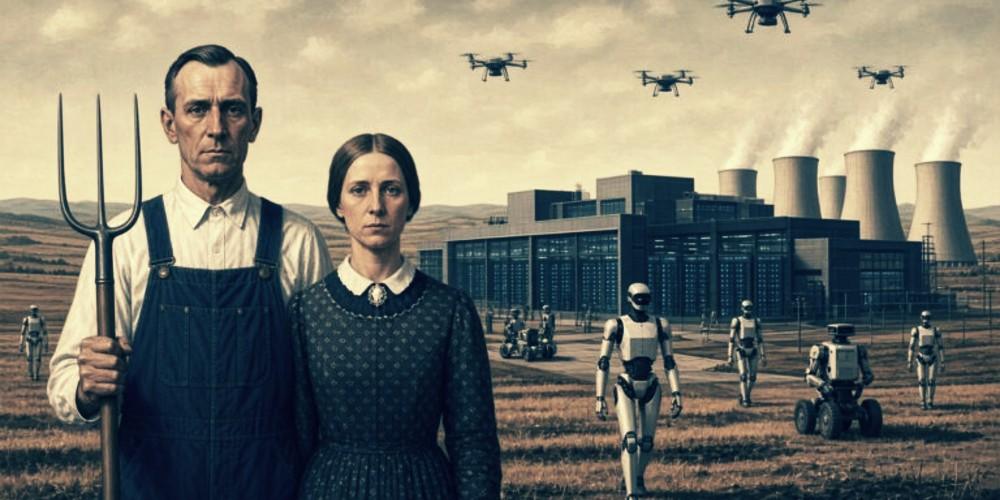
This article was written by Brandon Smith and originally published at Birch Gold Group
(Alt-Market)—In recent months I’ve been asked by numerous readers to give my take on the AI data center issue and the debate it has ignited across the US. In response, I’ve jumped into a steep learning curve, but it seems to parallel information I’ve covered in previous articles on AI.
From what I can tell, both political parties are split on the data center debate. There are Democrats and Republicans on both sides of the divide, though their reasons for opposing or supporting the centers are not necessarily the same.
It’s clear that the Trump Administration has given its seal of approval on the concept and this has spurred many on the left to mindlessly attack it by default. Some conservatives support the centers simply because leftists complain about them. It’s important to move past the partisanship on this issue to get to the facts. According to polls, around 70% of Americans oppose new data centers in their communities, but why?
We might call it “infrastructure”, which sounds very important, but it’s clear that the reason for all the public apprehension about data centers is because no one has outlined any tangible benefits for the economy or society at large. Corporations and technocrats wax philosophical about a Utopian future, but this kind of rhetoric is rightly treated with suspicion.
People want to know, what is the actual point of building so many of these facilities? I’ll try to break it down in basic terms…
What Do Data Centers Actually Do?
The vast majority of new data centers (the recently approved facilities and those still in development) are server farms focused primarily on AI training or AI “inference”. The more controversial greenfield mega-campuses are disproportionately used for the training of “frontier AI models”. These models run trillions of parameters and eat up significant power, operating full tilt 24/7 until the AI is deemed ready for inference.
Once one model is finished with training, another model is immediately started. To put it simply, imagine that each of these data centers is an assembly line factory and each factory builds AI products. They are products which most people view as intangible and ethereal rather than practical.

We can see and use cars, we can see and use televisions and refrigerators, we can see the workers on the factory floor and we can see the jobs these products create. Not so much with AI and data centers, and this is one of the problems with trying to convince the public that such operations are necessary for the future well-being of the country.
In some cases AI training facilities convert partially or fully to inference operations. Meaning they handle the day-to-day functions of existing AI. So, every time you ask Chat GPT a question, or ask it to create an image for you, or ask it to make a ridiculous uncanny valley video for you, that request is processed by a data center somewhere (I used AI to make an image for this very article – It’s a tool, like any other tool).
This uses up electricity from the grid. Sometimes it uses a lot of electricity from the grid depending on what you are doing and how many millions of people are doing the same thing at any given moment.
If this all seems highly centralized, that’s because it is. There’s very little privacy in terms of using a cloud model AI. In fact, your conversations with an AI like Chat GPT or Gemini essentially become the property of the company that owns that AI, because the AI uses every conversation as a training opportunity.

In other words data centers exist to grow more and more AI models while making them smarter and smarter (in theory). But again, why should the average American give a damn about this?
The Global “Race” For AI Supremacy And The Information Economy
In every white paper I have ever read from organizations like the WEF, the UN, and government agencies around the world dealing with everything from military security to economic advancement, the same vision keeps popping up: Integrated AI systems at every level of society and a “4th Industrial Revolution”.
The idea is that AI will run almost everything and that our entire evolution as a species will be transcendent because of this technology. At least, these are the musings of the technocrats. Some of them are well meaning and they truly dream of planet without scarcity. Others have distinctively nefarious agendas and they only taste power.
The latter group, from the evidence I have seen, views AI as a kind of “technological deity” – A machine god. They believe that if they pump all available information and enough computing power into these models, eventually one of them will hit “the singularity” point. This is the point at which an AI will supposedly become “sentient” and all-knowing.
I don’t think the singularity is a reality – I think it’s a pipe dream. That said, I do think AI is a very useful tool for making human beings even more lazy and easy to control if we allow it. As I’ve said in the past, the biggest threat from AI is NOT the rise of a “machine god” like “Skynet” from the Terminator movies, but the opportunity for complete apathy that this software creates. There are already far too many people who use AI to think for them instead of researching on their own.
The “information economy” is a more grounded notion of how AI might be applied, but it’s still a bit ridiculous. It’s the idea that larger economies will no longer rely on the production of tangible goods and resources to support the system. Rather, they will rely on the creation of digital products and the trading of data derived from algorithms.
If you think the global economy is fake now, you haven’t seen anything yet. This notion reminds me a lot of the tech bubble of the 1990s, the derivatives bubble of the early 2000s, and the dangerous Enron-like desire to create wealth through fiat concepts rather than making real and useful things. The AI bubble could be just as vaporous and destructive.
What Do Local Communities Get Out Of The “4th Industrial Revolution”
The Trump Administration is backing data centers from a place of economic ambition. He thinks this is an industrial competition and he believes that countries like China are going to strike some kind of AI gold while the US is left in the dust. He also has people in his ear who are fear mongering about the possibility of military disadvantage should other governments develop AI faster.
I can’t speak to the military applications because, frankly, they are entirely theoretical. If we are headed for a “Skynet” scenario then let’s hope I’m right and these apps are far less effective than they have been hyped up to be.
It’s also true that there are numerous foreign actors who prefer that the US doesn’t develop AI at an accelerated pace. This doesn’t mean that we should expend our resources chasing a digital phantom, but it’s obvious the Chinese would like to stay a step ahead even if it doesn’t gain them anything of substance in the end.
So far the biggest opposition to new data centers is rooted in concerns over power usage and increased utility bills for locals. Eyesore server farms with loud-ass fans ruining the serene landscapes of rural communities is not a good look. These communities are usually near hydro generators, solar farms, wind farms, etc. and are being targeted because of access to ample power and large plots of land at lower cost.
As someone who lives in one of these communities I can tell you right now, almost no one is going to jump on this bandwagon. Even with most of the population being hardcore conservative, and even with Trump selling the idea, they aren’t going for it. Rural Americans do not care about saving corporations money on electricity.
Maybe if companies and government officials finally built some friggin’ nuclear power plants instead of adding more strain to the grid, people would be less inclined to complain. They can put these data centers right next door to the plants and everyone can have cheap electricity. It’s a win-win.
What are the hard benefits of the centers? AI centers create some construction jobs for a few months. They offer around 100 to 200 permanent jobs in each community, but most of them are tech jobs in places where there is no tech labor pool, which means those people will have to be imported into the communities where these centers are built.
There’s expanded user access for the population at large. However, does anyone really care if they can’t make memes on Gemini or Grok anymore? Does any of this touch the lives of average American in a positive and meaningful way? I’m just not seeing it.
At most, communities that allow the establishment of data centers stand to gain some tax revenues, but that is all. I’m not completely dismissing the people who want to promote AI development, but none of them are conjuring up any selling points exciting enough to set imaginations aflame. This is not like the space race of the cold war era.
No one is clutching their chest in fear of “losing an AI race”. And, it’s not enough to jump blindly into the world of science fiction and paint grand pictures of a robot Utopia. We all know, deep down, that this is not going to happen, at least not for many generations to come.
When I look at the AI debate I see multiple factions, interests and visions colliding. Not everyone who wants data centers is some kind of demonic globalist looking for world domination. Some people truly desire a better future and they think AI is the way. On the other hand, not everyone who stands against data centers is a lefty communist, a Chinese agent or a “dumb country hick”. A lot of them are people with legitimate concerns and they still haven’t been offered a compelling reason why data centers should happen.
In the middle of all this, of course, we have the power mongers and nihilist elites who are only interested in using AI and the AI economy to further their own goals at the expense of the common man. They poison the well for everyone else.
I do wonder what would happen if these people and their armies of useful idiots were out of the way – Would AI development look completely different? Or maybe the public wouldn’t have any reason to be so suspicious of everything? Maybe the technology would progress more freely without constant fears of abuse?
It’s hard to say, but for now, most Americans oppose new data centers in their area. This is unlikely to ever change and trying to force the issue will only elicit anger.
If you would like to support the work that Alt-Market does while also receiving content on advanced tactics for defeating the globalist agenda, subscribe to our exclusive newsletter The Wild Bunch Dispatch. Learn more about it HERE.
Two Storms, One Harvest

Every food crisis in living memory has been a one-shock event. The 2008 price spike was a commodity bubble. The 2020 shortages were a logistics failure. The 2022 grain scare was a war on one exporter’s ports. Each time, the system bent, adjusted, and recovered, and each time the experts assured us afterward that global markets are simply too big and too diversified to fail.
What nobody in Washington seems eager to discuss is that 2026 is shaping up to be something the modern food system has never actually faced. Two independent shocks, one climatic and one geopolitical, are converging on the same harvest cycle at the same time. Not sequentially. Simultaneously.
Start with the weather. The Pacific Ocean is currently building toward what forecasters now openly call a record event. NOAA’s Climate Prediction Center puts the odds of at least a strong El Niño near 88 percent, with roughly two in three odds it reaches “very strong” status, the tier reserved for perhaps three or four events in the entire satellite era. Every major global model now projects a median peak in Super El Niño territory, and most of them project it exceeding the 2015-16 event, which until now held the modern record. Sea surface anomalies were already brushing the super threshold in mid-July, months before these events normally peak. The atmosphere has already shifted into El Niño mode, and the event is forecast to crest in late fall and early winter.
This is not about “climate change.” It’s about the standard cycles of weather, and the cycle we’re currently in is one that has likely devastated societies in the past. We’re better prepared as a society today, but not all Americans are equally prepared.
Serious households have started doing the quiet math on their own. Grocery bills tell part of the story, and the forecast maps tell the rest, which is why long-term food storage has moved from fringe hobby to mainstream line item in the family budget, with established suppliers like Heaven’s Harvest seeing demand from people who five years ago would have rolled their eyes at the idea. That instinct is not paranoia. It is pattern recognition, and the pattern is worth walking through carefully.
Editor’s Note: Heaven’s Harvest IS a sponsor, but the warnings of this article are real and would be written even if we didn’t have a survival food sponsor. With that said, those who take advantage of what they offer can use promo code “Patriot” for 15% off.
The Fertilizer Clock Is Already Running
While the Pacific warms, the second shock has been unfolding in the Strait of Hormuz. The conflict with Iran turned the world’s most important energy chokepoint into a contested waterway, and the consequences reach far beyond the gas pump. Roughly a third of global fertilizer trade moves through Hormuz, and the disruption sent urea prices up 86 percent year over year by March, with a 53 percent jump in a single month.
The World Bank projects energy prices rising about 24 percent in 2026 and fertilizer about 31 percent. By its own accounting, fertilizer prices ran 35 percent higher in the first five months of this year than the same period last year.
Here is the mechanism the nightly news will not explain. Fertilizer is not a grocery item. It is a time-delayed input. The nitrogen a farmer in Iowa or Punjab could not afford to apply this spring does not show up as a problem this spring. It shows up as a thinner harvest six to twelve months later.
The World Bank’s own food security brief concedes that the effects of reduced applications earlier this season “are likely to become visible only later in harvest outcomes.” Translate that from institutional language into plain English and it means this. The damage is already done, it is already in the ground, and we are simply waiting for it to arrive on the shelf.
Now check the calendar. Six to twelve months from the spring planting season lands us squarely in late 2026 and early 2027. Which is precisely when the strongest El Niño in the instrumental record is forecast to peak, bringing its signature droughts to Southeast Asia, Australia, southern Africa, northern Brazil, and South Asia, the very regions that grow the world’s rice, sugar, and oilseeds.
The World Bank warns openly that a strong El Niño “could disrupt multiple crop belts simultaneously” on top of the conflict-driven input costs. Their baseline projection assumes the Middle East disruptions ease by autumn. What in the last two years of Middle East history suggests that assumption is safe?
The System Has No Slack Left
The comfortable answer is that global markets always adjust. But adjustment requires slack, and the slack is gone. Global cereal production is expected to decline from last year’s records even before El Niño does its work. The UN World Food Programme, hardly a den of right-wing preppers, is calling this the most significant disruption to its supply chains since Covid and the invasion of Ukraine, and its supply chain director put the stakes bluntly.
Today’s supply chain challenges are tomorrow’s hunger crisis.
There is also a political dimension that markets cannot price. When food gets scarce, governments do not behave like economists. They behave like politicians. Export bans, hoarding mandates, and panic buying at the national level turned the modest rice shortfall of 2008 into a global crisis, and analysts are already warning that import-dependent nations are the first dominoes.
The 2015-16 Super El Niño, a far weaker event than what is now forecast, threw tens of millions into food stress across Africa and Asia. This one is projected to be stronger, and it arrives with fertilizer already rationed by price and shipping lanes already contested by missiles.
What Joseph Knew
Scripture does not treat preparation for lean years as faithlessness. It treats it as wisdom delivered in advance to those willing to act on it.
Behold, there come seven years of great plenty throughout all the land of Egypt: And there shall arise after them seven years of famine; and all the plenty shall be forgotten in the land of Egypt.
Joseph did not respond to that warning with a hashtag or a committee. He stored grain during the years of abundance, and when the famine came, Egypt stood while its neighbors begged. The lesson is not that famine is certain. It is that the time to prepare is precisely when preparation still looks optional.
Nobody who filled a pantry in a year of plenty has ever regretted it, and nobody standing in an empty aisle has ever been glad he waited for certainty.
None of this calls for panic, and panic is the enemy of sound judgment anyway. It calls for the same unglamorous prudence our grandparents considered ordinary. Keep some cash margin, know your local growers, and put real food in deep storage while it is cheap and available, because the entire arc of this story is that cheap and available is a closing window.
Families looking for a straightforward place to start can visit Heaven’s Harvest and use promo code Patriot for 15 percent off long-term storable food. The forecasts may yet soften, the strait may yet reopen, and we should pray they do. But hope is a fine thing to hold and a foolish thing to eat.