
Gavin Newsom spent years selling Californians a fairy tale. The jet-setting, the Davos photos, the London climate handshake, the week in China. None of that was supposed to cost the public a dime. A quiet little nonprofit would pick up the check. Wealthy friends would write the checks. Everybody would pretend that was clean.
Federal prosecutors in Sacramento just stopped pretending.
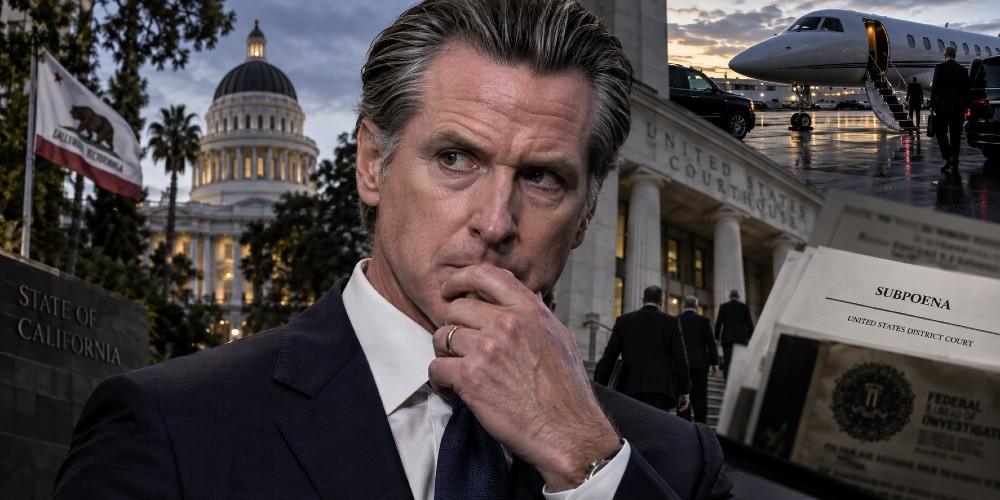
The New York Post reported Saturday that the U.S. Attorney’s Office issued subpoenas this month demanding roughly six years of records around the California State Protocol Foundation, the vehicle that has bankrolled Newsom’s overseas travel with privately donated cash.
The San Francisco Standard, which reviewed the documents, said investigators want the foundation’s donors and fundraisers, the governor’s international travel and events, and any money used for his residence, living costs, or personal expenses.
That last clause is the one that should make the marble floors in Sacramento creak. This is no longer just a travel-receipt story. The feds are asking who paid for how the governor lives.
One subpoena, signed by Assistant U.S. Attorney Michael D. Anderson, states the records are “for use in a criminal investigation pending in the Eastern District of California.” The Standard reported those records are headed to a grand jury. Grand juries do not convene to admire a governor’s itinerary.
The Slush Fund With Better Branding
The Protocol Foundation is not some civic Rotary club. It was born in 2001 under Gray Davis as the Golden State Host Foundation, rebranded under Arnold Schwarzenegger, went quiet under Jerry Brown, and roared back to life once Newsom needed a way to fly first class without putting the bill on the state ledger. In theory it “saves taxpayers.” In practice it lets companies with business before the state write checks that keep the governor in the air.
State records reviewed by The California Post show Newsom has directed more than $7.5 million from outside groups into the foundation since 2019. About $5.1 million of that was leftover inaugural money. Inauguration leftover. You raise cash to throw a party when you take the oath, then you park what remains in the account that pays for Davos hotels and London climate theater years later. Elegant.

The donor list reads like a permission slip for anyone who needs something from Sacramento. CVS. A Blue Shield foundation. Zoox, Amazon’s robotaxi shop testing in San Francisco and hunting state approvals. Crypto billionaire Chris Larsen. The left-wing dark-money shop New Venture Fund. Foundations tied to Susie Tompkins Buell and Lisa Stone Pritzker, both longtime underwriters of Newsom politics and of Jennifer Siebel Newsom’s nonprofit universe.
The Post documented earlier this year that the same foundation covered about $57,000 in flights, hotels, and meals for Newsom’s 2026 swing through the World Economic Forum in Davos, the Munich Security Conference, and a London environmental pact. Davos airfare alone ran more than $26,500. Zoox dropped $75,000 on the foundation in February. That is not charity. That is access with a boarding pass.
By the end of 2024 the outfit was running on fumes. IRS filings showed it had spent nearly $600,000 more than it took in over two years and was sitting on $7,790. Then the donors refilled the tank. Coincidence is a wonderful word if you work in protocol.
The Inner Circle on the Subpoena List
Investigators did not stop at the foundation’s bank statements. They went after the people who actually run Newsom’s travel life.
Becca Prowda, the governor’s chief protocol officer, is named in the subpoenas. She staffs the foreign trips. The Post, after winning a public-records fight this summer, found more than 30 briefings or meetings between Newsom and Prowda on his jet-set calendar and sit-downs with foreign leaders. She is also married to San Francisco Mayor Daniel Lurie. California’s ruling class is not a coalition. It is a family reunion with security badges.
The foundation’s board is a reunion of another kind. Chair Steve Kawa was Newsom’s chief of staff when Newsom ran San Francisco. Newsom just parked him as chair of the High-Speed Rail Authority, the eternal monument to California’s talent for spending other people’s money on trains that do not arrive.
Longtime adviser Jason Elliott sits on the foundation board and got the same rail appointment. Jim DeBoo, another former Newsom chief of staff, is the foundation’s secretary. Matina Kolokotronis, COO of the Sacramento Kings, serves as treasurer.
These are not independent civic stewards. They are the same men and women who have been in the room for two decades. When federal prosecutors ask for their communications with the governor, they are asking whether the line between official duty, donor gratitude, and personal lifestyle ever existed at all.
The foundation has also paid for more than plane tickets. Protocol money covered Newsom’s pandemic State of the State speech in an empty Dodger Stadium. It paid for the burner phones he sent last year to top tech CEOs with his personal number programmed in, a stunt Fox News flagged when the handsets went out. Nothing says “good government” like a secret second phone funded by a donor nonprofit run by your old staff.
For there is nothing covered, that shall not be revealed; neither hid, that shall not be known.
That is the problem with building a government on quiet money. Eventually someone with a subpoena reads the same books you thought were private.
He Calls It a Witch Hunt. The Timeline Says Otherwise.
Newsom’s office answered the obvious way. Spokesperson Tara Gallegos told the Post the governor “went after the king,” and now “the tyrant is coming after everyone around him.” She added the familiar line that Donald Trump investigates first and hunts for a crime second.
That speech writes itself. It also collides with reporting that has been on the table since June. Fox News and Breitbart both reported that the inquiries started in 2025, grew out of whistleblower complaints in Sacramento, and were not launched from Washington on Trump’s order. Multiple federal tracks have been circling the Newsoms for a year, including Jennifer Siebel Newsom’s taxes and the nonprofits in her orbit. Newsom’s former chief of staff, Dana Williamson, already pleaded guilty this spring to federal fraud and tax charges. The Gateway Pundit later reported the FBI had a mole inside that orbit during the Williamson case.
If this were only presidential score-settling, the paper trail would not keep leading back to inaugural leftovers, robotaxi checks, household expenses, and a former chief of staff who already admitted she stole.
The foundation, for its part, told the Standard it would not discuss the investigation and offered the usual civic hymn. It has “proudly supported both Republican and Democratic administrations” in representing California abroad. True enough as history. Schwarzenegger used the same machine. That does not make a donor-funded lifestyle account holy. It means California has been running a legalized influence pipeline for a generation and finally drew a prosecutor who can read a Form 990.
Meanwhile the Federal Election Commission is already poking Newsom’s Campaign for Democracy PAC over tens of thousands in travel reimbursements. The man cannot board a plane without a second set of books appearing behind him.
California Gets the Bill Either Way
Newsom will keep calling this politics. He is weighing 2028. He needs the martyr costume. Fine. Let him wear it.
The public question is simpler. Who paid for the governor’s life, and what did they expect in return? When a robotaxi company writes a fat check to the slush fund that flies the governor to Europe, and that same company wants Sacramento’s blessing to put driverless cars on California streets, you do not need a conspiracy board. You need a receipt.
When leftover inaugural cash becomes years of first-class diplomacy, when the protocol officer is married to the mayor of San Francisco, when the rail-authority chair also chairs the travel foundation, and when prosecutors now want six years of personal and household spending records, the “taxpayers were spared” line starts to sound like a punchline.
Californians live with the other half of this story every day. High-speed rail that does not move. Energy prices that do. Cities that lecture the country about justice while they empty the treasury on consultants and nonprofits. Newsom jets to Davos to tell the world how embarrassing America looks, then comes home and asks why anyone would audit the account that bought the ticket.
A grand jury in the Eastern District gets to decide whether any of this crosses from ugly into criminal. The rest of us already know what it is. A ruling class that found a prettier name for other people’s money, then acted shocked when someone followed the money home.
Two Storms, One Harvest

Every food crisis in living memory has been a one-shock event. The 2008 price spike was a commodity bubble. The 2020 shortages were a logistics failure. The 2022 grain scare was a war on one exporter’s ports. Each time, the system bent, adjusted, and recovered, and each time the experts assured us afterward that global markets are simply too big and too diversified to fail.
What nobody in Washington seems eager to discuss is that 2026 is shaping up to be something the modern food system has never actually faced. Two independent shocks, one climatic and one geopolitical, are converging on the same harvest cycle at the same time. Not sequentially. Simultaneously.
Start with the weather. The Pacific Ocean is currently building toward what forecasters now openly call a record event. NOAA’s Climate Prediction Center puts the odds of at least a strong El Niño near 88 percent, with roughly two in three odds it reaches “very strong” status, the tier reserved for perhaps three or four events in the entire satellite era. Every major global model now projects a median peak in Super El Niño territory, and most of them project it exceeding the 2015-16 event, which until now held the modern record. Sea surface anomalies were already brushing the super threshold in mid-July, months before these events normally peak. The atmosphere has already shifted into El Niño mode, and the event is forecast to crest in late fall and early winter.
This is not about “climate change.” It’s about the standard cycles of weather, and the cycle we’re currently in is one that has likely devastated societies in the past. We’re better prepared as a society today, but not all Americans are equally prepared.
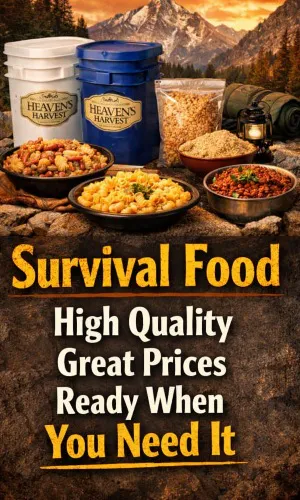
Serious households have started doing the quiet math on their own. Grocery bills tell part of the story, and the forecast maps tell the rest, which is why long-term food storage has moved from fringe hobby to mainstream line item in the family budget, with established suppliers like Heaven’s Harvest seeing demand from people who five years ago would have rolled their eyes at the idea. That instinct is not paranoia. It is pattern recognition, and the pattern is worth walking through carefully.
Editor’s Note: Heaven’s Harvest IS a sponsor, but the warnings of this article are real and would be written even if we didn’t have a survival food sponsor. With that said, those who take advantage of what they offer can use promo code “Patriot” for 15% off.
The Fertilizer Clock Is Already Running
While the Pacific warms, the second shock has been unfolding in the Strait of Hormuz. The conflict with Iran turned the world’s most important energy chokepoint into a contested waterway, and the consequences reach far beyond the gas pump. Roughly a third of global fertilizer trade moves through Hormuz, and the disruption sent urea prices up 86 percent year over year by March, with a 53 percent jump in a single month.
The World Bank projects energy prices rising about 24 percent in 2026 and fertilizer about 31 percent. By its own accounting, fertilizer prices ran 35 percent higher in the first five months of this year than the same period last year.
Here is the mechanism the nightly news will not explain. Fertilizer is not a grocery item. It is a time-delayed input. The nitrogen a farmer in Iowa or Punjab could not afford to apply this spring does not show up as a problem this spring. It shows up as a thinner harvest six to twelve months later.
The World Bank’s own food security brief concedes that the effects of reduced applications earlier this season “are likely to become visible only later in harvest outcomes.” Translate that from institutional language into plain English and it means this. The damage is already done, it is already in the ground, and we are simply waiting for it to arrive on the shelf.
Now check the calendar. Six to twelve months from the spring planting season lands us squarely in late 2026 and early 2027. Which is precisely when the strongest El Niño in the instrumental record is forecast to peak, bringing its signature droughts to Southeast Asia, Australia, southern Africa, northern Brazil, and South Asia, the very regions that grow the world’s rice, sugar, and oilseeds.
The World Bank warns openly that a strong El Niño “could disrupt multiple crop belts simultaneously” on top of the conflict-driven input costs. Their baseline projection assumes the Middle East disruptions ease by autumn. What in the last two years of Middle East history suggests that assumption is safe?
The System Has No Slack Left
The comfortable answer is that global markets always adjust. But adjustment requires slack, and the slack is gone. Global cereal production is expected to decline from last year’s records even before El Niño does its work. The UN World Food Programme, hardly a den of right-wing preppers, is calling this the most significant disruption to its supply chains since Covid and the invasion of Ukraine, and its supply chain director put the stakes bluntly.
Today’s supply chain challenges are tomorrow’s hunger crisis.
There is also a political dimension that markets cannot price. When food gets scarce, governments do not behave like economists. They behave like politicians. Export bans, hoarding mandates, and panic buying at the national level turned the modest rice shortfall of 2008 into a global crisis, and analysts are already warning that import-dependent nations are the first dominoes.
The 2015-16 Super El Niño, a far weaker event than what is now forecast, threw tens of millions into food stress across Africa and Asia. This one is projected to be stronger, and it arrives with fertilizer already rationed by price and shipping lanes already contested by missiles.
What Joseph Knew
Scripture does not treat preparation for lean years as faithlessness. It treats it as wisdom delivered in advance to those willing to act on it.
Behold, there come seven years of great plenty throughout all the land of Egypt: And there shall arise after them seven years of famine; and all the plenty shall be forgotten in the land of Egypt.
Joseph did not respond to that warning with a hashtag or a committee. He stored grain during the years of abundance, and when the famine came, Egypt stood while its neighbors begged. The lesson is not that famine is certain. It is that the time to prepare is precisely when preparation still looks optional.
Nobody who filled a pantry in a year of plenty has ever regretted it, and nobody standing in an empty aisle has ever been glad he waited for certainty.
None of this calls for panic, and panic is the enemy of sound judgment anyway. It calls for the same unglamorous prudence our grandparents considered ordinary. Keep some cash margin, know your local growers, and put real food in deep storage while it is cheap and available, because the entire arc of this story is that cheap and available is a closing window.
Families looking for a straightforward place to start can visit Heaven’s Harvest and use promo code Patriot for 15 percent off long-term storable food. The forecasts may yet soften, the strait may yet reopen, and we should pray they do. But hope is a fine thing to hold and a foolish thing to eat.