

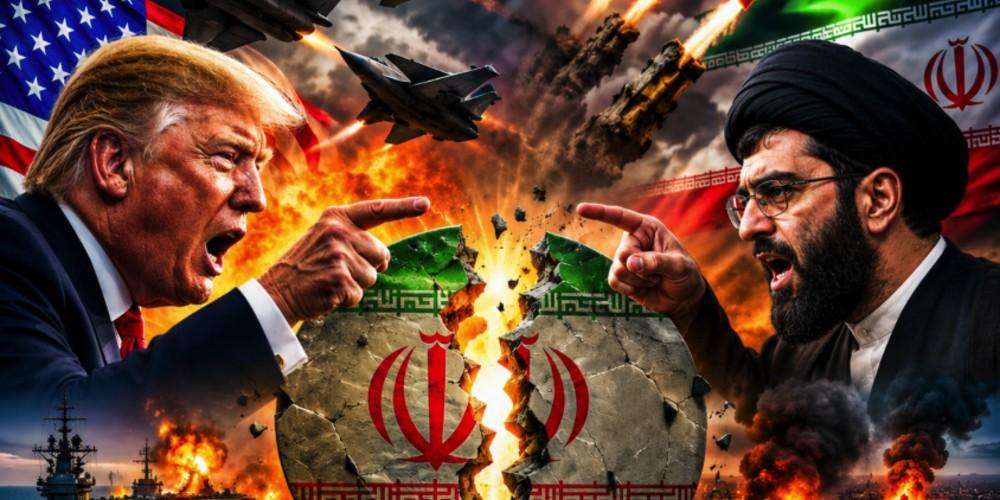
(End of the American Dream)—Iran could end this war tomorrow if they truly wanted to do so. The Trump administration is more than willing to sit down and negotiate, and they have let the Iranians know that they are willing to make enormous concessions. But the lunatics that are running Iran are not interested. They truly believe that they are winning the war, and they are demanding that the U.S. must comply with every single one of the outrageous demands that they are making. If the Trump administration will not do this, the Iranians have warned that they will keep the Strait of Hormuz closed for Trump’s entire term, and that would put extreme pressure on the global economy. And now it appears that Iran is not content to just hold the global economy hostage. It is being reported that Iran has issued an absolutely shocking ultimatum to the United States. If the Trump administration does not agree to all of Iran’s demands in a matter of weeks, Iran will go on the offensive against the United States and Israel.
This is not just some random Internet rumor.
Reuters originally reported this story, and it apparently came directly from a “senior Iranian official”…
Iran has decided to shift its strategy in the conflict with the United States from a defensive posture to a “fully offensive” one and has given Washington several weeks to implement a memorandum of understanding between the two sides, a senior Iranian official told Reuters on Monday.
The warning marks a further escalation in Tehran’s rhetoric as a U.S. naval blockade squeezes Iran’s economy and shipping through the Strait of Hormuz has slowed to a fraction of its prewar level.
This is an absolutely enormous story.
So why isn’t it getting a lot more attention?
According to this “senior Iranian official”, the United States will be given “a few weeks” to fulfill all of the obligations that it was supposed to meet under the infamous “Memorandum of Understanding”…
Iran has instead set a deadline of “a few weeks” for the United States to fully implement the memorandum, the official said. The precise timetable will be conveyed to Washington and regional governments through mediators.
If diplomacy fails, “all Iranian entities” will be prepared to escalate tensions in the Strait of Hormuz and across the region, the official said, adding that Iran would not wait indefinitely while the United States maintains its naval blockade.
Under Iran’s interpretation of the “Memorandum of Understanding”, the United States is required to pay 300 billion dollars in war reparations, arrange for the release of all frozen Iranian assets, permanently end the naval blockade, end fighting on all fronts, lift all sanctions and agree to permanent Iranian control of the Strait of Hormuz…

That is quite a list of demands.
There is no way that President Trump will ever agree to all of that.
So there will be more war.
Brigadier General Yadollah Javani is another Iranian official that is warning that Iran’s posture is about to become more “offensive”…
Brig. Gen. Yadollah Javani, the political deputy of the IRGC, told Iran’s Fars News agency that the armed forces would adopt a “transformative” approach under its recently refreshed leadership, including a potential shift toward more offensive operations.
Javani said Iran had never initiated a war and that its actions to date had been defensive, but, “from now on, every action we take, although it has a defensive nature, must take on an offensive form.”
Apparently this has been in the works for quite some time.

According to the Wall Street Journal, when the “Memorandum of Understanding” was signed in June Iranian leaders immediately started preparing for “a bigger fight”…
After President Trump signed a memorandum of understanding with Iran in mid-June, administration officials fanned out to build support for an agreement they hoped would reopen the Strait of Hormuz and start winding down the war.
Iran’s hard-line leaders huddled in Tehran and came up with a different plan, according to Iranian and Arab officials. In their view the pact was likely just an attempt by the U.S. and Israel to take pressure off the global economy and buy time for a bigger attack down the road. Instead of putting faith in talks, they took the past two months to prepare for a bigger fight.
In addition to preemptive missile and drone strikes, Iranian war plans reportedly include cutting undersea Internet cables and a potential ground operation in Kuwait by cutting across southern Iraq…

If Iranian troops actually enter Kuwait, there will be no turning back.
President Trump would feel compelled to commit U.S. ground forces, and things would get really crazy from that point forward.
Many were desperately hoping for some sort of a peace deal with Iran, but at this stage even Jared Kushner is publicly admitting that the Iranians “are not showing any interest in doing something that makes sense for us”…
Jared Kushner told Fox News on Monday that as the 60-day memorandum of understanding between the United States and Iran expires, Iran doesn’t appear to be willing to finish the deal and give up nuclear weapons.
“[President Trump] is willing to make a deal that could be great for the Iranian people … but right now they are not showing any interest in doing something that makes sense for us,” Mr. Trump’s son-in-law and adviser said in an interview with Fox News’ Trey Yingst.
Kushner said Iran has to be willing to make a fair deal without trying to “hide certain cards and get certain concessions.”
The Iranians are not going to compromise.
They have issued their list of demands, and they expect President Trump to comply.
There is no way that Trump will do that, and he just warned that Iran is “in big trouble”…
President Donald Trump said Monday he likes the idea of declaring the Strait of Hormuz U.S. territory, touting American control over the waterway while warning that Iran is “in big trouble.”
“We control it. We control it with the blockade. We have a blockade, we control it with the blockade. And I like the idea of declaring it a territory. We could do that,” Trump told reporters in the Oval Office.
“We have total control over the strait now,” Trump said before stating that the Iranian military “can be a nuisance.”
In addition, Trump is also claiming that he will bomb Oman if they go along with Iran’s plan for the Strait of Hormuz…
President Donald Trump threatened military action against Oman, an ally of the United States, if its negotiations with Iran over the Strait of Hormuz interfere with U.S. efforts to reach a peace deal with Tehran.
“If Oman gets in the way, we’ll bomb the s— out of them,” Trump told Fox News in an Aug. 17 phone interview, according to Trey Yingst, the network’s chief foreign correspondent who talked to the president.
Outside of talks with the United States, Iran has engaged in negotiations with Oman about reopening the Strait of Hormuz, which borders the two countries and both Iran and the United States have asserted control.
There isn’t going to be peace in the Middle East.
Those that believed that there would be were just deluding themselves.
If Iran chooses to go on the offensive against the United States and Israel, the entire region will erupt.
In such a scenario, both sides could go all the way up the escalation ladder very rapidly.
We really are living in extremely perilous times, and the world is simply not ready for what is about to happen next.
Michael’s new book entitled “10 Prophetic Events That Are Coming Next” is available in paperback and for the Kindle on Amazon.com, and you can subscribe to his Substack newsletter at michaeltsnyder.substack.com.
Starting the Day With a Scripture-Inspired Roast Helps Center Your Thoughts on Eternal Truths Amid Temporal Pressures
The world can seem chaotic, especially right after we wake up. Many believers start their mornings reaching for something familiar — a hot cup of coffee — yet end up settling for mediocre brews that do little more than deliver a caffeine jolt. The daily grind of life, with its endless distractions, news cycles, and responsibilities, can leave even the most faithful feeling spiritually parched alongside their physical fatigue. What if your morning ritual could do more than wake you up? What if it could ground you in truth, nourish your body with exceptional quality, and quietly advance a kingdom purpose at the same time?
That’s the promise — and the reality — behind Promised Grounds Coffee. This Christian-founded company doesn’t just roast beans; it approaches every step as an act of worship and discipleship. By selecting only the top 10% of specialty-grade beans, ethically sourced from dedicated farmers in Central and South America, and small-batch roasting them with reverence in Austin, Texas, Promised Grounds delivers what many describe as the best coffee available — never burnt, never bland, but rich with origin stories and layered flavors that honor God’s creation.
From the vibrant Psalm 27 Roast (a light, bright medium option) to the bold yet peaceful 2 Timothy 1:7 Decaf, each bag carries a Scripture verse that turns your daily pour into a gentle reminder of faith. And through their Ounce Per Ounce Promise, every ounce of coffee you enjoy provides an equal ounce of clean water to families in need via partnership with Filter of Hope — literally brewing hope for body and soul, one cup at a time.
The challenge for today’s Christians runs deeper than finding a decent cup. In an age of convenience-driven consumerism, it’s easy to support companies that dilute values or remain silent on matters of faith. Many believers want their everyday choices — from what they drink to how they spend — to reflect discipleship rather than just convenience. Promised Grounds solves this by weaving Christian excellence into the entire process: beans nurtured with prayerful stewardship by farming families, roasted as an offering rather than a commodity, and packaged with Bible verses to encourage a mindset of gratitude and purpose from the first sip. Reviewers consistently praise the smooth, rich profiles — whether enjoyed black in a drip maker, iced on a warm day, or shared in fellowship — noting how the quality stands toe-to-toe with premium secular brands while delivering something far more meaningful.
This integration of faith and flavor addresses a real need in Christian households and ministries. Busy parents, church leaders, and remote workers alike report that starting the day with a Scripture-inspired roast helps center their thoughts on eternal truths amid temporal pressures. The coffee’s exceptional character — bright citrus notes in lighter roasts or deep chocolate undertones in bolder ones — comes from meticulous selection and careful roasting that respects the bean’s natural gifts rather than masking them. It’s the kind of coffee that elevates a simple quiet time, fuels productive workdays, or sparks meaningful conversations when shared at Bible studies or outreach events. And because it’s ethically sourced with integrity, every purchase supports sustainable livelihoods for farmers who treat their crops like family harvests.
For those leading churches or small groups, the impact multiplies. Promised Grounds offers bundles and options perfect for hospitality ministries, turning ordinary coffee service into an opportunity to point people toward the living water of Christ. Imagine greeting visitors with a warm cup whose very bag carries God’s Word — a subtle yet powerful witness that aligns with the Great Commission. The company’s Texas roots and commitment to “brewing hope” resonate especially with believers who value American enterprise paired with global compassion.
Of course, quality alone isn’t enough if the experience feels out of reach. Promised Grounds keeps it accessible with practical perks like free shipping on orders over $40, sample sets for discovering favorites, and thoughtful add-ons such as faith-themed mugs. Whether you prefer whole beans for fresh grinding, grounds for convenience, or even bulk options for larger households and ministries, the result is consistently superior coffee that makes discipleship feel integrated rather than added on.
As you consider how to align even the smallest habits with your walk with God, Promised Grounds Coffee stands out as a refreshing solution. It tackles the dual problems of subpar daily sustenance and disconnected consumption by offering a product that genuinely excels in taste while advancing a mission of clean water, farmer dignity, and scriptural encouragement. Believers who make the switch often describe it as more than a beverage upgrade — it becomes part of their rhythm of gratitude, a daily invitation to remember that every good gift comes from above.
If you’re ready to transform your mornings (and perhaps your church gatherings) with coffee that honors both exceptional craftsmanship and Christian values, I encourage you to explore what Promised Grounds has to offer. One sip at a time, you’ll be nourishing your body, refreshing your spirit, and participating in something far greater — all while enjoying what truly is among the best coffee available.