
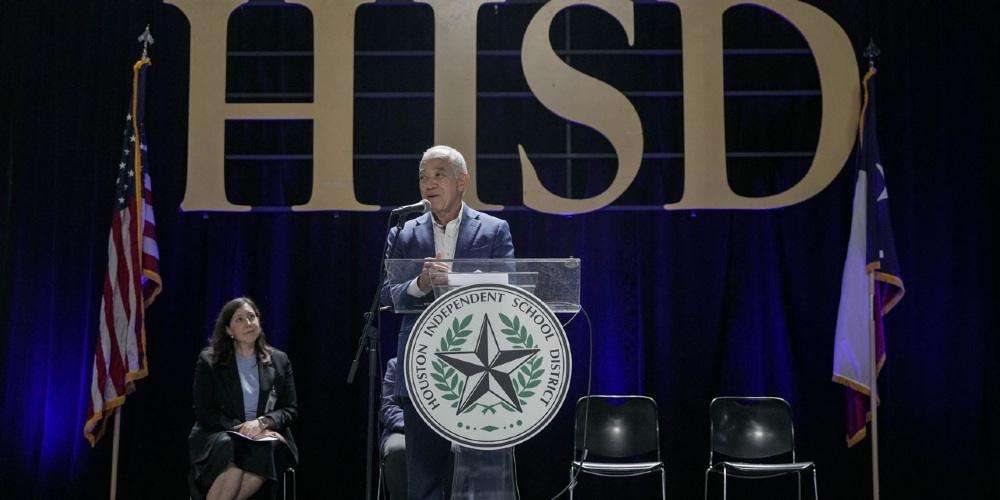
(Daily Signal)—A Texas conservative activist is suing the Houston Independent School District after the school board removed her from a meeting for reading sexually explicit passages from a book available in the district’s school libraries.
Bonnie Wallace, who lives in the Texas Hill Country, has attended multiple school board meetings to show trustees that books containing sexually explicit material are available in their school libraries and should be removed.
During a March 2026 Houston ISD school board meeting, Wallace addressed the board during public comment and said she would be reading from a book currently available to students in the district.
Wallace began reading verbatim from “A Court of Silver Flames,” a Sarah J. Maas fantasy romance novel filled with sexually explicit content. Trustees issued multiple warnings as she continued reading the book.
Trustees Remove Wallace From Meeting
After Wallace continued reading despite warnings from trustees, three police officers escorted her from the meeting.
“[Trustee Angela Lemond Flowers] said you can’t read anything inappropriate,” Wallace told the Daily Signal.
During the exchange, which was posted on X, Lemond Flowers can be heard telling Wallace that she was “not allowed to read things that are not appropriate.”
Wallace responded, “Then why are they in your schools?”
What’s Inside the Book
“A Court of Silver Flames” is described as an adult fantasy romance novel and is the fifth book in the “A Court of Thorns and Roses” series. The book is widely known for being significantly more sexually explicit and descriptive than previous installments in the series.
In excerpts from the book that Wallace shared with the Daily Signal, one passage contains a highly explicit sexual scene with detailed descriptions of physical intimacy.
The book also contains violence, descriptions of battle gore, and explorations of depression, self-loathing, and past abuse.
‘It Had to Be Done’: Wallace Sues Houston ISD
After the incident, Wallace said multiple attorneys told her she had grounds to sue Houston ISD, the largest school district in Texas. She said they also warned that failing to challenge the district’s actions could encourage other school districts to take similar action.

Wallace was initially hesitant to file a lawsuit, but said she “finally was convinced by people who know more than I do that it had to be done because of the implications if it’s allowed to stand.”
“I was not being disruptive,” Wallace added.
Wallace, with her attorneys Martin K. Etwop and Jonathan K. Hullihan of Remnant Law, filed a lawsuit against Houston ISD in April alleging violations of her First Amendment rights. The lawsuit, shared with the Daily Signal, was filed in the U.S. District Court for the Southern District of Texas, Houston Division.
Lawsuit Centers on First Amendment Rights
Wallace’s lawsuit alleges that Houston ISD violated her First Amendment rights by stopping her from speaking and removing her from the meeting.
“This was textbook viewpoint discrimination: HISD silenced Ms. Wallace precisely because she demonstrated the hypocrisy of its own policies, proving that if the content was too explicit for adults, it was too explicit for children. Such conduct is ‘an egregious form’ of content regulation that the First Amendment almost never tolerates,” the lawsuit states.
After Wallace filed suit, Houston ISD moved to dismiss the case, arguing that she relies on the wrong First Amendment framework.
“The public-comment portion of a school board meeting is undeniably a limited public forum. It is well established that in such forums, governmental bodies may adopt reasonable, viewpoint-neutral rules governing participation and may reserve the forum for its intended purposes,” reads the district’s motion obtained by the Daily Signal.
“Under her own allegations—as well as the plain record of the meeting that Plaintiff incorporates into her claims—this case does not concern a general prohibition on speech content, but instead only the presiding officer’s administration of a well-established, content-neutral guideline on limited public forum presentations during a single HISD board meeting,” the motion adds.
Wallace told the Daily Signal the district’s argument demonstrates its hypocrisy.
“They state in there [the motion to dismiss] that they had to remove me because I was reading sexually and inappropriate content, and they wanted to protect the children,” Wallace said.
“First of all, there were no children in the school board meeting—I did make an announcement before I started speaking,” Wallace continued, “but their whole position is that they had to remove me because I was reading sexually explicit content and they needed to protect the children.”
“My reply to that is, ‘Wow, you want to protect the children at the school board meetings of HISD, but not in the campus libraries of HISD?’” she added.
Wallace Believes Recent Supreme Court Ruling Helps Her Case
Just one month before Wallace filed suit, the U.S. Supreme Court issued its ruling in Chiles v. Salazar, which stated that a person may not be removed simply because their speech makes you uncomfortable.
Wallace said the ruling strengthened her position.
“That was so important,” Wallace said of the court’s decision. “When I’m reading books that are highly inappropriate, they’re very shocked, and then they don’t know what to do.”
Wallace also told the Daily Signal she has found more than 2,100 books she believes to be inappropriate in libraries across Texas school districts. She claims that Houston ISD carries nearly all of those books.
Texas Law Restricts Sexually Explicit School Library Material
Gov. Greg Abbott’s press secretary, Andrew Mahaleris, told the Daily Signal that Abbott expects school districts to follow state law.
“Sexually explicit material has no place in Texas public school libraries. Governor Abbott was proud to sign laws that require its removal,” Mahaleris said. “The Governor expects every school district to follow state law.”
In 2023, the Texas Legislature passed House Bill 900, also known as the READER Act. The law established standards for school library collection development and created requirements concerning sexually explicit and sexually relevant library materials. It also requires schools to recognize parents as the primary decision-makers regarding a student’s access to library materials and encourages catalog transparency.
Abbott signed the legislation in June 2023, and it took effect Sept. 1, 2023.
“Parents deserve to know what books are in school libraries. I’m signing a law that gets inappropriate or vulgar materials out of our schools,” Abbott said during the signing.
Education Advocates Weigh In
Education advocates also weighed in on Wallace’s lawsuit.
Corey DeAngelis, a research fellow for the Center for Education Policy at The Heritage Foundation, told the Daily Signal that what happened to Wallace was outrageous but predictable.
“Houston ISD removed a parent from a public meeting for reading aloud from a sexually explicit book that the district itself has placed in school libraries including those accessible to elementary, middle, and high school students,” DeAngelis said. “The school board doesn’t want the public to hear the material they’re giving kids. That tells you everything you need to know about their priorities.”
DeAngelis said one solution is to hold school board members accountable through elections.
“States should require school board elections to be held on the same day as the general election. Special-interest groups—especially the teachers unions—dominate low-turnout, off-cycle elections. Aligning them with higher-turnout general elections gives parents a much better chance of winning,” he said.
Mandy Drogin, senior fellow for the Government Reform & Oversight Coalition at the Texas Public Policy Foundation, also commented on the lawsuit.
“This is the M.O. of the education cartel [is] to shut down any dissent that does not go along with their radical progressive ideology, which includes desensitizing children to highly pornographic, explicit content,” said Drogin. “They are intentionally putting it in libraries.”
Drogin said there should be consequences for school leaders who allow such books to remain in libraries.
“The reality is, until we see severe consequences for putting this smut into our kids’ schools and classrooms, they’re going to keep doing it,” Drogin said. “There should probably be a full audit of all of the books that are in our libraries being put forth to our kids, and it all needs to be removed.”
“If it’s not removed, there should be consequences for the adults that are allowing it to be in there,” she added.
Wallace’s case is scheduled for trial Sept. 13, 2027, in the U.S. District Court for the Southern District of Texas, Houston Division.
Houston ISD did not respond to a request for comment by publication.
Two Storms, One Harvest

Every food crisis in living memory has been a one-shock event. The 2008 price spike was a commodity bubble. The 2020 shortages were a logistics failure. The 2022 grain scare was a war on one exporter’s ports. Each time, the system bent, adjusted, and recovered, and each time the experts assured us afterward that global markets are simply too big and too diversified to fail.
What nobody in Washington seems eager to discuss is that 2026 is shaping up to be something the modern food system has never actually faced. Two independent shocks, one climatic and one geopolitical, are converging on the same harvest cycle at the same time. Not sequentially. Simultaneously.
Start with the weather. The Pacific Ocean is currently building toward what forecasters now openly call a record event. NOAA’s Climate Prediction Center puts the odds of at least a strong El Niño near 88 percent, with roughly two in three odds it reaches “very strong” status, the tier reserved for perhaps three or four events in the entire satellite era. Every major global model now projects a median peak in Super El Niño territory, and most of them project it exceeding the 2015-16 event, which until now held the modern record. Sea surface anomalies were already brushing the super threshold in mid-July, months before these events normally peak. The atmosphere has already shifted into El Niño mode, and the event is forecast to crest in late fall and early winter.
This is not about “climate change.” It’s about the standard cycles of weather, and the cycle we’re currently in is one that has likely devastated societies in the past. We’re better prepared as a society today, but not all Americans are equally prepared.
Serious households have started doing the quiet math on their own. Grocery bills tell part of the story, and the forecast maps tell the rest, which is why long-term food storage has moved from fringe hobby to mainstream line item in the family budget, with established suppliers like Heaven’s Harvest seeing demand from people who five years ago would have rolled their eyes at the idea. That instinct is not paranoia. It is pattern recognition, and the pattern is worth walking through carefully.
Editor’s Note: Heaven’s Harvest IS a sponsor, but the warnings of this article are real and would be written even if we didn’t have a survival food sponsor. With that said, those who take advantage of what they offer can use promo code “Patriot” for 15% off.
The Fertilizer Clock Is Already Running
While the Pacific warms, the second shock has been unfolding in the Strait of Hormuz. The conflict with Iran turned the world’s most important energy chokepoint into a contested waterway, and the consequences reach far beyond the gas pump. Roughly a third of global fertilizer trade moves through Hormuz, and the disruption sent urea prices up 86 percent year over year by March, with a 53 percent jump in a single month.
The World Bank projects energy prices rising about 24 percent in 2026 and fertilizer about 31 percent. By its own accounting, fertilizer prices ran 35 percent higher in the first five months of this year than the same period last year.
Here is the mechanism the nightly news will not explain. Fertilizer is not a grocery item. It is a time-delayed input. The nitrogen a farmer in Iowa or Punjab could not afford to apply this spring does not show up as a problem this spring. It shows up as a thinner harvest six to twelve months later.
The World Bank’s own food security brief concedes that the effects of reduced applications earlier this season “are likely to become visible only later in harvest outcomes.” Translate that from institutional language into plain English and it means this. The damage is already done, it is already in the ground, and we are simply waiting for it to arrive on the shelf.
Now check the calendar. Six to twelve months from the spring planting season lands us squarely in late 2026 and early 2027. Which is precisely when the strongest El Niño in the instrumental record is forecast to peak, bringing its signature droughts to Southeast Asia, Australia, southern Africa, northern Brazil, and South Asia, the very regions that grow the world’s rice, sugar, and oilseeds.
The World Bank warns openly that a strong El Niño “could disrupt multiple crop belts simultaneously” on top of the conflict-driven input costs. Their baseline projection assumes the Middle East disruptions ease by autumn. What in the last two years of Middle East history suggests that assumption is safe?
The System Has No Slack Left
The comfortable answer is that global markets always adjust. But adjustment requires slack, and the slack is gone. Global cereal production is expected to decline from last year’s records even before El Niño does its work. The UN World Food Programme, hardly a den of right-wing preppers, is calling this the most significant disruption to its supply chains since Covid and the invasion of Ukraine, and its supply chain director put the stakes bluntly.
Today’s supply chain challenges are tomorrow’s hunger crisis.
There is also a political dimension that markets cannot price. When food gets scarce, governments do not behave like economists. They behave like politicians. Export bans, hoarding mandates, and panic buying at the national level turned the modest rice shortfall of 2008 into a global crisis, and analysts are already warning that import-dependent nations are the first dominoes.
The 2015-16 Super El Niño, a far weaker event than what is now forecast, threw tens of millions into food stress across Africa and Asia. This one is projected to be stronger, and it arrives with fertilizer already rationed by price and shipping lanes already contested by missiles.
What Joseph Knew
Scripture does not treat preparation for lean years as faithlessness. It treats it as wisdom delivered in advance to those willing to act on it.
Behold, there come seven years of great plenty throughout all the land of Egypt: And there shall arise after them seven years of famine; and all the plenty shall be forgotten in the land of Egypt.
Joseph did not respond to that warning with a hashtag or a committee. He stored grain during the years of abundance, and when the famine came, Egypt stood while its neighbors begged. The lesson is not that famine is certain. It is that the time to prepare is precisely when preparation still looks optional.
Nobody who filled a pantry in a year of plenty has ever regretted it, and nobody standing in an empty aisle has ever been glad he waited for certainty.
None of this calls for panic, and panic is the enemy of sound judgment anyway. It calls for the same unglamorous prudence our grandparents considered ordinary. Keep some cash margin, know your local growers, and put real food in deep storage while it is cheap and available, because the entire arc of this story is that cheap and available is a closing window.
Families looking for a straightforward place to start can visit Heaven’s Harvest and use promo code Patriot for 15 percent off long-term storable food. The forecasts may yet soften, the strait may yet reopen, and we should pray they do. But hope is a fine thing to hold and a foolish thing to eat.