
(End of the American Dream)—Archaeologists have made many surprising discoveries that simply do not fit what we are taught in our history textbooks. Vast numbers of “out-of-place artifacts” that have been found prove that ancient civilizations were far more advanced than we have been led to believe.
Today, I am going to discuss some “out-of-place people” that researchers dug up in China. These “out-of-place” people create a tremendous problem for many historians and they are highly embarrassing to the Chinese government because they aren’t Asian.
We are supposed to believe that China has been inhabited by the Chinese from the dawn of human history, but the extremely well preserved mummies that I am going to discuss in this article appear to be European.
Earlier this week, I came across a post on X that stopped me in my tracks…
4,000 year old European Mummies in China 🇨🇳
Early mummies (dating from around 2,135 to 1,623 BCE) from China had high levels of Ancient North Eurasian ancestry.
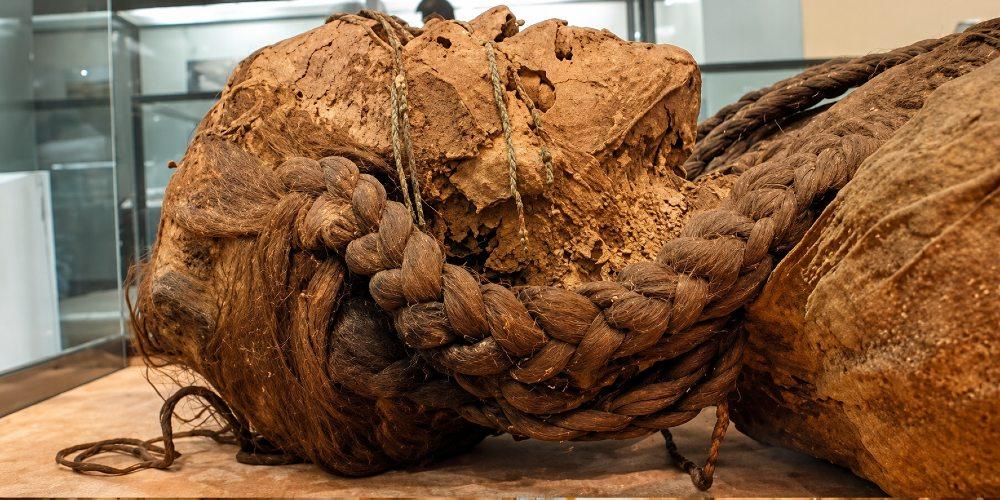
Many of them have their hair physically intact, ranging in color from blonde to red to brown which was generally long, curly & braided.
They were also very tall to neighboring populations at the time, some of these individuals would likely have seemed like “giants” many ranging around 6 feet + tall. One man was 6’6 feet tall.
After reading this, I had to learn more, and so I started doing some research.
According to the most commonly accepted theories of ancient history, it should be impossible to find 4,000-year-old European mummies in China.
But they are there.
Hundreds of them.
Some of them have blonde hair, some of them have red hair, and many of them are very tall.
They are known as the Tarim mummies, and according to Wikipedia they were found in the Tarim Basin in northwestern China…
The Tarim mummies were discovered at ancient cemeteries and settlements across the Tarim Basin, a large desert basin in present-day Xinjiang in northwestern China. The first remains became known to archaeologists during expeditions to the region in the late 19th and early 20th centuries. European explorers including Sven Hedin, a Swedish geographer and explorer; Albert von Le Coq, a German archaeologist; and Aurel Stein, a Hungarian-born British archaeologist, encountered naturally preserved human bodies while investigating ancient sites around the Taklamakan Desert, which occupies much of the centre of the basin.[15] Over the following century, hundreds of naturally mummified bodies were identified at sites around the basin.[16]
Some of the oldest remains were found in cemeteries around the eastern and southern margins of the desert. At Gumugou, a cemetery near the former Lop Nur lake in the eastern Tarim Basin, the earliest burials date to about 2135–1939 BCE, making them roughly 4,000 years old. The earliest mummies at Xiaohe Cemetery, another burial ground in the Lop Nur region, date to about 1884–1736 BCE, while those at Beifang, in the southern Tarim Basin, date to about 1785–1664 BCE.[16]
I found it to be very interesting that these mummies are considered to be about 4,000 years old.
Most estimates for the date of Noah’s Flood fall somewhere between 4500 BC and 4300 BC.

So that means that the Tarim mummies appear to be from the same general period of history as Noah’s Flood.
In fact, if the dating of the Tarim mummies is off by just a few centuries, it is possible that they actually come from a pre-Flood civilization.
Alternatively, it is also possible that the Tarim mummies come from a very early post-Flood civilization.
Normally, any human remains from that period of history would not be well preserved.
But thanks to the extraordinarily dry conditions in the Tarim Basin, the Tarim mummies were found “often with their hair and clothing still intact”…
Thanks to the basin’s dry conditions, the mummies were remarkably well preserved, often with their hair and clothing still intact. Their culture appears to have been distinctive. Despite living in a desert area, they were buried in boat-shaped structures covered in cowhides with grave markers shaped like oars—a practice most often associated with the Vikings.
“They bury their bodies in boats, and no one else does that,” Michael Frachetti, an anthropologist at Washington University in St. Louis who wasn’t involved in the study, tells CNN. “That means where that tradition comes from remains one of the biggest enigmas of this desert population, which should be the last community in the world to do this.”
They buried their dead like the Vikings did, but the Vikings lived nearly 3,000 years after the Tarim mummies did.
It is hard to imagine that there is some sort of a link between the two civilizations.
But maybe there is.
We do know that the Tarim mummies had European features.
They had “long faces”, “deep set eyes”, and some of them had “light or reddish hair”…
When archaeologists first encountered the bodies, they did not look like what many expected to find buried deep inside western China.
Some had light or reddish hair.
Long faces.
Deep set eyes.
Woollen clothing unlike anything normally associated with ancient China.
And because the desert had preserved them so extraordinarily well, these were not vague impressions reconstructed from skulls. Their hair remained. Their skin survived. Their clothing was still wrapped around their bodies.
They looked almost as if they had died yesterday.
But they had been lying beneath the sands for roughly four thousand years.
Perhaps the most famous of the Tarim mummies is a female known as “the Princess of Xiaohe”.
She is widely regarded as the most beautiful mummy in the entire world due to her “fair skin” and “long red hair”…
The Princess of Xiaohe also known as the Little River Princess, is a naturally mummified woman of the Bronze Age & one of the Tarim mummies. She is known as the most beautiful mummy in the world. She had European features, high fair skin, high set nose & long red hair.
Theoretically, she shouldn’t exist.
But she does.
All of the Tarim mummies are evidence that the history of the ancient world is very complicated.
Did the Princess of Xiaohe and the rest of her people live in northwestern China in the days before Noah’s Flood?
If they lived prior to Noah’s Flood, it is likely that the Flood wiped their civilization out.
If they lived after Noah’s Flood, what happened to them?
Did they migrate somewhere more hospitable?
Were they wiped out by war or famine or pestilence?
Obviously something happened, because northwestern China is not inhabited by people that look like Europeans today.
There is so much that we do not know about the Tarim mummies.
But we do know that they existed, and nobody can deny that.
Michael’s new book entitled “10 Prophetic Events That Are Coming Next” is available in paperback and for the Kindle on Amazon.com, and you can subscribe to his Substack newsletter at michaeltsnyder.substack.com.
Starting the Day With a Scripture-Inspired Roast Helps Center Your Thoughts on Eternal Truths Amid Temporal Pressures
The world can seem chaotic, especially right after we wake up. Many believers start their mornings reaching for something familiar — a hot cup of coffee — yet end up settling for mediocre brews that do little more than deliver a caffeine jolt. The daily grind of life, with its endless distractions, news cycles, and responsibilities, can leave even the most faithful feeling spiritually parched alongside their physical fatigue. What if your morning ritual could do more than wake you up? What if it could ground you in truth, nourish your body with exceptional quality, and quietly advance a kingdom purpose at the same time?
That’s the promise — and the reality — behind Promised Grounds Coffee. This Christian-founded company doesn’t just roast beans; it approaches every step as an act of worship and discipleship. By selecting only the top 10% of specialty-grade beans, ethically sourced from dedicated farmers in Central and South America, and small-batch roasting them with reverence in Austin, Texas, Promised Grounds delivers what many describe as the best coffee available — never burnt, never bland, but rich with origin stories and layered flavors that honor God’s creation.
From the vibrant Psalm 27 Roast (a light, bright medium option) to the bold yet peaceful 2 Timothy 1:7 Decaf, each bag carries a Scripture verse that turns your daily pour into a gentle reminder of faith. And through their Ounce Per Ounce Promise, every ounce of coffee you enjoy provides an equal ounce of clean water to families in need via partnership with Filter of Hope — literally brewing hope for body and soul, one cup at a time.
The challenge for today’s Christians runs deeper than finding a decent cup. In an age of convenience-driven consumerism, it’s easy to support companies that dilute values or remain silent on matters of faith. Many believers want their everyday choices — from what they drink to how they spend — to reflect discipleship rather than just convenience. Promised Grounds solves this by weaving Christian excellence into the entire process: beans nurtured with prayerful stewardship by farming families, roasted as an offering rather than a commodity, and packaged with Bible verses to encourage a mindset of gratitude and purpose from the first sip. Reviewers consistently praise the smooth, rich profiles — whether enjoyed black in a drip maker, iced on a warm day, or shared in fellowship — noting how the quality stands toe-to-toe with premium secular brands while delivering something far more meaningful.
This integration of faith and flavor addresses a real need in Christian households and ministries. Busy parents, church leaders, and remote workers alike report that starting the day with a Scripture-inspired roast helps center their thoughts on eternal truths amid temporal pressures. The coffee’s exceptional character — bright citrus notes in lighter roasts or deep chocolate undertones in bolder ones — comes from meticulous selection and careful roasting that respects the bean’s natural gifts rather than masking them. It’s the kind of coffee that elevates a simple quiet time, fuels productive workdays, or sparks meaningful conversations when shared at Bible studies or outreach events. And because it’s ethically sourced with integrity, every purchase supports sustainable livelihoods for farmers who treat their crops like family harvests.
For those leading churches or small groups, the impact multiplies. Promised Grounds offers bundles and options perfect for hospitality ministries, turning ordinary coffee service into an opportunity to point people toward the living water of Christ. Imagine greeting visitors with a warm cup whose very bag carries God’s Word — a subtle yet powerful witness that aligns with the Great Commission. The company’s Texas roots and commitment to “brewing hope” resonate especially with believers who value American enterprise paired with global compassion.
Of course, quality alone isn’t enough if the experience feels out of reach. Promised Grounds keeps it accessible with practical perks like free shipping on orders over $40, sample sets for discovering favorites, and thoughtful add-ons such as faith-themed mugs. Whether you prefer whole beans for fresh grinding, grounds for convenience, or even bulk options for larger households and ministries, the result is consistently superior coffee that makes discipleship feel integrated rather than added on.
As you consider how to align even the smallest habits with your walk with God, Promised Grounds Coffee stands out as a refreshing solution. It tackles the dual problems of subpar daily sustenance and disconnected consumption by offering a product that genuinely excels in taste while advancing a mission of clean water, farmer dignity, and scriptural encouragement. Believers who make the switch often describe it as more than a beverage upgrade — it becomes part of their rhythm of gratitude, a daily invitation to remember that every good gift comes from above.
If you’re ready to transform your mornings (and perhaps your church gatherings) with coffee that honors both exceptional craftsmanship and Christian values, I encourage you to explore what Promised Grounds has to offer. One sip at a time, you’ll be nourishing your body, refreshing your spirit, and participating in something far greater — all while enjoying what truly is among the best coffee available.