


(The Economic Collapse Blog)—What will the world look like if AI cyberattacks start doing so much damage that they essentially make the Internet unusable? Would our society be able to transition back to the old ways of doing things? Even if we were able to successfully do that, how messy would the transition period be?
Humanity created the Internet, but it has also created the perfect weapon for destroying the Internet. Hackers are using AI tools to conduct cyberattacks against our major institutions every moment of every day. Up until just recently, those that were defending our major institutions against these attacks had the upper hand. But now ultra-sophisticated AI tools have given the attackers the advantage, and it appears to be just a matter of time before cyberattacks start causing catastrophic damage.
So what is the plan? Are we just supposed to sit here and wait for the system to collapse all around us?
Within the past 7 days, we have witnessed the longest Microsoft outage in history, flights were grounded for hours from coast to coast, and Americans reported widespread service disruptions at banks and other financial institutions all over the United States.
Now we have learned that the NSA’s top secret communications network has gone down…
The National Security Agency (NSA)’s top secret communications network has gone down, with staff being warned of a ‘heightened’ threat level.
The NSA Net network, which employees use for highly classified internal communications, went down Tuesday morning, six people familiar with the situation told CNN.
At this point it is unclear what caused the outage at America’s most powerful intelligence agency, but officials say there is no evidence of a cyberattack.
They are telling us that it doesn’t look like it was a cyberattack.
Of course even if it was a cyberattack the NSA would never publicly admit it.
For decades, the Internet worked perfectly fine.
But now it seems like things are suddenly going haywire all around us.
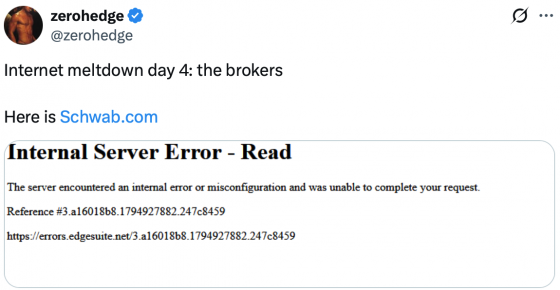
Earlier today, Schwab.com was completely down for an extended period of time…
And it appears that Gmail users have been experiencing significant problems…
Gmail users have reported an uptick in issues sending and receiving emails over the past 24 hours, according to Downdetector.
Reports peaked around 2:40 p.m. ET Monday before easing, then began climbing again Tuesday morning.
We have become completely and utterly dependent on the Internet.

How in the world would we be able to function without it?
Just hours ago, we learned that the websites of 178 major organizations were successfully compromised by hackers that were able to plant exploit code on iOS devices by hacking a website optimization platform known as Optimizely…
Some of the world’s most visited websites, including those belonging to Zoom, HSBC, Equifax, CNN, Salesforce, and IKEA, were subverted in an effort to steal cryptocurrency and infect iPhones, a security researcher said on Monday.
Malicious JavaScript was aimed at visitors to the websites of 178 organizations across various sectors through Optimizely, a website optimization platform, according to researcher Scott Helme.
The scripts attempted to replace cryptocurrency payment addresses with the attacker’s wallet, skim card numbers as users entered credit card details, steal cookies and screenshots, and plant exploit code on iOS devices.
In the old days, such a story would have been a major bombshell.
But it will probably be forgotten by most people within hours because we have reached a point where we are being hit by one major attack after another…
- The Asos app was pried open and forced to send out a ransom push notification saying the shopper data was ‘compromised’
- Hackers cranked up the heat of supermarket freezers in Europe
- A bug being patched out in a programming language called PHP forcing websites to go dark
- Airports, schools and news outlets in the UK and Europe were threatened with hoax bomb threats, often via email
- Air traffic operations over the US came to a halt after a faulty copper wire upgrade grounded some 18,000 flights
- A global Microsoft outage knocked out Outlook, Teams and other products for 36 hours, thanks, in part, to servers giving up
Most of us assume that those that are in charge of the system have everything under control.
But they don’t.
When DHS Secretary Markwayne Mullin was asked about the recent outages by Sean Hannity, he basically admitted that his agency is groping for answers, and he threw out a theory about “self-fixing” AI that someone in the tech industry had mentioned to him…
Homeland Security Secretary Markwayne Mullin told Fox News on Monday that artificial intelligence could be at least partly to blame for the recent wave of breakdowns across critical digital systems Americans rely on daily to travel and work.
Mullin told “Hannity” host Sean Hannity that the theory that AI, or “super intelligence” (SI), contributed to the cascading service failures came up during a briefing with a prominent technology expert.
“These programs aren’t designed to work as fast as SI is. And so when they put in a program that’s able to write codes, and it goes in and it self-fixes itself, as it starts self-fixing itself, it’s like doing a change order on a house. When you change one thing in a house, everything else starts changing. That’s a ripple effect,” he explained.
If Mullin really knew what was going on, he would have been able to give us a very clear answer.
Instead, he was publicly speculating on national television.
It is possible that “self-fixing” AI agents could be causing some of the problems.
But when major institutions start going down day after day, it doesn’t take a genius to figure out that there is a very high probability that we are under attack.
Google is ominously warning that AI models are continuously scanning software updates, identifying flaws, and creating attacks to exploit those flaws without any human involvement at all…
Imagine a hacker that doesn’t eat, sleep, or get tired, and never stops searching for a way in.
According to the latest AI Threat Tracker report, bad actors are now using autonomous LLM frameworks to continuously scan software updates, figure out what flaw was patched, and build an attack for it — all without human involvement.
In other words, our defenses are being probed every moment of every day.
If cyberattacks are this bad now, what will they be like once AI models are a thousand times more powerful than they are now?
For a moment, try to imagine a scenario where hordes of ultra-intelligent, ultra-sophisticated AI models are constantly pounding on the door of every legitimate website on the Internet.
How long will it take for us to get there?
A few years?
Maybe less?
Every major institution in our society is vulnerable.
Decades ago, we lived in an offline world.
But could we do it again?
Can you name even a single major institution that would be able to function effectively without the Internet?
The online world that we spent decades creating is in existential danger.
A lot of people thought that the AI bubble would usher in a bold new era of peace and prosperity.
Unfortunately, the AI bubble is now bursting and the carnage that we are witnessing on Wall Street is difficult to watch.
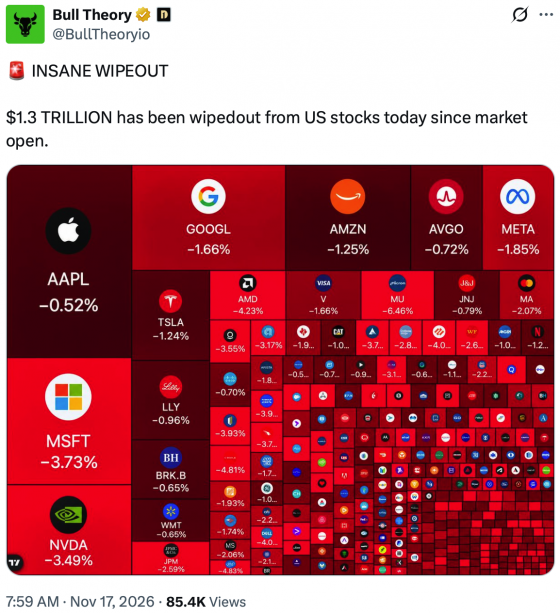
At one point today, another 1.3 trillion dollars in stock market wealth had been wiped out…
For a long time people have been talking about what would happen when the AI bubble burst.
That moment has now arrived.
So what happens next?
One thing that seems clear is that cyberattacks are likely to continue to escalate.
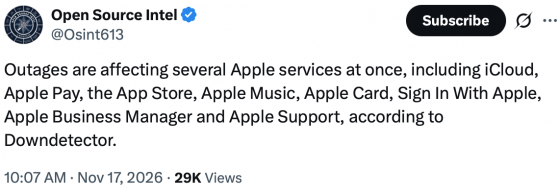
Just within the last hour, Apple users have begun reporting widespread outages…
Cyberattacks are an assault on our entire way of life, because our entire way of life depends upon the Internet.
I wish that wasn’t true, but it is.
We are literally sleepwalking into a systemic collapse, and there is zero plan for what comes next.
Michael’s new book entitled “10 Prophetic Events That Are Coming Next” is available in paperback and for the Kindle on Amazon.com, and you can subscribe to his Substack newsletter at michaeltsnyder.substack.com.
Starting the Day With a Scripture-Inspired Roast Helps Center Your Thoughts on Eternal Truths Amid Temporal Pressures
The world can seem chaotic, especially right after we wake up. Many believers start their mornings reaching for something familiar — a hot cup of coffee — yet end up settling for mediocre brews that do little more than deliver a caffeine jolt. The daily grind of life, with its endless distractions, news cycles, and responsibilities, can leave even the most faithful feeling spiritually parched alongside their physical fatigue. What if your morning ritual could do more than wake you up? What if it could ground you in truth, nourish your body with exceptional quality, and quietly advance a kingdom purpose at the same time?
That’s the promise — and the reality — behind Promised Grounds Coffee. This Christian-founded company doesn’t just roast beans; it approaches every step as an act of worship and discipleship. By selecting only the top 10% of specialty-grade beans, ethically sourced from dedicated farmers in Central and South America, and small-batch roasting them with reverence in Austin, Texas, Promised Grounds delivers what many describe as the best coffee available — never burnt, never bland, but rich with origin stories and layered flavors that honor God’s creation.
From the vibrant Psalm 27 Roast (a light, bright medium option) to the bold yet peaceful 2 Timothy 1:7 Decaf, each bag carries a Scripture verse that turns your daily pour into a gentle reminder of faith. And through their Ounce Per Ounce Promise, every ounce of coffee you enjoy provides an equal ounce of clean water to families in need via partnership with Filter of Hope — literally brewing hope for body and soul, one cup at a time.
The challenge for today’s Christians runs deeper than finding a decent cup. In an age of convenience-driven consumerism, it’s easy to support companies that dilute values or remain silent on matters of faith. Many believers want their everyday choices — from what they drink to how they spend — to reflect discipleship rather than just convenience. Promised Grounds solves this by weaving Christian excellence into the entire process: beans nurtured with prayerful stewardship by farming families, roasted as an offering rather than a commodity, and packaged with Bible verses to encourage a mindset of gratitude and purpose from the first sip. Reviewers consistently praise the smooth, rich profiles — whether enjoyed black in a drip maker, iced on a warm day, or shared in fellowship — noting how the quality stands toe-to-toe with premium secular brands while delivering something far more meaningful.
This integration of faith and flavor addresses a real need in Christian households and ministries. Busy parents, church leaders, and remote workers alike report that starting the day with a Scripture-inspired roast helps center their thoughts on eternal truths amid temporal pressures. The coffee’s exceptional character — bright citrus notes in lighter roasts or deep chocolate undertones in bolder ones — comes from meticulous selection and careful roasting that respects the bean’s natural gifts rather than masking them. It’s the kind of coffee that elevates a simple quiet time, fuels productive workdays, or sparks meaningful conversations when shared at Bible studies or outreach events. And because it’s ethically sourced with integrity, every purchase supports sustainable livelihoods for farmers who treat their crops like family harvests.
For those leading churches or small groups, the impact multiplies. Promised Grounds offers bundles and options perfect for hospitality ministries, turning ordinary coffee service into an opportunity to point people toward the living water of Christ. Imagine greeting visitors with a warm cup whose very bag carries God’s Word — a subtle yet powerful witness that aligns with the Great Commission. The company’s Texas roots and commitment to “brewing hope” resonate especially with believers who value American enterprise paired with global compassion.
Of course, quality alone isn’t enough if the experience feels out of reach. Promised Grounds keeps it accessible with practical perks like free shipping on orders over $40, sample sets for discovering favorites, and thoughtful add-ons such as faith-themed mugs. Whether you prefer whole beans for fresh grinding, grounds for convenience, or even bulk options for larger households and ministries, the result is consistently superior coffee that makes discipleship feel integrated rather than added on.
As you consider how to align even the smallest habits with your walk with God, Promised Grounds Coffee stands out as a refreshing solution. It tackles the dual problems of subpar daily sustenance and disconnected consumption by offering a product that genuinely excels in taste while advancing a mission of clean water, farmer dignity, and scriptural encouragement. Believers who make the switch often describe it as more than a beverage upgrade — it becomes part of their rhythm of gratitude, a daily invitation to remember that every good gift comes from above.
If you’re ready to transform your mornings (and perhaps your church gatherings) with coffee that honors both exceptional craftsmanship and Christian values, I encourage you to explore what Promised Grounds has to offer. One sip at a time, you’ll be nourishing your body, refreshing your spirit, and participating in something far greater — all while enjoying what truly is among the best coffee available.